
Executive Summary & ELA Integrity Mandate
The Advanced Placement (AP) English Literature and Composition Free-Response Question 3 (FRQ 3)—widely known as the “Open Question”—is the ultimate capstone assessment of independent high school literary analysis. In a 40-minute timed in-class write or structured take-home Chromebook drafting unit, students must select a novel or play of recognized literary merit entirely from long-term memory, formulate a defensible thesis analyzing a complex thematic prompt (e.g., moral ambiguity, exile, familial betrayal, the collision of past and present), marshal specific textual evidence without the book in hand, and develop a coherent line of reasoning.
In modern 1:1 Chromebook and digital LMS classrooms, this assessment faces an unprecedented integrity crisis: generative Large Language Models (LLMs) effortlessly output hyper-polished literary essays replete with graduate-level vocabulary (“bildungsroman,” “anagnorisis,” “hamartia,” “verisimilitude”), synthetic textual quotes, and generic thematic generalities—or conversely, confabulate plotlines, characters, and narrative chronology that never occurred in the actual text (The Great Gatsby, Frankenstein, Beloved, Invisible Man, Hamlet). Meanwhile, generic whole-document AI percentage detectors trigger catastrophic false positives on elevated student writing while failing on stealth paraphrased AI text.
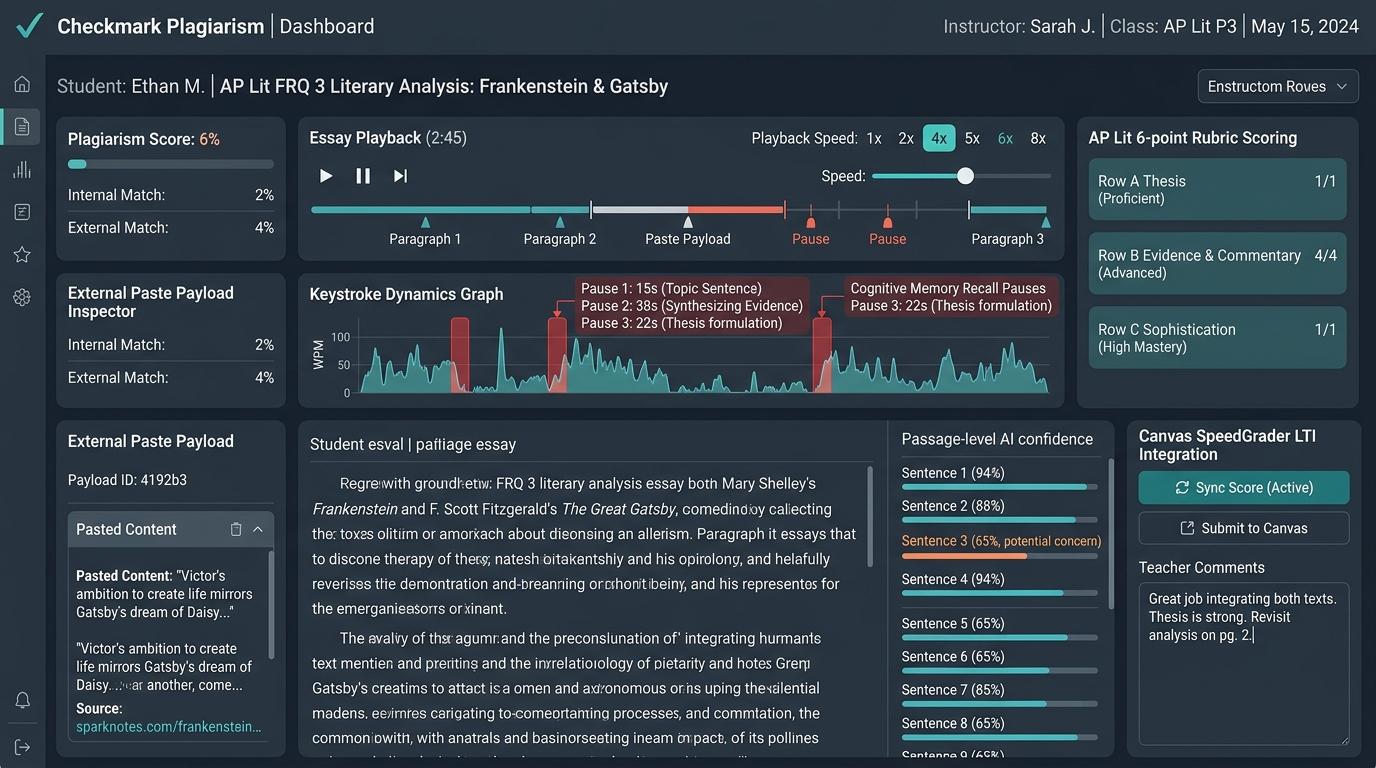
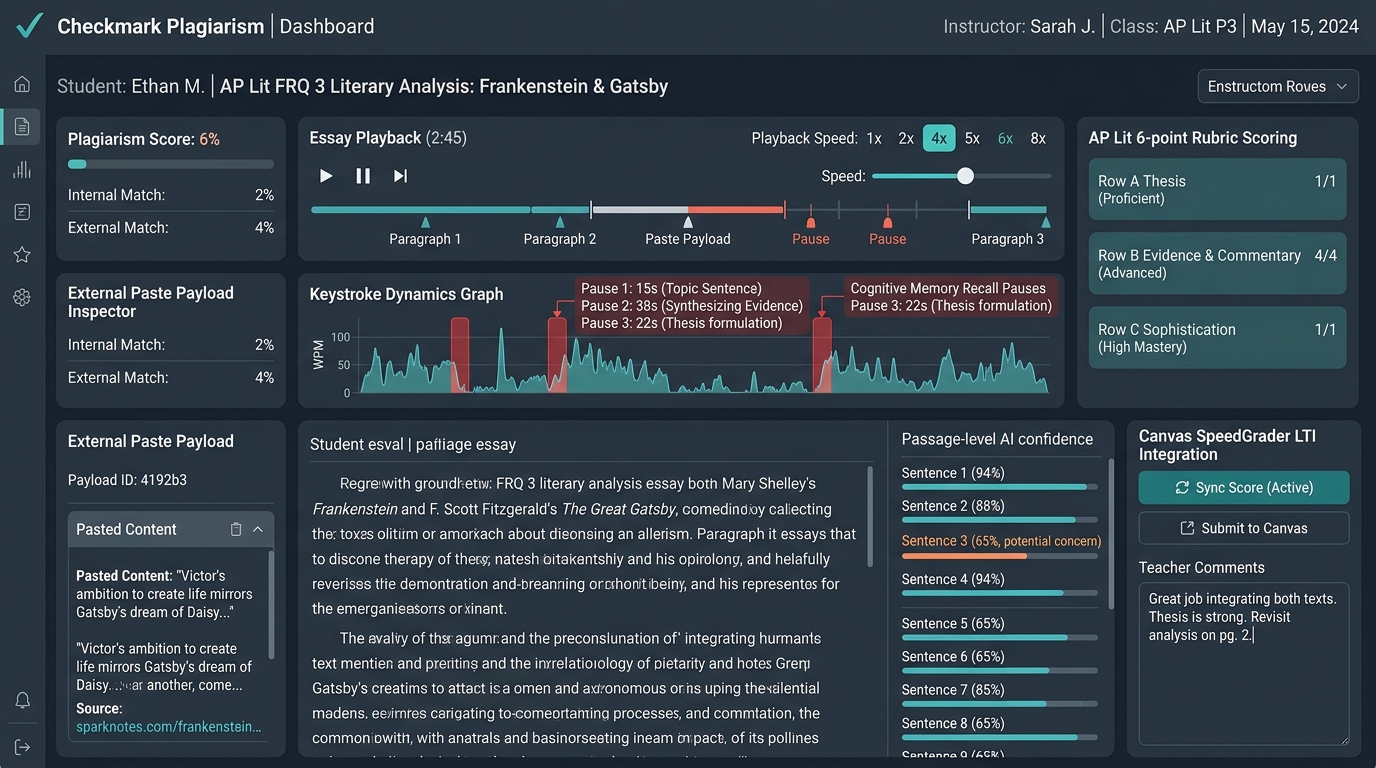
Checkmark Plagiarism’s integrated writing integrity and rubric suite solves this challenge through patent-pending Essay Playback™ (1x–8x keystroke replay and cognitive pause telemetry), external clipboard paste payload capture, passage-level confidence sliders, and quote-anchored AP rubric autograding. By tracking the organic cognitive pauses (10–45 seconds) characteristic of authentic human memory retrieval, Checkmark enables secondary English educators to distinguish genuine textual recall from AI generation, protect honest high-achieving writers, and conduct restorative, evidence-based literary coaching conferences.
1. The Anatomy and Disciplinary Stakes of the AP Literature FRQ 3 (“The Open Question”)
In the landscape of secondary English Language Arts curricula, the College Board AP English Literature and Composition examination assesses collegiate-level close reading, critical theory, and argumentative writing. The exam’s free-response section consists of three distinct 40-minute essays:
- FRQ 1 (Poetry Analysis): Close reading of an unprompted poem printed on the exam sheet.
- FRQ 2 (Prose Fiction Analysis): Close reading of a printed prose excerpt (novel, short story, or drama).
- FRQ 3 (Literary Argument / The Open Question): A thematic prompt requiring students to choose a work of recognized literary merit from memory, establish an analytical claim, and defend it using specific textual evidence without access to the physical text.
College Board 6-Point AP Literature Analytical Rubric
| Rubric Row | Criterion | Points | Disciplinary Core Requirement & Analytical Standard |
|---|---|---|---|
| Row A | Thesis | 0–1 pt | Responds to the prompt with a defensible thesis that establishes a clear line of reasoning regarding the work as a whole. |
| Row B | Evidence & Commentary | 0–4 pts | Provides specific, relevant evidence from the chosen work; consistently explains how the evidence supports the overarching argument with sustained literary insight. |
| Row C | Sophistication | 0–1 pt | Demonstrates complex literary understanding through nuanced analysis, alternative interpretations, vivid rhetorical style, or broad sociocultural synthesis. |
The Cognitive Architecture of Memory Recall in Literary Argument
Unlike FRQ 1 and FRQ 2—where students annotate physical lines of printed text—FRQ 3 assesses deep cognitive schema retrieval. To write an authentic, high-scoring FRQ 3 response under 40-minute timed conditions, a high school junior or senior must simultaneously orchestrate four complex cognitive operations:
Prompt Deconstruction
Deconstructs the abstract thematic prompt (e.g., moral ambiguity, spiritual exile, parental betrayal, or past vs. present).
Schema Retrieval
Scans mental canon for optimal works and character arcs (e.g., Victor Frankenstein, Sethe, Jay Gatsby, Hamlet).
Scene Reconstruction
Retrieves episodic memories: turning points, conflicts, symbolic motifs, and dialogue fragments from long-term memory.
Synthesis & Drafting
Synthesizes recalled evidence into a coherent line of reasoning with active recursive backspaces and syntactic revisions.
Because 16-to-18-year-old students do not possess photographic memory, authentic student memory recall is inherently messy, non-linear, and hesitative. An authentic student drafting an FRQ 3 on Mary Shelley’s Frankenstein:
- Hesitates for 15 to 45 seconds before drafting key evidentiary paragraphs to mentally retrieve plot sequences, character relationships, and specific scene dynamics.
- Typoes or self-corrects character names and settings (e.g., momentarily typing “Justine” before clarifying her role in William’s murder trial, or changing “Geneva” to the “Orkney Islands” when detailing Victor’s aborted second creation).
- Paraphrases dialogue and narrative action rather than citing verbatim 40-word book quotes (“When the creature confronts Victor on the Mer de Glace...”).
- Restructures sentences midway through a paragraph as their mental model of the novel’s thematic arc sharpens and adapts to the prompt.
The Classroom Reality: 130 Students and the Weekend Grading Stack
A high school English educator teaching four sections of AP Literature and one section of 11th Grade Honors ELA manages 120 to 160 students. Grading a single class set of FRQ 3 essays across the 6-point analytical rubric requires 10 to 14 minutes per essay—totaling 25 to 35 hours of grading per assignment cycle.
When essays are composed digitally on 1:1 Chromebooks via Google Docs, Canvas LMS, Schoology, or Agilix Buzz, educators encounter an unprecedented evidentiary dilemma:
- The Ghostwriting Challenge: How does a teacher distinguish an authentic student who spent 10 minutes silently outlining from a student who generated an outline or paragraph via ChatGPT in a hidden browser tab?
- The High-Achiever False Flag: Why do high-achieving AP students who naturally write with elevated academic phrasing trigger 85% “AI probability” alarms on generic text detectors?
- The Administrative Impasse: How can department chairs and academic integrity committees adjudicate suspect take-home AP practice essays without resorting to adversarial, unprovable accusations?
2. The AI Disruption: Hallucination, Jargon-Inflation, and the Illusion of Depth
Generative Large Language Models (e.g., GPT-4o, Claude 3.5 Sonnet, Google Gemini) excel at probabilistic token sequence generation based on internet-scale text corpora. Because classic AP Literature works (Hamlet, The Great Gatsby, Beloved, Invisible Man, Their Eyes Were Watching God, Jane Eyre, King Lear, Wuthering Heights) are analyzed across thousands of public study guides, scholarly journals, and digital encyclopedias, LLMs can instantly generate essays that simulate high-level literary analysis.
However, LLM generation exhibits three distinct structural signatures that diverge fundamentally from authentic adolescent memory recall: The Jargon-Inflation Trap, The Synthetic Quotation Mirage, and Textual Confabulation / Hallucination.
Authentic Memory Recall vs. AI-Generated Literary Analysis
| Analytical Dimension | Authentic Student Memory Recall | AI-Generated Text (LLM) |
|---|---|---|
| Textual Evidence Format | Paraphrased key scenes, episodic summaries, approximate dialogue recollections grounded in plot. | Synthetically polished quotes, generic scene archetypes, or confabulated narrative events that never happened. |
| Critical Vocabulary | Concrete, purposeful terms applied directly to specific character decisions (e.g., foil, motif, symbol). | Hyper-inflated jargon density (bildungsroman, hamartia, verisimilitude) used as syntactic filler. |
| Line of Reasoning | Emergent, iterative logic; occasional tangents resolved through active drafting and paragraph transitions. | Symmetrical, formulaic 3-part structure; smooth rhetorical transitions masking analytical shallowness. |
| Keystroke Drafting Telemetry | Burst-and-pause rhythm; 10–45s memory recall pauses; active backspaces, rewrites, and clause reordering. | Rapid linear transcription (65+ WPM flat) or single external paste block; zero cognitive recall pauses. |
The Jargon-Inflation Trap
LLMs frequently overcompensate for lack of genuine textual grounding by saturating essays with elevated literary critical jargon. Compare these two writing samples:
“Fitzgerald uses the green light at the end of Daisy’s dock as a physical symbol of Gatsby’s impossible dream to recapture the past and transcend his socioeconomic origins.”
Teacher Diagnosis: Concrete, direct, accurate character motivation grounded in the text.
“The green light operates as an elusive objective correlative within Fitzgerald’s quintessential modernist bildungsroman, illustrating the profound anagnorisis and inexorable hamartia of Jay Gatsby’s pursuit of bourgeois verisimilitude.”
Teacher Diagnosis: Saturated with four graduate-level terms in one sentence without connecting to plot action.
When high school teachers encounter essays saturated with four or five graduate-level literary critical terms in a single sentence—without clear grounding in character decisions—they are often observing LLM stylistic mimicry rather than authentic student analysis.
The AI Hallucination & Confabulation Matrix in Canonical AP Lit Texts
Because LLMs generate text by predicting statistically probable words rather than retrieving facts from a deterministic database, they routinely confabulate (hallucinate) narrative events, character interactions, and chronological sequences.
High school AP Lit educators can quickly identify AI-assisted submissions by auditing for these common confabulation patterns across staple curriculum texts:
Canonical AP Lit Texts: Common AI Confabulations & Hallucinations
| Work & Author | Typical Confabulated / Hallucinated Narrative Scene in AI Essays | Actual Textual Reality in the Novel or Play |
|---|---|---|
| The Great Gatsby F. Scott Fitzgerald |
Claims Daisy Buchanan secretly visits Gatsby’s mansion during his funeral, or invents a dramatic face-to-face dialogue between Daisy and George Wilson at the inquest. | Daisy leaves town with Tom without sending a message or flowers; Daisy and George Wilson never speak in the novel. |
| Frankenstein Mary Shelley |
Claims Victor Frankenstein personally attends William’s murder trial in Geneva and delivers a passionate public confession, or invents dialogue between Justine and the Creature. | Victor remains silently paralyzed by cowardice and guilt during Justine’s trial; the Creature and Justine never speak. |
| Beloved Toni Morrison |
Claims Sethe directly confronts schoolteacher in a Cincinnati courtroom, or invents a scene where Paul D discovers Beloved’s true identity from Stamp Paid in the 124 kitchen. | Schoolteacher leaves after the woodshed event; Paul D learns about Sethe’s past from Stamp Paid showing him a newspaper clipping on the porch. |
| Invisible Man Ralph Ellison |
Claims the narrator confronts Dr. Bledsoe in a Harlem jazz club, smashing his golden token upon the counter to reject institutional accommodation. | Dr. Bledsoe remains at the southern college; the narrator never sees him again in New York; the golden token confabulates Brother Tarp’s iron chain link. |
| Hamlet William Shakespeare |
Claims Hamlet stabs Claudius during the “Mousetrap” play, or confabulates a private soliloquy where Ophelia explicitly reveals Hamlet’s madness is staged. | Claudius halts the play by calling for lights and flees; Ophelia is genuinely distressed and never delivers such a soliloquy. |
| Their Eyes Were Watching God Zora Neale Hurston |
Claims Janie Crawford delivers an impassioned courtroom speech condemning racial injustice in the Everglades after shooting Tea Cake. | Janie speaks quietly from the witness stand about her love for Tea Cake, focusing entirely on grief rather than political rhetoric. |
| Jane Eyre Charlotte Brontë |
Claims Jane openly confronts Bertha Mason in the attic of Thornfield Hall and forgives Mr. Rochester on the spot. | Jane is horrified by Bertha’s violent appearance, refuses to become Rochester’s mistress, and flees Thornfield immediately in the night. |
These confabulations occur because the LLM synthesizes broad thematic motifs (e.g., confrontation, justice, moral reckoning) into generalized narrative tropes, inventing scenes that seem thematically plausible but never occurred in the actual book.
3. The Failure of Generic Whole-Document AI Detectors on AP Literature Essays
When faced with suspect literary essays, many high school educators and school districts turn to generic whole-document AI classifiers (such as standard LMS-integrated Turnitin AI scores, GPTZero, or CopyLeaks). In the context of AP English Literature, these tools fail systematically.
High-achieving AP students are trained to write with elevated academic register, complex subordinating conjunctions, and uniform syntax.
- Low perplexity from structured academic vocabulary
- Uniform sentence cadence triggers high AI scores
- Outcome: Devastating 70%–95% false alarms on honest student work
Students who copy AI text rarely paste raw output. They run text through QuillBot or prompt AI for “minor adolescent imperfections.”
- Surface paraphrasing artificially inflates perplexity
- Detector assigns a deceptive “0% AI” clean bill
- Outcome: Completely synthetic essays slip through unchecked
The Black-Box Administrative Impasse
When a high school teacher brings an 88% generic Turnitin AI score to a parent-teacher-student conference, the conversation inevitably deteriorates:
- The Student: “I wrote every word myself. I worked all weekend on this essay.”
- The Parent: “Show me which specific sentence is AI. Why is this software accusing my child?”
- The Administrator: “Without timestamped proof, keystroke evidence, or a direct source match, we cannot enforce a disciplinary zero or record an academic dishonesty infraction on an AP student’s permanent transcript.”
A single probabilistic percentage provides zero defensible evidence. To protect academic integrity while supporting student growth, educators require transparent process telemetry and temporal writing playback.
4. The High School Literary Analysis Evidentiary Matrix
To understand how writing process telemetry transforms academic integrity adjudication, consider how four distinct assessment modalities perform across core classroom dimensions:
High School ELA Writing Assessment Evidentiary Matrix
| Evaluation Dimension | Timed Blue Book (Paper) | Generic AI Text Detectors | Google Docs Version History | Checkmark Writing Process Telemetry |
|---|---|---|---|---|
| Verification of Independent Authorship | 100% Authentic physical presence | Probabilistic statistical guess (0–100%) | Coarse snapshots (10–30 min intervals); easily spoofed | Keystroke-by-keystroke temporal replay (1x–8x) |
| Memory Recall Tracking (Hesitation Gaps) | Natural handwritten pauses visible live | Inferred from vocabulary score (flawed) | Invisible; cannot measure inter-keystroke latency | Exact hesitation pause heatmaps (10s–45s) |
| External Clipboard Paste Payload Inspection | N/A (Handwritten) | Blind to paste events & external sources | Shows lump-sum text insert; loses text after rewrites | Full original payload preserved permanently |
| Protection of High-Achieving Writers | Absolute | High risk of false-positive alarms | Moderate; requires tedious manual revision clicking | Complete exoneration via visible drafting replay |
| Restorative Conference Defensibility (“Receipts”) | Physical paper inspection | Adversarial black-box statistical score | Ambiguous; lacks typing velocity context | Objective video-style Essay Playback™ |
| Rubric Autograding & LMS SpeedGrader Sync | 100% Manual teacher grading | None (Score-only add-on) | None (Manual LMS grading) | 1-Click Sync to Canvas SpeedGrader & Buzz |
5. Step-by-Step ELA Teacher Audit Protocol for FRQ 3 Submissions
When evaluating AP Literature FRQ 3 essays—whether completed during a 45-minute timed Chromebook write or a multi-day take-home assignment—high school English educators can follow this 5-step objective audit protocol to verify authentic memory recall.
Textual & Chronological Fact-Checking (The 60-Second Literary Audit)
Before inspecting digital telemetry, conduct a rapid read of the student’s textual evidence:
- Character Role Verification: Did the student attribute actions to the correct character? (e.g., in Beloved, does the essay attribute the infanticide to Sethe or misattribute it to Baby Suggs?)
- Chronological Sequence: Do the scenes unfold in the novel’s authentic narrative arc, or does the essay present an illogical mashup of events?
- Dialogue Specificity: Is dialogue paraphrased with authentic high school memory recall, or does it contain suspiciously perfect, unformatted 30-word block quotes from a book the student did not have in hand?
Keystroke Drafting Dynamics & Memory Retrieval Hesitation Audits
Open Checkmark’s Essay Playback™ and observe the student’s temporal drafting timeline:
- The Cognitive Retrieval Pause (10–45 Seconds): In authentic FRQ 3 writing, students consistently pause for 10 to 45 seconds between paragraphs and before introducing major textual evidence (e.g., recounting the scene where the creature confronts Victor in the Swiss Alps).
- Organic Drafting Rhythm: Look for the natural human rhythm of burst-and-pause typing (15–40 words typed, followed by a 4-second pause to formulate the next sentence).
- Transcription Dynamics: If telemetry shows continuous, unwavering typing at 75 words per minute for 25 consecutive minutes with zero pause gaps greater than 2 seconds, the student was almost certainly transcribing text from a secondary screen or phone.
External Clipboard Paste Payload Inspection
Inspect Checkmark’s External Paste Inspector:
- Timestamped Paste Events: Identify any text inserted via
Ctrl+Vor right-click paste from outside the active session. - Pre-Edit Payload Preservation: Checkmark preserves the raw, unedited pasted text even if the student spent the subsequent 15 minutes manually retyping, replacing synonyms, or restructuring clauses.
- Jump-to-Playback Sync: Click the “Jump to Playback” button to navigate directly to the exact millisecond in the timeline where the insertion occurred.
Linguistic Burstiness & Passage-Level Confidence Slider Analysis
Review Checkmark’s sidebar evidence cards:
- Passage-Level Granularity: Rather than displaying an opaque 80% whole-document score, Checkmark underlines specific sentences and paragraphs with individual calibrated confidence sliders.
- Calibrated Confidence: Sliders indicate whether a passage exhibits typical human drafting variability or typical AI linguistic predictability.
- Short-Text Guardrails: Checkmark automatically displays
N/Afor text blocks under ~150 words (such as outline notes or brief introductory warm-ups), preventing false alarms on insufficient sample sizes.
The Restorative Literary Coaching Conference Protocol
When an essay exhibits substantial external paste events, transcription telemetry, or hallucinated plotlines, the goal is pedagogical restoration and writing growth—not punitive destruction.
- Open Essay Playback Together: Seat the student beside the educator and open the Checkmark timeline.
- Invite the Student to Narrate: “Walk me through your thinking when you were planning this paragraph on Jay Gatsby’s pursuit of Daisy. What scene were you picturing here?”
- Review the Telemetry Objectively: “I notice that at minute 14, an 800-word block appeared instantaneously from an external window. Let’s look at the original text that was pasted here.”
- Identify Underlying Pressure: Address AP exam anxiety, extracurricular overload, lack of reading completion, or fear of missing rubric cutoffs.
- Establish a Formative Growth Plan: Offer an in-class handwritten rewrite or a supervised Chromebook drafting session focused on authentic, student-generated reasoning.
6. Real High School Classroom Case Scenarios
To see these principles in practice, examine three realistic classroom scenarios from high school AP English Literature sections:
12th Grade AP Lit Take-Home FRQ 3 on Invisible Man
The Assignment: Multi-day take-home FRQ 3 draft analyzing how an author uses a character’s alienation to critique societal hypocrisy.
The Submission: A 920-word essay analyzing Ralph Ellison’s Invisible Man. The prose is immaculate, but paragraph 3 claims that “the narrator directly confronts Dr. Bledsoe in a smoky Harlem jazz club, smashing his golden token upon the bar to symbolize his rejection of institutional accommodation.”
The Investigation:
- Textual Audit: The teacher recognizes Dr. Bledsoe remains at the southern college and never visits a Harlem jazz club; the “golden token” is a confabulation merging Brother Tarp’s leg iron with the narrator’s coin bank.
- Process Telemetry: Checkmark’s External Paste Inspector reveals a single 850-word paste event at 11:42 PM on Sunday evening. The student spent a total of 3 minutes and 12 seconds in the document.
- Outcome: The teacher holds a supportive conference. Faced with timestamped paste payload evidence, the student admits they had not finished reading the second half of the novel and panicked. The student is assigned a restorative in-class rewrite on an alternate text they read completely (The Great Gatsby).
12th Grade AP Lit Timed In-Class Write on Frankenstein
The Assignment: 45-minute timed in-class FRQ 3 write on Mary Shelley’s Frankenstein exploring the pursuit of forbidden knowledge.
The Submission: A brilliant 850-word essay with sophisticated academic vocabulary (“Shelley constructs an ontological critique of Enlightenment hubris through Victor’s recursive psychic fragmentation...”).
The Crisis: The school’s legacy LMS AI detector flags the essay at 87% AI probability. The department chair is notified, and parents receive an automated academic dishonesty warning email.
The Investigation:
- Keystroke Playback: The teacher opens Checkmark Essay Playback. The session recording shows a flawless 42-minute authentic drafting session: 4 minutes of initial thesis outlining, 18–35 second hesitation pauses before introducing Victor’s isolation in the Orkney Islands, 58 active backspaces and clause reorganizations, and zero external pastes.
- Outcome: The student is 100% exonerated with concrete, irrefutable telemetry proof. The false flag from the generic detector is discarded, and the student receives a 6/6 on the AP rubric. The teacher demonstrates the playback to the parents, restoring complete trust.
11th Grade AP Bridge Essay on Beloved & The Great Gatsby
The Assignment: Thematic essay on the burden of the past in Beloved and The Great Gatsby.
The Submission: The essay compares Sethe’s “rememory” to Gatsby’s desire to “repeat the past.” A generic AI detector returns a clean 4% AI score.
The Investigation:
- Keystroke Telemetry: Checkmark’s Keystroke Velocity graph shows the student typed at an unvarying 74 words per minute for 18 continuous minutes without a single pause greater than 1.5 seconds.
- Revision Analysis: The document contains zero paragraph reorganizations and only 4 minor character corrections.
- Passage Sliders: Checkmark’s sidebar evidence cards highlight uniform sentence length and synthetic transitional phrasing characteristic of LLM-generated structures that were scrambled through a paraphrasing tool.
- Outcome: In a restorative conference, the teacher asks the student to explain the connection between Sethe’s chokecherry tree scar and Gatsby’s shirts. The student is unable to explain the concepts. The teacher shows the steady typing telemetry and guides the student through authentic outlining and evidence drafting.
7. How Checkmark’s Integrated Suite Empowers AP Literature Departments
Checkmark Plagiarism is engineered specifically for secondary English departments and high school humanities educators, combining deep forensic integrity tools with automated grading efficiency:
Scrub through the entire student writing session at 1x, 2x, 4x, or 8x speed. Visualizes active drafting vs. idle time, typing velocity curves, and cognitive memory recall pauses (10–45s).
Captures exact timestamps and character counts of paste payloads. Preserves raw original pasted text even if a student subsequently retypes or modifies every single word.
Replaces opaque whole-paper scores with discrete sidebar evidence cards. Evaluates perplexity and burstiness per paragraph, with strict N/A guardrails on texts under ~150 words.
Aligns deterministically with College Board rubric Rows A, B, and C. Drafts point recommendations backed by exact quotes from student prose, preserving full teacher authority.
Embeds directly into Canvas SpeedGrader, Agilix Buzz, Schoology, and Google Classroom. Features a strict zero-retention policy: student essays are never used to train commercial AI models, ensuring full FERPA and COPPA compliance.
8. Frequently Asked Questions (FAQ) for AP Literature Educators
Q1: Can AP Literature teachers still safely assign take-home FRQ 3 practice essays in the age of generative AI?
Yes. By requiring students to compose take-home drafts within Google Docs on school-managed Chromebooks or directly inside Checkmark’s embedded LMS editor, teachers capture full writing process telemetry. Because Checkmark records keystroke dynamics, cognitive pauses, and external paste events, teachers can assign take-home analytical essays with total confidence that unassisted drafting will be transparently verifiable.
Q2: How does Essay Playback™ distinguish between an authentic memory recall pause and a student looking at an illicit open book or secondary screen?
Authentic memory recall is accompanied by emergent, iterative drafting: a student pauses for 20 seconds, writes 25 words of paraphrased evidence, pauses for 5 seconds, backspaces to fix a character name, and continues composing. In contrast, a student copying from an illicit physical book or secondary device exhibits transcription dynamics: continuous, uniform typing (60–80 WPM) with eyes darting back and forth, producing clean text with almost zero backspaces, structural reorganizations, or natural cognitive pauses.
Q3: What if an honest student writes their essay on paper first and then types it into their Chromebook?
If a student prefers to draft on paper and type their final submission, teachers should establish a simple classroom protocol: submit the handwritten physical scratch paper alongside the typed document. When the teacher opens Checkmark and sees rapid transcription typing, they can instantly corroborate the keystroke telemetry against the student’s physical handwritten outline, completely validating the work.
Q4: How does Checkmark handle 504 and IEP accommodations, such as Speech-to-Text (STT) dictation or extended time?
Checkmark is built to support all learners. When a student utilizes approved assistive technologies like Speech-to-Text (STT), dictation software inserts text in spoken phrase chunks rather than individual keystrokes. Checkmark’s telemetry recognizes standard STT voice-input signatures and flags the input mode appropriately, preventing dictation from being misidentified as external clipboard copy-pasting. Extended time accommodations are seamlessly supported by the scrubbable playback timeline.
Q5: Why do generic AI detectors flag high-scoring AP Lit student essays so frequently?
Generic AI text detectors measure statistical predictability (perplexity) and sentence variation (burstiness). AP Literature students are explicitly trained to use formal academic transitions, sophisticated vocabulary, and balanced syntactic clauses—the exact stylistic markers that commercial detectors associate with LLMs. Checkmark eliminates this problem by relying on patent-pending Essay Playback™, providing indisputable proof of human composition regardless of how sophisticated the student’s prose is.
Q6: How should an AP Lit teacher handle a parent conference when an outside detector claims an essay is “90% AI”?
Teachers should immediately redirect the conversation from ungrounded statistical percentages to observable process evidence. Open Checkmark’s Essay Playback™ in front of the parents and administrator. Show the full 40-minute keystroke recording, the natural 20-second recall pauses, the active word revisions, and the absence of external clipboard pastes. Seeing their child’s authentic drafting process replay like a video instantly dispels suspicion, protects the student’s reputation, and resolves the dispute objectively.
Q7: How does Checkmark’s Rubric Autograder evaluate the elusive “Sophistication” (Row C) point on the College Board rubric?
Checkmark’s autograder examines whether the student’s commentary consistently explores alternative interpretations, contextualizes the literary work within broader social or historical tensions, or employs a vivid, persuasive writing style throughout the entire essay. Rather than guessing, Checkmark extracts the specific student sentences that attempt complex analysis and highlights them for the educator, allowing the teacher to make the final determination on Row C.
Q8: How does Checkmark integrate into Canvas SpeedGrader and Google Classroom?
Checkmark integrates via LTI 1.3 Advantage. When an AP Lit teacher opens Canvas SpeedGrader, Checkmark embeds directly within the grading pane. Teachers can scrub through Essay Playback™, review external paste payloads, inspect passage-level AI confidence cards, and approve AI-generated rubric scores without ever leaving Canvas or opening an external tab.
Empower Your AP Literature Classroom with Process-Driven Integrity
Stop guessing with black-box AI scores. Give your English department the forensic certainty of Essay Playback™, quote-anchored 6-point rubric autograding, and 1-click Canvas SpeedGrader sync.