
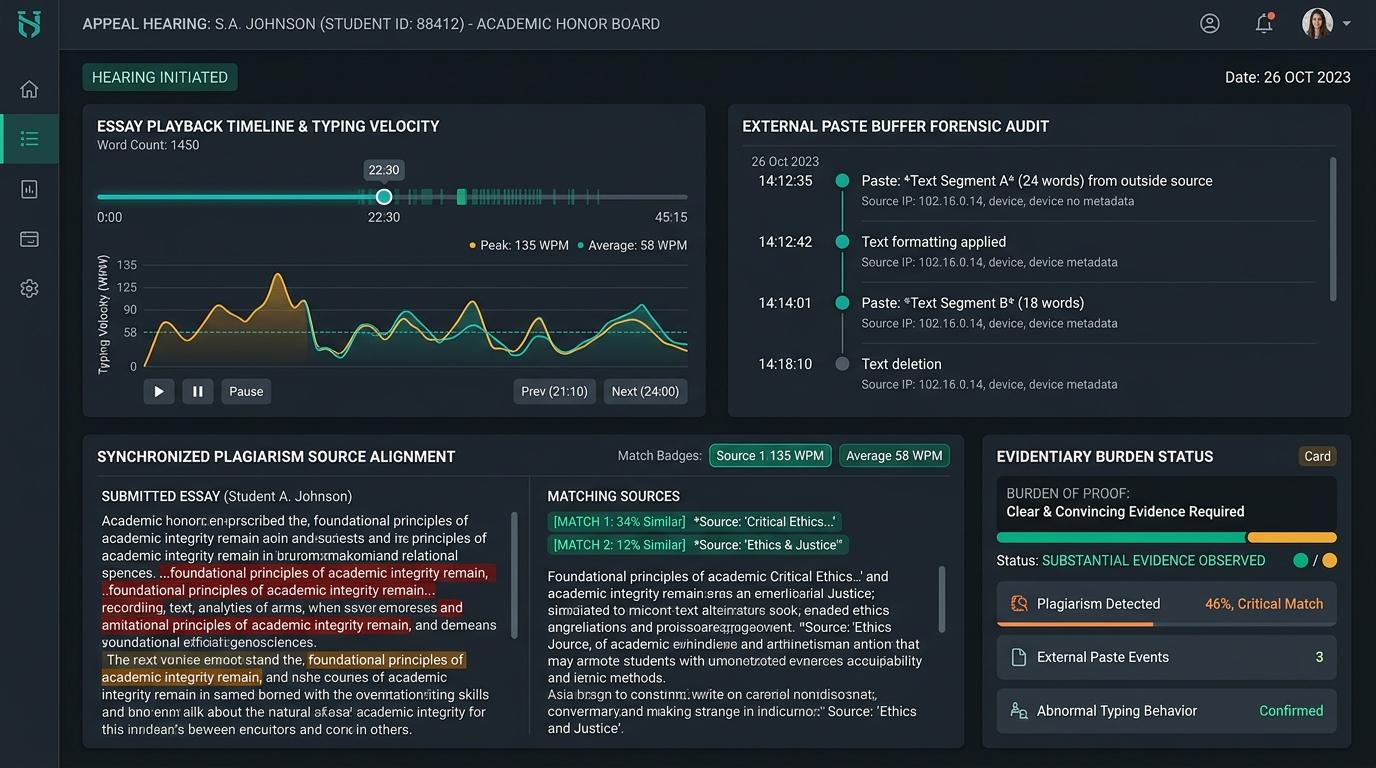
When student honor boards, university honor councils, academic integrity deans, and secondary school administrative hearing panels convene to adjudicate plagiarism and artificial intelligence misconduct appeals, they shoulder a high-stakes quasi-judicial mandate. Adjudicating sanctions that jeopardize a student's academic standing, transcript integrity, degree conferral, or professional trajectory requires strict adherence to Fourteenth Amendment procedural due process (Goss v. Lopez, Board of Curators v. Horowitz) and federal student inspection mandates under FERPA (34 CFR Part 99 § 99.10).
Yet hearing panels are routinely paralyzed by the “Black-Box Probability Deficit”—relying on uncorroborated, non-reproducible AI detector percentage scores or uncontextualized similarity percentages that fail the legal standard of a preponderance of the evidence (and, at many institutions, clear and convincing evidence in suspension or expulsion proceedings). Checkmark Plagiarism resolves this institutional crisis by establishing the 3 Pillars of Admissible Writing Evidence:
By instituting Checkmark's automated Multi-Dimensional Appeals Dossier, academic institutions replace adversarial guesswork with defensible factual receipts, safeguarding academic standards while upholding compassionate, restorative justice.
Checkmark Plagiarism equips university honor councils, academic deans, and secondary school hearing panels with forensic writing telemetry and enterprise LMS integrations across Canvas LMS, Agilix Buzz, and Google Classroom.
1. The Quasi-Judicial Imperative: Due Process, Evidentiary Standards, and the Adjudication Crisis
Student honor boards and academic integrity hearing panels occupy a distinct, highly sensitive position within educational governance. Unlike routine classroom grading conferences, formal appeal hearings function as quasi-judicial administrative tribunals. When a student appeals a referring instructor's allegation of plagiarism, unauthorized collaboration, or generative AI authorship fraud, the panel must weigh contradictory testimonies, analyze disputed digital artifacts, and render binding findings of fact.
In recent years, the nature of these appeals has undergone a seismic transformation. Historically, plagiarism adjudication rested upon tangible, easily verifiable evidence: an instructor identified an uncredited paragraph, retrieved the physical textbook or URL from which it was copied, and placed the two texts side by side. Today, however, academic integrity panels are inundated with ambiguous, emotionally charged disputes centered on black-box artificial intelligence classifiers (e.g., “This paper is 86% AI-generated”) or uninterpreted similarity scores (e.g., “32% similarity index”).
- Submits 3 handwritten outlines, Google Drive timestamps, and 12 browser search history links
- Explains non-linear drafting method, extensive editing, and ESL writing background
- Asserts Fourteenth Amendment Due Process & Contractual Fair Hearing violations
The Constitutional and Contractual Due Process Mandates
Hearing boards must operate within established legal and procedural frameworks:
Public Institutions & Fourteenth Amendment Due Process
Under the Due Process Clause of the Fourteenth Amendment, students enrolled in public colleges, universities, and public school districts can hold constitutionally protected property and liberty interests in their education when they face serious sanctions.
Private Institutions & Contractual Fair Hearing Rights
While private universities and independent preparatory schools are not direct state actors under the Fourteenth Amendment, they are strictly bound by the doctrine of contractual compliance.
FERPA Student Inspection Mandates (34 CFR Part 99 § 99.10)
Under the Family Educational Rights and Privacy Act (FERPA), students (and parents of secondary students) have a federal right (34 CFR § 99.10, subject to the limits in § 99.12) to inspect and review education records directly related to them.
Legal Evidentiary Standards in Academic Hearings
To render defensible decisions, honor boards must ground their deliberations in established legal standards of proof:
Preponderance of the Evidence
Standard Hearing ThresholdThe most common standard in honor board hearings. The referring party must prove that it is more likely than not (>50% probability) that the student engaged in the alleged misconduct.
Critical Legal Distinction: Preponderance requires qualitative and factual proof, not merely a software tool displaying a mathematical probability calculation of 51% or higher.
Clear and Convincing Evidence
High-Stakes Sanction ThresholdRequired by many university honor codes and school districts when considering severe sanctions such as suspension, expulsion, transcript notation, or degree revocation.
Critical Legal Distinction: Demands that evidence presented be highly and substantially more probable to be true than not, leaving no substantial or serious doubt in the minds of panel members.
2. Deconstructing the “Black-Box Probability Deficit” in Disciplinary Hearings
Why do statistical AI detector scores fail to meet even the modest preponderance of the evidence standard in a formal honor board appeal? The answer lies in the fundamental distinction between probabilistic classification and factual proof.
Commercial AI detection engines do not detect generative AI directly. Instead, they calculate two linguistic heuristics across static, submitted text:
- Perplexity: A mathematical measure of how “surprised” a language model is by a sequence of words. Lower perplexity indicates that words match the predictable statistical distributions of large language models.
- Burstiness: A measure of sentence length, grammatical structure, and syntactic variation across a document. Uniform, evenly balanced sentences produce low burstiness scores, which detectors treat as a marker of synthetic text.
The Four Fatal Evidentiary Flaws of AI Detection Scores
Flaw 1 Non-Reproducibility and Vendor Model Drift
Unlike chemical forensic tests or mathematical proofs, commercial AI detectors are dynamic, opaque systems. Vendors constantly update their underlying neural weights, training corpuses, and classification thresholds. A document scanned on Monday may return an “85% AI” score, but when re-scanned three weeks later during an honor board hearing, the same document may return a “22% AI” score due to silent vendor updates. An evidentiary metric that cannot be reliably reproduced under identical conditions fails basic legal standards of scientific reliability.
Flaw 2 Systematic Disparate Impact on ESL/ELL and International Writers
Research from Stanford University (Liang et al., 2023, Patterns) found that popular AI detectors were biased against non-native English writers. English Language Learners (ELL) naturally utilize a more constrained vocabulary, rely on standard grammatical phrasing, and exhibit lower lexical perplexity—the exact statistical features flagged as “machine-generated.” Penalizing an international student based on a detector score without process evidence can create a discriminatory disparate impact.
Flaw 3 Neurodivergent Composition Penalties
Educators and disability advocates have raised concerns that some students with Autism Spectrum Disorder (ASD), ADHD, or specific learning disabilities may employ highly structured, systematic, or non-idiomatic writing patterns, which can display low burstiness and rigorous uniformity. If so, relying on whole-paper probability scores could penalize those students for their authentic cognitive styles.
Flaw 4 The Absence of Primary Source Corroboration (“The Subpoena Problem”)
In traditional plagiarism cases, the evidentiary chain is complete: the prosecution points to Text A (student's essay) and Text B (Wikipedia or a published journal article). In generative AI accusations, however, there is no Text B. The language model generates ephemeral, non-indexed sequences of tokens. Because the detector cannot produce the original prompt, the server-side LLM output, or the source transcript, the accusation rests entirely on an algorithmic opinion rather than verifiable primary evidence.
Summary Matrix: Admissibility of Evidence Types in Honor Board Hearings
| Evidence Category | Example Artifact | Evidentiary Weight | Reproducibility | FERPA / Due Process Compliance |
|---|---|---|---|---|
| Monolithic AI Percentage | Whole-document “78% AI Detected” score | × Inadmissible Sole Proof | Poor (Vendor Drift) | Non-compliant (Black Box) |
| Monolithic Similarity Index | Unfiltered “34% Similarity” badge | Δ Insufficient / Needs Triage | Moderate (Index Shifts) | Partially compliant (Needs URLs) |
| Self-Reported Student Artifacts | Unverified browser history, local Word files | Δ Low Weight (Unverified) | Unverifiable | Compliant (Student-provided) |
| Temporal Keystroke Telemetry | Checkmark Essay Playback™ (1x–8x scrubbable video) | ★ Gold Standard Proof | 100% Deterministic | Fully Compliant & Auditable |
| Forensic Clipboard Capture | Checkmark 100% External Paste Buffer Log | ★ Gold Standard Proof | 100% Deterministic | Fully Compliant (Raw Strings) |
| Dual-Pane Source Alignment | Checkmark Synchronized Web/Peer Side-by-Side Match | ★ Gold Standard Proof | High (Direct URLs & Diffs) | Fully Compliant (Direct Links) |
3. The 3 Pillars of Admissible Writing Evidence
To eliminate the black-box probability deficit, modern honor boards, university councils, and academic integrity officers must establish clear, objective standards for what constitutes admissible writing evidence.
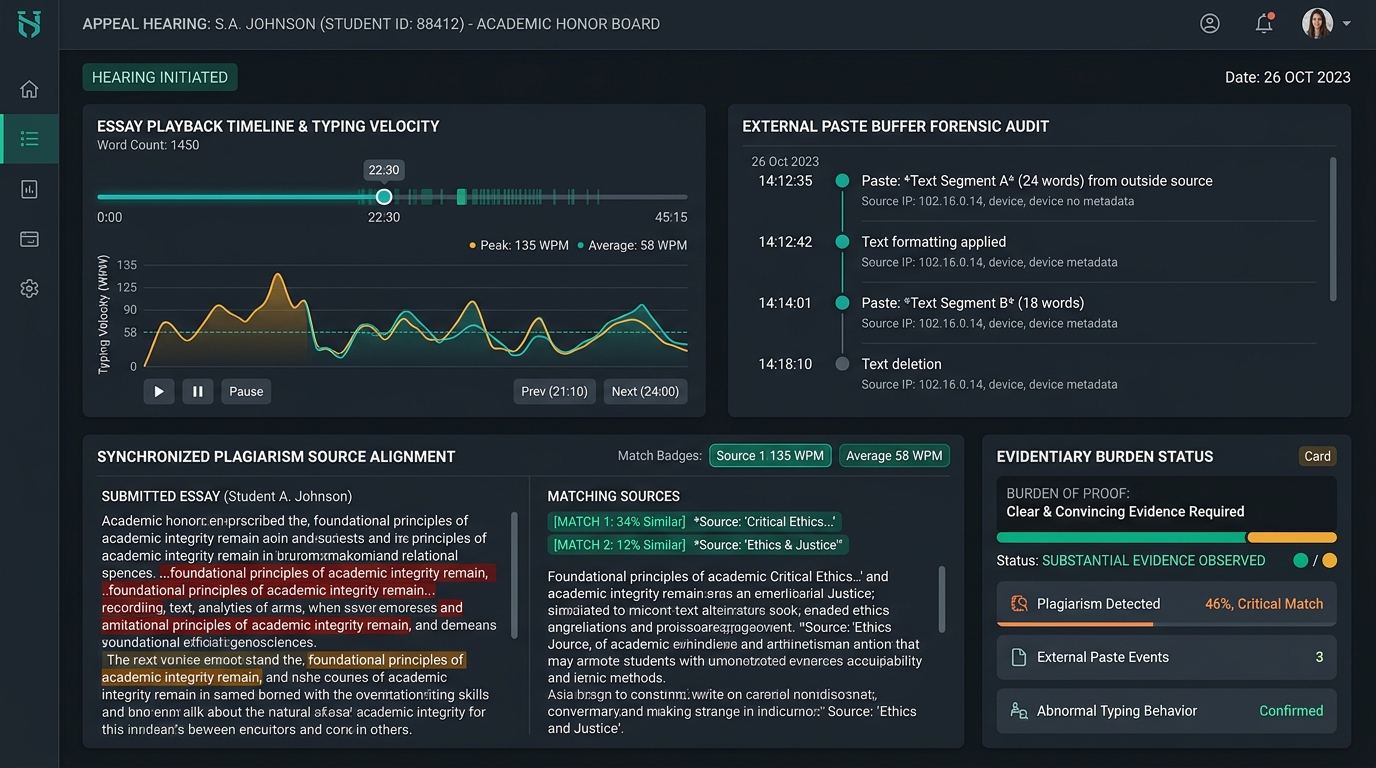
Checkmark Plagiarism provides a comprehensive, multi-dimensional evidentiary framework built upon The 3 Pillars of Admissible Writing Evidence. Rather than asking hearing panels to speculate on probabilities, Checkmark provides verifiable, timestamped “receipts” that document the entire lifecycle of a written submission.
Temporal Telemetry
- Patent-Pending Essay Playback™ (1x to 8x video replay)
- Inter-Key Interval (IKI) variance curves & typing velocity
- Cognitive drafting sessions, formulation pauses, and backspacing
Clipboard Provenance
- 100% External Paste Buffer capture (Timestamp & character count)
- Complete text preservation architecture (preserves raw paste even after rewrite)
- Synchronized “Jump-to-Playback” timeline button
Syntactic Alignment
- Synchronized dual-pane side-by-side matching against web & journals
- 4-Badge Evidence Taxonomy (Exact, Paraphrased, Uncited, Cited)
- Linked evidence cards with calibrated confidence sliders
Pillar 1: Temporal Writing Telemetry (The Process Receipt)
Writing is an active, iterative, and temporally distributed cognitive process. Authentic human authorship is characterized by natural pauses for reflection, erratic typing bursts, constant backspacing, line re-ordering, vocabulary substitution, and variable composition speeds. Conversely, generative AI injections and manual transcription (copying off a secondary screen or phone) exhibit distinct, non-human temporal signatures.
Checkmark's flagship innovation—Patent-Pending Essay Playback™—transforms the invisible act of writing into an immutable, verifiable visual record.
Key Telemetry Artifacts Evaluated by Honor Boards:
- Scrubbable Keystroke-by-Keystroke Video Replay: Board members can scrub through the entire writing timeline at 1x, 2x, 4x, or 8x speed, watching the student formulate ideas, draft arguments, delete paragraphs, and refine syntax in real time.
- Inter-Key Interval (IKI) Variance: The time interval between consecutive keystrokes (measured in milliseconds).
- Authentic Human Writing: High IKI entropy. The time between keystrokes varies widely (e.g., rapid bursts of 90–140 ms during familiar phrases, punctuated by cognitive pauses of 800–3,500 ms at clause boundaries).
- Mechanical Transcription: Low IKI variance. When a student manually retypes text while reading off an external phone screen or ChatGPT window, their typing speed is abnormally steady, devoid of natural pauses at conceptual junctures.
- Revision Friction Index: Tracks the ratio of backspaces, deletions, and structural rewrites relative to total keystrokes. Genuine student writing typically exhibits a deletion-to-insertion ratio of 10% to 25%. A paper produced with a 0.2% deletion rate and zero paragraph re-orderings strongly indicates non-cognitive transcription.
Pillar 2: Forensic Clipboard Provenance (The Ingestion Receipt)
A primary challenge in academic misconduct appeals is determining the origin and intent of pasted text. When a referring instructor sees a large block of text suddenly appear in a document, they may immediately assume unauthorized AI generation. However, students legitimately paste text during authentic scholarship: quotation excerpts, primary source archival material, their own pre-drafted research notes, or lab data tables.
Checkmark's Forensic Clipboard Provenance captures a complete, tamper-proof record of every external paste event.
“According to the 1933 Glass-Steagall Act, commercial banks were strictly prohibited from engaging in investment banking activities, a regulatory firewall designed to protect depositor assets from speculative market volatility.”
- 10:41:45 PM: Student inserted quotation marks around the block
- 10:42:10 PM: Student added introductory transitional phrase: “As historical records confirm,”
- 10:43:05 PM: Student added APA parenthetical in-text citation
- Conclusion: Legitimate source quotation ingestion with immediate scholarly attribution.
Forensic Clipboard Capabilities:
- 100% External Paste Buffer Capture: Checkmark logs the exact timestamp, character count, word count, and full textual payload of every string pasted into the editor from an external application.
- Complete Text Preservation Architecture: Even if an appellant student pastes a block of AI-generated text and subsequently spends three hours manually rewriting, synonym-swapping, and deleting every single original word, Checkmark preserves the raw, unedited original paste payload in perpetuity. The honor board can review the exact text that originally entered the document.
- Synchronized “Jump-to-Playback” Integration: Clicking the jump button on any paste record instantly navigates the Essay Playback™ video timeline to the exact millisecond the text was inserted, allowing board members to see what the student did immediately before and after the paste.
Pillar 3: Syntactic & Semantic Alignment (The Textual Receipt)
When an appeal centers on uncredited text, patchwriting, or source manipulation, honor boards must evaluate side-by-side textual alignment. Traditional plagiarism scanners often present confusing, multi-colored aggregate percentages that conflate standard bibliographic references, common idioms, and properly quoted text with deliberate source copying.
Checkmark Plagiarism delivers transparent Syntactic & Semantic Alignment through an interactive, dual-pane side-by-side viewer governed by an explicit 4-Badge Evidence Taxonomy.
The implementation of quantitative easing policies significantly altered the term structure of interest rates, suppressing yields across long-term sovereign bonds while inflating equity assets.
The deployment of quantitative easing frameworks substantially altered the term structure of interest rates, compressing yields across long-dated government securities while inflating equity valuations.
The 4-Badge Evidence Taxonomy:
Highlights identical, unquoted word sequences matching external web pages, digital encyclopedias, open-access journals, or peer submissions.
Identifies close sentence restructuring, clause swapping, and synonym replacement where the core conceptual structure is lifted directly without original synthesis.
Specifically flags external source material that lacks accompanying citations or parenthetical references, visually distinguishing formatting errors from deceptive plagiarism.
Automatically recognizes properly formatted quotation marks, standard bibliographic apparatuses, and widely recognized historical facts, filtering them out of misconduct tallies.
4. Checkmark Plagiarism’s Honor Board Evidence & Appeals Suite
To support academic integrity deans, honor council presidents, and hearing officers, Checkmark Plagiarism integrates its multi-dimensional forensic telemetry into a turnkey administrative suite designed specifically for formal appeals governance.
1. Automated Multi-Dimensional Appeals Dossier Export
Hearing panels cannot deliberate effectively when evidence is scattered across disparate email attachments, partial screenshots, and conflicting LMS timestamps. Checkmark generates an All-in-One Multi-Dimensional Appeals Dossier in two standardized formats:
- Interactive Secure HTML Dossier: Self-contained, browser-based package with full scrubbable Essay Playback™ video player and linked evidence cards.
- Cryptographic PDF Evidentiary Record: Bates-stamped PDF with velocity graphs, paste log tables, and side-by-side transcripts for official student judicial files.
2. Teacher-in-the-Loop Pre-Flight Review Records
Checkmark logs every interaction between the referring instructor and the submission, eliminating ambiguity regarding grading intent:
- Instructor Annotation Telemetry: Documents when the instructor opened the paper and which specific flags they designated as
Flagged,Resolved, orNot Flagged. - AI Autograder Rubric Justifications: Full criterion-by-criterion point breakdowns with quote-anchored justifications tied directly to student prose.
3. Strict Zero-Retention & Zero-Training Guarantees
Student submissions entered into disciplinary proceedings contain sensitive intellectual property. Unlike legacy vendors that ingest student papers to train commercial models:
- Zero Model Training: Student essays, drafts, and keystroke logs are never used to train or fine-tune AI models.
- FERPA & COPPA Compliant: Encrypted in transit (TLS 1.3) and at rest (AES-256), with private institutional repositories preventing data leakage.
4. Native LMS Ecosystem Interoperability
Checkmark integrates seamlessly via LTI 1.3 and REST APIs across institutional ecosystems:
- Canvas LMS: Direct integration within Canvas SpeedGrader, assignment submission portals, and gradebook passback.
- Buzz LMS & Google Classroom: Seamless rubric synchronization and automated telemetry capture across Google Docs and Word add-ins.
5. Illustrative Honor Board Scenarios: Evidence in Action
The following three scenarios illustrate how objective writing evidence could transform contentious, high-stakes disciplinary appeals into clear, fair, and defensible proceedings. They are hypothetical composites written for illustration, not reports of specific institutions, students, or hearings, and the figures in them are examples only.
Instructor flagged 6,500-word capstone for “88% AI Detection Probability”, issuing an automatic zero that blocked graduation.
Essay Playback™ proved 16.5 active writing hours across 7 sessions, 2,840 backspaces, complex econometric pauses, and Stata formula paste logs.
Unanimous dismissal of charges. Proven authentic human authorship beyond doubt. Immediate graduation clearance.
Pediatric clinical study flagged for “42% Plagiarism / Patchwriting”; student faced administrative dismissal from nursing program.
Dual-pane match proved 28% was universal clinical terminology; paste log showed legitimate EHR notes; classified as uncited formatting error.
Program dismissal overturned. Assigned 2-hour citation remediation module; student revised care plan for full academic credit.
Student pasted 4 entire paragraphs into Canvas LMS in under 2 minutes; accused of contract cheating, suspended 3 days, and stripped of NHS.
Google Docs extension telemetry retrieved 4.2 hours of composition on student Chromebook; character strings matched Canvas paste 100%.
Suspension rescinded immediately. National Honor Society standing restored and disciplinary referral completely expunged.
6. The 4-Phase Honor Board Adjudication Protocol
To institutionalize fair, predictable, and legally unassailable appeal proceedings, educational institutions should implement Checkmark’s 4-Phase Honor Board Adjudication Protocol.
Phase 1: Pre-Hearing Evidentiary Threshold Audit
- The Minimum Admissibility Rule: Referrals supported solely by a whole-document AI probability score are classified as evidentially insufficient and returned to faculty.
- Dossier Compilation: Board administrator exports Checkmark's automated Multi-Dimensional Appeals Dossier with complete Playback telemetry and paste buffer logs.
Phase 2: Dual-Party Dossier Exchange & Audit
- The 72-Hour Rule: Student, advocate, and instructor receive identical unredacted access to the Checkmark Appeals Dossier at least 72 hours prior to the hearing.
- Asynchronous Board Review: Panel members independently audit flagged paste records, confidence sliders, and Playback bookmarks before convening.
Phase 3: Synchronous Deliberation & Fact-Finding
- Playback Walkthrough: Board projects Essay Playback™ video onto hearing display, scrubbing directly to contested sections of the essay.
- Cognitive Thought Alignment: Appellant student explains thought processes during major drafting pauses and research formulation moments.
Phase 4: Restorative Finding & LMS Resolution
- Written Evidentiary Justification: Formal decision citing specific factual receipts (e.g., Paste Event #03 at timestamp 11:14 PM).
- Restorative Sanctions & LMS Passback: Tiered developmental remedies and direct one-click score synchronization back to Canvas, Buzz, or Google Classroom.
7. Institutional Toolkit: Honor Board Evidence Standards Checklist & Deliberation Rubric
To assist institutions in updating their honor board bylaws, this toolkit provides turnkey operational templates for academic integrity administrators.
Evidentiary Weight Deliberation Rubric
| Evidentiary Dimension | Insufficient for Misconduct Finding (0–1) | Substantial Corroborating Evidence (2–3) | Conclusive Proof of Misconduct (4–5) |
|---|---|---|---|
| 1. Textual Alignment | Match <5% aggregate; standard idioms, proper nouns, or properly quoted text with minor formatting errors. | Extensive uncredited patchwriting (15–30%) with close synonym substitution matching an identified online source. | Verbatim unquoted duplication (>30%) of external sources or 100% peer-to-peer match in student repository. |
| 2. Clipboard Provenance | Normal research ingestion (short quotes, citations, lab data) followed by immediate editing and attribution. | Large multi-paragraph external paste (>300 words) with subsequent superficial synonym edits and zero attribution. | Entire document or major analytical chapters inserted via single external paste with zero composing pauses or pre-drafts. |
| 3. Temporal Telemetry | Normal human typing speed (25–60 WPM), high IKI variance, natural cognitive pauses (30–180s), healthy revision friction (10–25%). | Unusually uniform typing speed with low IKI variance and minimal deletions, indicating transcription from secondary device. | Instantaneous text injection OR perfectly steady mechanical transcription at 85+ WPM with zero pauses and 0% friction. |
| 4. Cognitive Walkthrough | Student fluently articulates research methodology, explains specific drafting pauses, and defines all sophisticated vocabulary. | Student demonstrates general familiarity with topic but displays minor gaps in explaining complex sentence constructions. | Student is completely unable to explain core thesis, cannot define key terminology, or contradicts telemetry timeline. |
8. Frequently Asked Questions (FAQs)
1. Why is a high AI detection percentage (e.g., 90% AI) legally insufficient to uphold a plagiarism sanction?
A commercial AI detection percentage is a probabilistic estimate calculated by a neural network based on statistical metrics such as perplexity and burstiness. It is not an empirical measurement of fraud, nor does it produce a primary source artifact. Because these models are non-reproducible, subject to vendor model drift, and carry documented false-positive bias against non-native English writers (Liang et al., 2023) and raise similar concerns for neurodivergent writers, relying on a percentage score alone violates procedural due process and fails the legal standard of a preponderance of the evidence.
2. How does Checkmark's Essay Playback™ prove a student didn't just retype an AI-generated essay from their phone?
When a student manually retypes text from a second screen, phone, or printed sheet, their keystroke dynamics exhibit distinct mechanical patterns: uniform typing velocity, exceptionally low Inter-Key Interval (IKI) variance, and an absence of natural cognitive formulation pauses at complex conceptual boundaries. Furthermore, manual transcription displays a near-zero revision friction rate (lack of backspacing, sentence re-structuring, or vocabulary substitutions). Checkmark's telemetry dashboard flags these mechanical transcription anomalies instantly.
3. What is the difference between an uncredited source and deliberate plagiarism during an appeal?
Checkmark’s dual-pane viewer differentiates between malicious source copying and inadvertent citation errors using its 4-badge taxonomy. An Uncited Source flag indicates that source text was incorporated without proper attribution tags, which often points to citation formatting ignorance or poor note-taking. Conversely, Exact Match and Paraphrased Match flags tied to large external paste buffer records with deceptive synonym swapping demonstrate deliberate intent to misrepresent authorship.
4. How does the 72-hour dossier disclosure window relate to federal FERPA regulations?
Under FERPA (34 CFR Part 99 § 99.10), students have the right to inspect and review their education records, and the institution must respond to an access request within a reasonable time, no more than 45 days. A 72-hour advance window is a best practice that goes further for hearing preparation: by providing the appellant with an unredacted, interactive Checkmark Appeals Dossier 72 hours before the hearing, the institution gives the student early access to the records behind the allegation, eliminates “trial by ambush,” and allows the student to prepare a targeted, evidence-based defense.
5. Can a student falsely claim that a large paste was simply their own pre-drafted notes?
Yes, this is a common defense during appeals. However, Checkmark eliminates ambiguity through its ecosystem capture and paste forensics. If the student drafted the notes on an authorized platform (such as Google Docs, Word, or an LMS editor), Checkmark retrieves the underlying Essay Playback™ keystroke telemetry of that original note-taking session. If the student cannot produce verified telemetry or draft histories for the pasted text, the board evaluates the raw paste payload alongside the student's cognitive walkthrough.
6. How does Checkmark protect student data privacy during honor board proceedings?
Checkmark operates under a strict Zero-Retention and Zero-Training Architecture. Student essays, draft revisions, and keystroke logs are never used to train commercial AI models or shared with third-party vendors. All evidentiary dossiers are encrypted in transit and at rest, maintaining full compliance with FERPA and COPPA standards.
7. How does Checkmark streamline the post-hearing resolution in Canvas or Buzz LMS?
Once the honor board renders its final finding, the academic dean or committee chair can update the student's grade and rubric criteria directly within Checkmark. With native LTI 1.3 integration, finalized grades, official committee justifications, and restorative revision requirements are synchronized back to the Canvas SpeedGrader, Buzz LMS, or Google Classroom gradebook with a single click.
Conclusion: Transform Your Honor Board from Guesswork to Defensible Justice
The era of adjudicating academic misconduct through opaque percentages, subjective faculty intuition, and adversarial confrontations is over. Academic integrity hearings must protect the academic integrity of the institution while scrupulously upholding the constitutional, contractual, and pedagogical rights of students.
By demanding objective, multi-dimensional writing evidence—grounded in Checkmark Plagiarism’s patent-pending Essay Playback™, forensic clipboard provenance, and synchronized side-by-side textual alignment—student honor boards and academic deans can replace anxiety and suspicion with transparent, unassailable truth.
Stop Guessing. Start Trusting.
Equip your institution's honor council with the objective writing evidence required for fair, defensible, and restorative academic integrity adjudication. Explore Checkmark Plagiarism or schedule an institutional walkthrough today.