
The fundamental difference between AI assistance and AI authorship is the locus of intellectual agency: AI assistance occurs when a human student conceives the thesis, selects the evidence, and drafts the prose while using AI tools as supportive instruments (such as for spellchecking or brainstorming), whereas AI authorship occurs when the artificial intelligence engine generates the arguments, synthesizes the sources, and composes the actual sentences.
As generative AI becomes embedded in digital word processors, educators and students need clear, unambiguous boundaries. Simply using an AI tool does not automatically make a paper fraudulent; conversely, calling machine-generated text "assisted" does not make it honest scholarship. In academic assessment, authorship belongs to the mind that performed the intellectual and rhetorical labor. Checkmark Plagiarism pairs neural AI probability with keystroke writing process forensics to distinguish legitimate student assistance from surrendered machine authorship.
Below is a comprehensive guide defining the boundary between AI assistance and AI authorship.
Checkmark Plagiarism evaluates authorship integrity by pairing AI detection with essay writing playback, plagiarism detection, autograding, and integrations with Canvas and Google Classroom.
The 4 Criteria That Separate Assistance from Authorship
1. Locus of Intellectual Agency
Assistance: The student develops the core thesis, outlines arguments, and chooses evidence.
Authorship: The student prompts AI with a generic topic, and the model creates the thesis and arguments.
2. Syntactic & Rhetorical Execution
Assistance: The student types the sentences into the editor with authentic human rhythm.
Authorship: The machine generates finished sentences, which the student copies and pastes.
3. Cognitive Struggle in Process Telemetry
Assistance: Playback shows 3+ hours of typing, revisions, and backspaces.
Authorship: Playback shows zero drafting time and instant paste payloads.
4. Accountability & Conceptual Defense
Assistance: The student explains the logic behind every paragraph in an oral check-in.
Authorship: The student cannot explain unfamiliar vocabulary or synthetic claims.
The Continuum of Academic Authorship
Mapping where different writing tools fall along the authorship spectrum:
- 100% Human Authorship: Student conceives, researches, drafts, and self-edits without digital assistance beyond standard dictionaries.
- Assisted Human Authorship (Permissible with Guidelines): Student uses AI for conversational brainstorming or uses spellcheck to catch typographical errors. Core writing is 100% human.
- Co-Authorship / Hybrid Writing (Requires Explicit Permission): Student writes partial sections and prompts AI to expand or rephrase complex paragraphs.
- Full AI Authorship (Academic Misconduct): AI generates the entire text from a prompt. The student functions merely as a delivery conduit.
Read more in how Checkmark writing process analysis works.
Comparison: AI Assistance vs. AI Authorship
AI Assistance (Human in Control)
- Student writes 100% of original draft sentences.
- AI used as a reference tool or spellchecker.
- Writing Playback records full multi-hour typing telemetry.
- Student can explain and defend every claim in person.
AI Authorship (Machine in Control)
- AI generates the sentences, transitions, and analysis.
- Student acts merely as a prompt engineer and editor.
- Writing Playback shows instant paste payloads.
- Student struggles to define advanced terms or logic.
A 5-Step Educator Protocol for Evaluating Authorship
Authorship Evaluation Checklist:
- 1. Open the student's submission in Checkmark Plagiarism inside Canvas SpeedGrader.
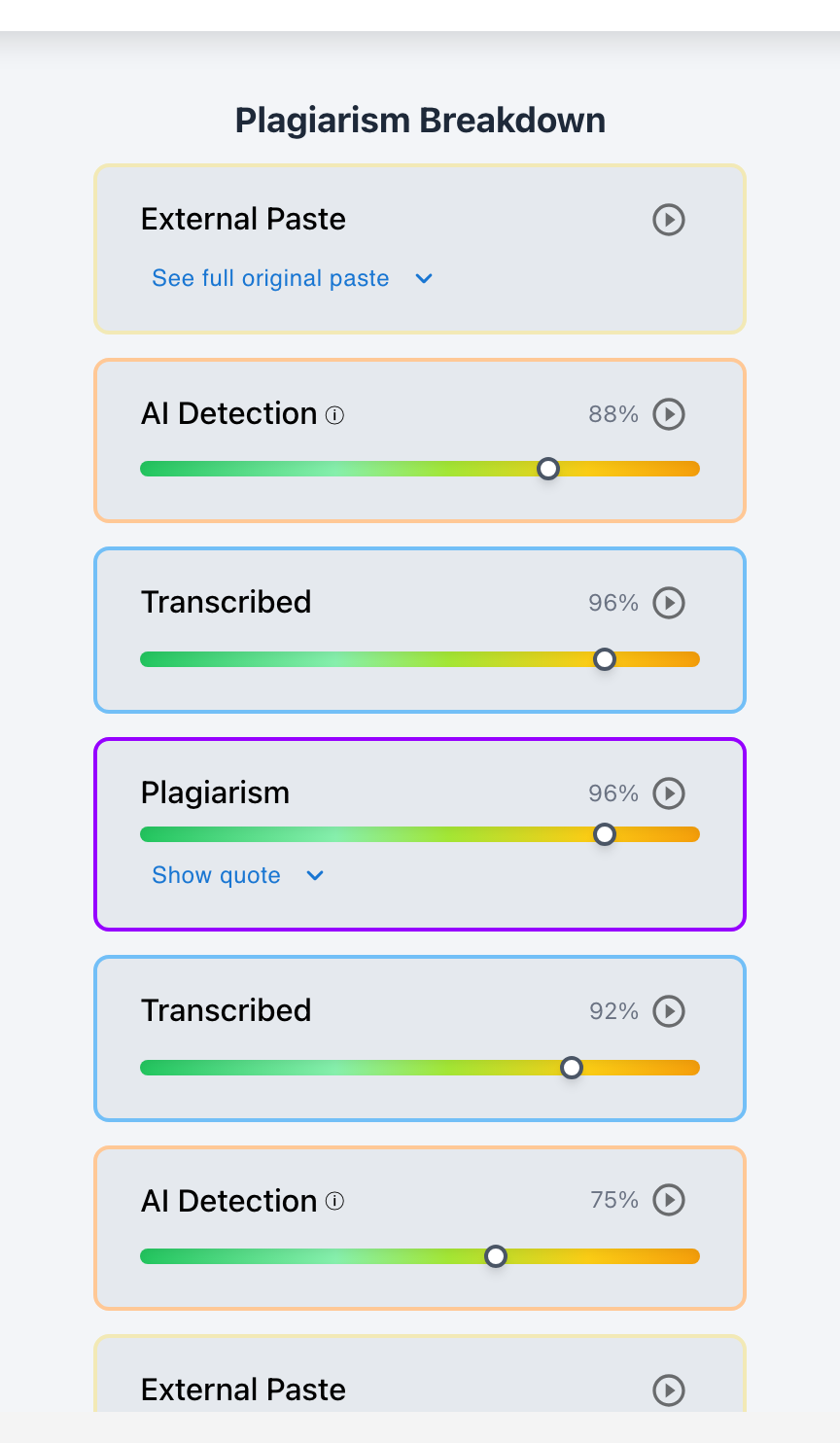
- 2. Review the Authorship Breakdown Meter: evaluate the balance of human drafting vs. AI probability.
- 3. Inspect the Writing Playback timeline: verify active typing duration, session counts, and backspaces.
- 4. Check the AI Disclosure Statement submitted by the student against actual document telemetry.
- 5. Hold a 2-minute oral check-in: ask the student to explain the thesis and research methodology.
How Checkmark Plagiarism Powers Authorship Analysis
Checkmark Plagiarism combines **AI detection, essay writing playback, static AI detection, plagiarism detection, autograding, and Canvas/Google Classroom integrations** to evaluate the entire spectrum of human-AI interaction with objective, verifiable proof.
Frequently Asked Questions
Can a student use AI without surrendering authorship?
Yes. If a student uses AI for preliminary topic brainstorming or basic spellchecking while drafting all sentences independently, the student remains the sole author.
When does AI assistance become AI authorship?
Assistance becomes authorship the moment the AI generates the actual sentences, paragraphs, and argumentative synthesis that appear in the final paper.
Is using an AI-generated outline considered AI authorship?
If the student takes an AI outline and writes original sentences independently, it is assisted human authorship; however, course policies may still restrict AI outlining.
How does writing playback prove human authorship?
Playback captures the physical keystroke telemetry—hours of active typing, deletions, pauses, and revisions—proving the student composed the text.
How does Checkmark Plagiarism integrate with Canvas LMS?
Checkmark provides certified LTI 1.3 integration, SpeedGrader sidebar embeds, two-way grade passback, and single sign-on (SSO).
Why do students confuse AI assistance with AI authorship?
Marketing from AI companies often blurs the line, labeling full generative writing features as "writing assistants."
What should a teacher do if an essay exhibits mixed authorship?
Review the Checkmark report with the student, distinguish between their human drafting and the AI-generated sections, and require an independent revision.
How can teachers design assignments that reward human authorship?
Include in-class drafting checkpoints, oral defense components, and personal reflective prompts that require authentic lived experience.
What is an AI Disclosure Statement?
A transparent student statement submitted alongside an essay detailing which AI tools were used and for what specific purpose.
Why is defining authorship essential for the future of education?
Because clarity around authorship empowers students to use technology responsibly without compromising the development of their own minds.
Empowering Human Minds in the Age of Intelligent Tools
True education is about cultivating independent critical thinkers. By establishing clear definitions between AI assistance and AI authorship with Checkmark Plagiarism, educators ensure that technology serves student learning rather than replacing it.
Checkmark Plagiarism supports this comprehensive approach with AI detection, essay writing playback, static AI detection, plagiarism detection, autograding, and integrations with Canvas and Google Classroom.
See how Checkmark pairs writing playback with multi-signal AI detection to verify intellectual authorship. View a sample report or request a demonstration.