
Patchwriting is the practice of copying sentences from a source text and modifying them superficially—by swapping a few synonyms, deleting minor adjectives, or slightly altering word order—while keeping the original author's grammatical clause structure intact. Yes, patchwriting is officially classified as a form of plagiarism under institutional honor codes because it misrepresents borrowed syntax and sentence structure as original student composition.
In the early 1990s, composition theorist Rebecca Moore Howard coined the term patchwriting in her article "A Plagiarism Pentimento" (Journal of Teaching Writing, vol. 11, no. 2) to describe a common phenomenon in student writing: novice writers resting heavily on source phrasing when tackling complex, unfamiliar scholarly literature. While patchwriting often stems from a developmental lack of reading comprehension rather than malicious intent to cheat, submitting patchwritten text in a final research paper violates academic standards. Knowing how to define, recognize, and remediate patchwriting is essential for cultivating genuine student scholarship.
Below is a comprehensive guide on the definition, ethics, and detection of patchwriting.
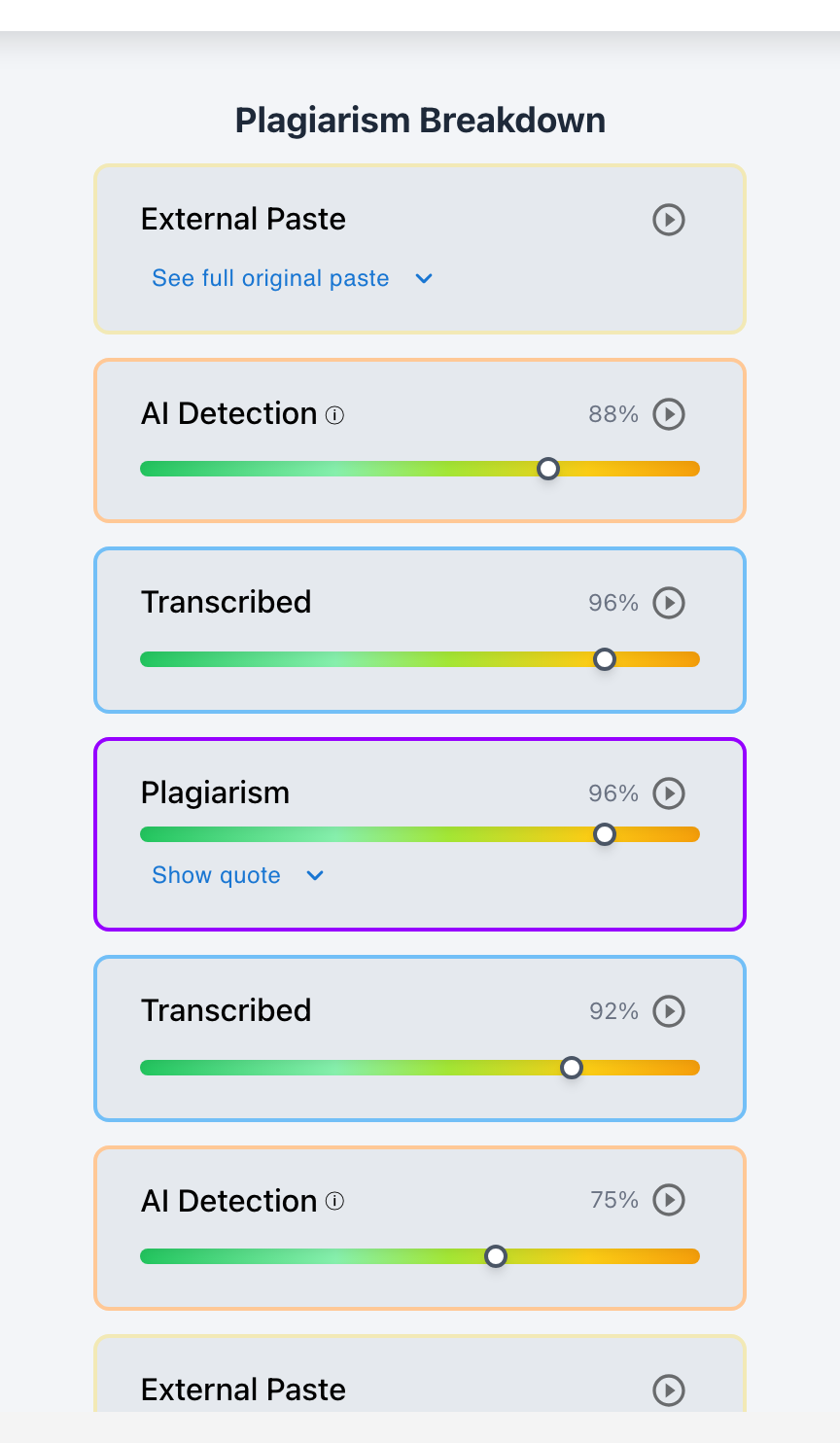
Checkmark Plagiarism identifies patchwriting by pairing plagiarism detection with AI detection, essay writing playback, autograding, and integrations with Canvas and Google Classroom.
The 4 Core Characteristics of Patchwriting
1. Clause-for-Clause Syntactic Mirroring
The student follows the source author's exact grammatical architecture, sentence by sentence, substituting nouns and verbs with simple synonyms.
2. Omission of Required Quotation Marks
Because the student changed 3 out of 10 words, they omit quotation marks—falsely implying the phrasing and structure are entirely their own.
3. Lack of Original Intellectual Synthesis
The student performs mechanical word substitution without internalizing or evaluating the concept, demonstrating zero critical analysis.
4. Thesaurus & Lexical Distortion Artifacts
Replacing words in isolation leads to unnatural, awkward phrasing that sounds robotic or grammatically strained in context.
Why Institutional Honor Codes Classify Patchwriting as Plagiarism
Understanding why academic integrity policies prohibit patchwriting:
- Misrepresentation of Authorship: Academic writing requires students to contribute their own synthesis. Borrowing an author's sentence skeleton without attribution misrepresents another's labor as student mastery.
- The "Quotation or Paraphrase" Standard: Standard style guides (APA, MLA, Chicago) require writers to choose: either quote the exact words in quotation marks, or rewrite the idea completely in new syntax with a citation. Patchwriting exists in an unacceptable middle ground.
- Developmental vs. Disciplinary Lens: In early drafts, patchwriting represents an opportunity for coaching; in final submissions, it results in grade deductions or academic referrals.
Read more in how Checkmark writing process analysis works.
Comparison: Direct Quote vs. Patchwriting vs. Genuine Paraphrase
Direct Quotation (Proper Attribution)
According to Garcia (2023), "Cognitive fatigue significantly diminishes executive function during prolonged testing sessions" (p. 42).
Patchwriting (Plagiarism)
Mental exhaustion greatly reduces executive performance during lengthy exam periods. (No quotation marks, no synthesis)
Genuine Paraphrase (Authentic Synthesis)
When students take long exams without breaks, their decision-making and focus steadily decline (Garcia, 2023).
Note: "Garcia (2023)" is a hypothetical source used only to illustrate the three approaches. It is not a real publication.
A 5-Step Educator Protocol for Addressing Patchwriting
Patchwriting Resolution Protocol:
- 1. Open the student's submission in Checkmark Plagiarism inside Canvas SpeedGrader.
- 2. Review the Side-by-Side Source Comparison card: note the syntactic clause mirroring.
- 3. Schedule a supportive 2-minute conference: explain the definition of patchwriting.
- 4. Practice the "Read, Close, Write" method together during the check-in.
- 5. Allow the student to revise the patchwritten sections into genuine paraphrasing with proper in-text citations.
How Checkmark Plagiarism Powers Patchwriting Remediation
Checkmark Plagiarism combines **AI detection, essay writing playback, static AI detection, plagiarism detection, autograding, and Canvas/Google Classroom integrations** to automatically identify patchwritten text and provide clear side-by-side visual comparisons for student coaching.
Frequently Asked Questions
Who invented the concept of patchwriting?
Composition scholar Rebecca Moore Howard introduced the term in the early 1990s in "A Plagiarism Pentimento" (Journal of Teaching Writing), defining it as "copying from a source text and then deleting some words, altering grammatical structures, or plugging in one-for-one synonym substitutes." She expanded on the idea in her 1995 College English essay "Plagiarisms, Authorships, and the Academic Death Penalty" (vol. 57, no. 7, pp. 788-806).
Is patchwriting considered cheating or a learning mistake?
In composition theory, patchwriting is viewed as a developmental stage where students struggle with complex texts; in final grading, however, it violates honor codes unless revised.
What is the difference between paraphrasing and patchwriting?
Paraphrasing rewrites the idea in a completely new sentence structure and voice with a citation. Patchwriting keeps the original structure while swapping isolated words.
Does patchwriting show up on plagiarism checkers?
Yes. Checkmark Plagiarism identifies fragmented text matches, clause mirroring, and synonym substitutions across global web and journal databases.
Can a patchwritten essay have a low similarity score?
Yes. If a student swapped every second word, traditional keyword-matching tools might report a low score (e.g., 8%), but Checkmark's Semantic Engine still flags the syntactic mirroring.
How does Checkmark Plagiarism integrate with Canvas LMS?
Checkmark provides certified LTI 1.3 integration, SpeedGrader sidebar embeds, two-way grade passback, and single sign-on (SSO).
What should a teacher do if a student patchwrites?
Use it as a teaching moment: show the student the side-by-side comparison in SpeedGrader and teach them how to summarize concepts independently.
What is the 'Read, Close, Write' technique?
It is an effective pedagogical method where students read a source paragraph, close the document completely, and write a summary from memory to ensure authentic synthesis.
Why do students use QuillBot to patchwrite?
Automated paraphrasing tools like QuillBot automate patchwriting by swapping synonyms, creating pseudo-original text that modern integrity platforms detect easily.
Why is understanding patchwriting essential for educators?
Because distinguishing between deliberate text theft and developmental patchwriting ensures that students receive appropriate pedagogical remediation.
From Mechanical Borrowing to Authentic Scholarship
Moving from patchwriting to authentic synthesis is a critical milestone in every student's intellectual development. By identifying patchwriting with precision and coaching students on true conceptual synthesis with Checkmark Plagiarism, educators ensure that writing instruction fosters genuine understanding and integrity.
Checkmark Plagiarism supports this comprehensive approach with AI detection, essay writing playback, static AI detection, plagiarism detection, autograding, and integrations with Canvas and Google Classroom.
See how Checkmark pairs patchwriting detection with multi-signal forensics to evaluate student research synthesis. View a sample report or request a demonstration.