
There is rarely one piece of evidence that is enough, by itself, to confidently say a student used AI on an assignment.
An AI detector score can raise concern. A sudden change in writing style can raise concern. A large block of text appearing at once in document history can raise concern. A student being unable to explain their own essay can raise concern. But each of those observations can also have legitimate alternate explanations.
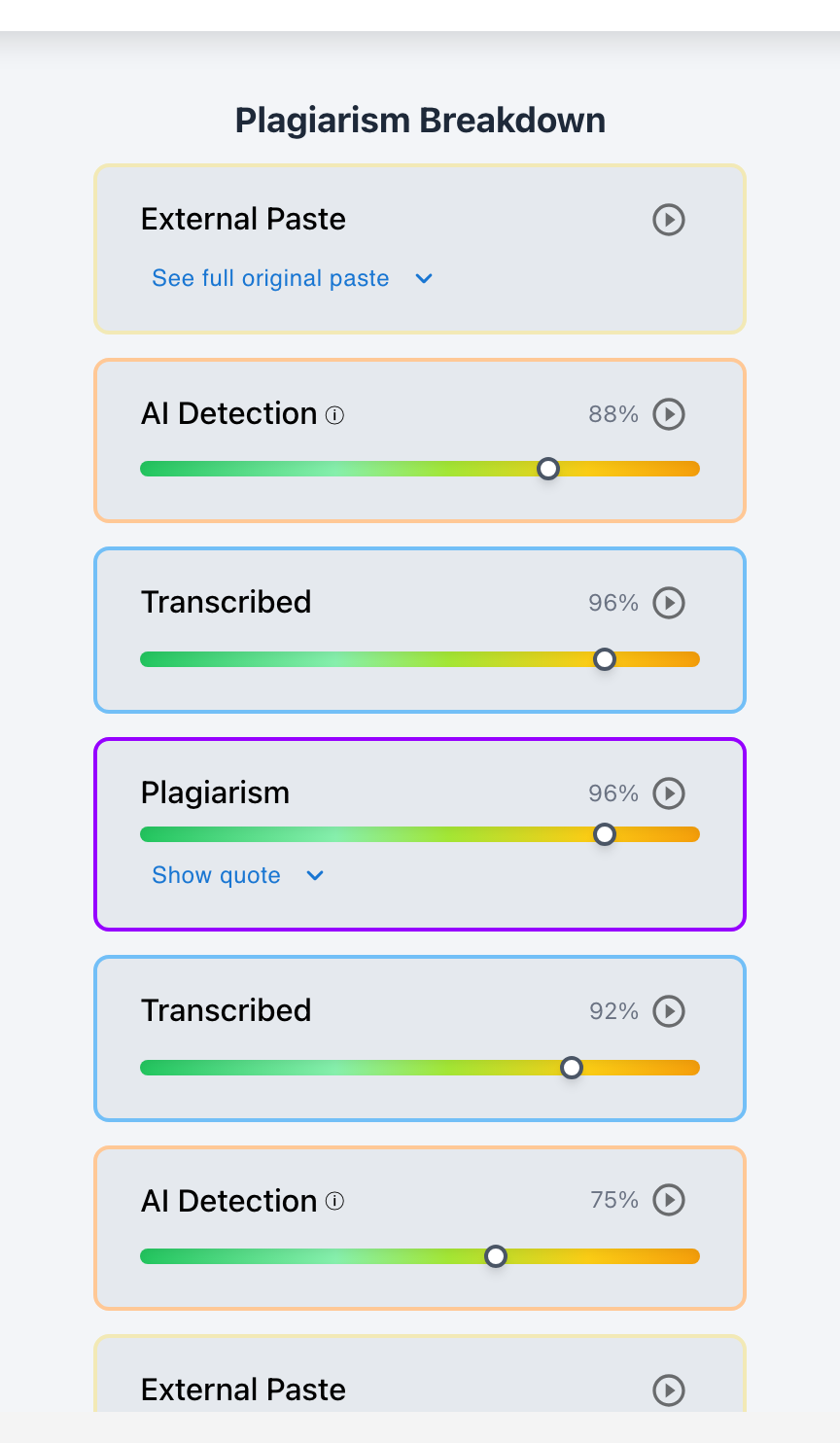
A stronger conclusion comes from multiple independent pieces of evidence that point in the same direction: statistical detector flags matching sudden paste events in playback, stylistic divergence from verified student baselines, hallucinated academic citations, and oral comprehension failure.
Checkmark Plagiarism supports this evidence-based review through AI detection, essay writing playback, static AI detection, plagiarism detection, autograding, and integrations with Canvas and Google Classroom.
There Is No Universal Threshold That Proves Misconduct
AI use ranges from allowed grammar editing and brainstorming to unauthorized wholesale generation. Rules like "an AI score above 80% proves cheating" fail because statistical detectors alone do not prove intent, tool type, or policy compliance. Read more in is an AI detector enough evidence for academic misconduct?
The Power of Independent Corroborating Signals
Evidence is persuasive when independent sources of data confirm the same timeline and outcome:
Strong Corroborating Evidence Set
- AI detection raises severe flags on body sections
- Playback shows those exact paragraphs added in one paste
- Vocabulary and syntax diverge radically from past work
- Multiple citations in those sections do not exist in indices
- Student cannot explain arguments or source origins orally
- Explanation directly contradicts observable document logs
Exculpatory Evidence Set
- Detector flags formal text, but...
- Playback shows multi-day drafting across 4 sessions
- Student provides rough outlines and notes
- Writing style matches previous baseline work
- All citations and quotes are fully verified
- Student fluently explains all arguments and revisions
How Essay Writing Playback Provides Concrete Process Evidence
Checkmark Plagiarism's essay writing playback allows teachers to examine how an assignment developed: multi-session drafting, large text additions, revisions, and deletions. This allows teachers to test student explanations against objective timeline logs. Read more in how Checkmark writing process analysis works.
Evaluating Direct vs. Circumstantial Evidence
- Direct Evidence: Student admissions describing unauthorized generative use, preserved AI chat logs, or explicit workflow records.
- Circumstantial Evidence: Detection probability scores, sudden paste events, writing style shifts, and unverified citations.
Circumstantial signals become compelling when multiple independent indicators align without plausible innocent explanations.
A Practical 10-Point Evidence Evaluation Test
A Practical 10-Point Evidence Evaluation Test:
- 1. What objective facts do I know with certainty versus assume?
- 2. Do I have multiple independent corroborating signals rather than a single detector score?
- 3. Does document writing playback support or challenge the student's explanation?
- 4. Does previous writing baseline context show a genuine, uncharacteristic shift?
- 5. Are cited sources, authors, and quotes verified in academic databases?
- 6. Can the student fluently explain the thesis, key arguments, and vocabulary orally?
- 7. Does the student's oral explanation fit observable timeline history?
- 8. What specific role did AI play (brainstorming, grammar, paragraph generation)?
- 9. Did that specific level of assistance violate the published course policy?
- 10. Have plausible innocent explanations (external drafting) been fairly investigated?
How Checkmark Plagiarism Helps Build a Stronger Body of Evidence
Checkmark Plagiarism combines **AI detection, essay writing playback, static AI detection, plagiarism detection, autograding, and Canvas/Google Classroom integrations** to provide educators with a complete, multi-signal evidence package for academic integrity decisions.
Frequently Asked Questions
Is an AI detector enough evidence to say a student used AI?
Usually it is best treated as one piece of evidence. Detection becomes persuasive when corroborated by writing history, baseline comparisons, source validation, and student conferences.
Is a high AI percentage proof?
No. The meaning of AI percentages varies by detector, and false positives can occur on formal human writing.
Is a large paste enough evidence?
No. The student may have drafted elsewhere in Microsoft Word or notes. Ask where the material came from and examine external drafts.
Is a sudden improvement in writing enough?
No. Students improve legitimately due to tutoring, writing center visits, and thorough revision.
Is being unable to explain an essay enough evidence?
Not by itself. Repeated inability to explain central ideas becomes significant when combined with other independent concerns.
Are fake citations proof of AI use?
They are a strong indicator when multiple non-existent sources appear alongside instant paste events and comprehension failure.
What is the strongest evidence of AI use?
Direct admissions of prohibited generation or a cohesive multi-signal package where detection flags, playback pastes, source hallucinations, and comprehension gaps all align.
What if the student says they used ChatGPT?
Ask how: brainstorming, grammar feedback, sentence rewriting, and full essay generation represent different levels of assistance under course policies.
What if the evidence points in both directions?
Do not force certainty. When evidence is mixed or insufficient, document the review and focus on process expectations for future assignments.
How does Checkmark Plagiarism help establish evidence of AI use?
Checkmark Plagiarism combines AI detection, essay writing playback, static AI detection, plagiarism detection, autograding, and Canvas and Google Classroom integrations.
Enough Evidence Means More Than a Detector Score
Sufficient evidence requires corroboration across multiple dimensions: what was submitted, how it was created, and whether the student's explanation aligns with observable facts. By evaluating the complete picture, educators ensure academic integrity decisions remain fair, accurate, and defensible.
Checkmark Plagiarism supports this evidence-based approach with AI detection, essay writing playback, static AI detection, plagiarism detection, autograding, and integrations with Canvas and Google Classroom.
See how Checkmark pairs essay writing playback with multi-signal detection to give teachers a comprehensive evidence package for every submission. View a sample report or request a demonstration.