
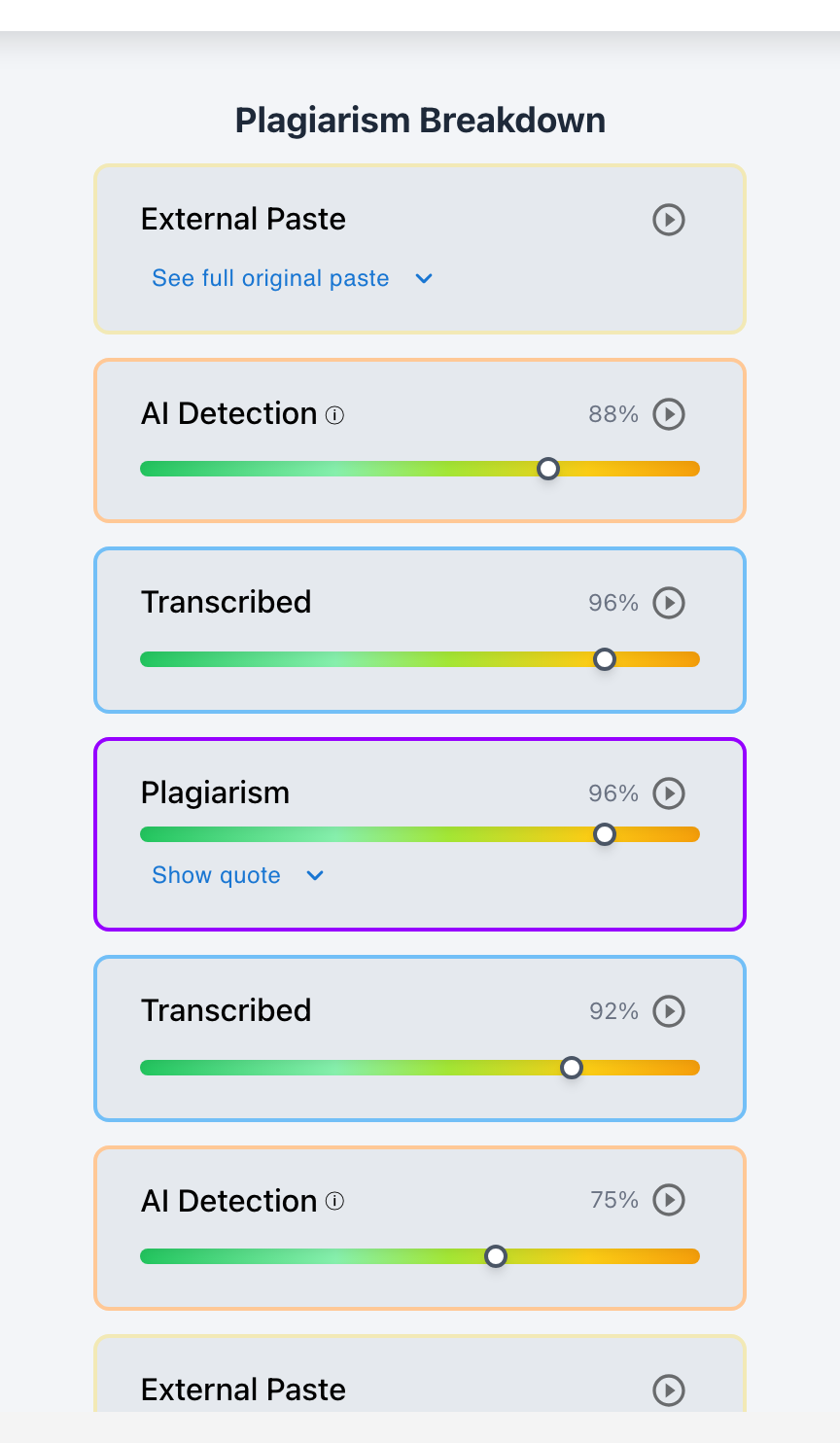
If a student denies using AI, teachers should avoid emotional arguments and execute a 3-part objective verification protocol: 1) review Checkmark Writing Playback together to inspect physical typing duration, deletion rates, and clipboard paste logs; 2) perform a live Citation Reality Check to test whether cited DOIs and sources physically exist; and 3) administer a 10-minute in-person handwritten synthesis prompt on the essay topic to immediately confirm whether the student possesses genuine authorship ability.
When a student strongly asserts: "I didn't use AI! I wrote every word myself!" an educator faces a critical crossroads. In some cases, the student is telling the truth—they wrote with elevated academic vocabulary and were falsely flagged by an imperfect detector. In other cases, the student is panicking and attempting to bluff past the allegation. Engaging in a "he-said-she-said" standoff damages relationships and leads to formal grievances. By relying on triangulated physical telemetry and real-time skill demonstration, teachers can conclusively separate honest false alarms from dishonest evasions.
Below is a comprehensive guide on resolving student denials with complete fairness and objective proof.
Checkmark Plagiarism resolves denial disputes by pairing AI detection with essay writing playback, plagiarism detection, autograding, and integrations with Canvas and Google Classroom.
The 3 Objective Verification Tests for Denials
Test 1: Keystroke Playback
The Physical Reality Test: Replay document drafting in Checkmark. Did the paper take 3 hours with 20% backspaces, or did 1,500 words appear in a 0.05-second paste payload?
Test 2: Citation Reality Check
The Factual Test: Test cited DOIs live on doi.org. If cited papers and authors do not exist in published academic databases, the paper contains AI hallucinations.
Test 3: In-Person Prompt
The Authorship Test: Have the student handwrite a 1-paragraph summary of their main argument in 10 minutes. Compare vocabulary and syntax to the submission.
Distinguishing False Positives from Entrenched Evasion
Analyzing what happens when the 3 tests are applied:
- The Innocent Student (False Positive): Playback shows 3.5 hours of active typing; citations resolve to real JSTOR/Google Scholar articles; student writes a sharp, coherent summary on the spot. Outcome: Complete exoneration with apology.
- The Dishonest Student (Evasion): Playback shows 4 minutes total document time and a massive paste event; cited DOIs produce 404 errors; student struggles to explain basic thesis concepts during the 10-minute prompt. Outcome: Conclusive academic violation.
Read more in how Checkmark writing process analysis works.
Comparison: Subjective Standoff vs. Triangulated Verification
Triangulated Verification (Checkmark Standard)
- Tests keystroke playback, citation reality, and in-person writing.
- Grounds inquiry in observable digital and physical facts.
- Exonerates honest students immediately and conclusively.
- Leaves zero room for bluffing or ambiguous grade appeals.
Subjective Standoff (Emotional & Risky)
- Teacher relies solely on a detector score or suspicion.
- Student digs into entrenched denial out of fear.
- No physical telemetry to prove or disprove the claim.
- Escalates into contentious parent grievances and hearings.
A 5-Step Educator Protocol for Handling Denials
Denial Resolution Checklist:
- 1. Remain calm and supportive: "I hear your denial, so let's look at the objective document evidence together."
- 2. Open Checkmark Playback in Canvas SpeedGrader to inspect active typing duration and paste logs.
- 3. Test 2 cited DOIs on doi.org to verify whether cited sources physically exist.
- 4. If telemetry shows a paste event and sources are fake, administer the 10-minute in-person prompt.
- 5. If the evidence conclusively demonstrates AI generation, apply course policy and export the Checkmark dossier.
How Checkmark Plagiarism Powers Denial Resolutions
Checkmark Plagiarism combines **AI detection, essay writing playback, static AI detection, plagiarism detection, autograding, and Canvas/Google Classroom integrations** to replace subjective arguments with unassailable digital telemetry.
Frequently Asked Questions
What if a student insists an AI detector is wrong?
Acknowledge that AI detectors can make mistakes, and shift the inquiry to physical keystroke playback and in-person writing validation.
How does writing playback conclusively resolve a denial?
Playback provides an immutable, physical recording of the document's creation—proving whether the student spent hours typing or pasted the text instantly.
What if a student says they wrote the paper on paper first and typed it up?
Ask the student to bring in their handwritten drafts and notes to verify drafting continuity.
What is an in-person synthesis prompt?
A 10-minute writing exercise where the student writes a short paragraph summarizing their thesis by hand, validating their authentic voice.
How does Checkmark Plagiarism integrate with Canvas LMS?
Checkmark provides certified LTI 1.3 integration, SpeedGrader sidebar embeds, two-way grade passback, and single sign-on (SSO).
What should a teacher do if cited sources are proven to be fake?
Demonstrating that cited DOIs and author combinations do not exist in academic literature provides incontrovertible proof of generative AI hallucination.
How can teachers protect innocent students who are falsely accused?
By prioritizing multi-hour writing playback and verified source checks, innocent students are instantly cleared of suspicion.
Can parents attend the denial resolution meeting?
Yes. Presenting Checkmark's visual playback replay and database checks to parents resolves disputes quickly and transparently.
How does Checkmark Autograder assist during denial inquiries?
Autograder analyzes the stylistic distance between the disputed essay and the student's in-class diagnostic baseline, providing objective data.
Why is maintaining emotional neutrality essential during denials?
Because remaining calm and evidence-focused ensures fairness, de-escalates conflict, and upholds professional educator standards.
Resolving Disputes with Truth, Fairness, and Grace
Academic integrity inquiries must always seek the truth. By utilizing triangulated keystroke telemetry and live writing validation with Checkmark Plagiarism, educators resolve student denials with complete confidence, ensuring that justice is done and student trust is protected.
Checkmark Plagiarism supports this comprehensive approach with AI detection, essay writing playback, static AI detection, plagiarism detection, autograding, and integrations with Canvas and Google Classroom.
See how Checkmark pairs writing playback with multi-signal detection to resolve AI disputes objectively. View a sample report or request a demonstration.