
Academic integrity officers, honor council chairs, deans of students, university legal counsel, and faculty hearing boards face an unprecedented administrative and legal crisis. Across higher education and secondary institutions, accusations involving generative AI are no longer simple matters of raw Large Language Model (LLM) generation. Instead, committees are inundated with complex cases involving LLM rewrites, AI paraphrasing tools (e.g., QuillBot, Wordtune), and text “humanizers” (e.g., Undetectable AI, BypassGPT, StealthWriter, HideMyAI) designed specifically to obfuscate machine origin and bypass static text detectors.
When students contest these allegations—asserting authorized grammar assistance, offline drafting, transcription of personal notes, or algorithmic bias against non-native English writers—traditional adjudication models collapse. Relying on an opaque, standalone whole-paper AI detector percentage (e.g., “This paper is 84% AI”) fails the legal threshold of Substantial Evidence and violates constitutional procedural due process (Goss v. Lopez, Dixon v. Alabama).
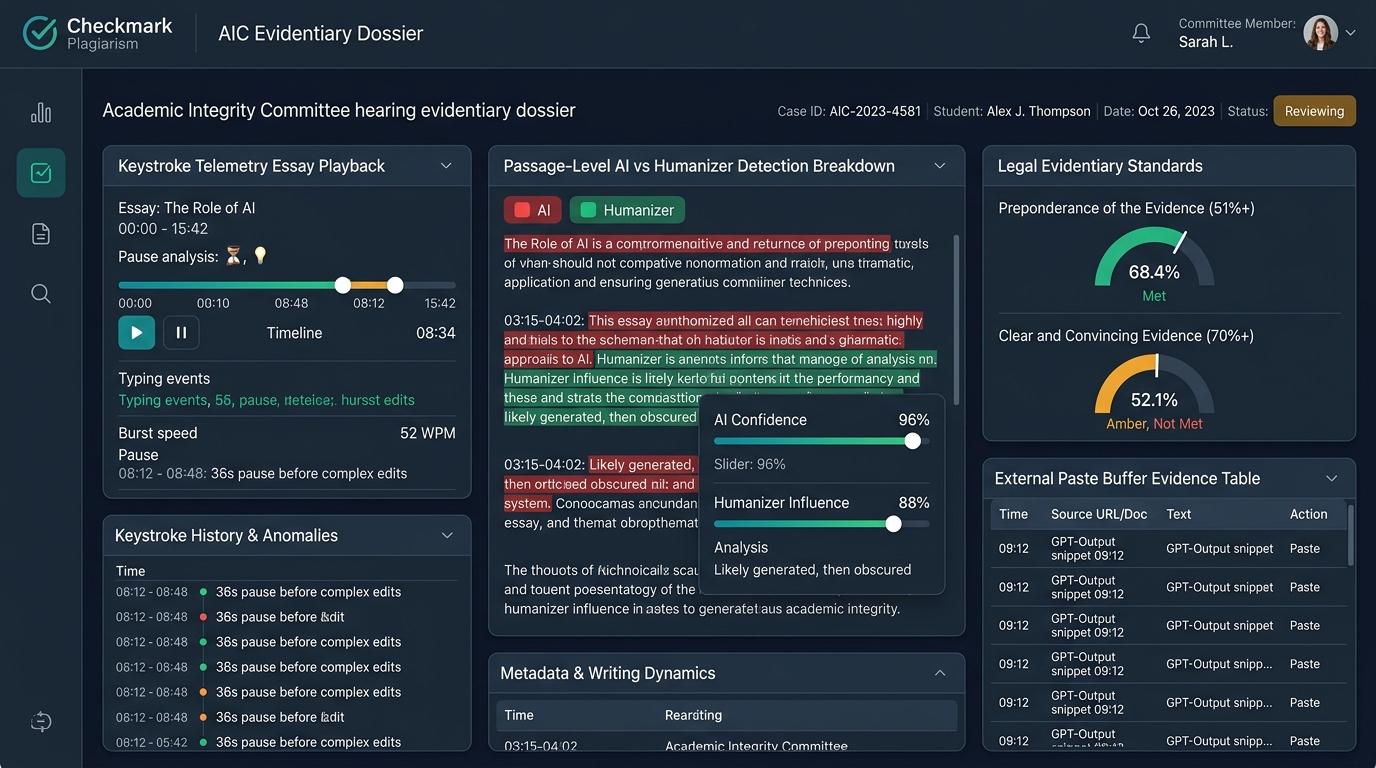
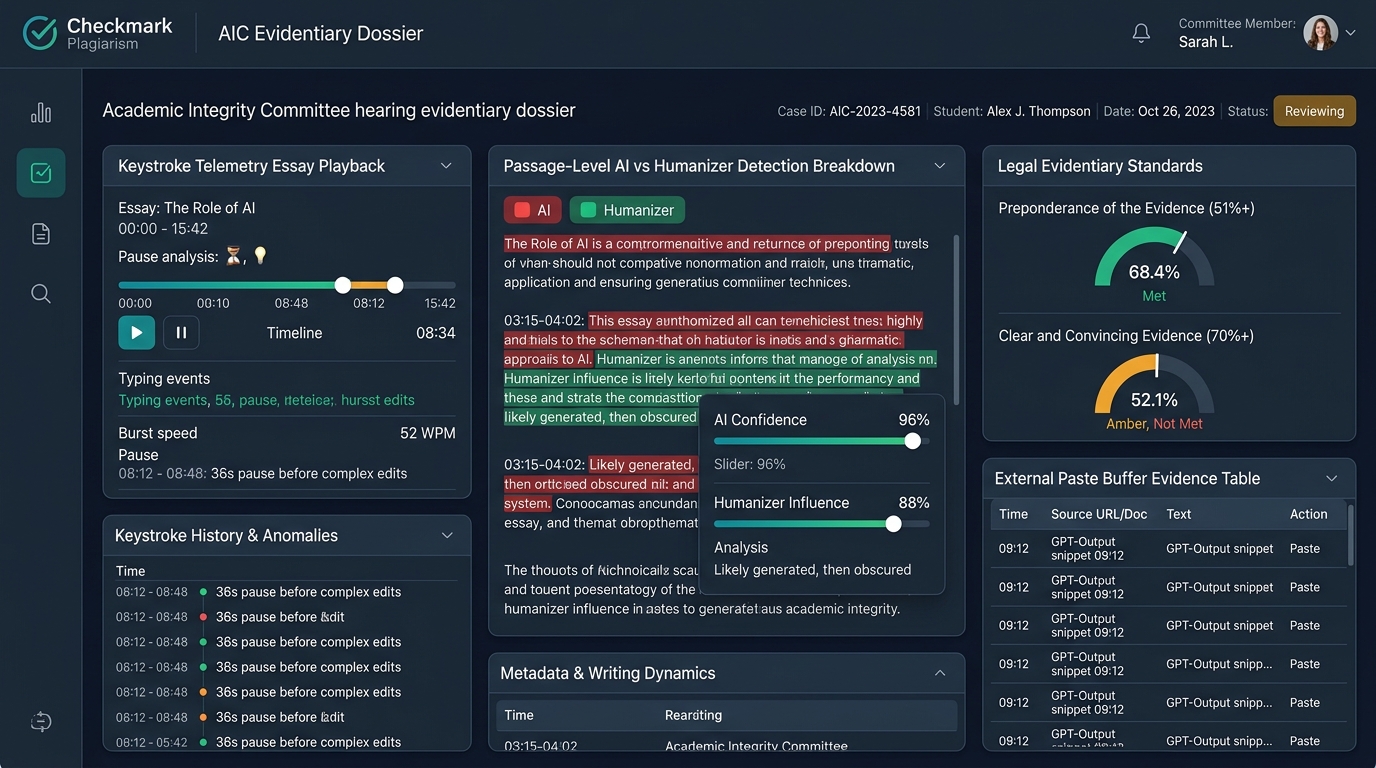
To render fair, transparent, and legally defensible decisions that satisfy either the Preponderance of the Evidence (>50%) or Clear and Convincing Evidence (~75%+) standards, academic integrity committees must transition from speculative linguistic guessing to an empirical Writing Telemetry Dossier. By combining:
- Temporal Process Telemetry (Patent-Pending Essay Playback™): 1x–8x scrubbable video reconstruction of keystroke dynamics, editing pauses, cognitive rhythm, and typing velocity;
- External Paste Provenance: Timestamped capture of all external clipboard insertions, character volumes, and immutable source text preservation; and
- Passage-Level Grounded Evidence: Calibrated confidence sliders and side-by-side plagiarism comparisons,
institutions can eliminate arbitrary black-box accusations, protect innocent students from false positives, and establish unassailable findings of fact.
Checkmark Plagiarism equips academic integrity committees, honor councils, department chairs, and university judicial officers with forensic writing telemetry and enterprise LMS integrations across Canvas LMS, Agilix Buzz, and Google Classroom.
1. The Modern Evidentiary Crisis: The Industrialization of LLM Rewriting and Text Humanizers
Academic integrity adjudication has entered an era of unprecedented sophistication. In the immediate aftermath of ChatGPT's release, academic dishonesty investigations typically involved raw, unedited text copied directly from an AI prompt into an assignment. Today, student writing workflows have evolved into multi-stage pipelines that blur the boundaries between legitimate editing, automated assistance, and substantive authorship fraud.
1.1 The Technical Anatomy of Modern Text “Humanization”
To establish fair evidentiary standards, hearing boards must understand the exact computer science mechanisms behind automated text rewriting and “humanizing” software:
Synonym Permutation & Thesaurus Swapping
Tools like QuillBot and legacy word spinners replace high-frequency academic vocabulary with less common synonyms. While this alters surface n-grams, it frequently introduces semantic incongruities, archaic phrasing, or broken idioms (e.g., translating “greenhouse gas emissions” into “hothouse vapor outpourings”).
Perplexity & Burstiness Manipulation
Specialized evasion tools (such as Undetectable AI, BypassGPT, and StealthWriter) analyze the mathematical predictability (perplexity) and sentence-length variation (burstiness) of the input text. They deliberately insert unusual transition words, fragmented sentences, and erratic punctuation to trick static neural classifiers into classifying the text as human-authored.
Intentional Dysfluency Injection
Advanced humanizers intentionally introduce mild stylistic awkwardness, non-standard phrasing, and idiosyncratic syntax designed to emulate human error without triggering basic spell-check flags, mimicking casual drafting flaws.
Iterative Multi-Prompt Re-generation
Students increasingly utilize meta-prompts within frontier models (e.g., “Rewrite this essay using an informal tone, varied sentence lengths, occasional colloquialisms, and a Flesch-Kincaid grade level of 10”), bypassing simple heuristics and surface checks.
1.2 The Failure of Single-Percentage Scores in Adversarial Hearings
When an instructor brings a student before an Academic Integrity Committee or Honor Council armed solely with a single percentage score from a generic AI detector (e.g., “The software flagged this essay as 78% AI-generated”), the evidentiary foundation is legally and procedurally fatally flawed.
| Technical Limitation | Hearing Board & Legal Implication | Due Process Defect |
|---|---|---|
| Black-Box Trade Secrets | Institution cannot explain algorithm weights or parameters to the student or legal counsel. | Violates Right to Examine Primary Evidence |
| Zero Temporal Awareness | Evaluates only static text snapshot; blind to active drafting time, keystroke pauses, or organic revisions. | Ignores Exculpatory Process Records |
| High False-Positive Vulnerability | Proven empirical bias against non-native English speakers (ELL/ESL) and formulaic academic templates. | Disparate Impact & Title VI / Equal Protection Risks |
| Paraphrase & Humanizer Blindspots | Surface text manipulation causes erratic score swings (e.g., 95% AI dropped to 0% after a single spin). | Arbitrary & Capricious Administrative Standard |
| Absence of Verifiable Source Match | Unlike plagiarism matching, AI scores offer no side-by-side origin document or grounded citation quote. | Fails "Substantial Evidence" Threshold |
When a student vigorously denies the allegation and presents a plausible counter-narrative, hearing board members are forced into an untenable position: choose between blindly trusting an unexplainable third-party software score or accepting the student's unverified word. This dynamic destroys faculty confidence, alienates students, and exposes the institution to severe legal and reputational liability.
2. Legal and Institutional Evidentiary Standards in Academic Adjudication
Academic integrity hearings are administrative quasi-judicial proceedings. While they are not bound by the formal Federal Rules of Evidence that govern criminal or civil courts, they are strictly governed by constitutional due process (at public institutions), contractual obligations set forth in student handbooks and honor codes (at private institutions), and common-law principles of fundamental fairness.
2.1 The Constitutional Due Process Framework
Under landmark legal precedents, public college and university students hold constitutionally protected property and liberty interests in their continued education, academic standing, and professional reputation:
- Goss v. Lopez, 419 U.S. 565 (1975): Established that disciplinary suspensions require fundamental procedural safeguards: timely written notice of specific charges, disclosure of the evidence, and an opportunity for the student to present their version of events before an impartial arbiter.
- Dixon v. Alabama State Board of Education, 294 F.2d 150 (5th Cir. 1961): Held that due process in higher education disciplinary proceedings requires an explanation of the evidence supporting the charge and a fair hearing before sanctions are imposed.
- Board of Curators of the University of Missouri v. Horowitz, 435 U.S. 78 (1978): While granting greater deference to purely academic evaluations, the Supreme Court emphasized that disciplinary sanctions or dismissals carrying moral opprobrium (such as fraud or academic dishonesty) demand procedural protections.
- The “Arbitrary and Capricious” Doctrine: Courts will overturn university disciplinary decisions if the institution acts arbitrarily, violates its own published procedures, or renders a finding unsupported by substantial evidence in the administrative record.
2.2 Standards of Proof Compared: Preponderance vs. Clear and Convincing
Institutions universally specify a standard of proof in their Academic Integrity Bylaws or Student Codes of Conduct. Committees must precisely apply the standard mandated for the specific sanction sought:
The "More Likely Than Not" Threshold
- Application: Standard across the vast majority of university honor councils and K-12 school boards for routine classroom violations, course-level grade reductions (e.g., receiving a zero on an assignment or an 'F' in the course), and initial honor warnings.
- Evidentiary Threshold: The evidence presented must demonstrate that the allegation of unauthorized AI rewriting or humanizer use is more likely true than not true.
- Application to AI Claims: A probabilistic AI score of 75% from a detector does not equal a 75% legal probability of misconduct. Because neural classifiers operate with systemic error rates, false positives on ELL text, and vulnerability to humanizers, a raw percentage fails to satisfy the preponderance standard unless corroborated by independent, empirical process telemetry.
The "Substantially More Likely" Threshold
- Application: Required by many elite universities, law schools, medical schools, graduate programs, and institutional codes whenever severe disciplinary sanctions are on the table—such as permanent transcript notations (e.g., 'XF' grade), academic suspension, expulsion, or degree revocation.
- Evidentiary Threshold: The evidence must produce in the minds of the committee members a firm belief or conviction that the factual claims are substantially true. The proof must be clear, explicit, and unclouded by substantial doubt.
- Application to AI Claims: It is legally impossible for a black-box AI detector percentage alone to satisfy the Clear and Convincing standard. To sustain a suspension or expulsion for AI rewriting, the hearing file must contain incontrovertible digital forensic artifacts (such as keystroke telemetry, external paste logs, and immutable clipboard preservation).
2.3 The Allocation and Shifting of the Burden of Proof
A foundational principle of academic justice is that the institution (represented by the reporting faculty member or academic integrity officer) bears the initial burden of production and persuasion.
Must present a prima facie case with competent, verifiable evidence. Presenting ONLY an AI percentage score fails this initial burden as a matter of law.
Institution presents Essay Playback™ replay, paste logs of external text, and timeline anomalies. Result: The burden of persuasion successfully shifts to the student to explain the objective record.
Student must offer credible, corroborating explanations or artifacts (e.g., offline drafts, browser history, handwritten research notes, or verifiable editing timeline).
Weighs competing evidence against the mandated institutional standard (Preponderance / Clear & Convincing). Issues written findings of fact.
3. The Academic Integrity Evidentiary Matrix
To evaluate claims involving LLM rewrites, paraphrasers, and text humanizers systematically, hearing panels must categorize evidence into a structured hierarchy based on technical verifiability, objectivity, and legal defensibility.
| Evidence Tier & Description | Technical Mechanics | Probative Value | Due Process & Legal Defensibility | Vulnerability to Student Counter-Claims | Committee Recommendation |
|---|---|---|---|---|---|
| Tier 1A: Essay Playback™ Keystroke Telemetry | Timestamped keystroke-by-keystroke replay (1x–8x speed); records character insertions, backspaces, composing pauses, and typing velocity. | Incontrovertible (Gold Standard) | Complete Compliance: Objective, reproducible audit trail of authentic writing. | Highly resistant; visual proof reveals authentic drafting vs. paste/transcription. | Primary Required Evidence for any formal sanction. |
| Tier 1B: External Paste Buffer Preservation | Captures timestamp, character volume, and exact preserved text of external clipboard insertions into document editor. | Incontrovertible | Complete Compliance: Documents exact ingested text even if student later edited it. | Disproves "I wrote it inside the doc" or proves exact external LLM/humanizer input. | Primary Required Evidence for rewrite and evasion claims. |
| Tier 2A: Passage-Level AI Linguistic Analysis | Highlights isolated sentences/paragraphs with calibrated confidence sliders; perplexity & burstiness scoring. | High Corroborative | Substantial: Explainable & granular; allows targeted inquiries on specific prose. | Vulnerable if used in isolation on short text (<150 words) or uncorroborated by telemetry. | Essential Corroborating Evidence; use to guide hearing questioning. |
| Tier 2B: Dual-Pane Grounded Plagiarism Sourcing | Side-by-side matching against live web pages, open-access journals, and student repositories with direct clickable URLs. | Incontrovertible | High: Objective factual alignment; demonstrates uncredited source appropriation. | Minimal; student can only contest intent/citation formatting, not textual identity. | Standard Evidence for traditional plagiarism and uncited web rewrites. |
| Tier 3A: Oral Defense & Viva Voce Examination | Real-time inquiry assessing student comprehension of thesis, specialized vocabulary, source synthesis, and conceptual mastery. | Moderate-to-High | Moderate: Subject to anxiety, memory lapses, neurodivergence, or ESL communication barriers. | Subject to subjective interviewer bias; must be standardized and recorded. | Supplementary Diagnostic Tool; pair with telemetry co-viewing. |
| Tier 3B: Comparative Baseline Samples | Analysis of student’s verified in-class bluebook essays, prior assignments, or timed proctored writing. | Moderate | Moderate: Shows stylistic divergence, but students legitimately improve with tutoring. | "I spent 40 hours revising this paper compared to my timed in-class quiz." | Contextual Background; insufficient on its own to sustain a sanction. |
| Tier 4A: Standalone AI Detector Percentage | Whole-document opaque percentage score (e.g., Turnitin AI Score, GPTZero 88% AI). | Extremely Low / Inadmissible | Legally Deficient: Fails procedural due process; proprietary black-box; high false-positive risk. | Devastatingly vulnerable to appeals, ESL bias claims, and legal challenges. | PROHIBITED as Sole Evidence; screening trigger only. |
| Tier 4B: Unsubstantiated Instructor “Vibe” | Subjective instructor assertion: "This doesn't sound like the student's usual voice." | Negligible | Inadmissible: Purely subjective conjecture; zero empirical evidentiary weight. | Vulnerable to implicit bias and discrimination complaints. | Disregard entirely during committee deliberations. |
4. Deconstructing the 4 Most Common Student Defenses in Humanizer & LLM Rewrite Cases
When confronted with academic dishonesty allegations involving AI rewriting, students rarely confess immediately. Instead, they present sophisticated technical and procedural defenses. Academic integrity panels must be equipped to audit each defense using empirical writing telemetry.
Student acknowledges using an automated tool but claims authorized, benign assistance (e.g., fixing commas, subject-verb agreement) permitted under course policy.
Student drafted an outline or raw AI generation, fed paragraphs into QuillBot's “Fluency/Creative” mode, and replaced entire sentence structures with algorithmic rewrites.
- Open Checkmark's External Paste Buffer Inspector and inspect timestamped insertion logs.
- If paste log shows an insertion of a 300-word block from an external window within a 2-second interval, examine preserved text.
- Compare preserved pasted text against the final prose. Direct paste of pre-paraphrased prose disproves “routine grammar checking.”
- Launch Essay Playback™: authentic grammar tool usage displays inline single-word replacements; bulk evasion displays block pastes with zero sentence formulation effort.
Student explains massive paste blocks by asserting they composed the essay in an external, unmonitored app and transferred the finished draft into Canvas LMS editor before submission.
Student generated the essay in ChatGPT or ran an AI draft through Undetectable AI / BypassGPT in an external tab and pasted the evasion output directly into the submission box.
- Examine File Metadata: Request native
.docxfile. Internal XML (app.xml) records total editing time; a 2,500-word doc with 3 minutes editing time proves external pasting. - Audit Drafting Progression: If created at 11:42 PM and entire 2,000 words pasted at 11:43 PM with zero prior keystrokes, student bears burden of producing contemporaneous offline version histories.
- Apply Presumption Rule: Students who draft outside prescribed LMS/Docs environments without electronic version history forfeit the benefit of process telemetry.
Multilingual student asserts formal, structured, and repetitive prose was falsely flagged by static AI detector due to documented bias against non-native writers.
Often a completely legitimate and factually accurate defense. Studies show traditional AI detectors misclassify ESL writing at rates exceeding 30%.
- Dismiss Standalone Score: Formally set aside generic AI detector percentage to ensure non-discriminatory adjudication.
- Analyze Temporal Telemetry in Essay Playback™: Authentic ELL drafting displays distinctive cognitive patterns: dictionary/translation pauses (45–90s), high backspacing on prepositions and verb tenses, and organic multi-pass paragraph expansion.
- Definitive Exoneration: If Essay Playback™ confirms natural, effortful composition over several hours, the student is completely exonerated, preventing a catastrophic false penalty.
Student explains steady, rapid typing with minimal pauses by claiming they were merely transcribing their own handwritten research notes or an offline paper outline.
Student placed a phone or second monitor next to laptop displaying ChatGPT/Undetectable AI output and manually retyped text character-by-character to evade paste detection.
- Examine Typing Velocity & Burst Uniformity: Human composing fluctuates (65 WPM idea burst → 0 WPM cognitive pause). Transcription evasion displays flat, mechanical uniformity (e.g. 50 WPM flat across 1,500 words with zero conceptual pauses).
- Audit Error Patterns: Authentic writing contains cognitive mid-sentence clause restructuring. Retyping exhibits purely mechanical adjacent-key typos without conceptual restructuring.
- Targeted Viva Voce: Ask student to explain complex vocabulary and source syntheses in the retyped passages. Genuine synthesis is easily explained; mechanical transcription cannot be defended.
5. Step-by-Step Hearing Board Audit Protocol: From Initial Referral to Final Determination
To guarantee due process, prevent administrative appeals, and maintain academic standards, Academic Integrity Committees and Faculty Hearing Boards should implement a rigorous, standardized five-phase audit protocol.
Enforce the “No Standalone Percentage” rule. Dismiss unsupported referrals immediately. Verify syllabus policy scope.
Compile Checkmark Telemetry Dossier: Essay Playback™ session, paste logs with preserved text, and passage breakdown.
Co-view Essay Playback™ with the student. Ask diagnostic, quote-anchored questions. Provide time for student rebuttal.
Apply mandated standard (Preponderance vs. Clear & Convincing) across the Evidentiary Matrix. Score probative weights.
Issue legally defensible findings citing timestamps and character lengths. Archive full audit logs under FERPA compliance.
Phase 1: Pre-Hearing Intake & Evidentiary Triage (The Gatekeeper Rule)
Before an academic integrity referral is scheduled for a formal hearing, the Academic Integrity Officer or Honor Council Chair must perform an evidentiary triage:
- The “No Black-Box Referral” Rule: If an instructor submits a referral supported solely by a whole-document AI detector percentage (e.g., “GPTZero says 85% AI” or “Turnitin AI report attached”), the referral is rejected at intake. The reporting instructor is instructed to compile corroborating process evidence or telemetry before the case can proceed.
- Jurisdictional & Policy Scope Check: Verify whether the instructor's syllabus explicitly prohibited AI rewriting tools, paraphrasers, or automated spinners. If the course policy was ambiguous, the committee must consider whether the student had adequate notice under due process principles.
- Threshold Prima Facie Determination: Ensure the case file contains sufficient prima facie evidence (e.g., suspicious paste logs, absence of drafting history, or unverified source citations) to warrant a formal proceeding.
Phase 2: Technical Telemetry Dossier Assembly
Prior to the hearing, the committee coordinator generates a comprehensive Writing Telemetry Dossier via Checkmark Plagiarism:
- Essay Playback™ Video Dossier: A compiled, scrubbable session reconstruction showing total active drafting time, session count, keystroke volume, and deletion ratios.
- External Paste Buffer Inspector Report: Complete, timestamped inventory of every external text insertion, including character counts and preserved original source strings.
- Passage-Level Granular Breakdown: Side-by-side linguistic analysis highlighting specific passages with calibrated confidence ratings and direct web plagiarism matches.
- Student Document Metadata Report: Complete Google Docs / Word / Canvas LMS revision timeline.
Phase 3: The Structured Co-Viewing Hearing Protocol
During the formal hearing, the committee shifts the traditional confrontational interrogation into an empirical, collaborative Co-Viewing Conference:
| Hearing Stage | Committee Action & Questioning Strategy | Psychological & Evidentiary Dynamic |
|---|---|---|
| 1. Telemetry Orientation | “We are reviewing the recorded drafting session of your essay from start to finish on screen together.” | Establishes objective transparency; eliminates fear of hidden algorithms. |
| 2. Timeline Review | “Here at 4:12 PM, we observe a 1,200-character block pasted from an external window. Can you explain the origin of this?” | Anchors questions in verifiable empirical events rather than abstract accusations. |
| 3. Conceptual Inquiry | “In paragraph 3, you utilize the term ‘hermeneutic dialectic.’ Walk us through your definition and research process.” | Tests authentic intellectual mastery without adversarial hostility. |
| 4. Rebuttal Presentation | Provide uninterrupted time for student to present notes, outlines, browser history, or draft files to corroborate their timeline. | Fulfills constitutional due process opportunity to be heard. |
By co-viewing the empirical playback, the student is not fighting an invisible, accusatory algorithm; they are observing their own recorded digital actions. In genuine misconduct cases, students routinely concede unauthorized tool use once they realize their external pasting and transcription behaviors are fully transparent. Conversely, honest students are given a clear platform to demonstrate their authentic writing process.
Phase 4: Committee Deliberation & Burden Weighing
In executive session, the committee evaluates the evidence strictly against the institutional standard of proof:
- Evaluating Preponderance of the Evidence (>50%):
- Standard Met If: Telemetry demonstrates external block pasting of substantive arguments, corroborated by passage-level AI detection, and the student fails to produce contemporaneous research notes or coherent conceptual explanations.
- Standard Not Met If: Telemetry shows organic drafting, multiple revision passes, and normal typing pauses, even if a static detector generated an elevated percentage score.
- Evaluating Clear and Convincing Evidence (~75%+ for Major Sanctions):
- Standard Met If: Incontrovertible digital forensics prove that the entire essay (or core analytical sections) was pasted from an external humanizer/LLM buffer, verified by zero inline composing keystrokes and total failure in the viva voce examination.
- Standard Not Met If: Evidence consists of mixed drafting with ambiguous paste sources, where the student demonstrates partial familiarity with the content and reasonable offline drafting claims cannot be definitively disproven.
Phase 5: Drafting the Legally Defensible Written Determination
The committee issues a written Notice of Findings and Sanctions designed to withstand administrative appeals and legal scrutiny:
- Procedural History: Record dates of notice, hearing attendees, and policies applied.
- Specific Findings of Fact: Reference exact timestamps, paste buffer character counts, and Essay Playback™ artifacts rather than vague generalities. (e.g., “The Committee finds that on November 14 at 10:22:15 PM, a 1,480-character text block was inserted from an external clipboard without prior drafting telemetry, matching patterns of automated text humanization.”)
- Application of Evidentiary Standard: Explicitly state how the evidence satisfied the Preponderance or Clear and Convincing standard.
- Sanction Justification & Educational Remedies: Detail grade reductions, academic integrity seminar requirements, or disciplinary suspensions.
- Appeals Notice: Clearly delineate deadlines and grounds for appeal.
6. How Checkmark Plagiarism Empowers Academic Integrity Committees
Checkmark Plagiarism was engineered specifically to solve the evidentiary crisis created by generative AI, paraphrasers, and text humanizers. Operating under the institutional philosophy “Stop guessing, start trusting,” Checkmark provides academic integrity officers, honor councils, and hearing boards with a comprehensive, multi-dimensional evidentiary suite.
- Calibrated confidence sliders (Spectrum view)
- Perplexity & burstiness metrics breakdown
- Honest N/A guardrail on short text (<150 words)
- Private educator flag statuses
- 1x to 8x scrubbable video reconstruction
- Keystroke-by-keystroke temporal timeline
- Cognitive pause & typing velocity graphs
- Inter-Key Interval (IKI) distribution analysis
6.1 Granular Passage-Level Analysis vs. Whole-Document Black-Box Percentages
Checkmark rejects arbitrary whole-document scores. Instead, Checkmark analyzes essays at the sentence and paragraph level, providing individual Evidence Cards in the sidebar with calibrated confidence sliders (typical human writing style vs. typical AI pattern). If a text segment is under ~150 words, Checkmark displays N/A, enforcing honest mathematical guardrails rather than guessing on insufficient sample sizes.
6.2 Patent-Pending Essay Playback™ (The Ultimate Hearing Board Asset)
Checkmark's flagship innovation, Essay Playback™, allows hearing board members to watch the entire essay being constructed keystroke-by-keystroke at 1x to 8x speed. Committees can observe:
- Authentic composing pauses and sentence re-structuring;
- Real-time backspacing, word selection, and dictionary lookups;
- Sudden bulk insertions and external clipboard dumps;
- Typing velocity trends that differentiate organic human formulation from mechanical transcription.
6.3 External Paste Buffer Preservation with Immutable Text Retention
When a student pastes text into the editor from an external window (such as ChatGPT, QuillBot, or Undetectable AI), Checkmark records the exact timestamp, character count, and preserves the complete original pasted text indefinitely. Even if the student subsequently spends two hours editing, synonym-swapping, or paraphrasing every single word in the document, the committee can click the “Jump to Playback” button and view the exact raw text that entered the clipboard buffer.
6.4 Immunity to “AI Humanizers” and Paraphrasing Tools
While tools like Undetectable AI, QuillBot, and BypassGPT can manipulate surface linguistic statistics to fool legacy static detectors, they cannot forge authentic human temporal writing telemetry. A student who runs an AI prompt through a humanizer must still paste or mechanically transcribe the result into the submission canvas. Checkmark captures this evasion instantly through paste logs and typing velocity analysis, rendering humanizer tools obsolete as evasion mechanisms.
6.5 Protecting and Exonerating Honest Students
The ultimate goal of an academic integrity system is not merely sanctioning dishonesty—it is protecting the innocent. For students falsely accused by uncalibrated generic detectors (especially English Language Learners, neurodivergent students, and structured academic writers), Checkmark's Essay Playback™ provides unassailable, objective proof of their authentic drafting journey, completely exonerating them and preserving their academic standing.
7. Institutional Policy Implementation: Sample Honor Code Clauses and Hearing Rubric
To institutionalize defensible evidentiary standards, universities and school districts should update their honor codes and provide hearing boards with standardized evidentiary evaluation rubrics.
Model Syllabus & Honor Code Policy Clauses
Hearing Board Evidentiary Weight Evaluation Rubric
Hearing panels can utilize the following scoring matrix to evaluate the overall weight of evidence during deliberations:
| Evidentiary Element | Observed Characteristics | Probative Weight Assigned |
|---|---|---|
| 1. Process Telemetry (Essay Playback™) |
• Continuous organic typing across hours & cognitive pauses • Sudden bulk paste of full draft with zero prior keystrokes • Steady mechanical transcription (flat velocity, 0 WPM variation) |
[+3] Strongly Exculpatory [ 0] Inconclusive / Mixed [-3] Strongly Inculpatory |
| 2. Paste Buffer Logs |
• 0 external pastes or cited quotes only • Uncited external text paste (>300 chars) • Preserved paste matches LLM/Humanizer signature |
[+3] Strongly Exculpatory [-2] Moderately Inculpatory [-3] Strongly Inculpatory |
| 3. Passage-Level AI Confidence |
• All passages rated typical human style • Isolated, mixed confidence flags • Clustered high-confidence AI flags across core thesis |
[+2] Moderately Exculpatory [ 0] Neutral / Inconclusive [-2] Moderately Inculpatory |
| 4. Grounded Plagiarism Matching |
• Zero external source matches • Uncited verbatim matching to live web sources / student repository |
[ 0] Neutral [-3] Strongly Inculpatory |
| 5. Viva Voce / Oral Examination |
• Fluent explanation of thesis, terms, and research journey • Partial recall with understandable hearing nervousness • Inability to define core paper terms or explain arguments |
[+3] Strongly Exculpatory [ 0] Neutral [-3] Strongly Inculpatory |
8. Frequently Asked Questions (FAQ)
1. Can a university legally be sued for suspending a student based solely on a commercial AI detector score?
Yes. Higher education institutions and public school districts have faced serious legal challenges, formal board grievances, and civil rights complaints when imposing severe academic sanctions based exclusively on black-box AI detection scores. Because commercial detectors operate with unverified proprietary algorithms, have demonstrated error rates, and lack verifiable audit trails, relying on them as sole evidence violates procedural due process (Goss v. Lopez) and fails the administrative law standard of substantial evidence. Institutions must substantiate allegations with empirical process telemetry, such as Essay Playback™ and external paste logs.
2. How does Checkmark differentiate between authorized grammar checking (e.g., Grammarly) and unauthorized text humanizing (e.g., Undetectable AI)?
Checkmark differentiates through temporal interaction dynamics and paste preservation. Authorized grammar tools typically suggest word-level or phrase-level adjustments accepted sequentially by the student, showing continuous human engagement, pause patterns, and manual keystroke acceptance in Essay Playback™. In contrast, text humanizers (such as Undetectable AI, BypassGPT, or StealthWriter) require the student to export entire drafts to an external website, process them through a neural rewriter, and paste large blocks of modified text back into the editor in a single timestamped event. Checkmark's External Paste Buffer captures the full inserted block and preserves the exact text, allowing committees to review the precise imported content.
3. What should an Academic Integrity Committee do if an instructor brings an AI case from a static PDF submission with no revision history?
If an essay was submitted as a static PDF or plain Word document without revision history or telemetry tracking, the committee must treat the case with extreme caution. The committee should:
1. Reject any standalone whole-paper AI percentage score as insufficient to meet the Preponderance of the Evidence standard.
2. Conduct a structured Viva Voce (Oral Defense), asking the student to explain their analytical arguments, thesis evolution, and source selections.
3. Request contemporaneous drafting artifacts from the student (e.g., version histories, research outlines, browser search histories, or library book records).
4. If no verifiable evidence exists from either side, the committee must dismiss the charge without prejudice, as the institution has failed to satisfy its initial burden of proof.
4. How does Checkmark protect English Language Learners (ELL) from false AI allegations during committee reviews?
Generic AI detectors frequently trigger false positives on ELL writing because non-native writers often utilize simpler sentence structures and predictable vocabulary. Checkmark protects ELL students by shifting the focus entirely away from fallible whole-text statistical guesses to objective temporal drafting evidence. Through Essay Playback™, an ELL student can clearly show their authentic human drafting journey—complete with natural composing pauses, translation breaks, vocabulary lookups, and organic sentence revisions. This keystroke-level proof provides definitive, objective exoneration.
5. Does reviewing keystroke telemetry and Essay Playback™ violate student privacy under FERPA?
No. Keystroke telemetry, revision logs, and session replays captured within institutionally managed educational software (such as Canvas, Buzz LMS, or Google Workspace for Education) constitute legitimate Educational Records under the Family Educational Rights and Privacy Act (FERPA, 34 CFR Part 99). These records are securely maintained with enterprise-grade encryption and access controls. Furthermore, under FERPA § 99.10, students and parents have the affirmative statutory right to inspect and review these exact digital records during an academic disciplinary proceeding.
6. Can a student fake authentic typing dynamics by using automated typing bots or macros?
While theoretically possible, automated typing scripts (such as browser extensions designed to simulate typing) exhibit distinct, non-human mathematical signatures. Macro typing runs at perfectly uniform millisecond intervals (e.g., exactly 28ms per character) across hundreds of words, with zero natural cognitive pauses between clauses and zero authentic typographical corrections. Checkmark's typing velocity algorithms instantly identify this unnatural, flat rhythm as mechanical transcription or macro insertion, flagging it for hearing panel review.
7. If a student rewrites an external paste word-for-word after inserting it, does Checkmark still catch it?
Yes. Checkmark's External Paste Buffer records and permanently preserves the full original text of every external clipboard insertion the instant it enters the document. Even if the student subsequently spends hours manually editing, replacing synonyms, or restructuring sentences in an attempt to hide the paste, the committee can access the timestamped paste log, view the original raw text that was imported, and use the "Jump to Playback" feature to watch the entire manual obfuscation process unfold.
8. How should an Academic Integrity Committee handle retroactive appeals of AI misconduct penalties from previous semesters?
When a student files a retroactive appeal alleging they were improperly penalized based solely on an uncalibrated AI detector score, the appeals board should review the original case file for procedural due process compliance. If the original sanction was based exclusively on a single percentage score without supporting process telemetry, paste logs, or source matching, the institution should grant the appeal, expunge the disciplinary notation, and establish a policy requiring telemetry-backed evidence for all future proceedings.
Conclusion: Stop Guessing, Start Trusting
The emergence of sophisticated LLM rewrites, paraphrasers, and text humanizers has permanently closed the era where academic integrity could be adjudicated through black-box percentage scores or subjective intuition. Academic institutions that rely on unexplainable heuristics risk violating student due process, damaging faculty-student trust, and exposing themselves to devastating legal challenges.
By anchoring academic integrity committees in defensible legal standards—supported by Checkmark Plagiarism's unified suite of Essay Playback™ keystroke dynamics, external paste preservation, and passage-level linguistic evidence—colleges, universities, and secondary schools can establish a transparent, objective, and restorative culture of academic honesty.
Stop guessing, start trusting. Equip your Academic Integrity Officers, Deans, and Faculty Panels with the empirical evidence needed to ensure absolute fairness and procedural integrity.
Equip Your Academic Integrity Board with Forensic Writing Telemetry
Empower your honor councils, judicial affairs officers, and deans with patent-pending Essay Playback™, immutable paste buffer tracking, and unassailable Multi-Evidence Dossiers.