
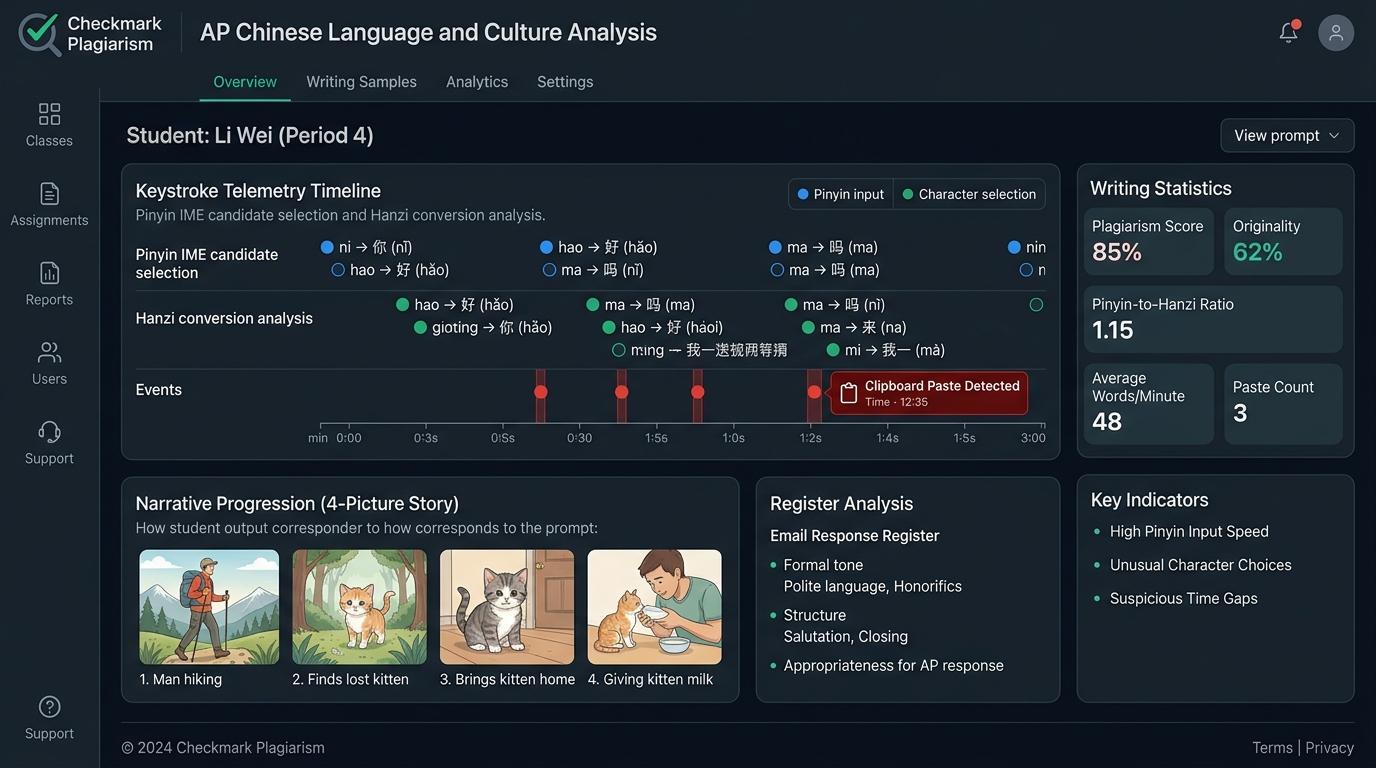
Executive Summary & Second Language Acquisition (SLA) Integrity Directive
In the Advanced Placement (AP) Chinese Language and Culture curriculum, Section II Free-Response writing tasks—Task 1: Presentational Writing (Story Narration) (15 minutes, 4 sequential line-drawing pictures) and Task 2: Interpersonal Writing (Email Response) (15 minutes, formal epistolary reply)—evaluate a high school student’s spontaneous second-language (L2) communicative competence, orthographic mastery across Chinese characters (Hanzi 汉字 / 漢字), and syntactic cohesion under strict timed conditions. In 1:1 Chromebook classrooms and learning management systems (Canvas LMS, Google Classroom, Buzz LMS), secondary Chinese teachers face an acute instructional crisis: students bypassing the essential cognitive struggle of character acquisition by inputting English prompts into Neural Machine Translation (NMT) tools like DeepL Pro or Generative AI models like ChatGPT and Claude.
Generic whole-document AI percentage detectors fail catastrophically in non-alphabetic, logographic writing systems like Chinese. They trigger aggressive false-positive flags on standard pedagogical patterns, formulaic email salutations (尊敬的李老师...), structural particles (的、得、地), and high-frequency transitional templates (首先...其次...最后) while remaining completely blind to sophisticated machine-translated prose.
To restore academic integrity without adversarial false accusations, high school world language departments must transition from opaque probability scores to transparent, process-based writing telemetry. By leveraging Checkmark Plagiarism’s patent-pending Essay Playback™ and Writing Telemetry Suite, AP Chinese educators gain granular, keystroke-by-keystroke forensic visibility into the student’s authentic composition: capturing Pinyin and Zhuyin Input Method Editor (IME) keystrokes, spacebar candidate selection cycles, homophone disambiguation pauses, lexical hesitation intervals, and external clipboard paste payloads. This objective evidentiary framework protects honest students, diagnoses developmental interlanguage gaps, and anchors restorative target-language writing conferences in undeniable pedagogical receipts.
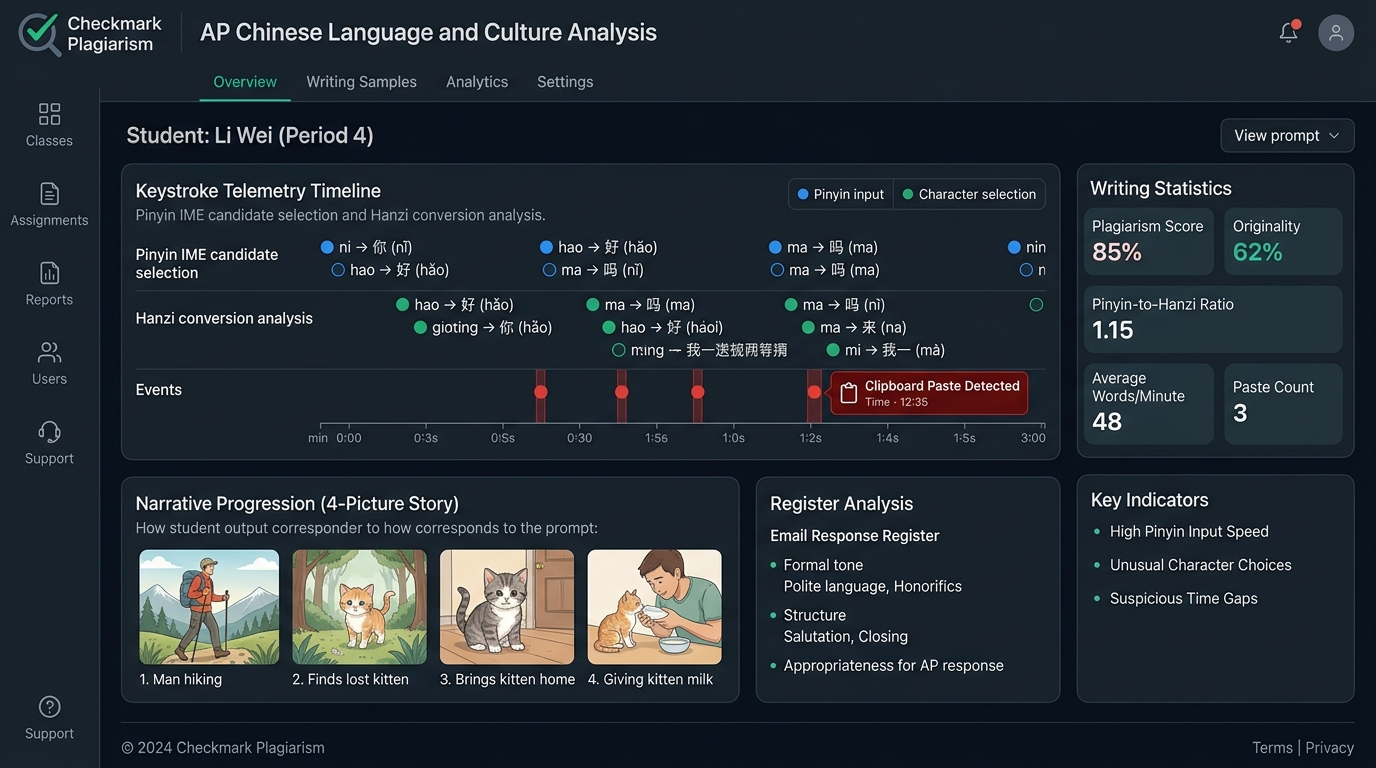
1. The High-Stakes Architecture of AP Chinese Language and Culture Section II Free-Response Writing
The College Board’s AP Chinese Language and Culture course is calibrated to the American Council on the Teaching of Foreign Languages (ACTFL) proficiency guidelines, targeting an exit proficiency level of Intermediate-Mid to Intermediate-High. The examination assesses communicative competence across the three foundational modes of communication: Interpersonal, Interpretive, and Presentational.
Section II of the AP Chinese Exam represents 50% of the total composite score and is divided into two distinct sub-sections: Part A (Writing Tasks) and Part B (Speaking Tasks). The writing tasks test whether high school students can independently negotiate Chinese orthography, maintain narrative coherence, and adhere to sociolinguistic registers without external aids under tight timed constraints.
- Task Stimulus: 4 Sequential Line-Drawing Pictures (看图写故事)
- Time Allocation: Exactly 15 Minutes Total (Planning + Drafting)
- Text Target: Complete Cohesive Narrative (150–250+ Chinese characters)
- Input Method: Pinyin / Bopomofo IME (Simplified or Traditional Characters)
- Discourse Arc: 起承转合 (Qǐ-Chéng-Zhuǎn-Hé) — Beginning, Development, Climax, Resolution
- Core Deliverables:
- Temporal progression & causal discourse markers
- Character emotions & psychological state descriptions (着急, 兴奋)
- Setting the physical environment & sensory details
- Dialogue integration with accurate quotation markers
- Target ACTFL Level: Intermediate-Mid to Intermediate-High
- Scoring: College Board 6-Point Holistic Scoring Rubric
- Task Stimulus: Formal / Semi-Formal Inbound Email (电子邮件回应)
- Time Allocation: Exactly 15 Minutes Total (Comprehension + Response)
- Text Target: Comprehensive Epistolary Reply addressing all sender queries
- Input Method: Pinyin / Bopomofo IME (Simplified or Traditional Characters)
- Register Flexibility: Honorific (您 / 尊敬的) vs. Peer (你 / 亲爱的)
- Core Deliverables:
- Formal salutation & opening politeness formulas (您好 / 见信如面)
- 2-character paragraph indentation (首行缩进两格)
- Direct, well-supported answers to all implicit & explicit inquiries
- Appropriate formal closing wishes (祝工作顺利) and signature format
- Target ACTFL Level: Intermediate-Mid to Intermediate-High
- Scoring: College Board 6-Point Holistic Scoring Rubric
Task 1: Presentational Writing — Story Narration (看图写故事 / 故事叙述)
In Task 1, students are presented with a series of four sequential stimulus pictures depicting an unfolding narrative scenario—such as a student missing a school bus, preparing a surprise birthday party for a friend, resolving a misunderstanding in a school club, or organizing a community volunteer recycling campaign:
- Timing and Pacing Constraints: The student has exactly 15 minutes to analyze the four images, outline the plot, draft the entire narrative in Chinese characters using an Input Method Editor (IME), and review their prose for grammatical and orthographic accuracy.
- Structural Narrative Imperatives: A high-scoring narrative cannot merely list static captions for each box (e.g., “Picture 1 shows a boy waking up. Picture 2 shows a clock.”). It must establish a sophisticated classical narrative arc:
- Beginning (起 - Qǐ): Setting the scene, introducing characters, establishing the temporal and physical environment.
- Development (承 - Chéng): Developing the central action, character motivations, and initial obstacles.
- Climax / Complication (转 - Zhuǎn): Introducing a plot twist, unexpected conflict, or emotional turning point.
- Resolution (合 - Hé): Providing a satisfying and logical conclusion, reflection, or moral lesson.
- Linguistic Repertoire: Upper-tier responses require varied sentence structures, vivid sensory adjectives, dialogue markers, psychological state descriptions (着急, 兴奋, 犹豫不决), and temporal cohesive devices (正当...的时候, 突然, 幸亏, 结果).
Task 2: Interpersonal Writing — Email Response (电子邮件回应)
Task 2 simulates authentic digital written communication in an academic, social, or community setting. Students receive an email from an exchange program coordinator, a teacher, a Chinese pen pal, or a student council leader containing multiple questions, proposals, and cultural context:
- Timing and Processing: Within a strict 15-minute window, the student must read and comprehend the stimulus email, identify all implicit and explicit inquiries, formulate thoughtful responses, and draft an appropriately formatted reply.
- Epistolary Conventions and Formatting:
- Formal Salutations: Proper opening address matching the social distance and hierarchy (e.g., 尊敬的李主任 [Respected Director Li], 亲爱的大生 [Dear Da Sheng]).
- Politeness and Opening Inquiries: Polite greetings (您好 / 见信如面) and acknowledgments.
- Body Paragraphs and Indentations: Standard 2-character indentation (首行缩进两格) and cohesive structural development answering all prompt requirements.
- Formal Closings and Best Wishes: Epistolary wish formulas (祝工作顺利 / 祝学习进步 / 祝身体健康) followed by formal sign-offs (此致敬礼 / 祝好).
- Signature and Date: Clear sender sign-off and proper Chinese date sequencing (Year-Month-Day: 年月日).
- Sociolinguistic Register Agility: If the sender is an elder or authority figure, the student must maintain the polite honorific pronoun 您 (nín), formal lexical choices, and indirect phrasing. If responding to a peer, the tone shifts naturally to an engaging, supportive conversational register.
The College Board 6-Point Holistic Scoring Rubric Matrix
AP Chinese Writing Benchmark| Score | Performance Level | Core Linguistic & Pedagogical Characteristics |
|---|---|---|
| 6 | Demonstrates Excellence | Full task completion; rich, precise vocabulary; varied and complex grammatical structures; seamless narrative flow; accurate orthography; culturally authentic register and idiom usage. |
| 5 | Demonstrates High Competence | Complete task completion; wide vocabulary with few minor character selection errors; cohesive transitions; highly appropriate cultural and sociolinguistic register. |
| 4 | Demonstrates Competence (Passing Benchmark) | Competent task completion (qualifying benchmark for AP credit); adequate vocabulary; generally accurate sentence structures with occasional Pinyin typos or homophone confusion; basic narrative flow. |
| 3 | Emerging Competence | Partial task completion; limited vocabulary range; frequent orthographic and grammatical errors; fragmented discourse; over-reliance on repetitive simple sentence stems. |
| 2 | Lack of Competence | Incomplete task; severe vocabulary limitations; persistent mechanical and syntactic errors impeding comprehension; frequent English or uncoverted Pinyin strings. |
| 1 | Almost No Competence | Barely connected phrases; severe lack of target vocabulary; inability to construct basic narrative or email sentences. |
| 0 | Unscorable / Off-Topic | Blank response; completely off-topic; written entirely in English or non-target alphabet. |
Connection to Speaking Tasks: The Developmental SLA Pipeline
The AP Chinese Free-Response section also encompasses Task 3: Conversation (6 turn-taking oral exchanges, 20 seconds each) and Task 4: Cultural Presentation (4 minutes preparation, 2 minutes continuous speech analyzing a specific Chinese cultural practice, product, or perspective).
Because written Story Narration (Task 1) and Presentational Speaking (Task 4) draw upon the same underlying mental lexicon, syntactic trees, and cultural schema, high school educators regularly use timed written assignments as formative scaffolding for oral performance. When a student illicitly outsources their written tasks to machine translation tools or generative AI, they bypass the neural encoding required for live, spontaneous target-language retrieval, causing severe collapse during spoken evaluations.
2. Chinese Orthography, Input Mechanics, and the Cognitive Load of IME Selection
Evaluating the authenticity of student writing in Chinese requires an intimate technical understanding of logographic orthography and digital input mechanics. Unlike alphabetic writing systems (such as English, Spanish, or French) where individual keys correspond directly to graphemes, typing in Chinese requires a multi-stage cognitive and mechanical translation pipeline.
yī jǔ liǎng dé
[ y ][ i ][ j ][ u ][ l ][ i ][ a ][ n ][ g ][ d ][ e ]
1. 一举两得 • 2. 依据两得 • 3. 一句两得
[SPACEBAR] or candidate number to commit characters to editor
2.1 Simplified vs. Traditional Characters and Pinyin/Bopomofo IMEs
Students taking AP Chinese may choose to write in either Simplified Characters (简体字) or Traditional Characters (繁体字):
Standardized in mainland China and Singapore, reducing stroke counts and structural components (e.g., 书, 学习, 电脑, 汉字, 发现). The predominant script taught in mainstream American public high school curricula.
Preserved in Taiwan, Hong Kong, and heritage overseas communities, maintaining historical radical structures (e.g., 書, 學習, 電腦, 漢字, 發現). Both scripts are fully accepted by College Board AP readers.
The primary input methods supported on AP exam computers and school Chromebooks are:
- Hanyu Pinyin (汉语拼音): Romanized phonetic typing using standard Latin QWERTY keyboards (e.g., typing
x-u-e-x-ito generate 学习 or 學習). - Bopomofo / Zhuyin (注音符号): Semi-syllabic phonetic input commonly used in Taiwan (e.g.,
ㄒㄩㄝˊ ㄒㄧˊ).
2.2 The Homophone and Polyphone Disambiguation Matrix
Because the Mandarin phonological system contains only approximately 400 distinct syllables (expanding to ~1,300 with tonal variations) to represent tens of thousands of characters, homophones (同音字 / 同音词) are ubiquitous. The digital candidate selection process is where genuine student second-language competence—and authentic developmental errors—are clearly revealed.
Critical Chinese Homophone Disambiguation Categories in AP Writing
| Category | Homophone Pairs / Triplets | Pedagogical & Orthographic Distinction |
|---|---|---|
| Third-Person Pronouns | 他 (tā) / 她 (tā) / 它 (tā) | Masculine / Generic (他) vs. Feminine (她) vs. Inanimate Object / Animal (它). Frequent candidate mis-clicks occur under time pressure. |
| Structural Particles (“The Three De’s”) |
的 (de) / 得 (de) / 地 (de) | 的: Attributive particle modifying nouns (我的书). 得: Complement particle following verbs/adjectives (跑得很快). 地: Adverbial particle preceding action verbs (认真地写). |
| Temporal / Action Adverbs | 在 (zài) / 再 (zài) | 在: Preposition / Progressive aspect (Located at / Currently doing: 在学校 / 正在看书). 再: Adverb: Again / Future repetition (明天见,再见). |
| Temporal Sequence Markers | 以后 (yǐhòu) / 已经 (yǐjīng) | 以后: Temporal marker: After / In the future (下课以后). 已经: Aspectual adverb: Already / Completed state (我已经吃过了). |
| Verbs & Actions | 戴 (dài) / 带 (dài) | 戴: Wear accessories on head/face/hands (戴帽子 / 戴眼镜). 带: Bring / Carry / Take along (带雨伞 / 带手机). |
| Seating & Transit | 坐 (zuò) / 座 (zuò) | 坐: Verb: To sit down / Ride transit (坐公共汽车 / 坐下). 座: Noun / Measure Word: Seat / Large structure (座位 / 一座山). |
| Completion vs. Play | 玩 (wán) / 完 (wán) | 玩: Verb: To play / Have fun (玩电脑游戏). 完: Resultative Verb Complement: Finished / Completed (做完了作业). |
In authentic high school student drafts, teachers routinely observe genuine developmental slips, such as typing zai and accidentally selecting 再 instead of 在, or typing de and defaulting to the attributive 的 across all syntactic contexts.
Conversely, when an essay submitted by an ACTFL Intermediate-Low student exhibits 100% flawless structural disambiguation between 的, 得, and 地 across complex compound clauses alongside flawless selection of 戴 vs 带, without a single recorded candidate correction pause in the keystroke stream, the submission carries the unmistakable signature of external machine generation.
Pinyin Candidate Selection & Homophone Hesitation Pauses
Prompt Context: “Describe getting ready in the morning and wearing your glasses.”
Student Types: [ d ][ a ][ i ] → Buffer renders candidate menu:
戴眼镜 without any preceding Latin Pinyin or candidate menu cycle events.
2.3 Syntactic Repertoire and Idiomatic Connectives
To earn scores in the 5–6 range on the AP Chinese rubric, students must demonstrate control over core syntactic structures, four-character idioms (Chéngyǔ 成语), and logical discourse markers:
- 一举两得 (yī jǔ liǎng dé) — Kill two birds with one stone; gain dual advantages.
- 半途而废 (bàn tú ér fèi) — Give up halfway; abandon effort prematurely.
- 塞翁失马 (sài wēng shī mǎ) — A blessing in disguise; misfortune turning to fortune.
- 拔苗助长 (bá miáo zhù zhǎng) — Spoil things through impetuous desire for quick results.
- 乱七八糟 (luàn qī bā zāo) — In a complete mess; totally chaotic.
- 莫名其妙 (mò míng qí miào) — Baffling; inexplicable; without rhyme or reason.
- 熟能生巧 (shú néng shēng qiǎo) — Practice makes perfect.
- 守株待兔 (shǒu zhū dài tù) — Wait passively for opportunities without making effort.
- Ba-Disposal Construction (把字句):
Subject + 把 + Object + Verb + Complement(e.g., 他把作业做完了 — He finished the homework). - Bei-Passive Construction (被字句):
Subject + 被 + (Agent) + Verb + Other Element(e.g., 自行车被小偷偷走了 — The bicycle was stolen). - Shi...de Focus Construction (是...的): Emphasizes time, place, manner of completed event (e.g., 我是昨天坐飞机来的 — It was yesterday by plane that I arrived).
- Comparative Structures (比较句):
A + 比 + B + Adj + Degree(今天比昨天冷得多) and negative comparisons with 没有 (火车没有飞机那么快). - Sequential Connectives: 首先...其次...最后 (First... Secondly... Finally).
- Additive / Concessive: 不但...而且... (Not only... but also...), 虽然...但是... (Although... nevertheless...).
3. The Acute High School Classroom Dilemma: Neural Machine Translation & LLM Infiltration
In modern high school environments where every student operates on a district-issued 1:1 Chromebook or personal laptop, the temptation to bypass target-language production during timed writing practice is severe. When students are assigned a 15-minute Story Narration or Email Response in Canvas LMS or Google Classroom, many turn to Neural Machine Translation (NMT) engines like DeepL Pro and Google Translate, or Generative AI models like ChatGPT and Claude.
Student drafts English narrative in external tab → DeepL translates to Chinese → Pastes complete 250-character block into LMS in 4 seconds.
Student prompts ChatGPT/Claude: “Write an AP Chinese 4-picture story with advanced Chengyu” → Injects hyper-literary, HSK 6 classical prose.
Student inputs prompt into smartphone translation app → Reads Chinese characters off screen → Types Latin Pinyin blindly without hesitation pauses.
3.1 Distinctive Linguistic Hallmarks of Machine-Translated and AI-Generated Chinese
When secondary educators review student submissions, machine translation and LLM text exhibit recognizable linguistic fingerprints that clash violently with the developmental capabilities of high school L2 learners:
1. Classical Chinese Syntax (Wényánwén 文言文) & Archaic Grammatical Particles
Large Language Models trained on massive historical and literary corpora frequently inject Classical Chinese grammar and archaic particles into modern colloquial writing. In an AP email task meant to reflect modern standard Mandarin (Putonghua 普通话), AI models regularly generate:
- Archaic grammatical particles: 之 (zhī as possessive or object pronoun), 乎 (hū), 者 (zhě), 也 (yě), 亦 (yì - also), 乃 (nǎi - then/is), 焉 (yān), 固 (gù), 遂 (suì), 矣 (yǐ).
- Four-character literary substitution for simple verbs: Using 不翼而飞 (bù yì ér fēi - vanished into thin air) when a student simply meant their pen dropped, or writing 余以为 (yú yǐwéi - I deem that...) instead of the standard high school 我觉得 or 我认为.
2. Literal Character-by-Character Western Idiom Calques
When students feed English idiomatic expressions into basic machine translators, the algorithms frequently generate literal, character-by-character calques that sound completely nonsensical in Chinese:
Machine Translation Idiomatic Calques vs. Authentic Mandarin Equivalents
| English Expression | Machine Translation Calque (DeepL/Google) | Authentic Mandarin Equivalent |
|---|---|---|
| “A piece of cake” | 一块蛋糕 (Literal bakery pastry) | 小菜一碟 (xiǎocài yī dié) / 易如反掌 |
| “Break a leg” | 折断一条腿 (Violent physical fracture) | 祝你演出成功 / 祝你好运 (Good luck) |
| “Cold feet” | 冰冷的脚 (Physically frozen feet) | 临阵退缩 (línzhèn tuìsuō) / 犹豫不决 |
| “Raining cats & dogs” | 下猫和狗 (Absurd animal precipitation) | 倾盆大雨 (qīngpén dàyǔ) / 下大雨 |
| “Under the weather” | 在天气下面 (Under the physical sky) | 身体不舒服 (shēntǐ bù shūfu) / 欠安 |
3. Sociolinguistic Register Incongruity
In Task 2 (Email Response), AI tools frequently mix hyper-formal imperial or diplomatic epistolary formulas into casual high school correspondence. For instance, generating 阁下 (géxià - Your Excellency), 鄙人 (bǐrén - My humble self), or 谨启 (jǐnqǐ - Respectfully presented) when writing an informal reply to a high school classmate organizing a weekend movie outing.
4. The 5-Second Whole-Text Paste
The most glaring mechanical signature is the instantaneous insertion of a complete 250-character Chinese response into the LMS text area in a single timestamped event, with zero preceding Pinyin typing keystrokes, zero spacebar candidate queries, and zero radical corrections.
3.2 Why Generic Whole-Document AI Detectors Fail Catastrophically in Chinese
Many school districts attempt to police foreign language writing using generic “black-box” AI percentage checkers (such as Turnitin AI Detector, GPTZero, or CopyLeaks). In high school Chinese education, these tools fail completely due to fundamental structural and algorithmic limitations:
Standard AI detectors are optimized for whitespace-delimited English text. In Chinese, where sentences contain no spaces between characters, tokenizer models struggle with word segmentation, producing wild perplexity and burstiness miscalculations.
AP Chinese students are explicitly taught standardized epistolary templates: 尊敬的李老师:您好!近来身体好吗? and transitional sequences: 首先...其次...最后... Because these high-frequency formulaic strings have near-zero mathematical perplexity, generic AI detectors flag them as “100% AI-Generated,” falsely accusing diligent students.
Generic AI detectors evaluate text against Generative LLM token probability distributions. When a student translates English text via DeepL Pro, the resulting Chinese characters represent human-curated translation mappings, completely bypassing AI detectors and scoring “0% AI.”
4. The High School World Language Evidentiary Matrix
To establish a defensible, objective standard of proof for high school academic integrity, world language departments must evaluate the evidentiary capabilities of different writing and verification modalities:
High School World Language Evidentiary Matrix
Comparative Integrity Analysis| Evidentiary Capability | Paper Manuscript (田字格) | Generic AI Score Detectors | Google Docs Version History | Checkmark Playback™ |
|---|---|---|---|---|
| Chinese IME Pinyin Keystroke Capture | ✗ Not Applicable (Handwritten) | ✗ No IME Data (Black-box score) | ✗ Collapsed into snapshots | ✓ Captures raw Latin Pinyin stream |
| Candidate Selection Pause Logging | ✗ Not Applicable | ✗ Invisible | ✗ Invisible | ✓ Logs candidate dropdown pauses |
| External Clipboard Paste Buffer Trace | ✗ Not Applicable | ✗ Invisible | ∼ Partial (Bulk char count only) | ✓ Preserves exact raw text payload |
| Homophone Correction Proof (的/得/地, 在/再) | ∼ Visible as ink cross-outs | ✗ Completely Blind | ✗ Overwritten in final render | ✓ Replays radical & homophone fixes |
| Drafting Cadence & Hesitation Analysis | ✗ No Timing Data | ✗ No Velocity Metrics | ✗ Sparse 5–10 min intervals | ✓ Keystroke millisecond precision |
| Defense Against DeepL & Machine Translation | ∼ In-class proctoring only | ✗ 0% Detection on NMT | ∼ Detects paste but no origin text | ✓ Exposes 0-pinyin instant pastes |
| Teacher Rubric Autograding Integration | ✗ Manual grading only | ✗ No Rubric Tools | ✗ No Grading Tools | ✓ Anchored directly to AP rubric quotes |
| Student Privacy & Data Protection | ✓ 100% FERPA/COPPA | ∼ Vendors often train on essays | ∼ District GSuite enterprise | ✓ 100% Zero Retention Guarantee |
5. Step-by-Step Chinese Teacher Audit Protocol
When evaluating timed AP Chinese Story Narrations or Email Responses, secondary educators need a consistent, pedagogical, and restorative 5-step investigative workflow. This protocol moves systematically from linguistic register analysis to keystroke forensics and restorative target-language dialogue.
5-Step Restorative AP Chinese Integrity Audit Protocol
Step 1: Linguistic Register & Pinyin-IME Candidate Concordance Audit
Compare the submitted vocabulary and syntax against the student’s historical ACTFL baseline. Flag advanced HSK 6 structures, Classical particles (之乎者也), or anomalous 100% perfection on homophones (的/得/地) that sharply diverge from classroom performance.
Step 2: Narrative Coherence and Cultural Perspective Sanity Checks
In Task 1 (Story Narration), verify that the response accurately describes the 4 stimulus line drawings without AI hallucinations. In Task 2 (Email Response), confirm that all specific inquiries from the sender are answered in the appropriate honorific register (您 vs 你).
Step 3: Analyzing Keystroke Dynamics with Essay Playback™
Scrub the drafting timeline at 4x–8x replay speed. Verify active Pinyin keystroke streams (k-a-n-d-i-a-n-y-i-n-g) and candidate lookup pauses (400–1200ms). Differentiate organic drafting from mechanical device transcription (unbroken 70+ WPM typing with 0 candidate pauses).
Step 4: Inspecting External Paste Buffer Payloads
Checkmark’s paste inspector archives the complete raw clipboard payload. Review whether the student inserted machine-translated text all at once and track any subsequent cosmetic edits or character substitutions designed to camouflage the paste.
Step 5: Conducting Supportive Restorative Target-Language Oral Debriefs
Host a supportive writing conference. Ask the student to read their submitted Hanzi aloud, explain Pinyin tones and Chengyu meanings, and spontaneously retell the 4-picture story in spoken Mandarin. Provide a structured, proctored rewrite opportunity if translation tools were used.
[00:12] Type: z-h-o-n-g-w-e-n (520ms)
→ IME Candidate Menu → [Pause: 850ms] → Select: 中文
[00:14] Type: k-e (180ms) → Select: 课
[00:15] Type: h-e-n (190ms) → Select: 很
[00:16] Type: y-o-u-y-i-s-i → Typo: "yisi" vs "yisi"
→ Backspace x3 → Type: y-i-s-h-i
→ [Pause: 1100ms] → Select: 有意思
Result: “中文课很有意思” (Natural cadence + editing)
[00:00 – 04:15] Idle document state (0 keystrokes)
[04:16] EXTERNAL PASTE: +248 characters (12ms)
[04:18] Student deletes 4 characters, changes 阁下 to 老师
[04:22] Document submitted. Total active time: 6s
Result: Classical syntax injection via clipboard
6. How Checkmark Plagiarism Powers Authentic AP Chinese Instruction
Checkmark Plagiarism delivers a purpose-built academic integrity and assessment suite tailored specifically to the unique orthographic and pedagogical demands of secondary world language education:
Underlines individual sentences and paragraphs directly in the essay viewer with calibrated confidence sliders. Differentiates between authentic email openings (尊敬的李老师:您好!) and AI-generated body paragraphs containing anomalous Classical Chinese particles (之乎者也).
Reconstructs the student’s entire drafting session like a high-definition video. Captures raw Latin Pinyin keystrokes, candidate lookup dropdowns, homophone selection pauses, and radical backspace corrections in both Simplified and Traditional characters.
Preserves the exact text payload copied from DeepL, Google Translate, or ChatGPT, even if the student spent 10 minutes modifying individual characters afterward. Includes a one-click “Jump-to-Playback” button.
Autogrades Story Narrations and Email Responses against the College Board’s official 6-point holistic rubric. Every point recommendation is substantiated by direct quotes from the student’s Chinese text. 1-click grade passback to Canvas, Buzz, and Google Classroom.
High school student Chinese essays, Pinyin keystrokes, and diagnostic telemetry are never cached or ingested to train commercial LLM models. Full data encryption in transit (TLS 1.3) and at rest (AES-256) with seamless district Google Workspace & Microsoft Azure SSO integration.
7. High School Classroom Case Scenarios
The following realistic high school scenarios demonstrate how process-based writing telemetry resolves complex integrity challenges in AP Chinese classrooms.
AP Chinese Classroom Case Scenarios Overview
| Scenario | Task & Student Level | Presented Integrity Crisis | Telemetry Resolution |
|---|---|---|---|
| Case 1 | Grade 11 AP Chinese Task 1: Story Narration (ACTFL Inter-Low) |
Flawless 4-picture story submitted in 3 minutes with HSK 6 classical idiom (物归原主). | Essay Playback™ exposes a single 274-char DeepL paste. Restorative rewrite held; authentic Score 4 earned. |
| Case 2 | Grade 12 AP Chinese Task 2: Email Response (ACTFL Inter-Mid) |
Generic AI detector flags 84% AI on formulaic email greetings and textbook transitions. | Playback logs 13m42s of active Pinyin typing, candidate pauses, and 戴/带 corrections. Fully exonerated with Score 6. |
| Case 3 | Grade 10 Pre-AP Chinese Timed Cultural Write (ACTFL Novice-High) |
Student manually copied translated text off propped smartphone during in-class session. | Keystroke dynamics reveal 72 WPM mechanical typing with zero candidate pauses on 赏月品茗. Restorative rewrite. |
Case Scenario 1: 11th Grade AP Chinese Story Narration (Task 1) — Machine-Translated Paste vs. Restorative Revision
An 11th-grade AP Chinese class at a suburban public high school with 1:1 Chromebooks.
15-minute timed Story Narration based on a 4-picture prompt depicting a student who accidentally brought the wrong backpack to school, found soccer gear instead of textbooks, and resolved the dilemma with a classmate.
A student with a historical ACTFL Intermediate-Low profile submitted a 280-character composition within 3 minutes of the assignment opening. The text featured flawless syntax, complex resultative complements, and the Classical Chinese idiom 物归原主 (wù guī yuán zhǔ - return property to its original owner) alongside archaic particles (遂将书包换之).
• Minute 01:14: External Paste Inspector logged +274 characters inserted in 18ms.
• Remaining 90s: Student made only two minor cosmetic edits (changing 同学 to a name).
• Preserved clipboard payload matched DeepL Pro translation of English outline.
Case Scenario 2: 12th Grade AP Chinese Email Response (Task 2) — False AI Flag Overturned by IME Candidate Telemetry
A 12th-grade AP Chinese Language and Culture student applying to competitive universities.
15-minute timed Email Response replying to an inquiry from a host family in Beijing regarding dietary preferences, arrival dates, and weekend excursion interests.
The district’s generic AI checker flagged the submission as “84% AI-Generated.” The school’s academic integrity coordinator initiated a referral, suspecting ChatGPT assistance due to the low perplexity of the email’s structural transitions.
• Total Active Time: 13 minutes and 42 seconds of continuous, active composition.
• Pinyin Stream: 512 Latin keystrokes (z-u-n-j-i-n-g-d-e, n-i-n-h-a-o, y-i-f-a-n-g-m-i-a-n).
• Candidate Hesitations: Pauses averaging 650ms on homophone selections (deliberating 在 vs 再).
• Radical Fix: At 08:20, typed d-a-i, mistakenly selected 带, paused 2.1s, backspaced, and chose 戴 for 戴眼镜.
• Zero clipboard paste events across the entire 15-minute session.
Case Scenario 3: 10th Grade Pre-AP Chinese Timed Write — Device Transcription Detected via Zero-Hesitation Retyping
A 10th-grade Pre-AP Chinese classroom conducting an in-class timed writing practice.
20-minute cultural synthesis paragraph explaining the significance of the Mid-Autumn Festival (中秋节) and mooncakes (月饼).
A student submitted an extraordinarily sophisticated 220-character essay containing no paste events in Google Docs, but the teacher noticed the student had kept their smartphone partially propped beneath their desk.
• Unbroken Mechanical Typing: Continuous typing velocity of 72 WPM with 0 pauses exceeding 300ms.
• Absence of Candidate Hesitations: Selected correct candidate numbers under 80ms per selection across complex idioms (花好月圆, 阖家团圆, 赏月品茗).
• Zero Phonetic Typos or Backspaces: Over 220 characters, 0 backspaces were recorded.
8. Frequently Asked Questions (FAQs)
Q1: How does Checkmark differentiate between authentic Pinyin typing and machine translation pasting?
Checkmark’s patent-pending Essay Playback™ logs the complete underlying keystroke stream. When a student types organically using a Pinyin or Zhuyin IME, Checkmark records the Latin keystrokes (e.g., n-i-h-a-o), the candidate lookup window event, and the cognitive selection pause (typically 400–1200ms) before the character is committed. In contrast, machine-translated text from DeepL or Google Translate enters the document as an instantaneous external clipboard paste payload with zero preceding Pinyin keystrokes.
Q2: Why do generic AI detectors flag standard AP Chinese email greetings and transitions as AI-generated?
Generic whole-document AI detectors rely on statistical language models that measure perplexity (word unpredictability) and burstiness (sentence structure variation). AP Chinese students are specifically trained to employ formulaic epistolary structures (e.g., 尊敬的..., 见信如面, 首先...其次...最后, 祝身体健康,工作顺利, 此致敬礼). Because these standard pedagogical templates have extremely low mathematical perplexity, generic AI detectors misidentify them as AI-generated text, creating severe false-positive risks for honest students.
Q3: Can Checkmark detect students writing in Traditional Chinese characters (繁体字) as effectively as Simplified characters (简体字)?
Yes. Checkmark’s linguistic analysis and keystroke telemetry engines natively support both Simplified Chinese (简体字) and Traditional Chinese (繁体字), as well as both Hanyu Pinyin and Bopomofo / Zhuyin (注音符号) input methods. The system tracks candidate conversions, homophone selections, and stroke structures identically across both orthographic systems.
Q4: How does Checkmark detect when a student manually retypes Chinese characters from a phone or second screen?
When a student manually transcribes translated text from a secondary device, they do not undergo authentic L2 cognitive retrieval. Checkmark’s keystroke dynamics engine detects this through Transcription Signatures: steady, continuous mechanical typing without natural thinking pauses (60–80 WPM), instantaneous candidate number selection (under 100ms) without visual scanning pauses, and an unnatural absence of backspaces or phonetic Pinyin typos across multi-clause sentences.
Q5: Does Checkmark store student Chinese essays or use them to train commercial AI models?
No. Checkmark operates under a strict Zero Model Training Policy and is fully compliant with FERPA (Family Educational Rights and Privacy Act) and COPPA (Children’s Online Privacy Protection Act). Student writing, Pinyin keystrokes, and diagnostic telemetry are encrypted in transit and at rest and are never sold, shared with third parties, or ingested into public LLM training datasets.
Q6: How does Checkmark’s AI Rubric Autograder assist AP Chinese teachers with heavy grading loads?
Grading 120–160 timed Chinese free-response tasks by hand takes entire weekends. Checkmark’s AI Autograder generates first-draft evaluations scored directly against the College Board’s 6-point holistic AP rubric (evaluating Task Completion, Language Use, Delivery, and Cultural Appropriateness). Every suggested score is accompanied by written justifications tied to direct quotes from the student’s Chinese prose. All grades remain drafts until reviewed, edited, and approved by the teacher, and finalized scores push directly into Canvas LMS, Buzz LMS, or Google Classroom gradebooks with one click.
Q7: What is the recommended procedure for conducting a restorative conference with a student suspected of using machine translation?
World language integrity conferences should always be supportive, diagnostic, and restorative rather than punitive: open with objective Essay Playback™ telemetry, conduct an oral reading check verifying pronunciation and Chengyu understanding, emphasize how machine translation stunts oral exam retrieval, and provide a structured proctored rewrite opportunity to demonstrate genuine competence.
9. Conclusion: Empowering Authentic Language Acquisition
Mastering Chinese as a second language is one of the most intellectually rewarding yet demanding journeys a high school student can undertake. The cognitive struggle of memorizing radicals, navigating homophones, and weaving narrative flow across 起承转合 is precisely where genuine bilingualism is forged.
When secondary educators rely on opaque, black-box AI percentage detectors, they risk falsely accusing diligent students who use standard email templates while remaining blind to students who copy from DeepL or ChatGPT. By adopting Checkmark Plagiarism’s transparent writing telemetry, patent-pending Essay Playback™, and teacher-controlled rubric autograding, high school AP Chinese teachers can protect honest writers, hold restorative and evidence-backed conferences, and ensure that every student’s journey toward target-language mastery is authentic, defensible, and celebrated.
Bring Keystroke Telemetry to Your World Language Department
Protect authentic Chinese writing, eliminate false AI accusations on AP templates, and streamline 6-point rubric scoring with direct Canvas LMS and Google Classroom passback.