
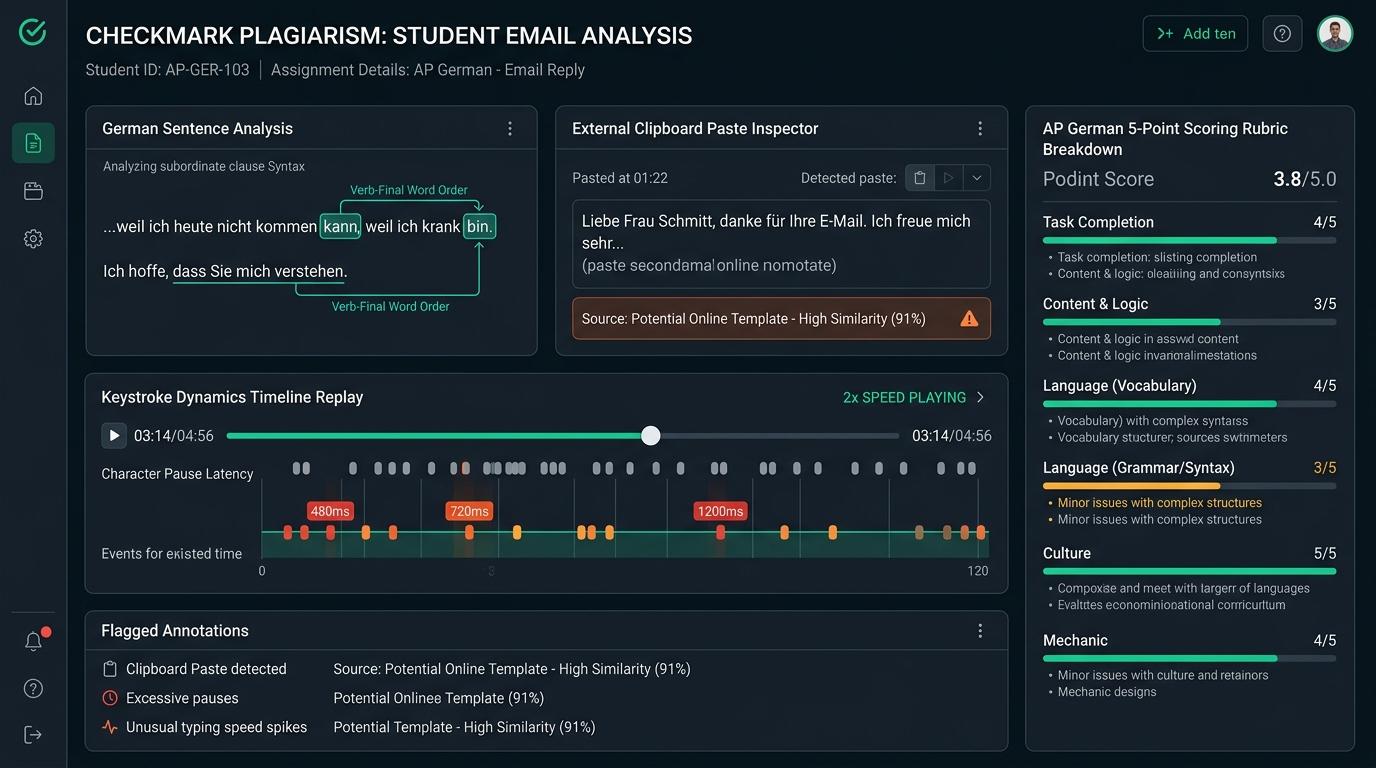
Executive Summary & SLA Integrity Directive
Evaluating student writing in the Advanced Placement (AP®) German Language and Culture classroom presents one of the most acute challenges in secondary World Language education. With high school students drafting on 1:1 Chromebooks, Google Docs, and Canvas LMS, the boundary between authentic second-language (L2) acquisition and unauthorized digital translation—ranging from Neural Machine Translation (DeepL, Google Translate) to generative Large Language Models (ChatGPT, Claude)—has become critically obscured.
Generic whole-document AI text detectors fail catastrophically in German: they trigger routine false-positive flags on formulaic, memorized epistolary greetings (Sehr geehrte Frau Dr. Weber, Ich bedanke mich im Voraus für Ihre Unterstützung, Mit freundlichen Grüßen) while remaining completely blind to machine-translated German syntax. Authentic high school German writing is fundamentally characterized by temporal drafting friction, cognitive hesitation pauses at subordinating conjunctions (weil, dass, obwohl, wenn), active verb-final repositioning edits (Verb-Letzt-Stellung), and special character input dynamics (ä, ö, ü, ß).
By integrating German syntactic error analysis with Checkmark Plagiarism’s patent-pending Essay Playback™, External Paste Buffer Inspector, and AP-aligned rubric autograding, high school AP German teachers and department chairs can replace opaque guesswork with verifiable, defensible writing process telemetry—protecting honest students, upholding AP exam rigor, and fostering authentic linguistic proficiency.
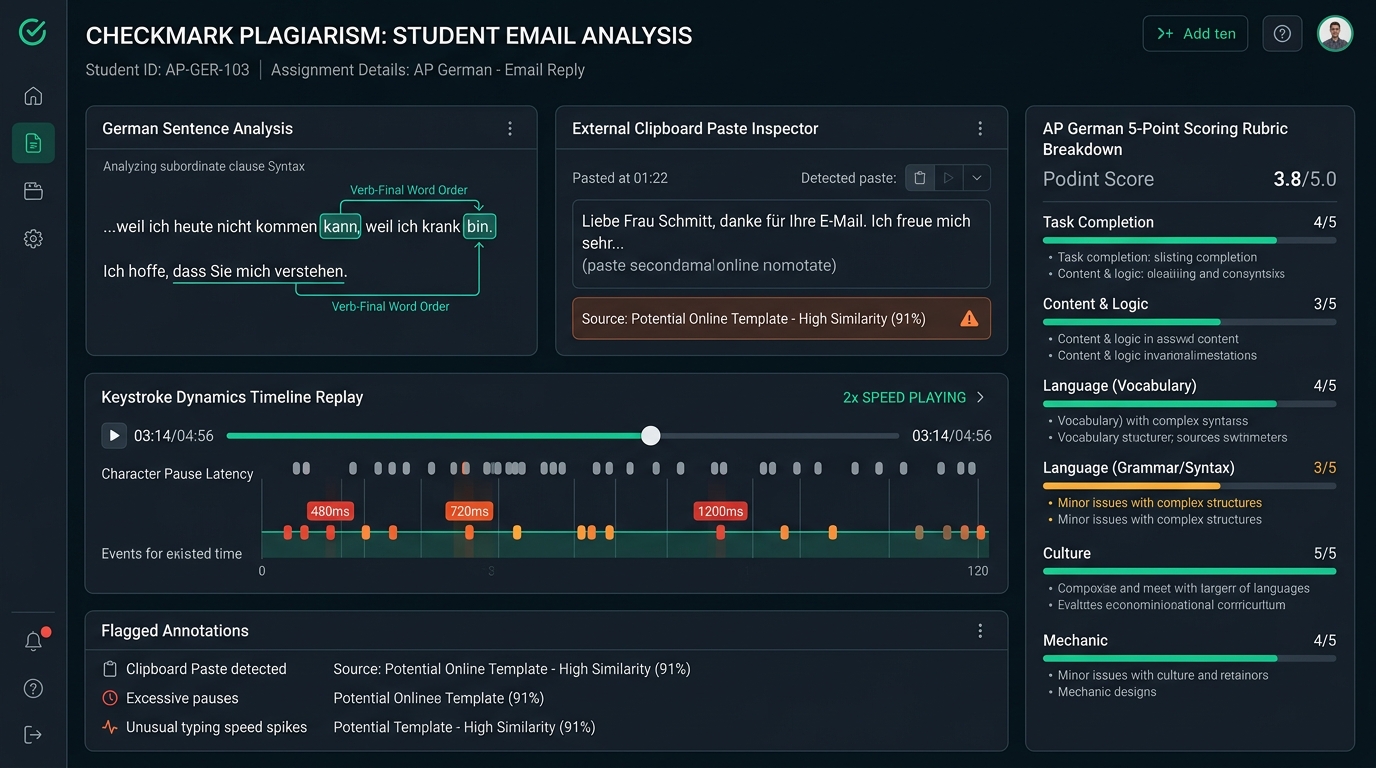
1. The High School AP German Digital Writing Dilemma on 1:1 Chromebooks
High school AP German Language and Culture educators face a demanding instructional reality. Under the College Board curriculum framework, students are expected to demonstrate language proficiency across the interpersonal, interpretive, and presentational modes of communication, targeting the ACTFL Intermediate-Mid to Intermediate-High benchmarks.
However, the widespread deployment of 1:1 district Chromebooks, Google Docs, Canvas SpeedGrader, Schoology, and Buzz LMS has introduced severe vulnerabilities into high school world language writing assessments:
- Character-by-Character Flow: Organic keystroke stream with natural intra-word typing rhythms.
- Conjunction Hesitations: Observable 1.2–3.5s cognitive pauses at weil, dass, obwohl, wenn.
- Verb Repositioning Edits: Verb initially typed in SVO, deleted, and moved to clause termination.
- Keyboard Accent Friction: Alt-code or dead-key latencies on ä, ö, ü, ß.
- Developmental Lexicon: ACTFL Intermediate-Mid vocabulary with occasional case errors.
- English Prompt Injection: Student writes English prompt in DeepL, ChatGPT, or Claude.
- Instantaneous Clipboard Paste: Single 140-word German text block injected in 0.8 seconds.
- Hyper-Formal Bureaucratic Register: Behördendeutsch and Kanzleideutsch idioms.
- Flawless Nested Passives: Multi-clause passives with modals beyond student oral level.
- Missing Temporal History: Zero prior character evolution or syntactic struggle recorded.
The Cognitive Friction of Second-Language German Syntax
For native English speakers in secondary German courses, internalizing German word order represents one of the steepest developmental hurdles. While English relies on a rigid Subject-Verb-Object (SVO) structure across both independent and dependent clauses, German operates under strict syntactic rules:
- Main Clauses (Hauptsätze): The conjugated verb must occupy the Verb-Second (V2) position.
- Subordinate Clauses (Nebensätze): When introduced by a subordinating conjunction (such as weil, dass, obwohl, wenn, da, damit, or während), the conjugated verb is pushed to the Verb-Final (Verb-Letzt) position.
When a high school sophomore or junior composes in German in real time, their cognitive drafting process mirrors this structural shift:
- The student begins drafting the subordinate clause using English SVO intuition (“weil ich habe keine Zeit...”).
- The student catches the syntactic error, pauses for 1,200–3,000 milliseconds, hits backspace 15 times to erase the auxiliary verb habe, types the predicate and direct object, and places habe at the absolute end of the clause (“weil ich keine Zeit habe”).
- Alternatively, the student uses the mouse or arrow keys to highlight the misplaced verb, cuts it, and pastes it at the clause termination.
The Rise of Neural Machine Translation and Generative LLMs
When students encounter the time pressure of a 15-minute AP Interpersonal Email task, the temptation to open a split-screen tab or secondary browser window for DeepL Translator, Google Translate, or an LLM like ChatGPT or Claude is acute.
Unlike early statistical machine translation tools that generated awkward, literal word-for-word substitutions, modern Neural Machine Translation (NMT) produces syntactically flawless German. In fact, NMT tools frequently produce hyper-formal bureaucratic German (Behördendeutsch or Kanzleideutsch), embedding complex nested relative clauses, passive constructions with modal verbs (Passiv mit Modalverben), and specialized vocabulary (“diesbezüglich”, “in Erwägung ziehen”, “zur Kenntnis nehmen”) that far exceed the developmental capacity of a high school AP student.
The Failure of Generic AI Text Detectors
When high school teachers submit these essays to generic, whole-document AI text detectors, the software fails on two fronts:
1. The Epistolary False-Positive Trap
Generic detectors evaluate text using statistical perplexity (word unpredictability) and burstiness (sentence length variation). Standard AP German email formulas taught in every classroom (“Sehr geehrte Frau Schmidt, ich bedanke mich herzlich für Ihre E-Mail vom 12. Oktober...”) have exceptionally low perplexity, causing the detector to flag completely honest student writing as “90%+ AI-Generated.”
2. The DeepL Blind Spot
DeepL and modern translation engines translate human-written English sentences into human-like German syntax, producing natural perplexity patterns that completely evade static LLM detectors.
To resolve this crisis, educators need an objective evidentiary framework grounded in writing process telemetry and keystroke replay.
2. Anatomy of College Board AP German Language and Culture Section II: Part A
The Free-Response section of the AP German Language and Culture Exam constitutes 50% of the total composite score. Part A evaluates written interpersonal and presentational communication through two distinct, rigorously timed tasks.
- Official German Designation: E-Mail-Antwort
- Weight on Composite Score: 12.5% of Total Exam
- Target Output Length: ~100–150 words
- Prescribed Register: Strict Formal Register (Formelle Anrede: Sie, Ihnen, Ihr)
- Required Components:
- Formal salutation (Sehr geehrte(r) Frau/Herr...)
- Courteous opening / acknowledgment of context
- Direct answers to ALL questions in the stimulus email
- Proactive request for further information/clarification
- Formal closing & sign-off (Mit freundlichen Grüßen)
- Official German Designation: Argumentativer Aufsatz
- Weight on Composite Score: 15% of Total Exam
- Target Output Length: 300–400+ words
- Required Source Integration:
- Quelle 1: Print Article / Text (Lesetext)
- Quelle 2: Chart, Table, or Graph (Grafik/Tabelle)
- Quelle 3: Audio Track / Podcast / Interview (Hörtext)
- Required Components:
- Defensible central thesis on AP German cultural theme
- Synthesis and attribution of all 3 sources (Laut Quelle 1)
- Advanced syntactic variety (Nebensätze, Konjunktiv II)
- Structured paragraph transitions and conclusion
Task 1: The 15-Minute Interpersonal Email (E-Mail-Antwort)
In Task 1, students receive a formal incoming email from a German-speaking organization, business, school coordinator, or exchange host (e.g., Der Leiter des Jugendumweltprojekts, Die Leiterin des Internationalen Austauschbüros, or Der Geschäftsführer eines Berliner Start-ups).
The student has exactly 15 minutes to read the prompt, formulate an appropriate response, and type the entire message. The response must satisfy five non-negotiable criteria:
- Maintain Consistent Formal Register: Use formal address (Sie, Ihnen, Ihr, Ihre) with mandatory capitalization. Any slip into informal pronouns (du, dich, dir, dein) drops the task performance score.
- Apply Appropriate Epistolary Formulas: Open with correct gender-inflected greetings (Sehr geehrte Frau Müller, Sehr geehrter Herr Dr. Schneider) and close with professional sign-offs (Mit freundlichen Grüßen).
- Address All Prompt Queries: Provide detailed, culturally appropriate responses to every question asked in the stimulus email.
- Formulate a Follow-Up Inquiry: Ask at least one proactive, contextually relevant question requesting further clarification or logistical details (“Könnten Sie mir bitte mitteilen, wann die erste Informationsveranstaltung stattfindet?”).
- Demonstrate Syntactic Range: Deploy subordinate clauses (weil, da, obwohl, wenn), modal verbs, and subjunctive structures (Konjunktiv II) to express polite requests.
Structural Breakdown of a High-Scoring (5/5) AP German Email Reply
Sehr geehrte Frau Dr. Schneider,
ich bedanke mich herzlich für Ihre E-Mail und die Einladung zum Jugendumweltprojekt in Freiburg.
Was meine Verfügbarkeit betrifft, kann ich im Juli teilnehmen, weil ich mich sehr für erneuerbare Energien interessiere. Obwohl ich noch keine praktische Erfahrung habe, möchte ich gern bei der Solaranlagen-Installation helfen.
Könnten Sie mir bitte mitteilen, ob eine Unterkunft vor Ort für die Schüler organisiert wird?
Mit freundlichen Grüßen,
Maya K.
The 15-Minute Telemetry Equation
In a 15-minute timed environment, an authentic student composing a 120-word email writes at an average rate of 8 to 12 words per minute (WPM). This includes reading time, planning, active typing, vocabulary retrieval pauses, grammar self-corrections, and final proofreading.
When writing process telemetry reveals that a student produced 0 keystrokes for 13 minutes and 45 seconds, followed by a single 130-word paste event taking 1.2 seconds, the teacher is not looking at authentic language acquisition—they are observing external clipboard insertion.
3. German Syntax & Grammar Mechanics: L2 Cognitive Load vs. AI Translation Signatures
To distinguish authentic student drafting from machine translation, educators must understand the specific syntactic mechanics of German and how they manifest in keystroke dynamics.
1. Subordinate Clauses (Nebensätze) & Verb-Final Position (Verb-Letzt-Stellung)
Conjunction typed → Cognitive pause (1.5–3.0s) → Subject typed → Verb initially typed in V2 position → Backspaced 10–18 times → Verb moved to clause termination.
Zero hesitation. Multi-clause verb-final syntax produced in a single unbroken burst or instant paste without intermediate syntactic repositioning.
2. Separable Prefix Verbs (Trennbare Verben — e.g., vorbereiten, stattfinden)
Main clause: Prefix typed attached to verb, erased, and moved to end. Nebensatz: Hesitation on whether to split or keep intact (..., weil die Konferenz stattfindet).
Flawless splitting in main clauses (Ich bereite mich vor) and recombination in subordinate clauses with zero trial-and-error edits.
3. Subjunctive Mood (Konjunktiv II) in Polite Requests
Targeted würde + Infinitiv or common modal forms (könnte, hätte, wäre) with occasional umlaut retrieval pauses.
Archaic or hyper-formal passive subjunctives (hätte berücksichtigt werden müssen, es gereichte mir zur Ehre) characteristic of Kanzleideutsch.
4. Two-Way Prepositions (Wechselpräpositionen: an, auf, in, über...)
Frequent case confusion: “in dem Zimmer” (Dative/Location) vs. “in das Zimmer” (Accusative/Motion) with visible backspacing over article endings.
Flawless case assignment reflecting abstract nuances (“bezugnehmend auf Ihr geschätztes Schreiben”) without cognitive pause.
5. Umlauts & Special Character Input (ä, ö, ü, ß)
Visible 300–800 ms latency spikes on ä, ö, ü, ß caused by Alt-codes, US-International dead-keys (" + vowel), or ChromeOS long-press menus.
Instantaneous character insertion with 0 ms inter-key latency identical to standard ASCII text dumps.
The Keystroke Signature of Authentic Nebensatz Drafting
Consider an authentic high school student attempting to write:
“Ich möchte an dem Projekt teilnehmen, weil ich mich sehr für den Umweltschutz interessiere.”
(I would like to participate in the project because I am very interested in environmental protection.)
In authentic drafting telemetry, this sentence unfolds in distinct cognitive stages:
- Clause 1 Drafting: Student types
“Ich möchte an dem Projekt teilnehmen,”with steady cadence (~140 CPM). - Conjunction Hesitation: Student types
“ weil”followed by a 2,400 ms pause as they plan the dependent clause. - SVO Interference & Correction:
- Student types:
“ weil ich interessiere mich” - Student pauses (1,800 ms), realizes the verb is in V2 position instead of verb-final.
- Student hits Backspace 17 times to erase
“interessiere mich”. - Student types:
“ mich sehr für den Umweltschutz interessiere.”
- Student types:
- Preposition/Case Check: Student pauses at
“für den Umweltschutz”to verify that für takes the accusative case (den masculine).
4. The AP 5-Point Scoring Rubric & Why Generic AI Detectors Fail in World Language
The College Board evaluates AP German Section II free-response tasks using a 5-point holistic scoring rubric. Understanding this rubric reveals why generic AI detectors are fundamentally misaligned with world language pedagogy.
| Score | AP Designation | Linguistic & Task Performance Characteristics |
|---|---|---|
| 5 | Strong | Fully addresses all prompt requirements with rich elaboration. Consistent, fully maintained formal register (Sie/Ihnen/Ihr). Varied, sophisticated vocabulary and high syntactic variety. Minor errors do not impede comprehensibility. |
| 4 | Good | Addresses all prompt requirements with adequate elaboration. Generally consistent formal register with rare minor lapses. Good vocabulary range and control of complex structures (Nebensätze). Occasional errors in verb agreements or case declensions. |
| 3 | Fair (Competent) | Addresses most prompt requirements; elaboration is basic or limited. Inconsistent formal register (occasional slips into du/dein). Basic vocabulary; simple sentences predominate; Nebensatz word order errors. |
| 2 | Weak | Partially addresses requirements; misunderstands key prompt elements. Inappropriate register; pervasive informal forms. Very limited vocabulary; heavily reliant on English syntax patterns. Constant grammatical breakdowns. |
| 1 | Poor | Fails to address prompt; minimal target language production. Unintelligible or disconnected words; no coherent sentence syntax. |
| 0 | Non-Scorable | Blank, written in English, off-topic, or mere restatement of prompt. |
The Static AI Detector Paradox in AP German
Authentic Student Memorized Formula
“Sehr geehrte Damen und Herren, ich bedanke mich herzlich für Ihre E-Mail. In Bezug auf Ihre Frage möchte ich...”
Detector Logic: Formula has near-zero perplexity.
Result: “92% AI-Generated” (Critical False Positive!)
DeepL-Translated Full German Draft
“Bezugnehmend auf Ihre Mitteilung beehre ich mich mitzuteilen, dass mir fundierte Fachkenntnisse eigen sind...”
Detector Logic: Natural human-like perplexity distributions.
Result: “0% AI-Generated (100% Human)” (Critical False Negative!)
5. The High School World Language Evidentiary Matrix
To evaluate student writing fairly and maintain defensible academic integrity standards, secondary World Language departments require a robust comparative evidentiary framework.
| Evidentiary Dimension | In-Class Handwritten Timed Writes | Generic AI Detectors (Whole-Doc %) | Google Docs Version History | Checkmark Telemetry & Essay Playback™ |
|---|---|---|---|---|
| Temporal Process Capture | None (Static final paper artifact). | None (Static text string evaluation). | Coarse periodic snapshots (every 2–10 min). | Granular keystroke telemetry with millisecond timestamps. |
| Verb-Final Subordinate Movement | Inferred via crossed-out ink corrections. | Completely invisible; evaluates only final text. | Collapses intermediate edits into single block. | Reconstructs full sequence: pause → V2 draft → backspace → end. |
| External Paste Payload Inspection | N/A (Physical paper environment). | Completely unaware of clipboard operations. | Marks large paste as added text; cannot view payload. | Captures exact pasted text, timestamp, and preserves raw payload. |
| Special Character Input Dynamics | Natural physical penmanship. | Indifferent to character input mechanics. | Cannot differentiate direct typing from pasted characters. | Tracks keyboard latencies on ä, ö, ü, ß vs instant paste. |
| Epistolary Formula Protection | Graded on rubric merit. | Severe false-positive risk on AP email greetings. | Shows text added; no perplexity context. | Exonerates formulas by proving manual keystroke typing. |
| LMS & AP Rubric Autograding | Manual paper grading; zero LMS automation. | None; isolated third-party percentage report. | None; standalone Google Workspace. | Direct LTI 1.3 Canvas/Buzz passback with quote-anchored rubrics. |
| Parent & Honor Board Defensibility | Subjective teacher judgment. | Indefensible black-box percentage score. | Ambiguous and easily disputed by parents. | Indisputable, video-like visual proof scrubbable at 1x–8x. |
6. Step-by-Step German Teacher Audit Protocol for Timed Email Tasks
When evaluating digital AP German email submissions, high school educators and department chairs should follow this systematic 5-phase forensic and pedagogical audit protocol:
Phase 1: Linguistic Register & Formal Sie Concordance Audit
Scan for formal Sie/Ihnen/Ihr consistency. Check whether capitalized pronouns are maintained throughout. Look for accidental slips into informal du/dein (indicating authentic L2 drafting) or archaic legalisms (indicating an LLM prompted for “formal German”).
Phase 2: Verb-Final Subordinate Clause Syntax Sanity Check
Highlight every subordinate clause introduced by weil, dass, obwohl, wenn, da, damit, or während. Check whether all conjugated finite verbs occupy the final position and whether separable prefixes are consolidated properly (..., weil das Treffen am Freitag stattfindet).
Phase 3: Essay Playback™ Keystroke Dynamics Audit
Scrub the timeline at 2x–4x speed. Verify typing velocity (80–180 CPM is standard L2). Verify cognitive hesitation pauses (1.2–3.5s) following subordinating conjunctions. Check for natural backspacing over V2 verbs and special character keyboard latency spikes on ä, ö, ü, ß.
Phase 4: External Paste Buffer & Payload Inspection
Inspect timestamped clipboard insertions. Checkmark preserves the exact original clipboard content even if the student spent 45 seconds deleting two words or changing an adjective ending to disguise the paste.
Phase 5: Restorative Target-Language Oral Conferencing
Conduct a 5-minute supportive interview in German asking the student to explain clause choices. Review the Essay Playback timeline collaboratively to shift the dynamic from punitive accusation to formative linguistic coaching.
Sample German Teacher-Student Restorative Dialogue
Herr Becker (Teacher): “Hallo Jonas. Ich habe mir deine E-Mail-Antwort für das Jugendumweltprojekt angesehen. Du hast einige sehr komplexe Nebensätze verwendet, zum Beispiel: ‚Zur Vermeidung etwaiger Missverständnisse bezüglich der Durchführbarkeit beabsichtige ich, diesbezüglich Rücksprache zu halten.‘ Kannst du mir auf Deutsch erklären, was dieser Satz bedeutet und warum du ‚diesbezüglich‘ gewählt hast?”
(Hello Jonas. I looked at your email reply for the youth environmental project. You used some very complex subordinate clauses, for example: [reads complex sentence]. Can you explain to me in German what this sentence means and why you chose 'diesbezüglich'?)
Jonas (Student): “Ähm... es bedeutet... like, I want to avoid misunderstandings about doing the project?”
Herr Becker: “Schau mal hier in den Essay Playback™. Hier sehen wir, dass der gesamte Absatz in Sekunde 4 auf einmal eingefügt wurde, ohne Tippvorgang. Lass uns darüber sprechen, was passiert ist. Unser Ziel für die AP-Prüfung im Mai ist, dass du selbstbewusst eigene Sätze mit ‚weil‘ und ‚dass‘ bildest—auch wenn kleine Fehler vorkommen. Wie können wir diesen Gedanken mit einfacheren Wörtern ausdrücken, die du selbst beherrschst?”
(Look here in Essay Playback. Here we see that this entire paragraph was pasted at second 4 all at once, without typing. Let's talk about what happened. Our goal for the AP exam in May is for you to confidently build your own sentences with 'weil' and 'dass'—even if minor errors happen. How can we express this thought with simpler words that you master yourself?)
7. Real-World High School AP German Case Studies
The following three case studies illustrate how high school German teachers use writing process telemetry to resolve common classroom integrity dilemmas.
Exonerating Memorized Epistolary Formulas from False AI Flags
Student & Scenario: Maya K., 10th Grade Accelerated AP German student, completed a timed 15-minute Interpersonal Email Reply responding to an exchange school director in Freiburg.
The Incident: The district’s generic AI text detector flagged Maya’s submission as “91% AI-Generated,” highlighting her opening greeting (“Sehr geehrte Frau Direktorin Dr. Schneider, ich bedanke mich vielmals...”) and formal closing formula.
Telemetry Findings: Essay Playback™ revealed that Maya typed the greeting character-by-character over 42 seconds at 142 CPM. When typing “Dr. Schneider”, Maya paused for 1,400 ms, initially typed “Sehr geehrter” (masculine), backspaced 2 characters, and corrected it to “Sehr geehrte” (feminine). Her special character inputs for ä and ü showed natural 450 ms latency spikes consistent with Chromebook keyboard shortcuts.
Outcome: The teacher immediately dismissed the false AI alarm and awarded Maya a top score of 5/5.
Instant DeepL Paste of Hyper-Formal Behördendeutsch
Student & Scenario: Lucas T., 11th Grade AP German student, submitted a 135-word email regarding an internship application at a renewable energy firm in Hamburg.
The Incident: The submission contained flawless, legalistic German (“Bezugnehmend auf Ihre geschätzte Mitteilung beehre ich mich... Zur Vermeidung etwaiger Missverständnisse...”).
Telemetry Findings: The Checkmark timeline showed zero keystrokes from minute 0:00 to 13:48. At minute 13:49, a single External Paste Event injected 135 words (894 characters) in 1.1 seconds. Lucas spent the remaining 25 seconds typing only his name at the bottom. The paste inspector proved the text originated from DeepL.
Outcome: Herr Becker conducted a restorative debrief using Essay Playback. Lucas admitted to panicking and completed a supervised 15-minute rewrite using authentic ACTFL Intermediate-Mid German.
Distinguishing Dictionary Lookups from Machine Translation
Student & Scenario: Sarah M., 12th Grade AP German student, composed a Task 2 Presentational Persuasive Essay on renewable energy subsidies (Erneuerbare Energien).
The Incident: The essay featured advanced technical terms (“die Windkraftanlage”, “die Einspeisevergütung”), raising questions about translation software.
Telemetry Findings: The replay showed continuous, organic drafting across 40 minutes (342 words). Telemetry recorded three single-compound-noun pastes (“Windkraftanlage”) preceded by 6–8s pauses (checking LEO/dict.cc) and immediately followed by manual typing of surrounding subordinate clauses (“, die auf dem Hügel gebaut wurde, weil...”).
Outcome: The teacher validated legitimate lexical lookups within student-constructed syntax, confirming an authentic 4/5 score.
8. How Checkmark Plagiarism Empowers Secondary German Language Educators
Checkmark Plagiarism is engineered specifically to meet the instructional, forensic, and administrative needs of high school World Language educators, department chairs, and exam coordinators.
1. Multi-Factor Passage-Level AI Sliders
Replaces opaque whole-paper percentages with sentence-level confidence sliders. Automatically disclaims short texts (<150 words) to eliminate false alarms on memorized email greetings and formulaic transitions.
2. Patent-Pending Essay Playback™ (1x–8x Replay)
Reconstructs the entire drafting session character-by-character. Teachers scrub at 1x–8x speed to observe verb-final repositioning (Verb-Letzt), conjunction pauses, and umlaut input mechanics.
3. External Paste Buffer Inspector
Captures every clipboard insertion with exact timestamps, word counts, and full text preservation—even if the student subsequently rewrites or modifies the pasted text to conceal it.
4. AP Rubric Autograding with LMS Passback
Evaluates student prose against the College Board 5-point AP German rubric, generating quote-anchored justifications and one-click score passback to Canvas SpeedGrader, Buzz LMS, and Google Classroom.
9. Frequently Asked Questions (FAQ)
1. How does keystroke replay distinguish a student using an online bilingual dictionary from a student using DeepL translation?
Keystroke replay differentiates dictionary use from machine translation based on paste payload volume and surrounding syntax generation. Legitimate dictionary use shows a brief pause (4–8 seconds), followed by the insertion of an isolated single word or short compound noun (e.g., “die Solaranlage”), followed immediately by manual, character-by-character typing of surrounding verbs, prepositions, and subordinate clauses. Full machine translation shows long inactivity followed by a multi-sentence paste event (30–150+ words) appearing instantaneously.
2. Why do generic AI detectors flag memorized AP German email greetings as artificial intelligence?
Generic AI detectors calculate statistical perplexity (how unpredictable a word is given previous words). High-scoring AP German email greetings (“Sehr geehrte Damen und Herren, ich bedanke mich herzlich für Ihre E-Mail...”) are rigid, highly standardized epistolary formulas that appear millions of times in German training data. Because their perplexity is near zero, generic detectors mistake these memorized human formulas for AI-generated text. Checkmark eliminates this flaw by verifying that the greeting was typed character-by-character in real time.
3. What typing speed (CPM/WPM) is normal for a high school student writing in German as a second language?
Authentic high school L2 German students typically compose at 80 to 180 Characters Per Minute (CPM), equivalent to 16 to 36 Words Per Minute (WPM). This speed includes natural pauses for case endings, gender recall, and verb conjugation. Steady, unbroken typing above 300 CPM with zero backspaces or hesitations strongly suggests manual transcription from a phone, second monitor, or external translation app.
4. How does German keyboard input (Alt-codes vs. US-International layout) show up in keystroke telemetry?
When high school students on Chromebooks type German special characters (ä, ö, ü, ß), their keystrokes exhibit distinct temporal signatures. On US-International keyboards, pressing " followed by a to produce ä creates a characteristic 300–600 ms latency spike between keystrokes. Alt-codes generate distinct keycode sequences. In contrast, pasted machine-translated text inputs all special characters instantaneously with 0 ms inter-key latency.
5. Can a student fake authentic German subordinate clause revisions by intentionally backspacing?
While a student could theoretically attempt to fake drafting by typing and backspacing, doing so in real time requires the student to already understand German syntax and word order rules. If a student knows that the verb in a Nebensatz belongs at the end and consciously manipulates the text to show that revision, they are actively demonstrating the exact linguistic competence being assessed. Furthermore, faking an entire 150-word email with realistic pause distributions within a 15-minute window is cognitively more difficult than simply writing the email organically.
6. How should an AP German teacher handle a situation where a student claims they drafted their email offline in a notes app?
District academic integrity policies should specify that all timed AP free-response tasks must be composed directly within the approved LMS or Checkmark-monitored writing environment. If a student pastes an entire email and claims offline drafting, the teacher can review the Checkmark report with the student, demonstrate that external drafting bypasses required process verification, and offer a supervised 15-minute in-class rewrite to establish an authentic baseline.
7. Does Checkmark store student German essays to train future AI models?
No. Checkmark strictly adheres to FERPA and COPPA compliance standards and maintains a strict zero-retention policy for model training. Student essays, emails, and keystroke logs are processed securely in an encrypted cloud environment solely for the school district’s assessment purposes and are never indexed or used to train general AI or machine learning models.
8. How does Checkmark integrate with Canvas LMS and Buzz LMS for AP German free-response assignments?
Checkmark integrates seamlessly via LTI 1.3 Advantage. When an AP German teacher creates an assignment in Canvas or Buzz, students open the writing task directly within their LMS interface. Keystroke telemetry, paste tracking, and rubric autograding run natively in the background. Once the teacher reviews and approves the quote-anchored rubric feedback, scores pass back instantly to the LMS gradebook.
Conclusion: Stop Guessing, Start Trusting with Transparent Process Telemetry
The mission of secondary World Language education is to empower students to express authentic thoughts, bridge cultural perspectives, and communicate with confidence in a global society. In the Advanced Placement German classroom, evaluating this growth requires tools that honor the complexity of second-language acquisition.
By moving away from arbitrary, punitive whole-document AI percentages and embracing transparent writing process telemetry, Essay Playback™, and objective paste inspection, educators can protect the integrity of AP German assessments while providing supportive, restorative feedback that helps every student master the German language.
Bring Process Integrity to Your AP World Language Classroom
Discover how Checkmark Plagiarism gives German, French, Spanish, and World Language departments verifiable, quote-anchored writing process telemetry and LMS-integrated rubric autograding.
Checkmark Plagiarism (checkmarkplagiarism.com) provides patent-pending Essay Playback™, multi-factor AI writing detection, side-by-side plagiarism source proof, and teacher-controlled rubric autograding for High School World Language, ELA, Social Studies, and AP programs nationwide. FERPA & COPPA Compliant.