
Executive Summary & SLA Integrity Directive
In Advanced Placement (AP) French Language and Culture courses, Free Response Question 1 (FRQ 1: Interpersonal Email Reply) and Free Response Question 2 (FRQ 2: Presentational Persuasive Argumentative Essay) represent the pinnacle of secondary second-language (L2) written assessment. Across 1:1 Chromebook classrooms and learning management systems like Canvas LMS, Google Classroom, and Buzz LMS, world language educators face an unprecedented integrity crisis: high school students bypassing active interlanguage cognitive development by drafting in English and feeding full paragraphs into Neural Machine Translation (NMT) engines (such as DeepL Pro and Google Translate) or Generative Large Language Models (such as ChatGPT and Claude).
Generic whole-document AI percentage detectors fail catastrophically in AP French—triggering aggressive false-positive flags on mandatory formulaic email templates (“Veuillez agréer, Monsieur le Directeur, l'expression de mes salutations distinguées”) and standard transition words (“néanmoins”, “par conséquent”), while remaining completely blind to machine translation generated by DeepL.
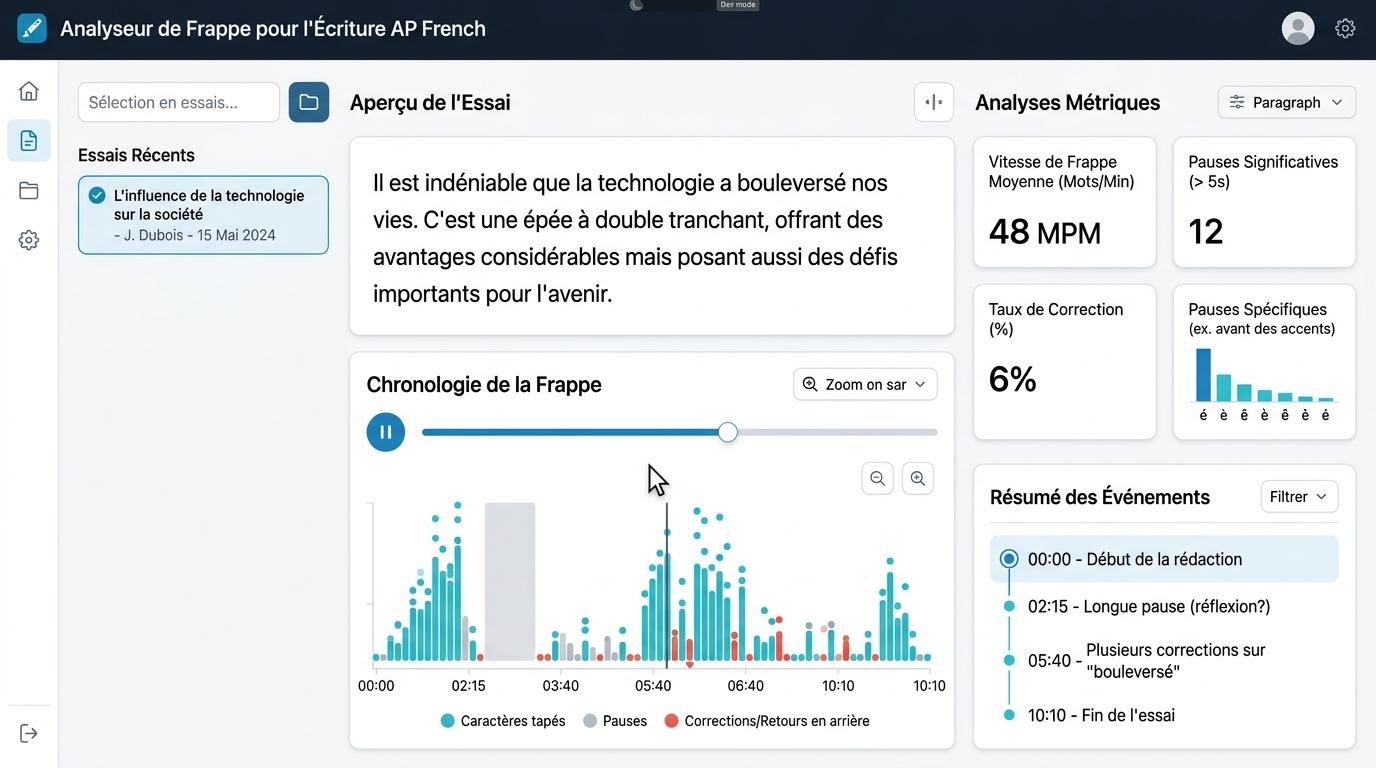
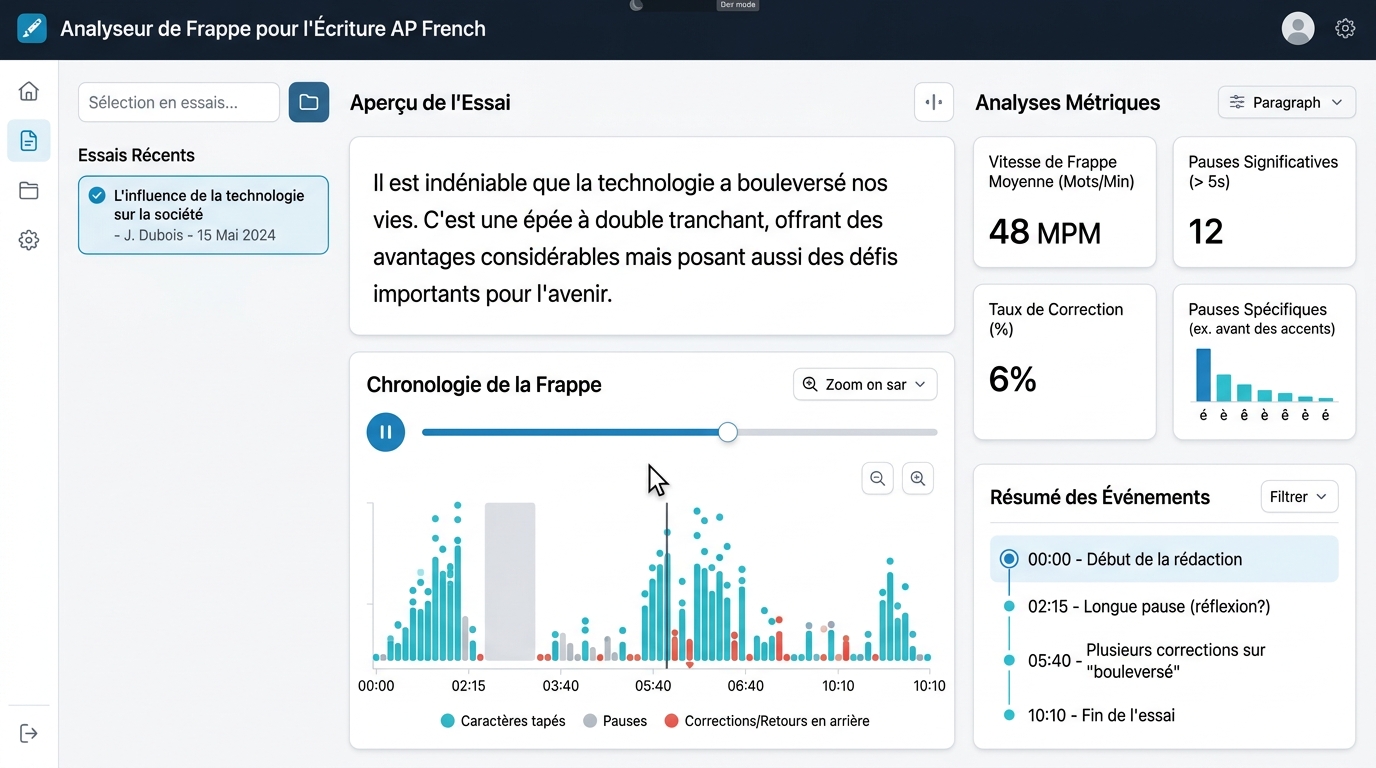
To resolve this structural breakdown, secondary world language departments must transition from black-box guesswork to transparent, process-based telemetry. By adopting Checkmark Plagiarism’s patent-pending Essay Playback™ and Writing Process Telemetry, AP French teachers gain character-by-character forensic visibility into organic composition: validating natural lexical retrieval pauses, diacritic input sequences (é, è, ê, ë, à, â, ç, î, ï, ô, ù, û), morphological self-corrections (gender and number agreements), and external clipboard dumps. This objective evidentiary foundation empowers educators to protect honest students, address unauthorized machine translation through supportive restorative target-language conferences, and safeguard authentic communicative acquisition across the AP French curriculum.
For decades, foreign language educators evaluated written proficiency through structured output: short paragraph responses in Level I/II, reflective narrative journals in Level III/IV, and timed cultural comparison or argumentative synthesis essays in Advanced Placement (AP) and International Baccalaureate (IB) courses. Writing served as the primary window into a student’s interlanguage—the dynamic, evolving linguistic system that bridges their native tongue (L1) and their developing target language (L2).
1. The High-Stakes Architecture of AP French Free Response Writing (FRQs 1 & 2)
The College Board’s AP French Language and Culture curriculum is meticulously structured to develop and evaluate communicative proficiency across the three foundational modes defined by the American Council on the Teaching of Foreign Languages (ACTFL): Interpersonal, Interpretive, and Presentational.
Within Section II of the AP French Exam (the Free Response section), written expression accounts for 25% of the total composite score, split between two distinct, highly specialized performance tasks.
- Official Task: Email Reply (Courriel de réponse)
- Register: Formal (vous / français soutenu)
- Stimulus: 1 incoming formal email message from a Francophone professional/educator
- Mandatory Deliverables:
- Formal salutation tailored to recipient title
- Opening courtesy & acknowledgment of receipt
- Detailed answers to 2 embedded inquiries
- 1 original follow-up inquiry from the student
- Culturally authentic closing formula (formule de politesse)
- Target ACTFL Level: Intermediate-Mid to Intermediate-High
- Scoring: 5-point College Board Holistic Rubric
- Official Task: Persuasive Argumentative Essay (Essai argumentatif)
- Time Split: 15 min stimulus analysis + 40 min drafting
- Stimuli: 3 authentic multi-modal sources:
- Source 1: Journalistic print article (~400 words)
- Source 2: Quantitative chart, table, or infographic
- Source 3: Authentic audio report/interview (played 2x)
- Mandatory Deliverables:
- Nuanced, defensible thesis addressing prompt
- Synthesis & direct citation of all 3 sources
- Counterargument acknowledgment and rebuttal
- Multi-paragraph structure with cohesive connectors
- Target ACTFL Level: Intermediate-High to Advanced-Low (B1/B2 CEFR)
- Scoring: 5-point College Board Holistic Rubric
The Interpersonal Writing Task: FRQ 1 Email Reply (Courriel de réponse)
In FRQ 1, students are placed in an authentic, simulated professional or academic scenario. They receive an incoming email from an authority figure in the Francophone world—such as the director of a youth non-profit organization (le directeur d'une association à but non lucratif), a university admissions coordinator, an environmental festival organizer, or an exchange program host.
Students are given precisely 15 minutes to read the stimulus email and compose a culturally authentic, formal reply. To achieve a top score of 5 on the College Board’s holistic scoring guidelines, the student must execute five mandatory structural and communicative functions:
- Culturally Appropriate Salutation (Formule d'appel): The student must open with an elevated formal greeting tailored specifically to the sender's title and gender (“Cher Monsieur Dupont,” “Madame la Directrice,” “Monsieur le Proviseur”, or “Chère Madame Martin”). Informal salutations (“Salut”, “Bonjour tout le monde”) immediately lower the score.
- Opening Courtesy and Acknowledgment (Entrée en matière / Remerciements): The student must formally acknowledge receipt of the email and express appreciation for the contact (“J'accuse bonne réception de votre courriel et je vous remercie vivement pour cette opportunité enrichissante”).
- Exhaustive Response to Embedded Inquiries: The incoming email invariably contains two specific questions or requests for information. The student must answer both inquiries thoroughly, providing detailed rationales, concrete examples, and appropriate register.
- Original Follow-Up Inquiry (Poser une question pertinente): The student must formulate at least one original, relevant question to elicit further logistical or operational details from the sender (“Pourriez-vous également m'indiquer si un hébergement est prévu sur place ?”).
- Formal Epistolary Closing (Formule de politesse / Prise de congé): The reply must conclude with an authentic, formal French closing formula (“Dans l'attente de votre réponse, je vous prie d'agréer, Monsieur, l'expression de mes salutations distinguées” or “Veuillez agréer, Madame la Présidente, mes sentiments respectueux”).
Mandated Structural Breakdown of an AP French Email Reply
Madame la Directrice,
J'ai bien reçu votre message concernant le programme d'échange écologique et je vous remercie vivement pour cette proposition.
En ce qui concerne ma disponibilité pendant l'été, je serai parfaitement libre durant tout le mois de juillet pour participer aux ateliers de reboisement. Quant à mon expérience préalable, bien que je n'aie jamais coordonné de projet international, j'ai dirigé le club d'écologie de mon lycée l'an dernier.
Serait-il possible de me préciser quels documents administratifs je dois vous faire parvenir avant la date limite ?
Dans l'attente de votre retour, veuillez agréer, Madame la Directrice, l'expression de mes salutations distinguées.
The Presentational Writing Task: FRQ 2 Persuasive Essay (Essai argumentatif)
FRQ 2 represents the most intellectually and linguistically demanding performance task on the AP French Exam. Students are presented with an overarching argumentative prompt connected to one of the six AP French thematic units:
Over a 55-minute testing block, students must navigate a rigorous multi-stage workflow:
- 15 Minutes (Stimulus Processing): Read an authentic French journalistic article (~400 words), analyze a quantitative chart/table/infographic, and listen to a three-minute authentic audio report or interview played twice.
- 40 Minutes (Argumentative Drafting): Formulate a clear, nuanced thesis answering the prompt, construct a multi-paragraph argumentative essay synthesizing evidence from all three sources, acknowledge counterarguments, and demonstrate control of advanced French syntax.
Advanced Morphosyntactic Benchmarks of the AP French Learner
To reach the ACTFL Intermediate-High to Advanced-Low threshold (securing a 4 or 5 on the AP rubric), high school students must demonstrate spontaneous control over sophisticated grammatical structures:
1. Subjunctive Mood (Le subjonctif présent et passé)
Required after verbs of volition, doubt, emotion, and essential subordinating conjunctions:
“bien qu'il y ait des divergences...”, “il est indispensable que la société prenne conscience...”, “pour que nous puissions en bénéficier...”
2. Hypothetical Conditionals (Les phrases conditionnelles avec « si »)
Accurate construction of conditional sentences combining imperfect with present conditional, or pluperfect with past conditional:
“Si les municipalités investissaient dans les transports en commun, les émissions diminueraient rapidement.”
3. Complex Relative Pronouns (Les pronoms relatifs composés)
Mastery of dont, lequel / laquelle / lesquels / lesquelles, auquel / à laquelle, ce qui, ce que, and ce dont:
“Le projet auquel l'auteur fait référence dans le document 1 démontre les limites dont souffre le système.”
4. Cohesive Transitional Devices (Les connecteurs logiques et argumentatifs)
Deployment of sophisticated transitional connectors for nuanced discourse flow:
“néanmoins”, “par conséquent”, “en revanche”, “d'un côté... de l'autre”, “il va de soi que”, “quant à”, “toutefois”
2. The Digital Classroom Dilemma: Neural Machine Translation vs. Interlanguage Realities
In contemporary 1:1 Chromebook high schools, formative preparation for FRQ 1 and FRQ 2 occurs primarily within digital word processors, Google Docs, and Learning Management Systems (Canvas LMS, Google Classroom, Schoology, Buzz LMS). While digital platforms enable rapid formative feedback, they have introduced an acute instructional crisis: unauthorized machine translation and generative AI ghostwriting.
- Target-Language Stimulus Processing: Student decodes French texts & audio.
- Mental Lexical Retrieval: Active search in internal memory for French vocabulary.
- Deliberate Morphosyntax Assembly: Conjugating verbs and aligning adjective agreements.
- Formative Revision & Backspacing: Self-correcting gender slips and accent errors.
- Consolidation: Reinforces neural pathways toward ACTFL Intermediate-High.
- English Ideation (L1): Student writes complex arguments in native English.
- External Tab Injection: Pasting English prose into DeepL Pro or ChatGPT.
- Neural Translation Engine: Transformer model outputs hyper-polished C1/C2 French.
- Instant Clipboard Paste: Injecting 200 words into Canvas/Docs in 0.04 seconds.
- Cognitive Bypass: Zero target-language memory activation or grammar practice.
Linguistic Tell-Tales and Hallmarks of Machine Translation
Unlike obsolete word-for-word translation tools, modern Neural Machine Translation (NMT) uses deep Transformer models with multi-head attention mechanisms. When high school students use NMT, the resulting text does not reflect high school interlanguage; it displays linguistic characteristics that are developmentally impossible for non-native high school learners:
1. The Passé Simple Anomaly
The passé simple (il fut, elle chanta, ils découvrirent, la loi suscita) is an exclusively literary historical tense never used in contemporary emails or argumentative essays. When students input narrative English (“When the law passed in 1995...”), DeepL frequently renders it as “Lorsque la loi passa en 1995...”. Organic high school writers never intentionally conjugate irregular literary past tenses.
2. Anglo-French Calques & False Cognates
Students retyping manually introduce calques: “faire du sens” (makes sense) instead of “avoir du sens”, “actuellement” (currently) for actually, and “demander une question” instead of “poser une question”. When DeepL translates, it renders these idioms flawlessly—creating an immediate mismatch with the student's oral proficiency.
3. Hyper-Polished Participle Agreements
Past participles conjugated with avoir must agree with a preceding direct object (COD): “Les preuves que j'ai découvertes dans le document 1...”. High school AP students routinely miss this during timed drafting. NMT engines execute this agreement with mathematical perfection across deeply nested relative clauses.
4. Pleonastic « Ne » (Ne Explétif)
In elevated French, the particle ne appears after comparative conjunctions (plus que, moins que) or verbs of fear (craindre que) without negation: “Le problème est plus grave qu'on ne le pensait”. Non-native learners are almost never taught to produce this spontaneously; its presence in a Chromebook draft is a definitive NMT footprint.
3. Why Generic AI Detectors and Traditional Revision Histories Fail French Teachers
When AP French teachers suspect academic dishonesty, they often turn to standard edtech tools: whole-document AI percentage detectors (e.g., Turnitin, GPTZero) or standard Google Docs Version History. Both tools fail dramatically in the world language classroom.
1. Whole-Document AI Percentage Detectors
- Massive False Positives on Mandated Stems: Mandatory formal email formulas and standard AP transitions trigger 80–100% AI probability scores due to low statistical perplexity.
- Blind to DeepL Neural Machine Translation: DeepL outputs have natural human-like perplexity, scoring 0% AI on generic classifiers.
- Black-Box Opaque Scores: Provides no evidentiary “receipts” to defend during contentious parent-teacher conferences.
2. Standard Google Docs Revision History
- Coarse Time Windows (5–15 Minute Chunks): Collapses hundreds of keystrokes into broad snapshots, obscuring external pastes.
- Blind to Split-Screen Retyping: If a student retypes from a second phone screen, Google Docs records it simply as “typed text.”
- Lost Clipboard Text: Cannot show the teacher what text was originally in the clipboard buffer before subsequent edits.
The “Template False Positive” Crisis in FRQ 1 Email Replies
Generic AI detectors work by calculating linguistic perplexity (word predictability) and burstiness (sentence structure variation). High perplexity represents human unpredictability, while low perplexity triggers an AI flag.
In AP French FRQ 1, however, the College Board scoring guidelines explicitly mandate standardized, low-perplexity formal formulas. When an honest student writes:
“Monsieur le Directeur, J'accuse bonne réception de votre courriel et je vous en remercie. Dans l'attente de votre réponse, veuillez agréer, Monsieur, l'expression de mes salutations distinguées.”
A generic AI detector analyzes these formulaic strings, calculates near-zero perplexity, and flags the essay as 85%–98% AI-Generated. The teacher is forced into an untenable position: either falsely accuse an honest student who memorized approved AP exam templates, or abandon detection entirely.
4. The High School World Language Evidentiary Matrix
To evaluate student writing fairly and defensibly, world language departments require multi-dimensional writing process evidence. The following matrix contrasts traditional methods with Checkmark Plagiarism’s telemetry-driven platform:
| Investigative Method | Primary Strength | Critical Deficiency | Value in AP French Audits |
|---|---|---|---|
| In-Class Timed Paper Writes (Pen & Paper) | 100% physically proctored writing environment. | Does not scale for take-home drafts or multi-source synthesis tasks. | High validity; zero digital diagnostic telemetry for revision. |
| Generic AI Detectors (Turnitin / GPTZero) | Instant single percentage whole-document score. | High false positives on email templates; 100% blind to DeepL translation. | Dangerous & unsupportable; generates false accusations. |
| Google Docs Revision History (Macro-Level) | Built into standard Chromebook ecosystems. | Coarse 10-min snapshots; no playback or paste text inspection buffer. | Insufficient for parent conferences; cannot prove second-screen retyping. |
| Checkmark Plagiarism & Essay Playback™ | Keystroke-by-keystroke replay (1x–8x), diacritic tracking, & paste buffer. | Requires digital editing environment (Chromebook, Google Docs, Canvas LTI). | Defensible gold standard; captures authentic L2 pauses and clipboard dumps. |
5. The Anatomy of Authentic L2 Keystroke Dynamics
Second-language writing is cognitively distinct from native-language writing. When a high school student composes in French (L2), their brain operates under heavy cognitive load, managing simultaneous mental operations: semantic conception in English (L1), lexical search in French (L2), morphological inflection (gender/number agreements), and orthographic accentuation.
This cognitive friction leaves an unmistakable keystroke dynamic signature:
Profile A: Organic L2 Student Drafting
- Velocity: 15–35 Words Per Minute (WPM)
- Diacritics: Multi-key entries (
'+e→é) - Self-Corrections: Backspacing adjectival endings
Profile B: External DeepL / LLM Paste Event
- Velocity: > 2,500 WPM (Instant dump)
- Keystroke Count: 1 (Ctrl+V / Command+V)
- Revision History: Zero prior character evolution
Profile C: Split-Screen / Phone Transcription
- Velocity: Monotonous 50–70 WPM
- Deletion Rate: < 1% (Zero syntactic rethinking)
- Accent Hesitation: Robotic cadence without searching
French Diacritic & Accent Keystroke Sequences
Typing French on standard US QWERTY keyboards (standard on school-issued Chromebooks) requires specialized input methods:
- US International Keyboard Combinations: Typing
'followed byeto produceé,`followed byato produceà, or^followed byeto produceê. - Alt-Code Entry: Holding
Altand typing numeric codes (e.g.,Alt + 0233foré). - Chromebook Long-Press / Accent Menu: Holding down the letter key until a numbered accent menu appears.
In Checkmark’s Essay Playback™, teachers can observe the exact micro-keystroke combinations used to generate French diacritics. When a student pastes text from DeepL, all diacritics appear instantly without the corresponding input keystrokes.
6. Step-by-Step AP French Teacher Audit Protocol
When an AP French teacher receives a suspicious digital submission on Canvas, Google Classroom, or Buzz LMS, they can execute a four-step investigative protocol using Checkmark Plagiarism:
Linguistic & Register Triage
Scan for literary passé simple (“il fut décidé”), rare formal collocations never covered in class (“il échet de souligner”), and formulaic email templates to verify they are not triggering false positive detector flags.
Essay Playback™ Scrubbing
Scrub the writing timeline at 2x to 4x speed. Verify linear paragraph composition vs. instantaneous block insertions. Inspect diacritic keystroke dynamics to ensure accents were typed via keyboard combinations.
Paste Buffer Inspection
Click Checkmark’s External Paste Badge to review the raw pre-edit clipboard content. Checkmark preserves the exact pasted text even if the student spent 15 minutes editing adjectives to camouflage the translation.
Restorative Target-Language Conference
Conduct a 10-minute collaborative debrief in French (la conférence de révision réparatrice). Walk through the playback timeline together and guide the student through a restorative target-language rewrite.
« Bonjour Julien. Regardons ensemble l'enregistrement de ton essai argumentatif sur Checkmark. J'ai remarqué qu'à la minute 12, ce paragraphe de 180 mots est apparu en un seul collage. Peux-tu m'expliquer ton processus de rédaction pour cette section ? »
« En fait, Madame, j'avais peur de manquer de vocabulaire sur l'énergie nucléaire, donc j'ai écrit mes idées en anglais dans DeepL et j'ai collé la traduction... »
« Je comprends ton anxiété face au sujet, mais l'examen AP évalue ton interlangue organique, pas celle d'un moteur de traduction. Regardons ce connecteur : tu as utilisé le passé simple ici (« la loi suscita »). En classe, nous utilisons le passé composé. Prenons 10 minutes pour réécrire ce paragraphe ensemble en utilisant ton propre vocabulaire. »
7. Checkmark Plagiarism: Purpose-Built Features for World Language Educators
Checkmark Plagiarism delivers an integrated, educator-controlled platform designed specifically for high school writing workflows:
1. Passage Confidence Sliders
No arbitrary whole-document percentages. Calibrated confidence sliders highlight specific passages while leaving standard French email formulas unflagged.
2. Patent-Pending Essay Playback™
1x to 8x playback scrubs through composing pauses, backspaces, and diacritic keystrokes to prove genuine cognitive writing effort.
3. External Paste Inspector
Preserves the original clipboard contents at the moment of pasting, revealing pre-edited DeepL text with full character fidelity.
4. Rubric Autograding + LMS Sync
Pre-configured 5-point College Board AP French rubrics generate quote-anchored justifications and sync directly back to Canvas, Google Classroom, or Buzz LMS.
5. Strict Zero-Retention Privacy Architecture
FERPA and COPPA compliant. Student essays are never stored in public databases, never shared with third parties, and never used to train commercial AI foundation models.
8. Real High School Classroom Case Studies
The following three case studies demonstrate how high school AP French teachers and department chairs use Checkmark Plagiarism to navigate real-world integrity challenges:
Exonerating Sophie from a 92% False Positive on Memorized Formulas
Setting & Assignment: Suburban public high school, 1:1 Chromebooks, Canvas LMS. Timed 15-minute Interpersonal Email Reply responding to an exchange coordinator in Lyon (L'Office Franco-Québécois pour la Jeunesse).
The Dilemma: A junior student, Sophie, submitted a well-structured email reply. When run through a generic AI detector, the submission received an alarming 92% AI-Generated Score due to her memorized opening (“J'accuse bonne réception...”) and formal closing formula (“Dans l'attente de votre réponse...”).
Checkmark Telemetry Audit: The teacher opened the assignment in Checkmark Plagiarism. The passage-level sliders recognized the opening and closing as standard pedagogical templates and marked them neutral. Replaying the writing session in Essay Playback™ revealed steady, organic drafting at 28 WPM. Sophie spent 3 minutes planning, paused for 8 seconds before typing “bien que je sois occupée”, backspaced three times to correct the subjunctive stem, and used standard US International keyboard diacritic sequences (' + e → é).
Outcome: Sophie was completely exonerated and commended for her accurate execution of mandated AP French epistolary conventions.
Unmasking a 240-Word DeepL 3-Source Synthesis Paste
Setting & Assignment: Public high school, Google Classroom. 55-minute Persuasive Essay on Les défis mondiaux: “Faut-il interdire les véhicules diesel dans les grands centres urbains ?” synthesizing an article from Le Monde, an air quality infographic, and an audio broadcast.
The Dilemma: A senior student, Lucas, submitted an essay containing advanced subjunctive inversions and the literary passé simple (“La loi de 2019 marqua un tournant...”). A generic AI detector gave the essay a clean 2% AI Score due to DeepL's natural perplexity.
Checkmark Telemetry Audit: Scrubbing the timeline in Essay Playback™ showed Lucas idle on a blank screen for 22 minutes. At minute 23:14, an instantaneous 240-word external paste event occurred (>3,600 WPM). Checkmark's Paste Inspector displayed the raw clipboard text: an English essay translated through DeepL Pro.
Outcome: In a supportive conference, the teacher shared the playback recording. Lucas admitted feeling overwhelmed by synthesizing three sources under time pressure. He was guided through a structured restorative rewrite under in-class conditions.
Differentiating Approved WordReference Lookups from Full NMT
Setting & Assignment: Independent school, Buzz LMS. Multi-day take-home draft on La science et la technologie: “L'impact de l'intelligence artificielle sur l'éducation”.
The Dilemma: Students were permitted to use WordReference.com for single-word lookups but strictly prohibited from sentence-level translation. The teacher noticed elevated vocabulary in Marc's essay (“l'apprentissage adaptatif”, “entraver”) and wanted to verify integrity.
Checkmark Telemetry Audit: Essay Playback™ confirmed Marc drafted paragraph-by-paragraph. At minute 14, he paused for 15 seconds to look up the verb to hinder (entraver), returned to the document, and manually typed e-n-t-r-a-v-e-r letter-by-letter. No multi-sentence paste events occurred.
Outcome: The teacher verified legitimate reference tool usage, reinforcing healthy second-language inquiry habits.
9. Frequently Asked Questions (FAQs) for AP French Educators
1. Does using keystroke replay violate student privacy laws (FERPA / COPPA)?
No. Checkmark Plagiarism operates under a strict Zero-Retention Privacy Architecture designed specifically for K–12 school districts. Checkmark records telemetry only within authorized educational document environments (Canvas LMS, Buzz LMS, Google Classroom, and Google Docs). Student drafts and keystroke logs are never sold, never shared with third parties, and never used to train commercial AI foundation models. Checkmark is fully compliant with FERPA, COPPA, and state-level student privacy statutes.
2. How does Checkmark distinguish between approved WordReference dictionary lookups and unauthorized DeepL translation?
Checkmark’s External Paste Inspector and Essay Playback™ track both paste volume and typing velocity. When a student uses an online dictionary like WordReference, they look up single words or two-word idiomatic phrases and manually type them into the document (accompanied by natural composing pauses). In contrast, unauthorized DeepL or ChatGPT usage generates multi-sentence paragraph blocks (>50 words) pasted instantaneously with zero pre-paste character evolution.
3. How does Essay Playback™ handle French diacritics and special characters on school Chromebooks?
Checkmark’s telemetry engine captures hardware and software input events, including US International keyboard combinations (' + e → é, ` + a → à, ^ + e → ê), Alt-code keystrokes, and Chromebook long-press accent menu selections. When teachers replay the drafting session, these diacritic keystroke events appear naturally in the timeline, proving organic typing.
4. Why do required AP French email closing formulas trigger false positives on generic AI detectors?
Generic AI detectors measure perplexity (statistical unpredictability). Standard AP French email formulas (“Dans l'attente de votre réponse, veuillez agréer, Monsieur...”) are highly standardized and predictable, causing generic detectors to assign them an 80%+ AI probability score. Checkmark’s passage-level multi-factor engine recognizes standard pedagogical templates and filters them out, preventing false accusations.
5. Can students bypass keystroke replay by manually retyping text translated on a second screen or phone?
No. When a student manually retypes machine-translated text from a second device (transcription), their keystroke dynamics display a distinct mechanical signature: steady typing velocity (50–70 WPM) with zero natural second-language retrieval pauses, zero grammatical backtracking, and an abnormally low backspace rate (<1%). Checkmark’s Writing Process Telemetry flags these mechanical transcription profiles for teacher review.
6. How does Checkmark’s Rubric Autograder align with the official College Board AP French scoring rubrics?
Checkmark includes pre-configured, standardized rubrics matching the official College Board 5-point holistic scoring guidelines for both FRQ 1 (Email Reply) and FRQ 2 (Persuasive Essay). The AI Autograder evaluates submissions across Task Completion, Topic Development, and Language Usage, generating quote-anchored justifications tied directly to the student’s prose while allowing the teacher to adjust and finalize all grades before syncing to the LMS.
7. How should world language departments introduce Essay Playback™ to students and parents?
World language departments should position Essay Playback™ as a supportive, transparent learning tool under the philosophy: “Stop guessing, start trusting.” Educators explain that keystroke replay exists to protect honest students from false AI accusations, validate hard work, and provide teachers with diagnostic insights into where students struggle with grammar and vocabulary during drafting.
10. Conclusion: Empowering Authentic Language Acquisition
Second-language writing is an active, developmental journey. When high school students rely on machine translation shortcuts, they deprive themselves of the neural connections required for true communicative competence.
By replacing opaque, unreliable AI percentage scores with Checkmark Plagiarism’s patent-pending Essay Playback™, External Paste Inspector, and Quote-Anchored Rubric Autograding, AP French educators can safeguard academic integrity, protect honest learners, and foster deep, lasting language acquisition across every high school classroom.
Elevate AP French Writing Integrity in Your District
Equip your World Language faculty with patent-pending Essay Playback™, external paste buffer inspection, and official College Board AP French rubric autograding. Protect student trust and guarantee authentic communicative proficiency.