
Unnaturally consistent typing occurs when a student's keystroke stream exhibits robotic, metronomic timing—devoid of the natural thinking pauses, hesitations, backspaces, and structural revisions that characterize authentic human thought.
When a human writer composes an original essay, typing speed fluctuates wildly based on cognitive load: typing accelerates when writing familiar transitional words, slows down when choosing precise vocabulary, pauses for 30–60 seconds at paragraph transitions to formulate ideas, and frequently reverses with backspaces to restructure awkward sentences. In contrast, when a student transcribes text from an external screen (such as ChatGPT on a phone), their typing becomes flat, continuous, and unnaturally uniform.
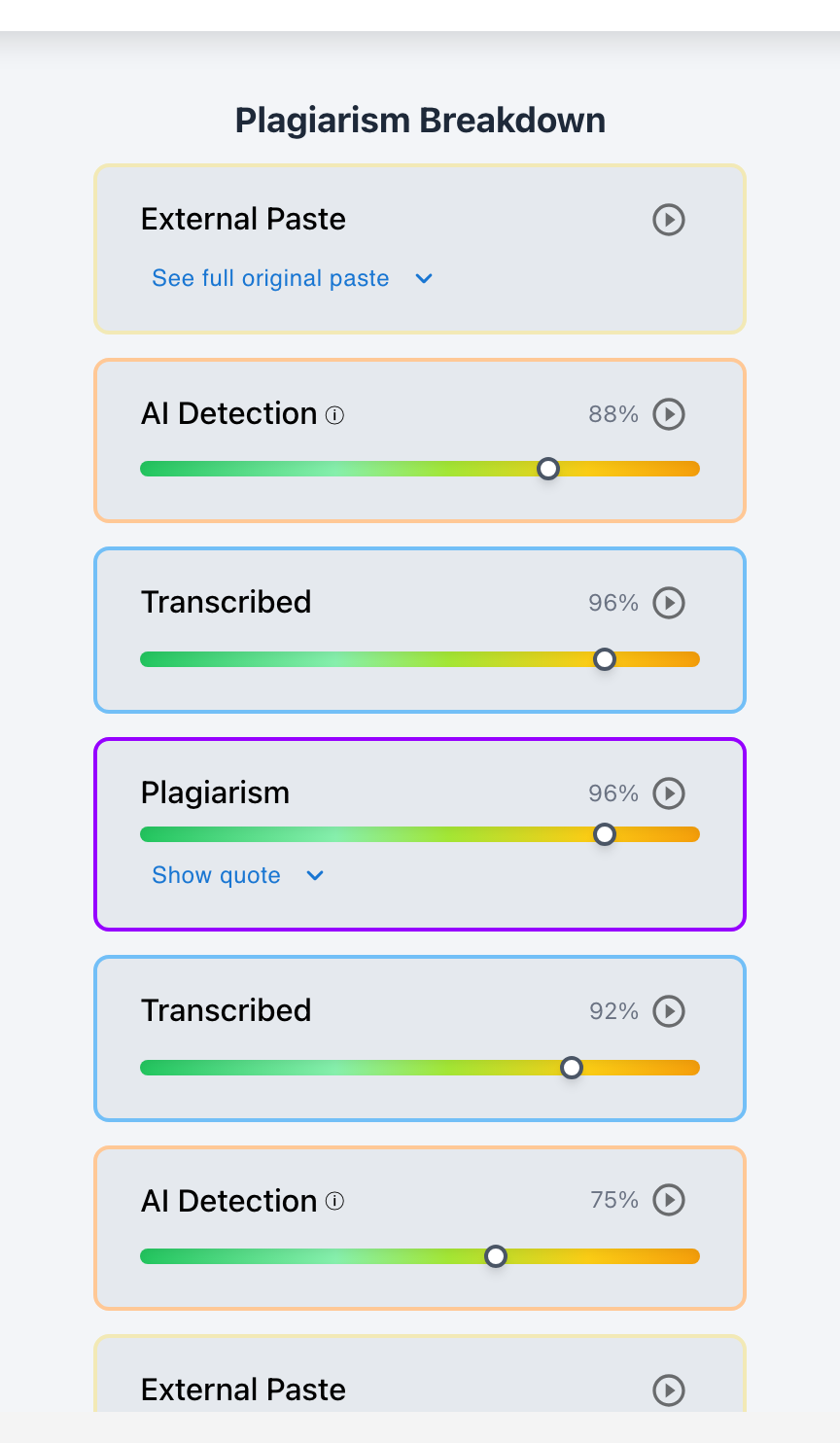
Through Checkmark Plagiarism's Keystroke Analytics, educators can visualize typing dynamics to separate authentic human composition from robotic transcription.
Checkmark Plagiarism powers keystroke analysis by pairing essay writing playback with AI detection, plagiarism detection, autograding, and integrations with Canvas and Google Classroom.
The 4 Characteristics of Unnaturally Consistent Typing
1. Flat Inter-Key Interval (IKI) Distribution
The time between consecutive keystrokes remains virtually identical across the entire document, regardless of whether typing simple words or dense technical terminology.
2. Absence of Cognitive Ideation Pauses
Authentic writers pause for 20–60 seconds between arguments. Unnaturally consistent typing shows zero ideation pauses across thousands of words.
3. Abnormally Low Backspace / Edit Rate
Human composition averages 15–30% deletions and backspaces. Transcribing text produces an edit rate below 2%, with zero paragraph restructuring.
4. Metronomic Gaze-Shift Chunking
Keystroke logs record rigid cycles of 4–6 words typed rapidly, followed by an exact 2-second pause to read a secondary screen, repeated continuously.
What Checkmark Keystroke Analytics Visualizes
In Checkmark Plagiarism's Essay Playback, keystroke dynamics are rendered as visual, intuitive graphs:
- Keystroke Velocity Graph: Shows typing speed fluctuations over time; authentic writing resembles jagged mountain peaks, while transcription resembles a flat plateau.
- Burst & Pause Histograms: Displays the distribution of typing pauses, highlighting the absence of natural brainstorming intervals.
- Edit & Deletion Heatmaps: Highlights where sentences were reworked or deleted in blue; retyped essays show unbroken green text from start to finish.
Read more in how Checkmark writing process analysis works.
Comparison: Natural Human Keystrokes vs. Unnaturally Consistent Typing
Natural Human Keystroke Dynamics
- Variable typing speed (30–80 WPM fluctuations).
- 15–30% backspaces, typos, and sentence revisions.
- Thinking pauses (20–90 seconds) at paragraph breaks.
- Drafting unfolds non-linearly across multiple sessions.
Unnaturally Consistent Typing (Transcription)
- Flat, unvarying typing velocity across all words.
- <2% backspace rate; zero paragraph reorganization.
- Zero cognitive formulation pauses; rigid 2s gaze pauses.
- Entire essay typed linearly in a single unbroken session.
A 5-Step Educator Protocol for Investigating Typing Dynamics
Educator Keystroke Audit Checklist:
- 1. Open the Checkmark Essay Playback report in Canvas SpeedGrader.
- 2. Review the Keystroke Velocity and Pause Distribution graphs.
- 3. Check the backspace/deletion rate: authentic drafting exceeds 15%.
- 4. Cross-reference with dual AI detection and direct plagiarism database matches.
- 5. Hold a supportive conference asking the student to explain their drafting process.
How Checkmark Plagiarism Powers Keystroke Analytics
Checkmark Plagiarism combines **AI detection, essay writing playback, static AI detection, plagiarism detection, autograding, and Canvas/Google Classroom integrations** to analyze keystroke dynamics automatically, giving teachers clear visual evidence of authentic writing behavior.
Frequently Asked Questions
What does 'unnaturally consistent typing' mean?
It refers to typing that proceeds at an unvarying pace without the natural hesitations, thinking pauses, backspaces, or sentence rewrites typical of human composition.
Why do authentic writers have variable typing speeds?
Because cognitive load changes constantly: writers type quickly when ideas are clear and slow down or pause when formulating complex arguments or choosing words.
Can a fast typist trigger false alarms?
No. Fast human typists still make typos, use backspaces (15%+), and pause to formulate ideas. Fast transcription lacks both errors and ideation pauses.
How does writing playback detect transcription?
Playback reveals continuous linear typing from the first word to the last word without structural reorganizations, deleted paragraphs, or thesis formulation pauses.
What is an Inter-Key Interval (IKI)?
The time in milliseconds between one keystroke and the next. Authentic human IKIs vary widely; transcription IKIs are unnaturally uniform.
Can students fake natural keystroke patterns?
Simulating hours of realistic typos, backspaces, and variable pause lengths is virtually impossible and takes longer than writing the essay honestly.
What should a teacher do if consistent typing is flagged?
Review the playback timeline alongside AI probability scores and citation audits, and conduct a brief oral conference to evaluate conceptual mastery.
How does Checkmark Plagiarism integrate with Canvas LMS?
Checkmark Plagiarism displays visual writing playback replays, keystroke velocity graphs, and pause histograms directly inside Canvas SpeedGrader.
Does keystroke analysis protect honest students?
Yes. Honest students show authentic drafting rhythms with natural pauses and revisions, completely protecting them from false accusations.
Why is keystroke analysis better than static AI detectors?
Detectors provide probabilistic estimates, whereas keystroke analysis provides objective physical proof of human typing and revision behavior.
Cognitive Effort Leaves a Human Footprint
Authentic writing is messy, iterative, and dynamic. By analyzing keystroke dynamics and visualizing writing sessions with essay playback, Checkmark Plagiarism ensures that genuine human effort is celebrated and defended with total clarity.
Checkmark Plagiarism supports this comprehensive approach with AI detection, essay writing playback, static AI detection, plagiarism detection, autograding, and integrations with Canvas and Google Classroom.
See how Checkmark pairs essay writing playback with multi-signal detection to analyze keystroke dynamics and typing patterns inside your LMS. View a sample report or request a demonstration.