
When an essay contains a Works Cited page or bibliography but has zero matching in-text citations in the body paragraphs, it usually indicates one of three root causes: a developmental misunderstanding of attribution mechanics (the student believes listing sources at the end is sufficient), deliberate ornamental citation padding to satisfy a rubric requirement, or an AI prompt disconnect where ChatGPT generated a separate bibliography without anchoring claims.
Every writing instructor has encountered the "orphan bibliography": an essay with five beautifully formatted sources on the final page, but completely devoid of parenthetical citations (e.g., [Smith, 2023]), signal phrases, or page numbers in the body text. This disconnect leaves the reader unable to determine which specific facts, statistics, or arguments originated from which source. Knowing how to diagnose the reason behind unlinked bibliographies allows teachers to address academic integrity risks while providing targeted pedagogical coaching.
Below is a comprehensive guide on analyzing essays with unlinked sources and resolving citation gaps.
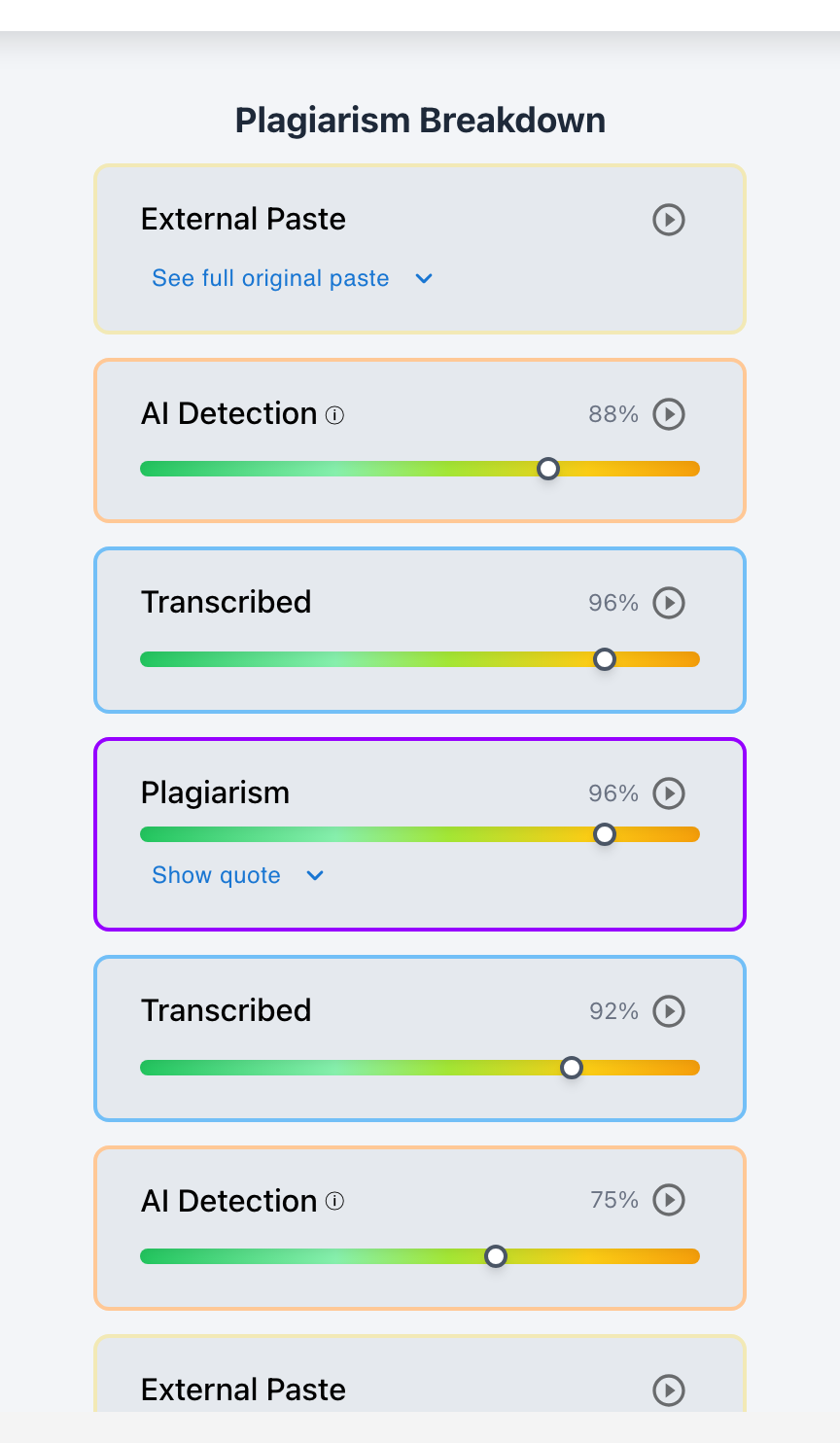
Checkmark Plagiarism maps citation attribution by pairing plagiarism detection with AI detection, essay writing playback, autograding, and integrations with Canvas and Google Classroom.
The 4 Explanations for Unlinked Bibliographies
1. Developmental Attribution Confusion
The student genuinely believes that listing sources at the end of the paper fulfills all citation requirements, unaware that every specific borrowed claim requires an in-text marker.
2. Ornamental Citation Padding
The student wrote the essay from memory or uncredited web searches, and quickly pasted five random sources into the bibliography right before submitting to avoid losing rubric points.
3. Generative AI Prompt Disconnect
The student prompted ChatGPT to "write an essay on climate change and include 4 sources at the end." The AI generated a clean paper and bibliography without in-text tags.
4. Uncited Paraphrasing & Patchwriting
The student closely paraphrased content from the listed sources throughout the body paragraphs but omitted in-text citations to make the prose look entirely original.
Why In-Text Citations Are Essential for Academic Integrity
Understanding why an unlinked bibliography constitutes an integrity risk:
- The Attribution Contract: Scholarship relies on precise provenance. An unlinked bibliography leaves the reader guessing whether facts were measured, hypothesized, or borrowed.
- Unintentional Plagiarism Risk: Paraphrasing an author's ideas without an in-text citation is still considered plagiarism under standard honor codes, even if the source is listed on the final page.
- Playback Telemetry Clues: Checkmark Playback reveals whether the bibliography was assembled organically over hours alongside body paragraphs or pasted in a single 0.05-second burst at the end.
Read more in how Checkmark writing process analysis works.
Comparison: Formatting Confusion vs. Deceptive Citation Padding
Formatting Confusion (Pedagogical Coaching)
- Student can point to which paragraph used which source.
- Playback shows multi-hour drafting and research pauses.
- Student speaks fluently about the cited sources in person.
- Action: Teach parenthetical citation formatting and revise.
Deceptive Citation Padding (Integrity Issue)
- Student cannot match any source to any paragraph.
- Bibliography pasted in 0.05s right before deadline.
- Student has never read the listed sources.
- Action: Require full revision with verified attribution.
A 5-Step Educator Protocol for Unlinked Citation Audits
Unlinked Citation Resolution Checklist:
- 1. Open the student's submission in Checkmark Plagiarism inside Canvas SpeedGrader.
- 2. Review the Citation Mapping Card: verify whether in-text citations match bibliography entries.
- 3. Inspect Writing Playback: check when the bibliography was added to the document.
- 4. Hold a brief 2-minute conference: "I see you listed five great sources at the end. Can you show me which paragraphs used source #2?"
- 5. If genuine formatting error, require in-text citation insertion; if ornamental padding, apply grading penalties.
How Checkmark Plagiarism Powers Citation Mapping
Checkmark Plagiarism combines **AI detection, essay writing playback, static AI detection, plagiarism detection, autograding, and Canvas/Google Classroom integrations** to automatically map body paragraph claims to bibliography entries and flag unlinked references.
Frequently Asked Questions
Is it plagiarism if a student lists sources in the bibliography but omits in-text citations?
Yes. Presenting specific ideas, statistics, or paraphrased arguments without in-text attribution is technically plagiarism, even if the source is mentioned on the Works Cited page.
Why do students forget in-text citations?
Many novice writers are taught that a bibliography is where sources belong, not realizing that academic readers require paragraph-level attribution markers.
What does ornamental citation padding mean?
It refers to adding random, unread sources to a bibliography solely to satisfy a rubric requirement for a minimum number of sources.
How does Checkmark map citations in SpeedGrader?
Checkmark highlights every in-text citation and draws dynamic links to the corresponding bibliography entry, highlighting orphan sources instantly.
What if a student used signal phrases instead of parenthetical citations?
Signal phrases (e.g., "According to Dr. Johnson...") are valid attribution methods; Checkmark recognizes semantic signal phrases as linked citations.
How does Checkmark Plagiarism integrate with Canvas LMS?
Checkmark provides certified LTI 1.3 integration, SpeedGrader sidebar embeds, two-way grade passback, and single sign-on (SSO).
What should a teacher do when a student has an unlinked bibliography?
Conduct a brief 2-minute conference: ask the student to match their sources to their claims and require an annotated revision.
Can writing playback show when a bibliography was created?
Yes. Playback logs whether the bibliography was assembled alongside research notes or pasted wholesale at the end of the session.
What is patchwriting in unlinked essays?
Patchwriting occurs when a student stitches together phrases from listed sources without quotation marks or in-text citations, creating pseudo-original text.
Why is citation mapping essential for fair assessment?
Because automated citation mapping helps teachers quickly distinguish between honest formatting confusion and deliberate citation padding.
Guiding Developing Researchers Toward Precise Attribution
Accurate citation is an acquired scholarly skill. By combining citation mapping with writing playback in Checkmark Plagiarism, educators can identify citation disconnects, guide developing writers toward precise attribution, and uphold uncompromising academic standards.
Checkmark Plagiarism supports this comprehensive approach with AI detection, essay writing playback, static AI detection, plagiarism detection, autograding, and integrations with Canvas and Google Classroom.
See how Checkmark pairs automated citation mapping with multi-signal detection to evaluate student bibliographies. View a sample report or request a demonstration.