
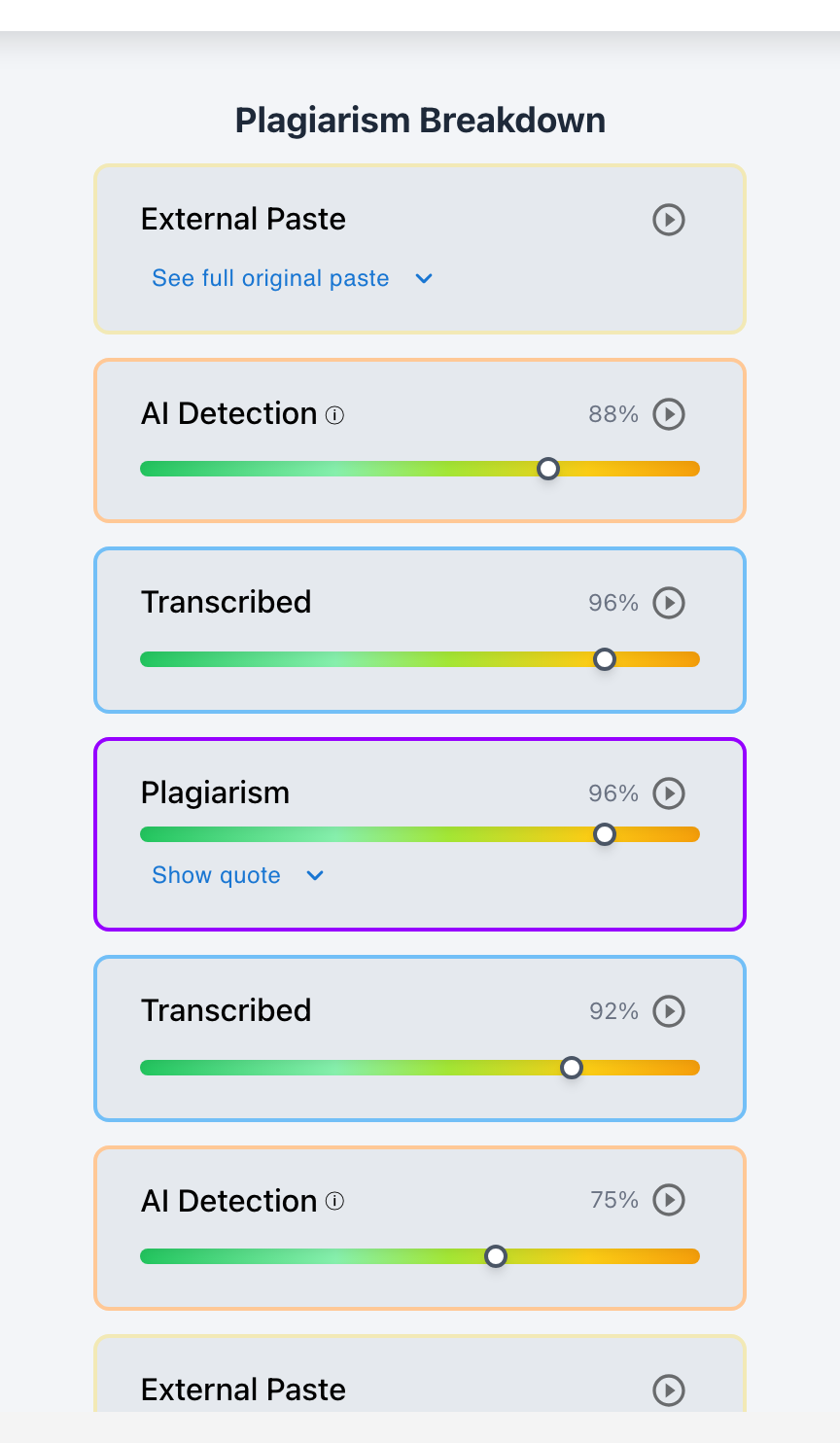
An AI-written essay in writing history leaves unmistakable behavioral anomalies—characterized by instantaneous wholesale text pastes, section-by-section prompt assemblies, unnatural linear transcriptions, or minimal active drafting times.
While generative AI models like ChatGPT can generate polished, grammatically flawless essays on the screen, they cannot simulate the messy, iterative physical timeline of human cognition. In a document's audit history, an AI-written submission looks completely artificial: thousands of characters appear in milliseconds, paragraph restructurings are non-existent, and the typical 3-to-5-hour human drafting process is reduced to 3 minutes.
Through Checkmark Plagiarism's AI + Process Evidence Engine, educators can inspect the 4 primary archetypes of AI submissions in writing history.
Checkmark Plagiarism powers process verification by pairing essay writing playback with AI detection, plagiarism detection, autograding, and integrations with Canvas and Google Classroom.
The 4 Archetypes of AI Essays in Writing History
1. The Instant Wholesale Paste
The document goes from a blank page to 1,500 words in 0.05 seconds at 11:42 PM. Total active typing duration: under 3 minutes.
2. The Paste-and-Polish Modification
An entire AI essay is pasted into the doc, followed by 12 minutes of rapid synonym swaps. Checkmark's Original Paste Preservation captures the raw AI baseline.
3. Section-by-Section Prompt Assembly
The student prompts ChatGPT paragraph-by-paragraph, pasting 250-word chunks every 90 seconds with zero typing in between.
4. The Linear Transcribed Waterfall
The student hand-types the AI output from a phone: keystrokes flow in an unbroken line with <2% backspaces and zero paragraph reorganization.
What Checkmark AI + Process Evidence Visualizes
When an instructor reviews a submission in Checkmark Plagiarism, the system combines two independent forensic layers:
- The Linguistic Layer: Static neural engines evaluate perplexity and burstiness, flagging synthetic AI language patterns with 99%+ accuracy.
- The Process Layer: Essay Playback provides a visual timeline showing paste timestamps, active drafting duration, and keystroke velocities.
- Citation Auditing: Instantly cross-checks cited bibliography entries in Google Scholar, exposing hallucinated studies and dead DOIs.
Read more in how Checkmark writing process analysis works.
Comparison: Authentic Drafting History vs. AI Writing History
Authentic Drafting History (Human Process)
- 3–5 distinct sessions over several days.
- Active typing duration: 3.5 to 5 hours.
- 15–30% backspaces, deletions, and structural rewrites.
- Citations added incrementally over multiple sessions.
- 0% AI probability score; verified real sources.
AI Writing History (Synthetic Process)
- 1 single session lasting under 5 minutes.
- Active typing duration: <3 minutes.
- <2% backspaces; zero structural reorganization.
- 1,400 words inserted via paste or linear transcription.
- 95%+ AI probability score; hallucinated citations.
A 5-Step Educator Protocol for Investigating AI History
Educator AI History Audit Checklist:
- 1. Open the Checkmark Playback report in Canvas SpeedGrader or Google Classroom.
- 2. Review total active typing time: flag submissions under 20 minutes for major essays.
- 3. Inspect the timeline for instant wholesale paste blocks or 250-word chunk insertions.
- 4. Check the Original Preserved Paste view for unedited raw AI text.
- 5. Verify cited sources in academic databases and hold a brief oral check-in.
How Checkmark Plagiarism Powers AI Process Evidence
Checkmark Plagiarism combines **AI detection, essay writing playback, static AI detection, plagiarism detection, autograding, and Canvas/Google Classroom integrations** to make AI writing history instantly visible, objective, and legally defensible inside your LMS.
Frequently Asked Questions
Can teachers tell if an essay was written by AI from revision history?
Yes. AI essays show instant wholesale pastes, lack of active typing time (under 5 minutes), zero structural revisions, and high AI probability scores.
What if I generate an essay in ChatGPT and edit it in Google Docs?
Checkmark's Original Paste Preservation captures the unedited AI text at the moment of insertion, and playback logs show the entire essay appeared in one paste.
Can teachers see if I pasted ChatGPT paragraph-by-paragraph?
Yes. Playback logs record the exact timestamp of every individual paste, revealing a distinct pattern of 250-word chunks inserted every 90 seconds.
What if I typed ChatGPT's answer by hand?
The keystroke log will show linear transcription with <2% backspacing and zero formulation pauses, while the AI detector flags synthetic syntax.
How does writing history protect honest students?
If an honest student triggers a false positive on an AI detector, their multi-hour typing history, high backspace rate, and multi-session drafts prove authentic authorship.
What should a teacher do when AI writing history is detected?
Compile the multi-signal dossier (AI score, playback log, citation audit, baseline comparison) and hold a supportive academic integrity conference.
How does Checkmark Plagiarism integrate with Canvas LMS?
Checkmark Plagiarism displays visual writing playback timelines, paste volume alerts, and dual AI/plagiarism reports directly inside Canvas SpeedGrader.
Does writing history record student webcams?
No. It analyzes only keystroke timing and text edits inside the assignment document, maintaining complete student privacy.
Why is process evidence better than static AI detection alone?
Detectors provide statistical estimates, whereas process evidence provides objective physical proof of human typing vs. copy-pasting.
How can teachers design assignments that prevent AI shortcuts?
Require students to draft inside the LMS with writing playback enabled, incorporate in-class baselines, and require 2-sentence source annotations.
Objective Process Evidence Defends Academic Rigor
Generative AI can fake finished prose, but it cannot fake the authentic process of human writing. By combining AI neural detection with essay writing playback, Checkmark Plagiarism gives educators the clear, indisputable evidence needed to uphold academic truth.
Checkmark Plagiarism supports this comprehensive approach with AI detection, essay writing playback, static AI detection, plagiarism detection, autograding, and integrations with Canvas and Google Classroom.
See how Checkmark pairs essay writing playback with multi-signal detection to identify AI writing history signatures inside your LMS. View a sample report or request a demonstration.