
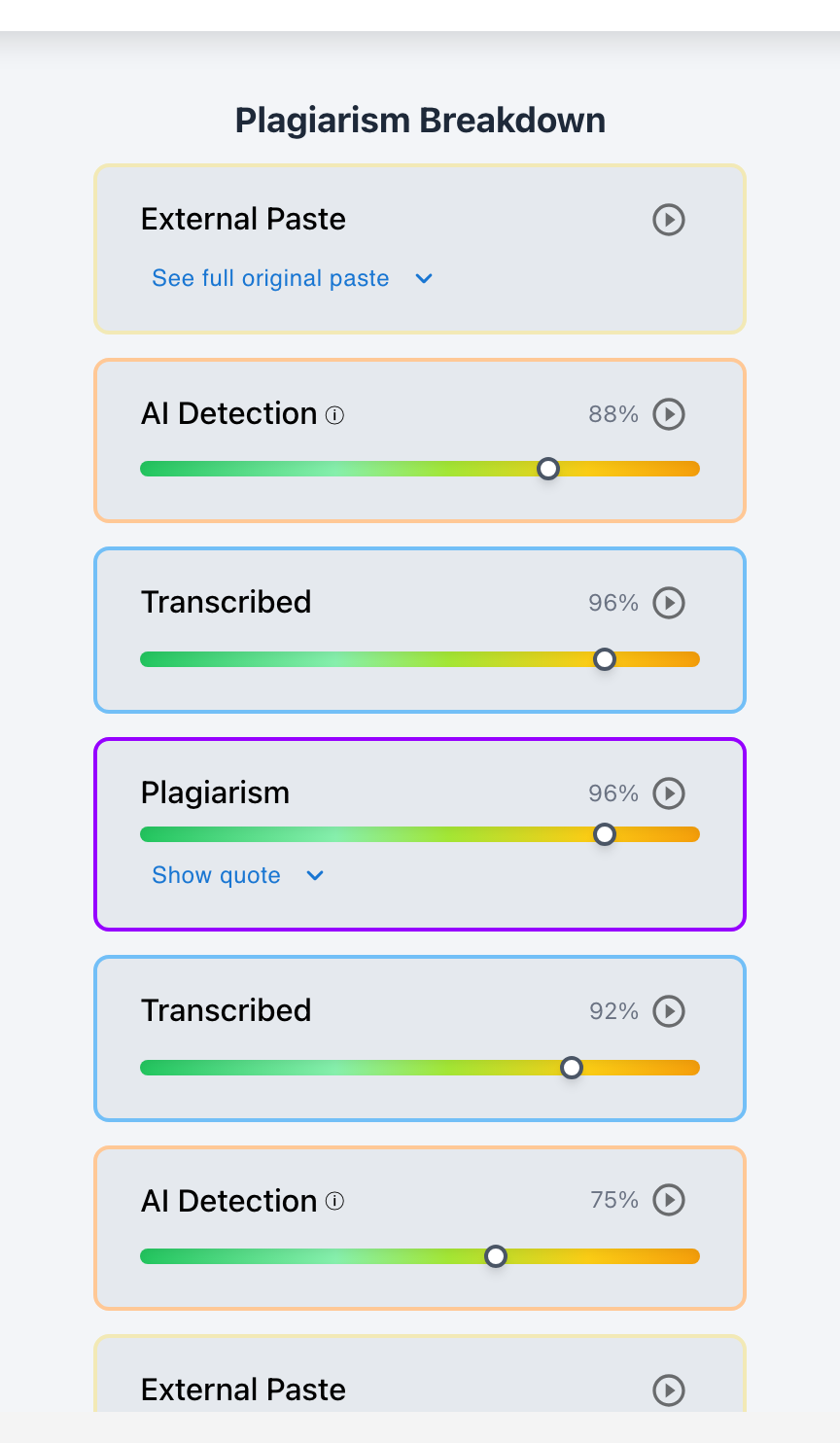
A sudden burst of writing in document history can mean three very different things: a legitimate "flow-state" typing sprint where an inspired student drafts rapidly with natural typos and backspaces, a normal citation paste event (inserting a primary source block quote), or an unauthorized wholesale paste from an AI generator or website.
When teachers review document creation graphs in Google Docs or Canvas SpeedGrader, they often notice sharp spikes in word count. A horizontal line suddenly shoots upward, adding hundreds of words in a brief window. Knowing how to interpret these velocity spikes is essential for fair grading: an inspired human typing burst represents genuine creative momentum, while a 1-second vertical wall represents a clipboard paste payload. Checkmark Plagiarism's Writing History Engine automatically analyzes typing velocity, character counts, and clipboard telemetry to classify every burst.
Below is a comprehensive guide on diagnosing sudden writing bursts in student document timelines.
Checkmark Plagiarism powers burst forensics by pairing essay writing playback with AI detection, plagiarism detection, autograding, and integrations with Canvas and Google Classroom.
The 4 Types of Sudden Writing Bursts
1. Human "Flow-State" Typing Sprint
Velocity: 50–75 WPM over 20–40 minutes.
Telemetry: Character-by-character creation with active backspaces (15–25%) and typo corrections.
2. Legitimate Quotation / Source Paste
Velocity: Instant (0.05s).
Telemetry: 30–80 words inserted from clipboard, enclosed in quotation marks, and followed by immediate citation formatting.
3. Wholesale AI / Web Paste Event
Velocity: Instant (0.05s).
Telemetry: 800–1,500 words inserted in one shot with 0% active typing and 0 subsequent structural edits.
4. Assignment Heading / Template Influx
Velocity: Instant (0.05s).
Telemetry: Inserting teacher-provided rubric headers, lab report section titles, or bibliography templates.
How Keystroke Telemetry Differentiates Typing from Pasting
The difference between fast human typing and clipboard insertion is clear in telemetry:
- The Physical Ceiling: Even the fastest human writers cannot exceed 90–100 words per minute while composing original analytical thoughts. Adding 500 words in 1 minute represents an impossible 500 WPM rate—proving clipboard insertion.
- Keystroke Variance: Human flow-state typing exhibits micro-variations: typing faster on familiar words ("the", "because") and pausing briefly on complex terms ("authoritarianism").
- Backspace Signatures: Flow-state typing is filled with rapid typos and instant corrections. Paste events contain zero keystroke telemetry.
Read more in how Checkmark writing process analysis works.
Comparison: Flow-State Typing vs. Wholesale AI Paste Spike
Human Flow-State Typing (Authentic Effort)
- Adds 400 words over 25 minutes of steady typing.
- 18% backspaces with real-time spelling corrections.
- Variable keystroke velocity with natural pauses.
- Smooth, steep drafting curve on the playback graph.
Wholesale AI Paste Spike (External Influx)
- Adds 1,200 words in 0.05 seconds.
- 0% backspaces; zero keystrokes recorded.
- Vertical 90-degree cliff on the word count graph.
- High AI probability score and zero subsequent edits.
A 5-Step Educator Protocol for Investigating Writing Spikes
Writing Spike Investigation Checklist:
- 1. Open the student's submission in Checkmark Playback inside Canvas SpeedGrader.
- 2. Click on the sudden vertical spike on the time-lapse creation graph.
- 3. Inspect the Paste Event Card: review the character count, timestamp, and raw inserted text.
- 4. If the paste is a short, cited quote or assignment template, dismiss the alert immediately.
- 5. If the paste is 800+ words of body text, cross-reference with AI detection and hold a student check-in.
How Checkmark Plagiarism Powers Velocity Forensics
Checkmark Plagiarism combines **AI detection, essay writing playback, static AI detection, plagiarism detection, autograding, and Canvas/Google Classroom integrations** to automatically categorize writing bursts and provide instant diagnostic clarity.
Frequently Asked Questions
Can a fast student type 500 words in 5 minutes?
Typing 500 words in 5 minutes is 100 WPM—physically possible for elite copy-typists, but composing original academic prose at that speed with zero backspaces is impossible.
What does a flow-state typing session look like in Essay Playback?
It appears as a steep, steady upward curve where words appear character-by-character with realistic typing rhythms and active backspace corrections.
Does pasting a quote trigger a cheating flag?
No. Checkmark recognizes legitimate quote pastes (30–80 words) and verifies whether the text is enclosed in quotation marks and cited properly.
What does a wholesale AI paste look like on the creation graph?
It looks like a vertical 90-degree wall where the word count jumps instantly from 0 to 1,200 words in a single recorded millisecond.
How does Checkmark capture the raw pasted text?
Original Paste Preservation captures the unedited text snippet at the moment of insertion, preserving the original payload even if edited later.
How does Checkmark Plagiarism integrate with Canvas LMS?
Checkmark provides certified LTI 1.3 integration, SpeedGrader sidebar embeds, two-way grade passback, and single sign-on (SSO).
What if a student copied an outline template provided by the teacher?
Checkmark recognizes institutional assignment templates and filters them out of similarity and paste risk scores.
Can students fake realistic flow-state typing?
Simulating 30 minutes of natural typing rhythms, typos, and backspaces requires more effort than actually writing the paper honestly.
Why is keystroke velocity better evidence than raw timestamps?
Because velocity measures character generation per minute, physically proving whether text was typed on that keyboard or inserted from the clipboard.
What should a teacher say if a large paste spike is identified?
Ask supportively: "I noticed this 900-word section was pasted at 10:15 PM. Where did you draft this text prior to inserting it?"
Distinguishing Inspiration from Shortcuts
An inspired writing sprint is a triumph of student engagement that should be celebrated, while a bulk paste shortcut requires supportive intervention. By analyzing keystroke velocity and paste telemetry with Checkmark Plagiarism, educators can evaluate sudden writing bursts with complete accuracy and fairness.
Checkmark Plagiarism supports this comprehensive approach with AI detection, essay writing playback, static AI detection, plagiarism detection, autograding, and integrations with Canvas and Google Classroom.
See how Checkmark pairs velocity burst analytics with multi-signal detection to evaluate student writing inside your LMS. View a sample report or request a demonstration.