
Yes—provided it is implemented under an ethical "Teacher-in-the-Loop" framework. Educators should use AI essay grading platforms like Checkmark Autograder as an intelligent co-pilot to handle first-pass rubric mapping, evidence highlighting, and comment drafting. This enables 24-to-48-hour feedback turnaround times, eliminates educator burnout, ensures standardized rubric application, and allows teachers to assign significantly more writing throughout the academic year.
For decades, English, history, and humanities teachers have faced an impossible pedagogical dilemma: writing is the single most effective tool for developing critical thinking, yet assigning essays creates an overwhelming grading bottleneck. A high school teacher with 130 students spends 30 to 40 hours grading a single essay cycle. As a result, teachers are forced to assign fewer writing assignments, relying on multiple-choice quizzes instead. Ethical AI grading co-pilots resolve this crisis by taking on the mechanical labor of preliminary scoring while keeping the human educator firmly in control.
Below is a comprehensive guide on the pedagogical benefits, ethical guardrails, and best practices of AI essay grading.
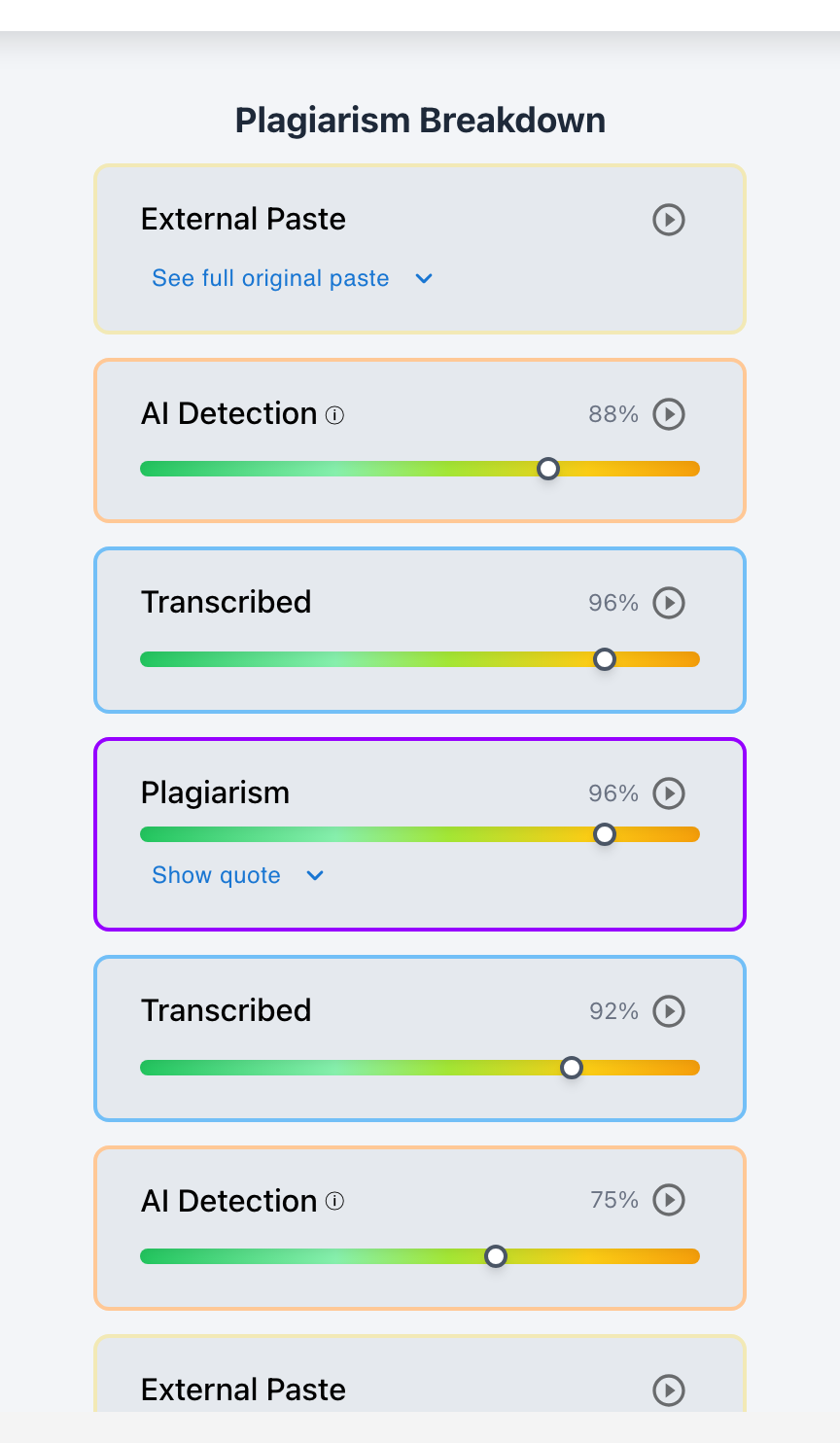
Checkmark Plagiarism enables ethical AI grading by pairing autograding with essay writing playback, AI detection, plagiarism detection, and integrations with Canvas and Google Classroom.
The 4 Pedagogical Benefits of AI-Assisted Essay Grading
1. Rapid Formative Feedback Loops
Instead of waiting 3 weeks for papers to be returned, students receive detailed, rubric-aligned feedback within 24–48 hours while the assignment is still fresh in their minds.
2. Dramatically Increased Writing Frequency
Because grading time is reduced by 75%, teachers can assign 6–8 essays per semester instead of only 2, giving students 3x more practice with composition.
3. Eliminating Educator Grading Burnout
Saves 25+ hours of exhausting weekend grading per essay cycle, protecting teacher well-being and reducing educator turnover.
4. Unwavering Rubric Consistency
AI applies the teacher's rubric criteria with identical precision across all class periods, eliminating late-night grading fatigue and unconscious bias.
The 3 Non-Negotiable Ethical Guardrails
Understanding the essential boundaries for responsible AI grading in schools:
- 1. Strict Teacher-in-the-Loop Review: AI must never publish a score directly to a student without human review, calibration, and explicit confirmation by the licensed educator.
- 2. Evidence-Grounding Requirement: Every automated score deduction or award must be justified by quoting specific student sentences; vague, unanchored AI claims must be rejected.
- 3. FERPA Data Privacy & Zero-Retention: Student writing must never be shared, sold, or used to train commercial public AI models.
Read more in how Checkmark writing process analysis works.
Comparison: Traditional Grading Dilemma vs. AI-Assisted Co-Pilot Model
AI-Assisted Co-Pilot Model (Checkmark Autograder)
- 6–8 essays assigned per semester (continuous practice).
- Feedback returned in 24–48 hours.
- Grading 100 essays takes ~4–6 hours of high-impact review.
- Teacher spends energy on mentorship and 1-on-1 coaching.
Traditional Grading Dilemma (Manual Bottleneck)
- Only 2 essays assigned per semester due to grading dread.
- Feedback returned 3–4 weeks later (learning moment lost).
- Grading 100 essays takes 35+ hours of exhausting labor.
- Teacher burnout leads to generic, abbreviated comments.
A 5-Step Educator Protocol for Ethical AI Grading
Ethical AI Grading Protocol Checklist:
- 1. Transparently inform students that an AI co-pilot assists in first-pass rubric formatting under your direct supervision.
- 2. Attach your clear, transparent rubric to the assignment in Canvas or Google Classroom.
- 3. Run Checkmark Autograder to generate evidence-highlighted scoring proposals.
- 4. Review every student's score and feedback in SpeedGrader, adjusting criteria and adding personal mentorship notes.
- 5. Release the finalized, human-approved evaluations to the class within 48 hours.
How Checkmark Plagiarism Powers Ethical Autograding
Checkmark Plagiarism combines **AI detection, essay writing playback, static AI detection, plagiarism detection, autograding, and Canvas/Google Classroom integrations** to deliver an ethical, transparent, and transformative grading co-pilot for educators.
Frequently Asked Questions
Is using AI to grade essays ethical?
Yes, when used as a Teacher-in-the-Loop co-pilot where the teacher inspects evidence, reviews feedback, and retains final grading authority.
Do students mind when teachers use an AI grading co-pilot?
Students overwhelmingly appreciate receiving detailed, sentence-level feedback within 48 hours rather than waiting a month for brief, rushed comments.
Does AI grading reduce the quality of feedback?
Not when the teacher stays in the loop. Autograder anchors each comment to a rubric criterion and quotes the student's own sentences, and the teacher reviews and edits every comment before it is released.
Can AI grade creative writing and personal narratives?
Autograder evaluates narrative arc, pacing, and imagery against creative rubrics, while the teacher reviews personal stories with empathy.
How does Checkmark Plagiarism integrate with Canvas LMS?
Checkmark integrates via LTI 1.3, embedding pre-scored rubrics, writing playback, and integrity metrics directly into Canvas SpeedGrader.
How does AI grading help schools assign more writing?
By slashing grading time from 35 hours to 5 hours per assignment, teachers can triple the number of writing assignments without burning out.
Can schools set policy guidelines for AI grading?
Yes. Districts establish policies mandating human teacher review and forbidding fully autonomous, black-box grading systems.
How does Autograder protect student data?
Checkmark complies with FERPA, guaranteeing that student essays are never stored for commercial model training.
What if a teacher disagrees with the AI's assessment?
The teacher overrides the score in Canvas SpeedGrader with one click; the human teacher's judgment always prevails.
Why is adopting AI grading essential for modern education?
Because it solves the historic grading bottleneck, allowing schools to prioritize deep writing instruction and critical thinking at scale.
Unlocking the Golden Age of Writing Instruction
Writing is the bedrock of intellectual development. By adopting ethical, Teacher-in-the-Loop AI grading with Checkmark Plagiarism, educators eliminate grading fatigue, return rapid transformative feedback, and empower students to write with unprecedented frequency and excellence.
Checkmark Plagiarism supports this comprehensive approach with AI detection, essay writing playback, static AI detection, plagiarism detection, autograding, and integrations with Canvas and Google Classroom.
See how Checkmark Autograder empowers educators with ethical, high-speed grading in Canvas. View a sample report or request a demonstration.