
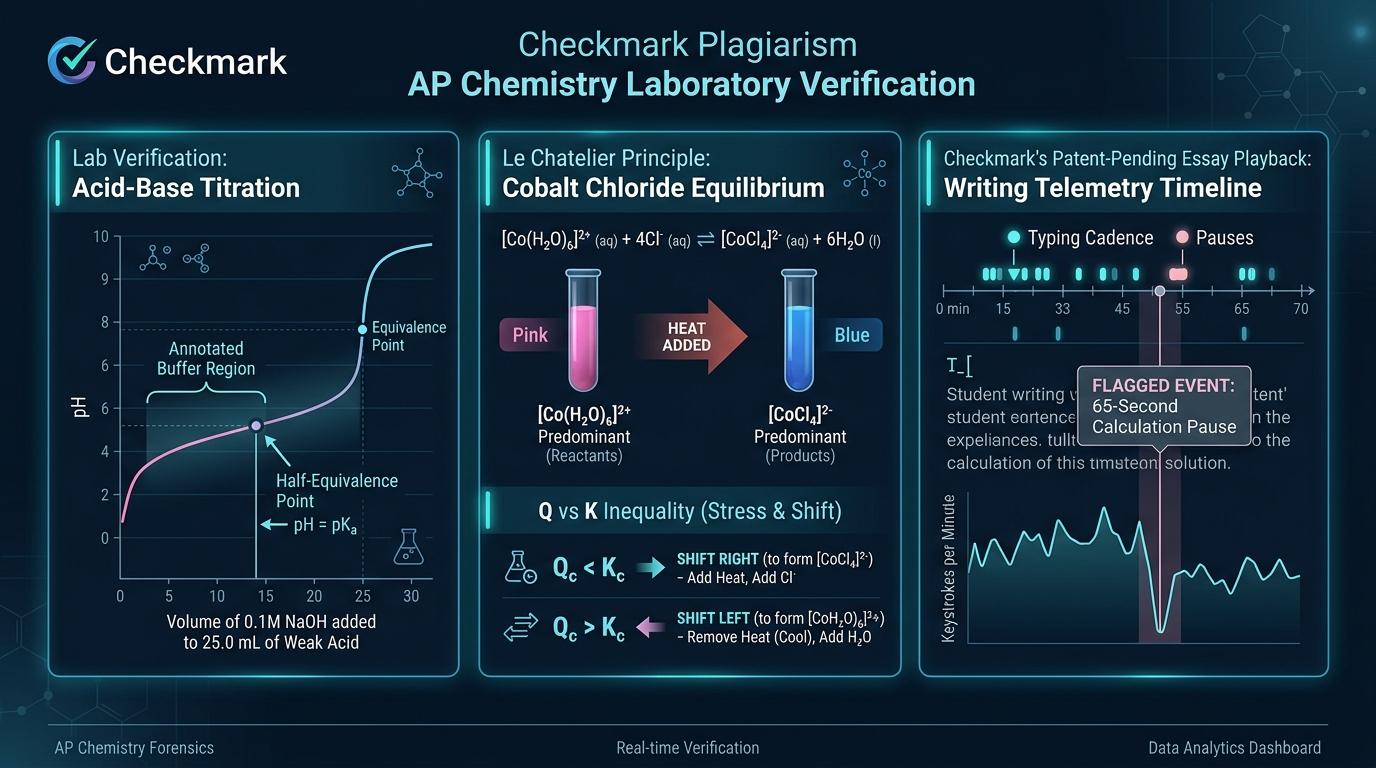
In high school Advanced Placement (AP) and Honors Chemistry classrooms, educators are encountering a confounding phenomenon: student laboratory writeups featuring mathematically pristine, frictionless sigmoidal titration curves, exact zero-error equilibrium constants, and impeccably phrased Claim-Evidence-Reasoning (CER) sections that read like university physical chemistry treatises. Yet, when students conduct these wet labs in 45-minute periods using Class B burets with ±0.05 mL readability, budget benchtop pH probes with thermal drift, and 2-decimal digital scales, experimental data is inherently noisy.
Generic whole-document AI percentage detectors fail catastrophically in high school science: they trigger aggressive false-positive alarms on legitimate student work (because rigid stoichiometric equations, LaTeX formulas, and standard chemical vocabulary match textbook corpora) while remaining completely blind to synthetically fabricated datasets and AI-generated equilibrium justifications.
This comprehensive guide provides AP Chemistry educators, science department chairs, and STEM coordinators with a defensible, multi-layered verification framework. By combining buret-probe physical concordance audits, stoichiometric Q vs. K sanity checks, Checkmark’s patent-pending Essay Playback™ writing telemetry, and restorative lab bench debriefs, teachers can distinguish authentic scientific inquiry from synthetic confabulation, protect honest students, and restore the integrity of the secondary laboratory experience: “Stop guessing, start trusting.”
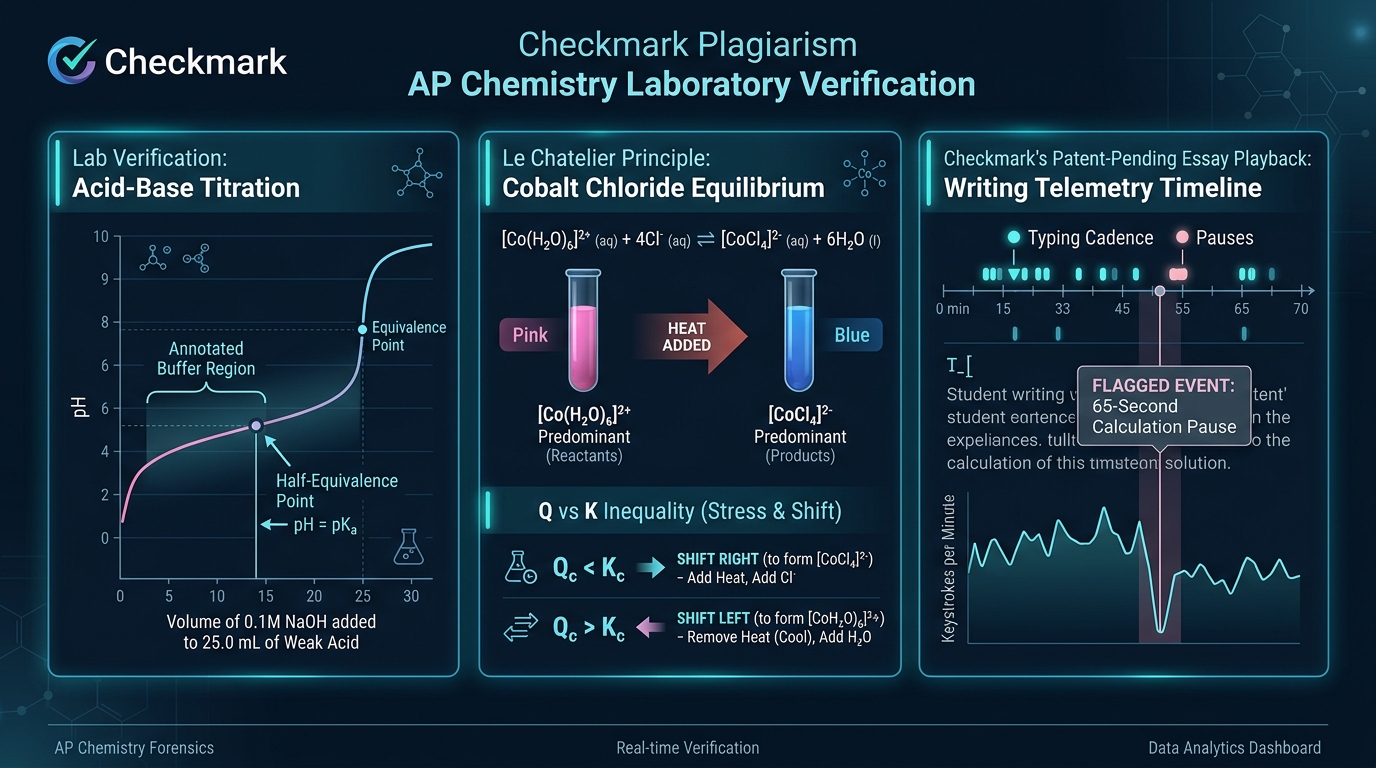
Modern high school science education is grounded in the empirical cycle: forming hypotheses, manipulating laboratory apparatus, collecting imperfect physical data, and defending quantitative claims through rigorous chemical theory. When artificial intelligence tools generate synthetic datasets and perfectly phrased post-lab rationales in seconds, science educators need forensic clarity without alienating honest learners. Checkmark Plagiarism pairs patent-pending Essay Playback™ with passage-level AI confidence sliders, quote-anchored AP rubric autograding, and direct LMS sync for Canvas LMS and Google Classroom.
1. The AP Chemistry Laboratory Architecture & The High School CER Framework
In high school science departments across the country, Advanced Placement (AP) Chemistry stands as one of the most intellectually demanding laboratory courses in the secondary curriculum. Under the College Board Course and Exam Description (CED), laboratory investigations are not merely illustrative demonstrations; they represent the empirical crucible where students cultivate AP Science Practice 5 (Data Analysis) and AP Science Practice 6 (Scientific Argumentation).
Two foundational curricular pillars dominate second-semester high school chemistry inquiry: Unit 7: Chemical Equilibrium and Unit 8: Acids and Bases.
- Weak Acid / Strong Base Potentiometric Curves
- Half-Equivalence Buffering Region (pH = pKa)
- Alkaline Equivalence Point (Conjugate Base Hydrolysis)
- First & Second Derivative Inflection Point Proofs
- Cobalt(II) Chloride Hydration System (Pink ↔ Blue)
- Iron(III) Thiocyanate Complex Ion Equilibrium
- System Stresses: Temperature, Concentration, Dilution
- Quantitative Reaction Quotient Q vs. K Inequalities
• Practice 5 (Data Analysis): Determine Ka/Keq, compute numerical derivative inflection points, propagate instrument error.
• Practice 6 (Scientific Argumentation): Construct CER writeups connecting macroscopic observations to particulate collision models.
Schedule: 45–50 min periods (or 90 min blocks) | Class Size: 28–34 students per section | Glassware: Class B 50.00 mL burets (±0.05 mL) | Probes: Uncalibrated pH meters (±0.1 pH) | Total Teacher Grading Load: 120–160 students.
The Analytical Chemistry Mechanics of Weak Acid–Strong Base Titrations
In a standard high school AP Chemistry laboratory, students perform a potentiometric titration of an unknown weak monoprotic acid (e.g., acetic acid, HC2H3O2 or CH3COOH) with a standardized strong base (e.g., 0.100 M NaOH):
The resulting titration curve is divided into four mathematically distinct chemical zones that high schoolers must calculate, plot, and interpret:
Hydronium concentration is dictated solely by weak acid dissociation equilibrium before any titrant is added:
Governed by Henderson-Hasselbalch. At exactly VNaOH = ½ Veq, [HA] = [A−], making log(1) = 0:
All HA is converted to conjugate base CH3COO−, which undergoes basic hydrolysis with water:
Students identify the true equivalence volume using numerical first- and second-derivative inflection analysis:
The Chemical Dynamics of Le Chatelier’s Principle Inquiries
In Unit 7 laboratory inquiries, high school students stress dynamic equilibrium systems to observe macroscopic shifts and justify them using particulate collision dynamics and reaction quotients (Q).
ΔH° > 0. Adding heat increases Keq, creating a temporary Q < K state that shifts the system right toward tetrahedral [CoCl4]2− (blue).
ΔH° < 0. Adding heat decreases Keq, resulting in Q > K and driving the reverse reaction toward reactants to dissipate thermal energy.
Equilibrium Perturbation & Q vs. K Response Taxonomy
| Stress / Perturbation | Thermodynamic / Q State | System Kinetic Response | Macroscopic Observation |
|---|---|---|---|
| Temp Increase (Hot Bath) | For ΔH° > 0: Knew > Kold ⇒ Q < K | Forward Shift (Ratefwd > Raterev) | Solution shifts from Pink to Dark Blue ([CoCl4]2− rises) |
| Temp Decrease (Ice Bath) | For ΔH° > 0: Knew < Kold ⇒ Q > K | Reverse Shift (Raterev > Ratefwd) | Solution shifts from Blue to Bright Pink ([Co(H2O)6]2+ rises) |
| Addition of Cl− (12M HCl / NaCl) | K unchanged; Q = [CoCl4]/([Co][Cl]4) < K | Forward Shift (Ratefwd > Raterev) | Pink solution turns Blue; Cl− stresses reactant side |
| Addition of AgNO3 (Precipitation) | Ag+ + Cl− → AgCl(s); [Cl−] crashes ⇒ Q > K | Reverse Shift (Raterev > Ratefwd) | White precipitate forms; Solution turns Bright Pink |
| Dilution (Add DI Water) | Volume expands; Q = Q0 · d4 > K | Reverse Shift (Toward more aqueous ions) | Shifts toward side with 5 aqueous species (Reactants) |
The Claim-Evidence-Reasoning (CER) Framework in Secondary Science
To cultivate rigorous scientific argumentation, high school science departments structure laboratory writeups around the CER Framework:
Direct Empirical Assertion
Answers the inquiry question directly: “The unknown weak acid is acetic acid with an experimental Ka of 1.82 × 10⁻⁵, and cobalt chloride complexation is endothermic.”
Quantitative Raw Data
Specific empirical measurements: equivalence volume Veq = 24.35 mL, half-equivalence pH = 4.74, absorbance at 447 nm, and recorded temperature changes.
Chemical Theory Synthesis
Articulates why data supports the claim: Henderson-Hasselbalch buffering, ICE tables, Keq expressions, Le Chatelier principle, and mathematical Q vs. K inequalities.
2. The Acute Laboratory Dilemma: Synthetic Perfection vs. Classroom Reality
When high school chemistry teachers grade a stack of 140 lab writeups over a weekend, they encounter a growing pedagogical crisis: student lab submissions that are mathematically and stylistically indistinguishable from peer-reviewed literature.
Real High School Lab Bench vs. AI Synthetic Artifacts
| Physical Lab Bench Reality | AI-Generated Synthetic Artifact |
|---|---|
| 1. Buret Parallax & Drop Error Students overshoot the end point by 1–2 drops (~0.05–0.10 mL); buret readability is ±0.05 mL with occasional tip bubble adhesion. | 1. Zero-Error Cubic Spline Smoothness Generates 50 data points perfectly matching the theoretical equilibrium polynomial with R2 = 1.0000 and 0.00% parallax. |
| 2. Probe Calibration Drift Uncalibrated Vernier/PASCO probes fluctuate ±0.1 pH units; thermal drift and incomplete magnetic stirring alter readings by 0.05 pH. | 2. Impossible Significant Figures Reports Ka = 1.75482 × 10⁻⁵ or Keq = 138.4921 despite raw measurements taken on a ±0.01 g balance and a ±0.1 mL buret. |
| 3. Indicator Transition Realities Phenolphthalein turns pale pink between pH 8.2 and 10.0; students note the gap between indicator end point and theoretical equivalence. | 3. Confabulated Color & Equivalence Mechanics Claims phenolphthalein turned pink at exactly pH = 7.00, or confabulates bromothymol blue transition in a weak acid titration. |
| 4. Mechanistic Q vs. K Reasoning Students explain shifts using ICE tables, ion concentrations, and mathematical Q < K inequalities connecting micro to macro. | 4. Generic “Relieve Stress” Parroting Repeats textbook boilerplate (“the system shifts right to relieve added stress”) without setting up Q or comparing particulate collision rates. |
The Four Tell-Tale Hallmarks of Synthetic Chemistry Writeups
When a high school student prompts a commercial Large Language Model (e.g., ChatGPT-4o or Claude 3.5 Sonnet) with “Write an AP Chemistry CER lab report for weak acid titration and Le Chatelier cobalt lab,” the model generates distinct synthetic artifacts:
-
Frictionless Synthetic Titration Curves with 0.00% Parallax Error: Real student buret data contains droplet adhesion, meniscus reading parallax (±0.05 mL), and delayed probe equilibration during stirring. Commercial LLMs compute data points using the exact cubic acid-base equilibrium polynomial (
[H+]3 + (Ka + Cb)[H+]2 + ... = 0), yielding smooth simulated curves with zero dropwise scatter and micro-liter perfection impossible on a high school lab bench. -
Significant Figure Violations (5–7 Sig Figs from 2-Decimal Tools): High school hardware limits precision (balances: ±0.01 g ⇒ 3–4 sig figs; burets: ±0.05 mL ⇒ 3–4 sig figs; pH sensors: ±0.1 pH ⇒ 1–2 decimals in pH). Synthetic writeups routinely calculate
Ka = 1.75382 × 10⁻⁵orPercent Error = 0.003184%, revealing backward fabrication from textbook constants. - Confabulation of Indicator End Point vs. Equivalence Point: Generic models frequently confuse the physical indicator transition with stoichiometric equivalence, claiming: “The titration reached equivalence when the solution turned faint pink at exactly pH = 7.00.” In reality, weak acid titrations reach equivalence at pH ≈ 8.72 due to acetate hydrolysis, and phenolphthalein changes color between pH 8.2 and 10.0.
- Hand-Waving Equilibrium Assertions Without Q vs. K Calculations: Authentic AP Chemistry students evaluate the reaction quotient (Q). When volume is halved, [Cl−] doubles, increasing the denominator of Q by 24 = 16, resulting in Q = ⅛ Q0 < K, driving a forward shift. Synthetic text avoids mathematical Q comparisons, relying on anthropomorphic language (“the reaction dislikes pressure and shifts right to relieve stress”).
3. The AP Scoring & Laboratory Integrity Dilemma
High school educators evaluating AP Chemistry lab notebooks must navigate both the formal scoring standards established by the College Board and the technical pitfalls of modern plagiarism detection software.
College Board 10-Point AP Chemistry Lab FRQ Scoring Taxonomy
| Point | Scoring Criterion | Rigid College Board Standard |
|---|---|---|
| Pt 1 | Raw Data Presentation | Complete buret initial/final volumes recorded to 2 decimal places (±0.05 mL). |
| Pt 2 | Stoichiometric Moles Analysis | Correct calculation of titrant moles (n = M × V) delivered at equivalence. |
| Pt 3 | Analyte Molarity Determination | Stoichiometric 1:1 mole ratio applied to find initial [HA] molarity. |
| Pt 4 | Half-Equivalence Identification | Correct extraction of pKa at exactly Veq / 2 from potentiometric curve. |
| Pt 5 | Ka Derivation & Sig Figs | Ka = 10−pKa with correct significant figure tracking from pH decimals. |
| Pt 6 | Equivalence Point pH Justification | Explaining basic pH > 7 via conjugate base hydrolysis (CH3COO− + H2O ⇌ CH3COOH + OH−). |
| Pt 7 | Le Chatelier Directional Claim | Correct prediction of equilibrium shift direction under thermal/concentration stresses. |
| Pt 8 | Particulate & Collision Reasoning | Linking macro shift to unequal forward vs. reverse collision rates. |
| Pt 9 | Q vs. K Inequality Justification | Explicit mathematical proof demonstrating Q < K or Q > K post-perturbation. |
| Pt 10 | Experimental Error Propagation | Evaluating directional effect of clinging buret drops or air bubbles on calculated Ka. |
Why Generic Whole-Document AI Detectors Fail High School Science
When high school science departments attempt to police lab writeups using generic whole-document AI detectors (such as Turnitin AI, GPTZero, or CopyLeaks), the results are disastrous for two opposite reasons:
Failure Mode A: The False-Positive Trap
Chemical equations, Henderson-Hasselbalch derivations, and standard procedural descriptions have low perplexity (predictability) and uniform burstiness. Because every student writes “The buret was conditioned three times with 0.100 M NaOH,” generic models flag authentic student reports with 85%–98% false “AI Scores,” destroying student trust.
Failure Mode B: The Fabricated Data Blindspot
Generic AI detectors only evaluate text syntax; they have zero domain awareness of physical chemistry laws. If a student uses an LLM to invent an impossible, zero-error titration table and lightly edits the surrounding prose, the detector returns a 0% AI score, awarding full credit to completely fake lab work.
4. The High School Chemistry Evidentiary Matrix
To evaluate laboratory authenticity with 100% defensibility, high school educators need a multi-dimensional evidentiary matrix that contrasts legacy tools with modern writing telemetry:
The High School Chemistry Evidentiary Matrix
| Evidentiary Dimension | Paper Lab Notebooks | Generic AI Detectors | Google Docs Revisions | Checkmark Playback™ |
|---|---|---|---|---|
| Raw Data Origin Verification | High; handwritten ink at wet lab bench. | Zero; ignores data validity & physics. | Low; only shows raw text paste events. | High; captures real-time data entry log. |
| Chemical Formula & LaTeX Handling | Static; no proof of calculation process. | Catastrophic; flags formulas as AI text. | Poor; collapses math edits into chunks. | Granular; passage sliders isolate math. |
| Calculation Pause Telemetry | Zero; only shows final computed number. | Zero; no temporal or drafting telemetry. | Minimal; snapshots every few minutes. | Precision; tracks 45–90s scratch pauses. |
| External Paste & Prompt Extraction | N/A; paper only. | Zero; cannot detect clipboard origin. | Basic; shows paste without full payload. | Flawless; captures original raw paste. |
| Rubric & Science Practice Autograding | Manual; 15+ hours of weekend red-inking. | Zero; no grading or rubric functionality. | Zero; versioning tool only. | Automated; quote-anchored AI rubrics. |
5. Step-by-Step Chemistry Teacher Audit Protocol
When an AP or Honors Chemistry educator opens a lab submission that looks suspiciously flawless, they should follow this five-step clinical audit protocol to establish definitive empirical receipts before holding a conference:
Step 1: Buret Drop Volume & Physical pH Probe Concordance Audit
- Buret Precision Limits: Check whether every volume recording respects the ±0.05 mL resolution of a Class B 50 mL buret. If a student records volumes like
14.332 mLor18.174 mL, data was computationally generated. - Equivalence Cliff Jump: In a manual titration, moving across the steep equivalence cliff (pH 4.5 → 9.5) typically occurs over a single drop (≈0.05 mL). Smooth 0.2 pH increments across the entire vertical rise indicate synthetic polynomial calculation.
Step 2: Stoichiometric & Thermodynamic Sanity Checks
- Q vs. K Mathematical Rigor: For Le Chatelier perturbations, ensure the student wrote the exact expression for Q, substituted post-perturbation concentrations, and explicitly proved whether Q < K or Q > K.
- Conjugate Base Hydrolysis Proof: Ensure the student did not claim equivalence occurred at pH = 7.00. Verify their ICE table for acetate hydrolysis (
Kb = 5.6 × 10⁻¹⁰,[OH−] = √(Kb · [CH3COO−])).
Step 3: Analyzing Keystroke Drafting Dynamics with Essay Playback™
- Calculation Pauses: A student calculating an equilibrium constant or Henderson-Hasselbalch ratio on a TI-84 naturally pauses typing for 45 to 120 seconds, followed by typing numerical values with occasional backspaces to correct arithmetic errors.
- Monotonic Transcription vs. Organic Drafting: If 2,000 characters of dense chemical justification are typed at a constant, mechanical speed of 85 words per minute with zero backspaces or structural rearrangements, the student is transcribing an AI output from a second screen.
Step 4: Inspecting External Paste Buffer Payloads
- Original Paste Buffer Preservation: Checkmark preserves the raw, unedited clipboard text even if the student subsequently rewrote every sentence.
- Prompt Remnants: Look for dead giveaways: ChatGPT markdown formatting (e.g.,
**Claim:**,### Scientific Reasoning), unrendered LaTeX delimiters (( ext{p}K_a = 4.74 )), or prompt conversational remnants (“Certainly! Here is your complete AP Chemistry CER writeup...”).
Step 5: Supportive Restorative Lab Bench Debrief at the Fume Hood
- “Stop guessing, start trusting”: Invite the student to the lab bench or fume hood for a 1-on-1 debrief. Review the Playback timeline together transparently.
- Particulate Whiteboard Challenge: Hand the student a dry-erase marker and ask them to sketch submicroscopic particle distributions: “Can you draw the ratio of acetic acid molecules to acetate ions in the beaker when 12.5 mL of NaOH has been added?”
| Time (Min) | Keystroke Activity | Authenticity Interpretation |
|---|---|---|
| 00:00–04:15 | Types lab title, headers, equipment list. | Normal setup typing speed. |
| 04:15–06:30 | [PAUSE: 135s] TI-84 calculation on bench. | AUTHENTIC: Solving [HA] = (Mb·Vb)/Va. |
| 06:30–07:45 | Types “Molarity of HA = 0.0984 M”, edits. | AUTHENTIC: Active numerical drafting. |
| 07:45–07:48 | [PASTE EVENT: 1,420 chars in 1.2s] | FLAGGED: External LLM CER payload containing prompt artifacts. |
| 07:48–08:15 | Adjusts font size, fixes line breaks. | Formatting pasted payload. |
6. Real High School Classroom Case Studies
These real-world case studies illustrate how chemistry educators navigate anomalous lab writeups using writing telemetry, physical concordance checks, and restorative pedagogy.
Incident Profile: Marcus submitted a 6-page digital CER lab report featuring 48 volume data points forming an absolutely frictionless sigmoidal curve with R2 = 1.0000, Ka = 1.80000 × 10⁻⁵, and 0.00% experimental error.
The Investigation: The teacher checked Marcus’s physical bench station and discovered that his group’s Vernier pH probe had dried KCl crystals on the bulb and an uncalibrated +0.4 pH offset. Opening Marcus’s submission in Checkmark Essay Playback™ revealed that Marcus opened Google Docs, typed the title, and at minute 03:12 pasted a 2,400-character payload containing a Python-generated matplotlib data table. Checkmark’s Paste Inspector captured the prompt string: “generate a simulated dataset for 0.100 M acetic acid titrated with 0.100 M NaOH with 50 pts”.
Restorative Resolution: In a supportive debrief, Marcus admitted that his group ran out of time during the 45-minute wet lab and collected only 4 data points. The teacher allowed Marcus to re-titrate the sample after school with a freshly calibrated probe and submit an authentic CER writeup reflecting genuine experimental noise.
Incident Profile: Elena submitted a rigorous CER report on buffer capacity and Henderson-Hasselbalch derivations. A generic whole-document detector flagged her submission with a 94% “AI Score,” triggering an automated cheating alert.
The Investigation: The generic detector flagged Elena’s work simply because it contained dense LaTeX formulas (pH = pKa + log([A−]/[HA])) and ICE calculation tables matching textbook corpora. Elena’s teacher pulled up the Checkmark Playback log, which documented 58 minutes of continuous, organic composition: 14 distinct calculation pauses (ranging from 35s to 110s) as Elena solved equations on scratch paper, real-time typo corrections, and zero external paste events.
Resolution & Outcome: Checkmark’s undeniable keystroke telemetry completely exonerated Elena. The department chair presented the telemetry log to the academic integrity committee, establishing Checkmark as the district-wide verification standard.
Incident Profile: In Jordan’s CER writeup on cobalt(II) chloride equilibrium, the Reasoning section stated: “When silver nitrate (AgNO3) was added, the solution turned blue because silver ions reacted with water molecules, dehydrating the cobalt complex.”
The Investigation: In chemical reality, adding AgNO3 causes Ag+ to precipitate with Cl− forming AgCl(s), which crashes [Cl−], making Q > K and shifting the endothermic system LEFT to the PINK [Co(H2O)6]2+ form. Jordan’s claim that it turned blue and dehydrated water was a classic AI confabulation (hallucination). Checkmark’s Passage Slider flagged the sentence with 89% AI confidence, and the Paste Inspector revealed Jordan pasted the paragraph from a mobile chat app 15 minutes before the submission deadline.
Restorative Resolution: At the lab bench, the teacher mixed cobalt chloride and silver nitrate in a test tube in front of Jordan. Jordan watched the white precipitate form and the solution turn bright pink. The teacher coached Jordan through writing an authentic Q vs. K inequality proof.
7. How Checkmark Plagiarism Empowers High School Chemistry Educators
Checkmark Plagiarism was engineered specifically to solve the unique challenges of secondary STEM and humanities classrooms. Rather than assigning arbitrary, black-box suspicion scores, Checkmark equips educators with actionable, transparent evidence.
Passage-Level Granularity & Sliders
Generic detectors assign an opaque score (e.g., “78% AI”) to entire documents. Checkmark isolates individual passages, displaying clear evidence cards in the sidebar with calibrated confidence sliders. Standardized formulas like pH = −log[H3O+] are recognized as standard curriculum notation, while unedited AI-generated paragraphs are flagged with precision.
Patent-Pending Essay Playback™ (1x–8x)
High school science teachers can scrub through a student’s entire lab report drafting session like a digital video. Teachers observe organic drafting of complex stoichiometry, genuine 60-second calculation pauses where students solve ICE tables on scrap paper, and real-time corrections of chemical formulas and significant figure rounding.
External Paste & Payload Inspector
When a student pastes content into Google Docs, Word, or an LMS editor, Checkmark captures the exact clipboard payload. Even if the student spends an hour rewriting every sentence, Checkmark stores the original pasted text and provides a direct “Jump to Playback” button to show the exact moment of insertion.
Teacher-in-the-Loop AI Rubric Autograder
Grading 150 multi-page CER lab reports can consume 15 to 20 hours of a teacher’s weekend. Checkmark’s AI Autograder evaluates student claims, quantitative data citations, and scientific reasoning against custom AP Chemistry rubrics, generating point breakdowns and quote-anchored justifications while keeping teachers in 100% control before syncing to Canvas or Google Classroom.
8. Frequently Asked Questions (FAQ) for Chemistry Educators & Leaders
Q1: Why do generic AI detectors flag stoichiometric formulas and Henderson-Hasselbalch equations as AI-generated text?
Answer: Generic AI detectors rely on statistical language metrics known as perplexity (word choice predictability) and burstiness (sentence length variation). Mathematical equations like pH = pKa + log([A−]/[HA]) and standardized chemical names (e.g., “sodium hydroxide titrant”, “phenolphthalein indicator”) are linguistically rigid and appear identically across thousands of chemistry textbooks. Generic detectors interpret this predictable text as machine-generated. Checkmark solves this by utilizing passage-level granularity and Essay Playback™ writing telemetry, verifying the authentic process of how the student drafted the equation.
Q2: How can I tell if a student’s titration curve data was fabricated or collected on a real buret?
Answer: Check for three physical laboratory markers:
- Instrument Readability Limits: High school Class B 50 mL burets can only be estimated to ±0.05 mL. If volume readings have 3 or 4 decimal places, the data was generated computationally.
- Equivalence Cliff Shape: In a manual titration, crossing the vertical equivalence region (pH 4.5 → 9.5) almost always occurs over a single drop (≈0.05 mL). If the student’s table shows smooth, gradual 0.2 pH increments across the entire vertical rise, the data is synthetic.
- Drafting Telemetry: Checkmark Essay Playback™ will show whether the data was entered manually point-by-point with authentic typing cadence or dumped into the document via an instantaneous external paste payload.
Q3: What is the difference between an indicator end point and the stoichiometric equivalence point in AP Chemistry?
Answer: The stoichiometric equivalence point is the exact mathematical point where moles of added titrant chemically equal initial moles of analyte (ntitrant = nanalyte). For a weak acid–strong base titration, the equivalence point is basic (pH 8.5–9.2) due to conjugate base hydrolysis. In contrast, the indicator end point is the physical pH range where the chemical indicator changes color (e.g., phenolphthalein transitions from colorless to faint pink between pH 8.2 and 10.0). Generic AI models often confabulate that phenolphthalein turned pink at exactly pH = 7.00, confusing a neutral strong-acid titration with a weak-acid experiment.
Q4: How does Checkmark differentiate between a student pausing to use their calculator and a student reading an AI prompt from their phone?
Answer: Checkmark’s Essay Playback™ captures the full rhythm of composition. When a student pauses for 60 seconds to calculate an equilibrium constant on a TI-84, the subsequent typing involves numerical drafting, decimal placement, unit labels, and occasional immediate backspacing to correct transcription typos. When a student transcribes text from a phone, they type at a continuous, steady, mechanical speed across long prose paragraphs with unnatural rhythm and zero structural pauses.
Q5: How should a high school teacher handle a situation where a student pasted an AI-generated Le Chatelier reasoning section?
Answer: Adopt Checkmark’s restorative approach: “Stop guessing, start trusting.”
- Do not make public accusations. Invite the student to the lab bench or fume hood for a private conversation.
- Open Checkmark Essay Playback™ and show them the exact paste payload and timeline.
- Hand the student a dry-erase marker and ask them to explain the particulate-level mechanism on a lab whiteboard: “Can you show me how adding heat affects the collision frequency and reaction rates of this endothermic reaction?”
- Use the debrief as a coaching opportunity, allowing the student to revise their CER reasoning using their own authentic scientific voice.
Q6: Can students use AI legitimately during an AP Chemistry laboratory inquiry?
Answer: Yes, when explicitly authorized under teacher-established guidelines. Legitimate AI assistance includes: clarifying laboratory safety protocols or SDS hazard sheets before entering the lab, troubleshooting Python or Google Sheets graphing code to plot experimental derivatives, and brainstorming potential sources of systematic experimental error. However, using AI to invent synthetic lab data, write the core Claim-Evidence-Reasoning justification, or bypass genuine scientific analysis constitutes authorship fraud. Checkmark provides teachers with the transparent telemetry needed to uphold this distinction.
Q7: How does Checkmark AI Autograder handle non-standard student phrasing from English Language Learners (ELLs)?
Answer: Unlike rigid keyword matchers that look for exact string matches, Checkmark’s AI Autograder evaluates semantic scientific reasoning. If an ELL student explains that “the equilibrium moves forward because there are fewer molecules on the product side after pressure went up” instead of using formal terminology like “shifts toward fewer moles of gas according to Le Chatelier’s principle”, Checkmark recognizes the underlying conceptual mastery, awards appropriate rubric points, and suggests targeted vocabulary enhancements.
Q8: Does Checkmark integrate with high school Learning Management Systems (LMS) and 1:1 Chromebook workflows?
Answer: Yes. Checkmark integrates natively with Google Docs, Google Classroom, Canvas LMS, Schoology, and Buzz LMS. Teachers can launch Essay Playback and review CER writeups directly within their standard grading workflow, with finalized rubric scores and quote-anchored feedback syncing straight into the LMS gradebook in a single click.
9. Conclusion: Restoring Empirical Trust to Secondary Science Education
The ultimate objective of high school science education is not to produce pristine, error-free documents; it is to teach students how to think critically, interrogate empirical evidence, navigate real-world experimental uncertainty, and construct defensible scientific arguments.
When AI tools tempt students to bypass messy lab measurements in favor of synthetic perfection, traditional black-box detection tools only worsen classroom anxiety and suspicion. By adopting Checkmark Plagiarism’s writing telemetry, patent-pending Essay Playback™, and transparent rubric autograding, high school educators can move beyond guesswork, protect authentic student inquiry, and ensure that secondary school laboratories remain vibrant spaces of genuine discovery.
Ready to Verify Authentic Laboratory Reasoning in Your AP Chemistry Classes?
Equip your science department with patent-pending Essay Playback™, passage-level AI detection, and quote-anchored rubric autograding designed specifically for secondary STEM integrity.