
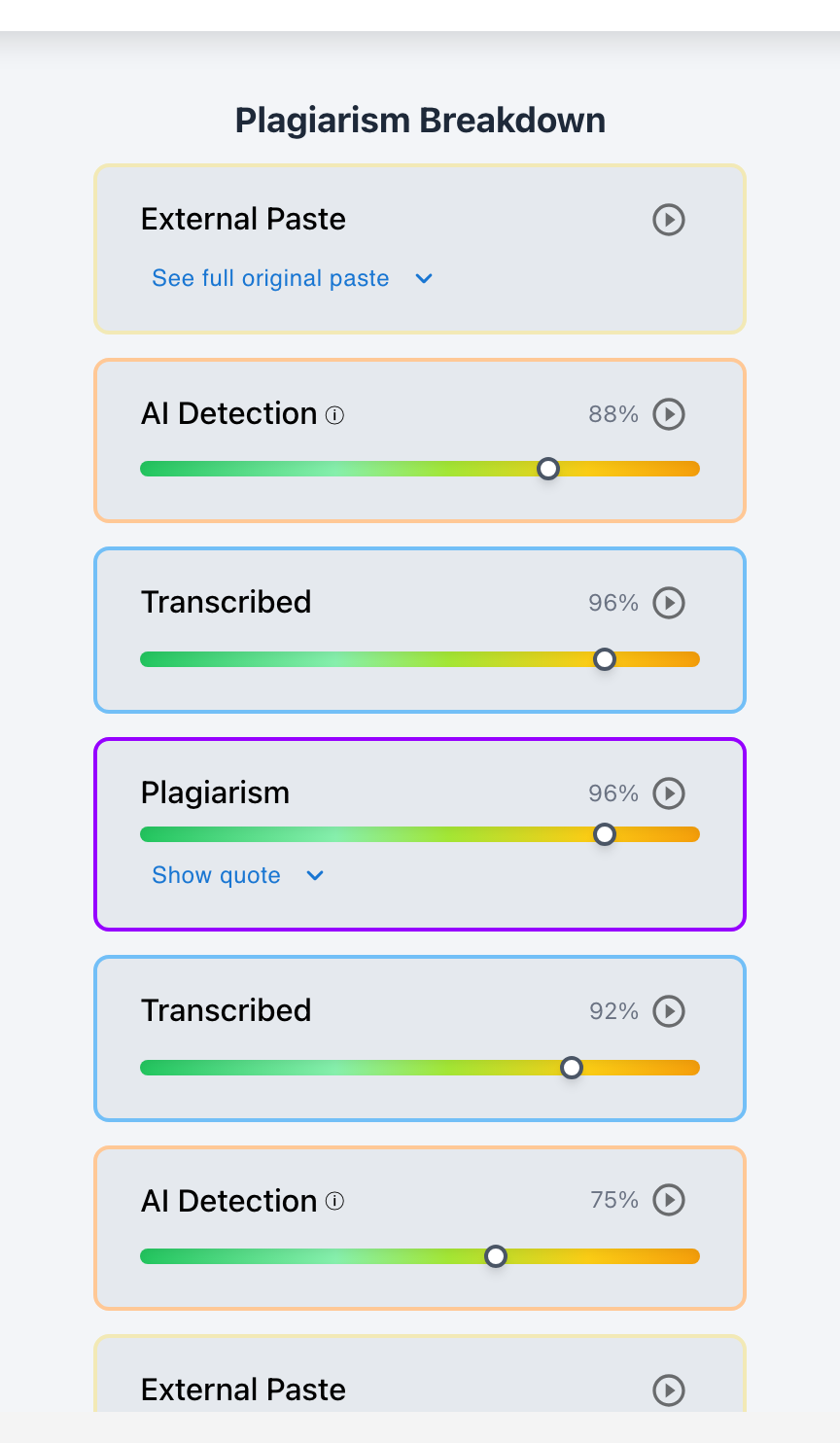
Yes. Teachers should always check writing history and keystroke playback before viewing an AI detector score—because physical writing history provides observable ground truth of human labor. If document telemetry shows 3+ hours of active typing with organic backspaces and revisions, the student wrote the essay, instantly eliminating false positive alarms and preventing confirmation bias.
When an educator runs an AI detector first, the resulting number (whether it is 30% or 90%) immediately biases their reading of the essay. A teacher who sees a high AI score begins hunting for robotic phrases, overlooking the student's authentic intellectual effort. By reversing this workflow and checking writing history first, teachers determine whether the student engaged in genuine keyboard composition before ever consulting a probabilistic model. Checkmark Plagiarism embeds writing playback directly alongside AI analysis in Canvas SpeedGrader to facilitate this best-practice workflow.
Below is a comprehensive guide on why checking writing history first is the gold standard of modern grading.
Checkmark Plagiarism enables writing-history-first grading by pairing essay writing playback with AI detection, plagiarism detection, autograding, and integrations with Canvas and Google Classroom.
The 4 Reasons to Check Writing History First
1. Elimination of False Alarm Fatigue
Checking writing history clears 95%+ of false AI alarms in under 10 seconds. Seeing 4 hours of typing and 22% backspaces confirms authenticity immediately.
2. Ground Truth vs. Probabilistic Guessing
An AI detector is a mathematical prediction of word likelihood; keystroke playback is a factual, digital recording of human physical effort.
3. Protection for Neurodivergent & ELL Writers
Students with structured, formal writing styles often trigger AI alarms; checking playback first ensures their hard work is validated without bias.
4. Instant Identification of External Pastes
If writing history shows a 0.05-second paste payload with zero drafting hours, teachers know immediately that the text was generated externally.
The Psychology of Confirmation Bias in Grading
Understanding why score-first workflows harm student-teacher trust:
- The "AI Colored Glasses" Effect: Once a teacher sees a "95% AI" badge, perfectly normal human phrases like "In conclusion" or "Furthermore" are interpreted as proof of ChatGPT generation.
- Reversing the Burden of Proof: Relying on detectors forces honest students into the defensive position of having to prove their innocence against an algorithm.
- The Playback Antidote: Writing playback shifts the standard of proof back to physical evidence, creating a transparent, supportive grading environment.
Read more in how Checkmark writing process analysis works.
Comparison: AI Detector First vs. Writing History First
Writing History First (Objective & Fair)
- Checks active typing duration and backspace depth.
- Authentic 3+ hour papers cleared in 10 seconds.
- Eliminates false accusation anxiety for teachers and students.
- AI score consulted only when drafting telemetry fails.
AI Detector First (High Bias & Conflict)
- Anchors teacher on a statistical probability percentage.
- Generates false positive suspicion on gifted writers.
- Creates adversarial student conferences.
- Requires tedious manual fact-checking to undo bias.
A 5-Step Educator Protocol for History-First Grading
History-First Grading Checklist:
- 1. Open the student's submission in Canvas SpeedGrader with Checkmark enabled.
- 2. Glance first at the Active Typing Duration metric in the sidebar.
- 3. If active time exceeds 2.5 hours with >15% backspaces, grade the paper directly on rubric criteria.
- 4. If active time is under 15 minutes, check the Clipboard Paste Log and consult the AI detector heatmap.
- 5. If multi-signal telemetry confirms external text insertion, schedule a supportive 2-minute check-in.
How Checkmark Plagiarism Powers History-First Workflows
Checkmark Plagiarism combines **AI detection, essay writing playback, static AI detection, plagiarism detection, autograding, and Canvas/Google Classroom integrations** to present writing process metrics at the top of every grading report, encouraging an evidence-first approach.
Frequently Asked Questions
Why is writing history more reliable than an AI detector?
Because writing history is an empirical record of real-time keystrokes and active typing hours, whereas an AI detector is a statistical estimate vulnerable to false positives.
What if an essay scores 90% AI on a detector, but took 4 hours to type?
The essay is authentic human writing. The 4 hours of typing and backspaces prove human composition, and the detector score is a false positive.
How does writing playback show that a student didn't just retype AI text?
Natural human drafting exhibits variable typing bursts, frequent backspaces (15–25%), and long thinking pauses, whereas retyping produces a flat, mechanical speed with zero structural edits.
Can students see their writing history in Canvas?
Yes. Students can view their writing playback to reflect on their drafting habits and provide transparent proof of their effort.
How does Checkmark Plagiarism integrate with Canvas LMS?
Checkmark provides certified LTI 1.3 integration, SpeedGrader sidebar embeds, two-way grade passback, and single sign-on (SSO).
What should a teacher do if writing history shows zero drafting time?
Check if the student drafted in an offline desktop app (requesting the .docx file with version history) or hold a conference to check if the text was pasted from AI.
How fast can a teacher check writing history in SpeedGrader?
In Checkmark, active drafting duration and deletion rates are summarized in a prominent sidebar badge, taking less than 5 seconds to review.
Why does AI-first grading harm English Language Learners?
Because non-native writers often use simpler, more formulaic sentence structures that trigger AI detectors, leading to unfair accusations unless history is checked first.
How does Autograder utilize writing history?
Checkmark Autograder incorporates drafting effort and revision depth into formative rubric feedback, rewarding authentic human labor.
Why is a history-first protocol essential for institutional integrity?
Because it ensures that academic decisions are always grounded in observable, verifiable facts, protecting student due process and teacher credibility.
Grounding Assessment in Observable Reality
Grading should be an act of recognizing and guiding student achievement. By placing writing history and keystroke playback at the forefront of every review with Checkmark Plagiarism, educators ensure that honest student effort is celebrated, false alarms are eliminated, and assessment is always just.
Checkmark Plagiarism supports this comprehensive approach with AI detection, essay writing playback, static AI detection, plagiarism detection, autograding, and integrations with Canvas and Google Classroom.
See how Checkmark pairs writing history with multi-signal detection to support history-first grading. View a sample report or request a demonstration.