
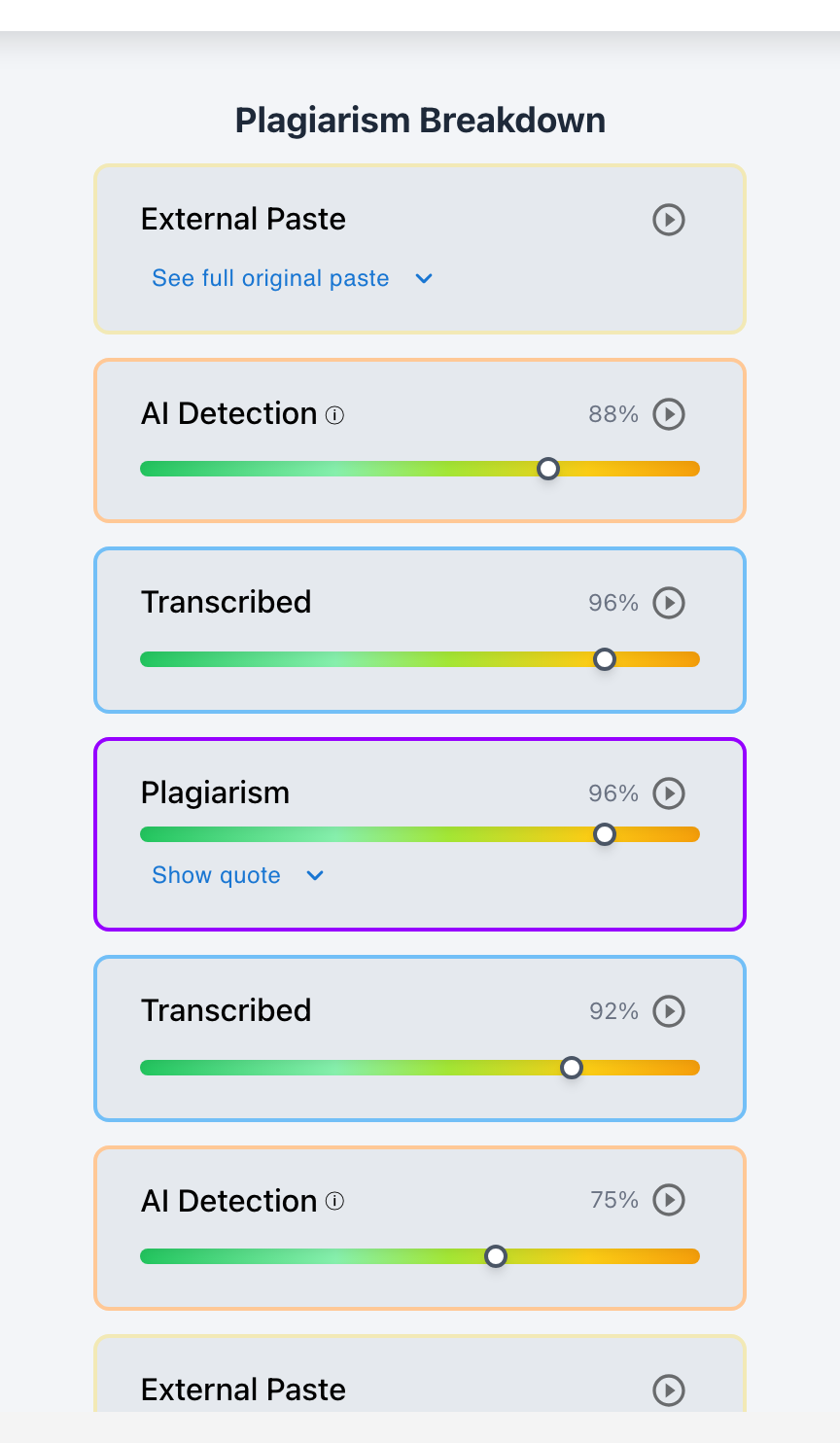
Yes. Students must always have the right to appeal AI detection decisions. Because automated AI detectors are probabilistic models capable of generating false positives on advanced or multilingual writers, a transparent appeals process is a foundational requirement of educational due process. School policies should provide a 5-to-10 day appeal window where students can present independent drafting artifacts (handwritten notes, outline timestamps, or cloud version history) to an impartial Honor Committee. Checkmark Plagiarism provides the objective evidence framework needed to resolve appeals fairly.
Denying students the right to appeal an AI cheating accusation violates basic legal due process and destroys student trust in academic institutions. When a student who spent 10 hours drafting an original research paper is penalized without recourse because an unverified algorithm outputted an 85% score, the educational damage is catastrophic. A structured, transparent appeals process provides a safety valve that protects innocent students from algorithmic errors while ensuring that genuine academic dishonesty is adjudicated fairly and defensibly.
Below is a comprehensive guide for school leaders on designing a robust, legally sound student appeals framework for AI misconduct cases.
Checkmark Plagiarism supports fair student appeals by pairing AI detection with essay writing playback, plagiarism detection, autograding, and integrations with Canvas and Google Classroom.
The 4 Pillars of a Fair Student Appeals Framework
1. The Formal 5-Day Appeal Window
Students must receive written notice of the finding along with the Checkmark dossier, with 5 business days to file a formal appeal form.
2. Admissibility of Independent Artifacts
Students are entitled to submit handwritten notes, brainstorming outlines, voice memos, or original Google Drive version logs as evidence.
3. Impartial Committee Review
Appeals are heard by an independent Academic Honor Committee or Department Chair rather than the accusing teacher alone.
4. The Supervised Prompt Option
If evidence is contested, the student can prove authentic authorship by completing a 15-minute in-person writing prompt on the same thesis.
The 3 Legitimate Artifacts Students Can Present on Appeal
Understanding the empirical evidence students use to prove authentic authorship:
- Artifact 1: Continuous Cloud Version History: The student shares their original Google Doc or Word file showing hours of incremental drafting timestamps and organic deletions.
- Artifact 2: Physical Pre-Writing & Research Notes: The student brings in physical notebooks, annotated library printouts, or digital research bookmarks demonstrating the origin of cited ideas.
- Artifact 3: Checkmark Writing Playback Replay: The student and committee review the 15-second time-lapse replay together to verify active typing cadence.
Read more in how Checkmark writing process analysis works.
Comparison: Arbitrary Finality vs. Structured Due Process Appeals
Structured Due Process Appeals (Fair & Defensible)
- Formal 5-day appeal window with impartial panel.
- Student presents independent drafting artifacts.
- Checkmark playback dossier provides objective data.
- Protects school from legal and accreditation challenges.
Arbitrary Finality (High-Risk & Unfair)
- Teacher's accusation is final with zero recourse.
- Innocent students penalized by algorithm errors.
- Sparks explosive parental meetings and attorney involvement.
- Destroys student morale and trust in administration.
A 5-Step Leadership Protocol for Managing Student Appeals
Student Appeals Management Checklist:
- 1. Provide the student and family with the official Checkmark Multi-Signal Case Dossier.
- 2. Accept the student's written Appeal Request and accompanying drafting artifacts within 5 days.
- 3. Convene the Academic Honor Committee to review the dossier alongside the student's artifacts.
- 4. Conduct a 10-minute hearing allowing the student to explain their drafting process and sources.
- 5. Issue a formal, written determination: either upholding the finding or completely exonerating the student.
How Checkmark Plagiarism Powers Fair Appeals
Checkmark Plagiarism combines **AI detection, essay writing playback, static AI detection, plagiarism detection, autograding, and Canvas/Google Classroom integrations** to provide objective, indisputable telemetry data that makes appeal hearings rapid, fair, and decisive.
Frequently Asked Questions
Why is an appeals process legally required in public schools?
In public institutions, grades and disciplinary sanctions impact student educational records and property interests, requiring constitutional Fourteenth Amendment procedural due process.
What if a student has no drafting notes but claims they wrote it?
The committee can offer the student a 15-minute in-person writing prompt on the same topic to evaluate whether their spontaneous writing voice matches the essay.
Who should sit on the Academic Honor Appeals Committee?
A balanced committee typically includes an administrator, a department chair from another subject, an ELA teacher, and a student advocate or counselor.
How does writing playback help the appeals committee?
Playback provides physical video proof of how the essay was constructed, allowing the committee to see whether text was typed over hours or pasted in seconds.
How does Checkmark Plagiarism integrate with Canvas LMS?
Checkmark allows administrators to review student submissions, playback logs, and appeal notes directly inside Canvas.
What happens if an appeal is successful?
The academic penalty is completely removed, the essay is graded on merit, and all disciplinary notes are expunged from the student's file.
Can a student appeal more than once?
Standard policy typically provides one appeal to the Honor Committee and a final discretionary review by the Principal or Head of School.
How does an appeals process deter dishonest students?
Dishonest students realize that appeals require producing verifiable drafting artifacts and explaining ideas orally, discouraging frivolous claims.
How does Checkmark Autograder assist during appeals?
Autograder provides the original rubric benchmark and text-highlighted analysis, giving the committee full context on the initial academic evaluation.
Why does an appeals process strengthen school culture?
Because students respect rules when they know the system is transparent, fair, and dedicated to protecting their rights.
Upholding Academic Justice for Every Learner
True integrity requires the humility to listen and the mechanisms to correct mistakes. By establishing a transparent student appeals process supported by Checkmark Plagiarism's objective process telemetry, schools ensure that every student receives fair due process and academic justice.
Checkmark Plagiarism supports this comprehensive approach with AI detection, essay writing playback, static AI detection, plagiarism detection, autograding, and integrations with Canvas and Google Classroom.
See how Checkmark provides objective telemetry evidence for academic integrity appeals in Canvas. View a sample report or request a demonstration.