
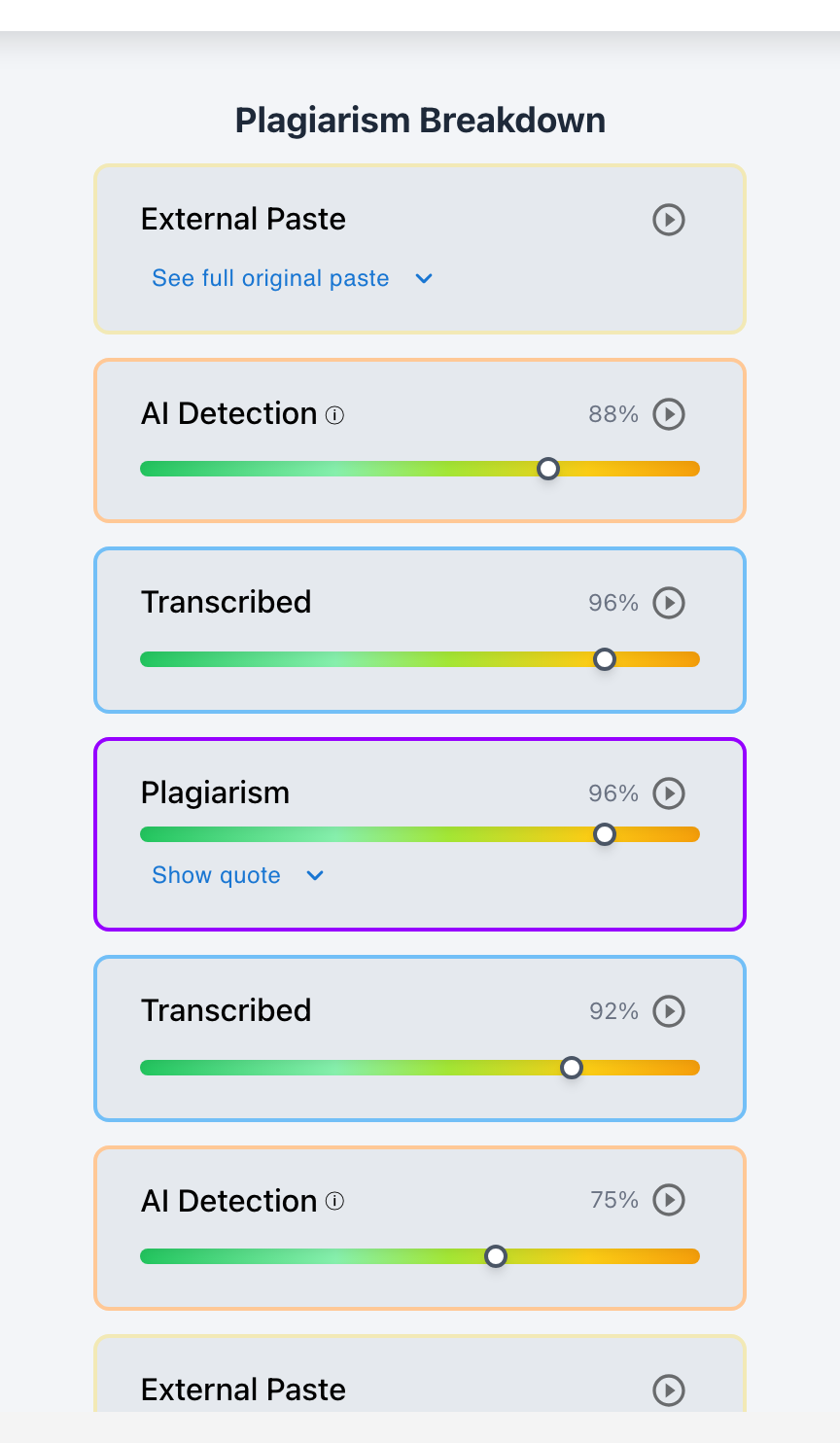
AI detection should never be used as standalone evidence to penalize a student; it should strictly be used as a triage starting point that prompts educators to review multi-signal process evidence, keystroke playback, citation validity, and student dialogue.
The arrival of generative AI in education sparked a rush toward automated enforcement, with some institutions attempting to treat algorithmic probability percentages as judge, jury, and executioner. This approach has proven disastrous: it produces false accusations against articulate writers, ignores student due process, and damages the trusting relationship between teachers and students. At Checkmark Plagiarism, our foundational philosophy is that software should empower human teachers with transparent evidence—not replace teacher judgment with an unexplainable number.
Below is an in-depth exploration of why AI detection must be positioned as a starting point and how multi-signal verification creates an ethical, legally sound academic integrity standard.
Checkmark Plagiarism powers this philosophy by pairing AI detection with essay writing playback, plagiarism detection, autograding, and integrations with Canvas and Google Classroom.
The 4 Principles of Checkmark's Evidence-First Philosophy
1. Triage Indicator, Not Verdict
An AI score is an algorithmic alert suggesting where a teacher should look closer, not proof of academic misconduct.
2. Mandatory Process Corroboration
No disciplinary determination is made without reviewing physical drafting evidence: active typing hours, revision depth, and paste logs in Essay Playback.
3. Human-in-the-Loop Authority
Software provides objective forensic data, but the classroom teacher retains complete professional judgment and authority over academic evaluations.
4. Unwavering Student Due Process
Every student is guaranteed the opportunity to present document revision histories, research notes, and participate in a supportive oral defense.
Why 'Evidence-First' Protects Institutional Integrity
Treating AI detection as a starting point provides major institutional benefits:
- Eliminates Wrongful Accusations: Articulate students with high AI scores are immediately cleared when their 4-hour typing log and 25% backspace rate are verified.
- Unassailable Case Files: When real misconduct occurs, teachers present a complete dossier (AI score, instant paste timestamp, hallucinated citations) that withstands any appeal.
- Restores Pedagogical Focus: Shifting emphasis from policing to celebrating the drafting process encourages students to develop authentic writing skills.
Read more in how Checkmark writing process analysis works.
Comparison: AI Detection as Evidence vs. AI Detection as a Starting Point
AI as Standalone Evidence (Flawed Model)
- Issues a zero based strictly on an 85% AI score.
- Ignores keystroke logs, drafting time, and revisions.
- Treats probabilistic estimates as definitive proof.
- High false accusation rate; vulnerable to appeals.
AI as a Starting Point (Checkmark Model)
- AI score prompts teacher to open Essay Playback.
- Verifies active typing hours, backspaces, and paste logs.
- Audits citations for AI hallucinations in Google Scholar.
- Grounds decisions in undeniable, multi-signal proof.
A 5-Step Educator Protocol for Multi-Signal Verification
Checkmark Multi-Signal Protocol:
- 1. Review the Checkmark AI Detection score as an initial triage indicator.
- 2. Open Essay Playback to inspect active typing duration, session count, and backspace rates.
- 3. Cross-check cited bibliography sources in academic databases to rule out hallucinations.
- 4. Compare the submission against the student's in-class diagnostic writing baseline.
- 5. Hold a 2-minute oral check-in if minor clarification is required before recording the grade.
How Checkmark Plagiarism Powers Ethical Integrity
Checkmark Plagiarism combines **AI detection, essay writing playback, static AI detection, plagiarism detection, autograding, and Canvas/Google Classroom integrations** to turn AI detection into an ethical, transparent, and legally defensible process directly inside your LMS.
Frequently Asked Questions
Why shouldn't schools use AI detectors as proof of cheating?
Because AI detectors measure statistical vocabulary predictability, not actual creation history. They are probabilistic tools that cannot provide legal or forensic proof on their own.
What does it mean to use AI detection as a 'starting point'?
It means a high AI score prompts the teacher to examine physical drafting evidence—such as keystroke writing playback, active typing time, and citations—before making any decision.
How does writing playback support this philosophy?
Playback provides the physical ground truth of creation—showing whether an essay was typed over hours with revisions or inserted in an instant clipboard paste.
What is a normal student backspace rate?
Authentic student writing typically exhibits a 15% to 30% backspace/edit rate as thoughts are refined. AI copy-pastes show 0% edits.
How does Checkmark Plagiarism integrate with Canvas LMS?
Checkmark Plagiarism displays visual writing playback timelines, session breakdowns, and dual AI/plagiarism reports directly inside Canvas SpeedGrader.
How does this philosophy protect teachers from parent disputes?
Teachers present verifiable physical facts (video playback replays, active typing hours, and paste timestamps) rather than defending an abstract algorithm score.
Can students request a playback review if falsely accused?
Yes. Checkmark ensures that students have full access to their writing playback timelines and revision histories to defend their authentic work.
What should a school's official AI policy state?
It should explicitly state that AI detection scores are triage tools and that disciplinary actions require multi-signal evidence including writing process analytics.
Does this approach take more grading time?
No. With Checkmark embedded directly in Canvas SpeedGrader, reviewing typing duration, revision depth, and citations takes under 45 seconds per flagged paper.
Why is preserving student-teacher trust essential?
Because education relies on mentorship. Accusing students without proof destroys morale, while evidence-based verification nurtures authentic learning and growth.
Empowering Educators with Ethical, Multi-Signal Truth
Technology should serve education, not dictate it. By positioning AI detection as a starting point and grounding integrity in physical essay writing playback, Checkmark Plagiarism ensures that academic rigor, student due process, and human mentorship remain at the heart of learning.
Checkmark Plagiarism supports this comprehensive approach with AI detection, essay writing playback, static AI detection, plagiarism detection, autograding, and integrations with Canvas and Google Classroom.
See how Checkmark pairs essay writing playback with multi-signal detection to implement ethical, evidence-based academic integrity inside your LMS. View a sample report or request a demonstration.