
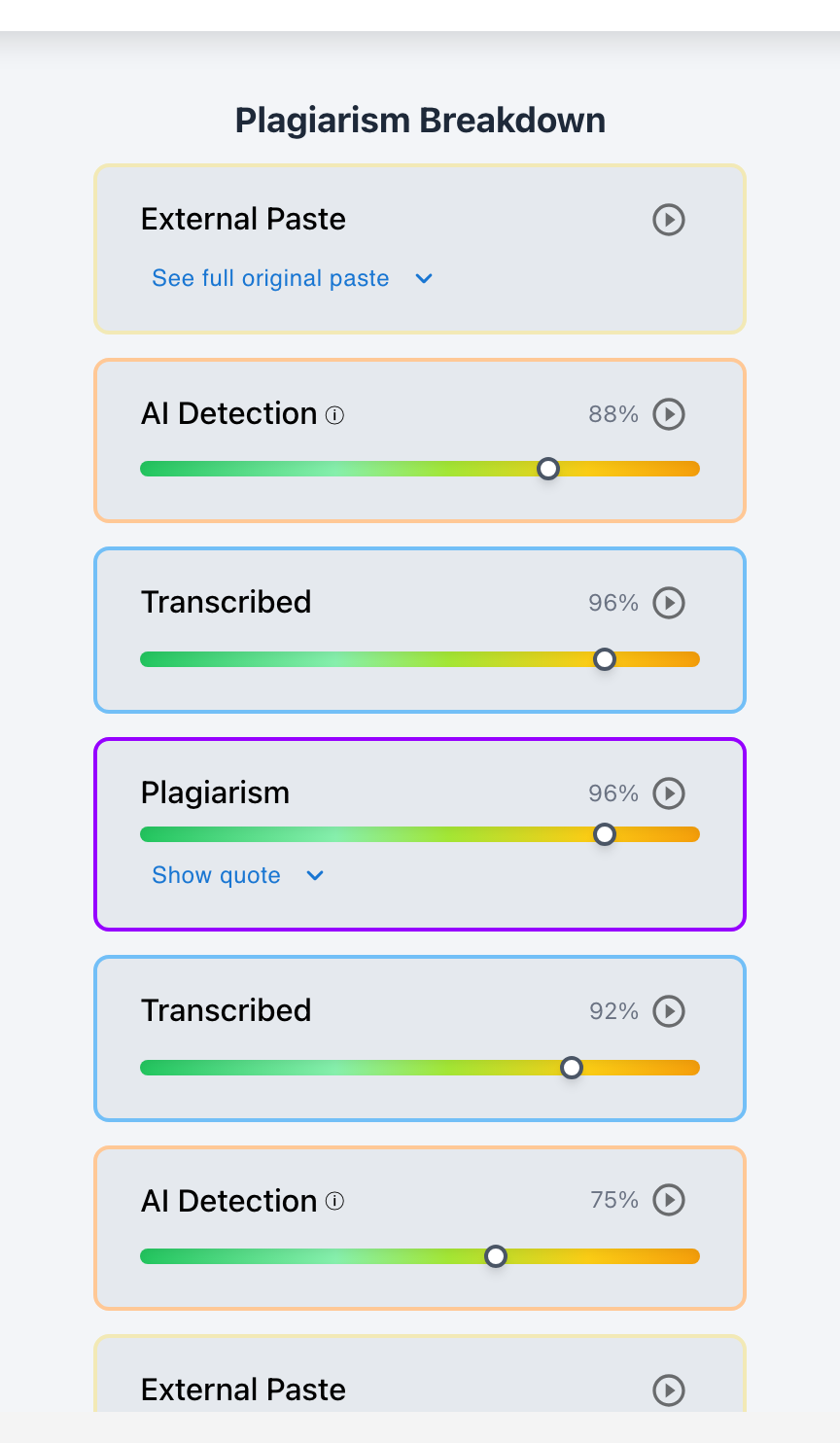
When a student submits an essay that is dramatically more sophisticated than their normal writing, teachers should follow a structured 4-step diagnostic protocol: 1) Compare the submission against their verified In-Class Writing Baseline in Checkmark; 2) Inspect Checkmark Writing Playback telemetry (checking whether the complex prose required 4+ hours of intense drafting or appeared in minutes); 3) Verify citation validity and DOIs; and 4) Hold a supportive 2-minute diagnostic oral check-in. If the student demonstrates multi-hour drafting effort and oral mastery, celebrate their genuine writing breakthrough.
Every writing teacher dreams of seeing a struggling student suddenly write a brilliant, eloquent essay. However, in the era of generative AI and online paraphrasers, a sudden leap from a C-level paragraph to graduate-level prose often signals unauthorized external assistance or ghostwriting. Accusing a student of cheating when they legitimately worked with a tutor or experienced an authentic cognitive breakthrough is devastating. Teachers need objective forensic tools to celebrate genuine student growth while addressing unauthorized authorship with complete fairness.
Below is a comprehensive guide on investigating sudden changes in student writing style.
Checkmark Plagiarism analyzes stylistic divergence by pairing essay writing playback with AI detection, plagiarism detection, autograding, and integrations with Canvas and Google Classroom.
The 4 Potential Causes of a Stylistic Leap
1. Authentic Student Breakthrough (Legitimate)
The student invested extensive time (5+ hours), worked closely with the school writing center or peer tutor, and experienced genuine cognitive growth.
2. Synthetic Generative AI Assistance (Misconduct)
The student prompted ChatGPT to write or heavily rewrite their essay, injecting advanced vocabulary and complex syntactic structures they do not understand.
3. Third-Party Adult Ghostwriting (Misconduct)
A parent, older sibling, or private paid tutor wrote or substantially rewrote large portions of the essay for the student.
4. Uncited Source Patchwriting (Formative)
The student spliced together sophisticated sentences copied directly from published academic articles without proper quotation marks.
The 4-Step Baseline Diagnostic Protocol
How Checkmark establishes authentic authorship during stylistic leaps:
- Step 1: Checkmark Baseline Differential: Compare the essay's readability index, vocabulary richness, and average sentence length against the student's in-class diagnostic writing sample.
- Step 2: Active Typing Duration Check: Authentic human improvement takes immense labor: check if Playback logs 4+ hours of active drafting with healthy deletions (18–25% backspaces).
- Step 3: Automated Citation Audit: Check if cited DOIs and references exist in real scholarly databases or if they are synthetic hallucinations.
- Step 4: The 2-Minute Diagnostic Oral Check-In: Ask the student to define advanced vocabulary words used in the paper and explain how they developed their thesis.
Read more in how Checkmark writing process analysis works.
Comparison: Authentic Student Breakthrough vs. AI/Ghostwritten Essay
Authentic Student Breakthrough (Celebrate & Reward)
- Playback logs 4 to 6 hours of persistent drafting labor.
- Version history shows gradual, messy structural evolution.
- Student fluently defines every complex word used.
- Student proudly explains how their thesis developed.
AI / Ghostwritten Essay (Investigate & Address)
- Document appeared in a single paste or <15 min session.
- Zero drafting notes or pre-writing outlines exist.
- Student cannot define advanced vocabulary in paragraph 2.
- Contains hallucinated academic citations and dead DOIs.
A 5-Step Educator Protocol for Stylistic Mismatches
Stylistic Mismatch Investigation Checklist:
- 1. Notice the stylistic jump: open the student's Baseline Comparison card in Canvas SpeedGrader.
- 2. Inspect Checkmark Writing Playback: check active drafting hours and backspace percentages.
- 3. Run Citation Verification: confirm all cited sources and quotes exist in real databases.
- 4. Hold a private conference: "Your essay is written with incredible depth. Can you walk me through your research and define this term on page 2?"
- 5. If verified, give enthusiastic praise and celebrate their hard work; if unverified, discuss academic integrity standards.
How Checkmark Plagiarism Powers Baseline Analysis
Checkmark Plagiarism combines **AI detection, essay writing playback, static AI detection, plagiarism detection, autograding, and Canvas/Google Classroom integrations** to automatically compare submissions against verified in-class student baselines.
Frequently Asked Questions
Can a struggling writer suddenly improve without cheating?
Yes. Students who spend hours revising, attend tutoring, or write on topics they are deeply passionate about can produce remarkable leaps in quality.
How does writing playback prove an authentic breakthrough?
Watching a student spend 5 hours typing, pausing, re-wording sentences, and restructuring arguments provides undeniable physical proof of genuine cognitive labor.
What if a student cannot define the words they used in the essay?
If a student cannot explain central vocabulary words or arguments in their own paper, it indicates that someone or something else composed the text.
How does Checkmark Plagiarism integrate with Canvas LMS?
Checkmark embeds baseline deviation indicators directly in Canvas SpeedGrader, flagging stylistic leaps alongside writing playback links.
What should a teacher do if a parent wrote the essay for the student?
Hold a conference with the student (and parent if necessary) explaining that while parental feedback is welcome, the writing must be the student's authentic cognitive work.
How does establishing an in-class baseline help during the year?
Having a verified 30-minute handwritten or in-class digital writing sample from September gives teachers an objective stylistic benchmark for the entire school year.
What if the student used a thesaurus tool on every sentence?
Checkmark Playback records the thesaurus replacement events, allowing teachers to guide the student toward more natural, authentic vocabulary.
How does Checkmark Autograder evaluate sudden quality jumps?
Autograder evaluates the text against rubric criteria while cross-referencing process telemetry to ensure high scores reflect authentic human labor.
Can students see their baseline comparison metrics?
Yes. Students can view their writing analytics to track their longitudinal vocabulary and structural growth over time.
Why is a supportive conference approach essential when writing improves?
Because approaching the student with curiosity and celebration protects honest learners while prompting students who used shortcuts to be honest.
Validating Effort, Inspiring Excellence
When student writing shines, educators should verify with care and celebrate with joy. By utilizing Checkmark Plagiarism's baseline tracking and writing playback telemetry, teachers honor authentic student perseverance and nurture genuine intellectual growth with total confidence.
Checkmark Plagiarism supports this comprehensive approach with AI detection, essay writing playback, static AI detection, plagiarism detection, autograding, and integrations with Canvas and Google Classroom.
See how Checkmark tracks student writing baselines and process telemetry in Canvas. View a sample report or request a demonstration.