
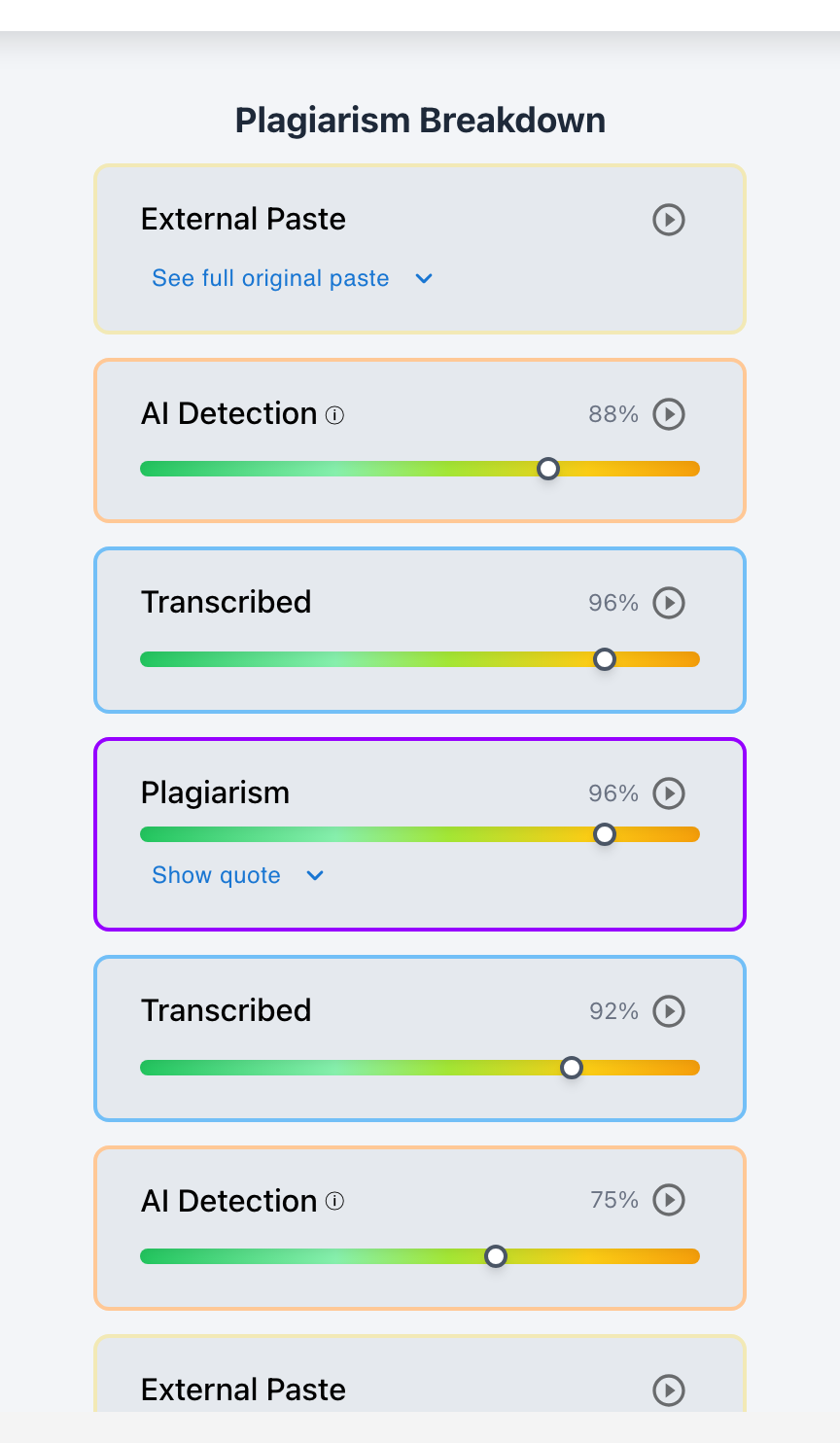
When a student says an AI detector is wrong, teachers should check four objective evidence layers before making any determination: 1) Checkmark Writing Playback Telemetry (verifying whether active typing duration matches essay length); 2) Keystroke Deletion Ratios (confirming healthy 15–25% backspace rates indicative of human self-correction); 3) Citation & DOI Authenticity (verifying that all cited academic sources actually exist); and 4) A 2-Minute Diagnostic Oral Conference (asking the student to explain their core ideas). If drafting telemetry and citations are verified, the AI score should be immediately dismissed as a false positive.
Hearing a student passionately declare "I didn't use AI! I wrote every single word myself!" puts an educator in a difficult position. If the teacher insists on trusting a statistical detector score, they risk alienating an honest student and sparking a contentious parental dispute. If they dismiss the score without checking, they may let genuine misconduct slip by. Resolving an AI detection dispute requires looking beyond the statistical percentage and examining the physical, empirical telemetry of how the essay was drafted.
Below is a step-by-step forensic checklist for teachers handling a student AI dispute.
Checkmark Plagiarism resolves AI detection disputes by pairing essay writing playback with AI detection, plagiarism detection, autograding, and integrations with Canvas and Google Classroom.
The 4-Step Forensic Dispute Checklist
1. Active Typing Duration in Playback
Open Checkmark Playback: did the student spend 2.5+ hours actively typing this 1,200-word draft, or did it appear in 8 minutes?
2. Organic Deletion & Backspace Ratio
Authentic human composition averages 15% to 25% backspaces. Copied or transcribed text rarely exceeds 3% deletions.
3. Citation & Source DOI Verification
Checkmark automatically cross-references all cited academic DOIs. Hallucinated sources prove LLM text generation; valid sources support the student.
4. The 2-Minute Diagnostic Oral Check-In
Ask the student 3 non-accusatory questions about their thesis, research journey, and vocabulary choices to evaluate spontaneous fluency.
How to Read the Evidence: Exoneration vs. Misconduct
Understanding what the diagnostic signals reveal:
- The Student Is Telling the Truth (False Positive): Active drafting time is 3.5 hours, backspace ratio is 18%, citations are valid, and the student fluently explains their thesis orally. → Action: Dismiss AI flag immediately and praise their writing.
- The Student Used AI (Confirmed Misconduct): Active drafting time is 6 minutes, document consists of a 0.05-second paste payload, citations are non-existent, and the student cannot explain core vocabulary. → Action: Apply school AI misconduct policy with documented evidence.
- The Student Transcribed from Phone/Screen: Continuous typing with 0 pauses, <2% backspaces, constant 60 WPM cadence with zero revisions. → Action: Show playback video and discuss unauthorized drafting assistance.
Read more in how Checkmark writing process analysis works.
Comparison: Arguing Over Detector Scores vs. Inspecting Physical Telemetry
Inspecting Checkmark Telemetry (Objective & Decisive)
- Reviews 15-second writing playback video together.
- Checks physical active drafting hours and backspaces.
- Verifies cited academic DOIs against databases.
- Dispute resolved in 3 minutes with zero animosity.
Arguing Over Detector Scores (Subjective & Bitter)
- Teacher points to "82% AI"; student claims innocence.
- Neither party has physical evidence to prove their claim.
- Sparks heated parent meetings and formal complaints.
- Damages the educational relationship permanently.
A 5-Step Educator Protocol for Resolving Student Disputes
Student Dispute Resolution Protocol:
- 1. Remain calm and supportive: "Thank you for letting me know. Let's look at your drafting data together."
- 2. Open Checkmark Writing Playback in Canvas SpeedGrader alongside the student.
- 3. Inspect the Active Typing Duration badge and deletion ratio chart.
- 4. Check the Source Verification Card to confirm all cited academic references exist.
- 5. If telemetry validates human drafting, clear the flag on the spot; if telemetry confirms external pasting, discuss the finding objectively.
How Checkmark Plagiarism Resolves AI Disputes
Checkmark Plagiarism combines **AI detection, essay writing playback, static AI detection, plagiarism detection, autograding, and Canvas/Google Classroom integrations** to turn contentious AI arguments into calm, collaborative, and evidence-backed resolutions.
Frequently Asked Questions
Why do students get upset when flagged by an AI detector?
Because being accused of cheating when you worked hard on an assignment feels deeply unfair and invalidates the student's authentic intellectual effort.
Can an AI detector be 100% wrong?
Yes. Statistical detectors have documented false positive rates, especially on eloquent writers, structured thinkers, and English Language Learners.
What is the single most convincing piece of evidence to clear a student?
Checkmark Writing Playback showing 3+ hours of active, continuous typing with natural pauses and organic sentence restructuring.
How does Checkmark Plagiarism integrate with Canvas LMS?
Checkmark embeds dispute verification cards—combining playback duration, paste logs, and citation audits—directly inside Canvas SpeedGrader.
What if a student drafted in Microsoft Word offline?
Ask the student to email the original .docx file to inspect its internal save timestamps and creation metadata.
What questions should I ask during the 2-minute oral check-in?
Ask: 1) "What was your favorite source and how did you find it?", 2) "Can you define this term in paragraph 3?", 3) "How did your thesis change as you drafted?"
How long does it take to run this 4-step dispute check?
With Checkmark enabled in Canvas SpeedGrader, an educator can complete all four checks in under 3 minutes.
How does Autograder assist during student disputes?
Autograder benchmarks the disputed essay against course rubric standards, ensuring that academic evaluation remains objective throughout the inquiry.
Can parents view the dispute verification report?
Yes. Checkmark exports a clean, FERPA-compliant PDF audit dossier that clearly shows typing hours and citation status to parents.
Why is a supportive dispute process essential for student trust?
Because listening openly and checking objective facts demonstrates that the school values justice and cares deeply about every student's integrity.
Justice Grounded in Physical Evidence
When a student speaks up, they deserve to be heard with fairness and verified with facts. By checking Checkmark Plagiarism's four objective telemetry layers, educators eliminate false accusations, uphold authentic student achievement, and build unbreakable classroom trust.
Checkmark Plagiarism supports this comprehensive approach with AI detection, essay writing playback, static AI detection, plagiarism detection, autograding, and integrations with Canvas and Google Classroom.
See how Checkmark resolves AI detection disputes with physical writing playback in Canvas. View a sample report or request a demonstration.