
Yes. Using ChatGPT to fix grammar is technically considered AI use because Large Language Models do not just correct typos—they rewrite sentence structures, substitute advanced vocabulary, and alter the natural rhythm of student prose. Whether it constitutes academic misconduct depends entirely on your instructor's specific course policy, whether the assistance was disclosed, and whether the tool performed minor proofreading versus structural rewriting.
When students prompt ChatGPT with "proofread my essay and fix any grammatical errors," they often believe they are simply using an advanced spellchecker. However, unlike traditional spellcheck software (which identifies misspelled words in isolation), ChatGPT processes text contextually and frequently generates new, synthetic clause structures. If an assignment is evaluating a student's individual mastery of sentence mechanics, syntax variety, or language conventions, having ChatGPT rewrite the sentences undermines the learning objective. Checkmark Plagiarism's Process Telemetry Engine helps teachers clearly see how much text was modified during grammar polishing.
Below is a comprehensive guide on evaluating AI-assisted grammar correction and establishing clear classroom guidelines.
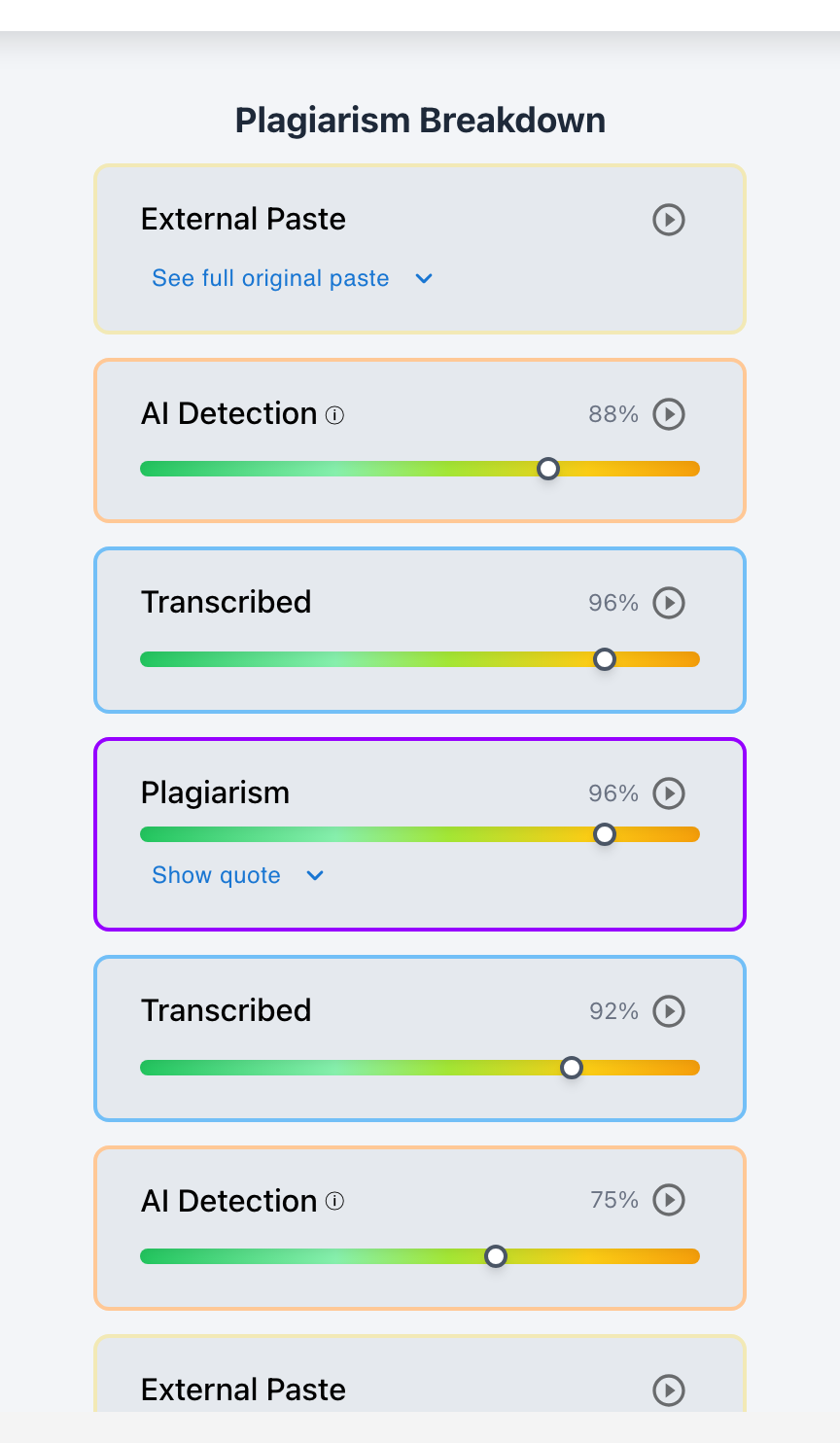
Checkmark Plagiarism evaluates grammar assistance by pairing AI detection with essay writing playback, plagiarism detection, autograding, and integrations with Canvas and Google Classroom.
The 4 Levels of AI Grammar Assistance
Level 1: Isolated Mechanical Correction
Acceptable in most courses. Fixing spelling errors, apostrophes, and standard punctuation while leaving 98% of the original student sentence structure unchanged.
Level 2: Phrasal & Vocabulary Polish
Acceptable with disclosure. Swapping informal phrases for formal academic equivalents while preserving the student's core argument sequence.
Level 3: Syntactic Restructuring
Restricted. ChatGPT converts simple human compound sentences into complex, passive participial clauses, altering the student's authentic writing voice.
Level 4: Generative Co-Writing
Violation of independent policy. The student provides vague notes, and ChatGPT writes polished, complete analytical paragraphs from scratch.
Why ChatGPT Is More Than a Simple Spellchecker
Understanding why AI proofreading triggers AI detection flags:
- Syntactic Flattening: When ChatGPT edits a draft, it naturally injects its own statistical language patterns—lowering perplexity, flattening burstiness, and adding formulaic transition markers.
- False Positive Triggers: An honest student who wrote a full draft by hand but let ChatGPT "clean it up" will often score 85%+ on static AI detectors because the surface sentences were rewritten by the model.
- Playback Protection: In Checkmark Playback, the teacher can see the student's original 3-hour draft, proving that the ideas and structure were authentic human work.
Read more in how Checkmark writing process analysis works.
Comparison: Traditional Spellcheck vs. ChatGPT Grammar Rewriting
Traditional Spellcheck (MS Word / Google Docs)
- Flags misspelled words individually.
- Preserves 100% of student's authentic sentence structure.
- 0% AI probability score generated.
- Universally accepted across all academic assignments.
ChatGPT Grammar Rewriting (Generative AI)
- Rewrites entire clauses and vocabulary choices.
- Replaces student voice with formulaic AI syntax.
- High AI probability scores on static detectors.
- Requires explicit instructor permission and disclosure.
A 5-Step Educator Protocol for AI Grammar Policies
AI Grammar Policy Checklist:
- 1. Define allowable editing tools in your syllabus (e.g., standard spellcheck vs. generative AI rewriting).
- 2. Require an AI Disclosure Statement if generative tools are used for proofreading.
- 3. Open flagged submissions in Checkmark Playback inside Canvas SpeedGrader.
- 4. Inspect the Revision Diff tab: verify whether the AI assistance was limited to grammar or altered core arguments.
- 5. If genuine human drafting is confirmed in Playback, grade the essay on conceptual mastery.
How Checkmark Plagiarism Powers Grammar Policy Enforcement
Checkmark Plagiarism combines **AI detection, essay writing playback, static AI detection, plagiarism detection, autograding, and Canvas/Google Classroom integrations** to clearly highlight the difference between authentic human drafting and AI grammar replacement overlays.
Frequently Asked Questions
Is it cheating to use ChatGPT to check grammar?
It depends on the course syllabus. If the assignment assesses student grammar and writing mechanics, having AI rewrite sentences is a violation; if the focus is research and ideas, proofreading may be permitted with disclosure.
Why does an essay get flagged as AI if the student only used it for grammar?
Because ChatGPT rewrites entire sentence structures to fix grammar, replacing human linguistic variance with machine-generated token sequences.
How can a student prove they only used ChatGPT for grammar?
Checkmark Playback shows the multi-hour human drafting session that existed before the grammar edits were pasted into the document.
What is the difference between Grammarly and ChatGPT?
Basic Grammarly operates on rule-based linguistic algorithms for punctuation and spelling, whereas ChatGPT is an autoregressive generative model that rebuilds sentences.
How does Checkmark Plagiarism integrate with Canvas LMS?
Checkmark provides certified LTI 1.3 integration, SpeedGrader sidebar embeds, two-way grade passback, and single sign-on (SSO).
How should teachers address students who used AI for grammar without permission?
Review the Playback history together: acknowledge their original drafting effort, explain why AI rewriting compromises voice, and request a self-edited revision.
Can students use AI grammar tools in foreign language classes?
In world language courses, using AI to fix grammar or translate sentences directly bypasses the core learning objective and is almost always prohibited.
What does a transparent AI disclosure look like?
Example: "I wrote this essay independently and used ChatGPT to proofread Section 3 for verb tense consistency."
How does Checkmark Autograder evaluate grammar?
Checkmark Autograder provides actionable, sentence-level feedback based on the teacher's rubric without altering student text.
Why is writing process evidence essential for AI grammar cases?
Because it provides the only objective proof of the student's authentic pre-edited draft, protecting students from unfair false accusations.
Clear Guidelines for Empowered Learning
Grammar and clarity are essential skills, but authentic voice is irreplaceable. By establishing transparent AI proofreading policies and using Checkmark Plagiarism to verify drafting process telemetry, educators empower students to write clearly while preserving genuine authorship.
Checkmark Plagiarism supports this comprehensive approach with AI detection, essay writing playback, static AI detection, plagiarism detection, autograding, and integrations with Canvas and Google Classroom.
See how Checkmark pairs writing playback with AI detection to evaluate grammar assistance. View a sample report or request a demonstration.