
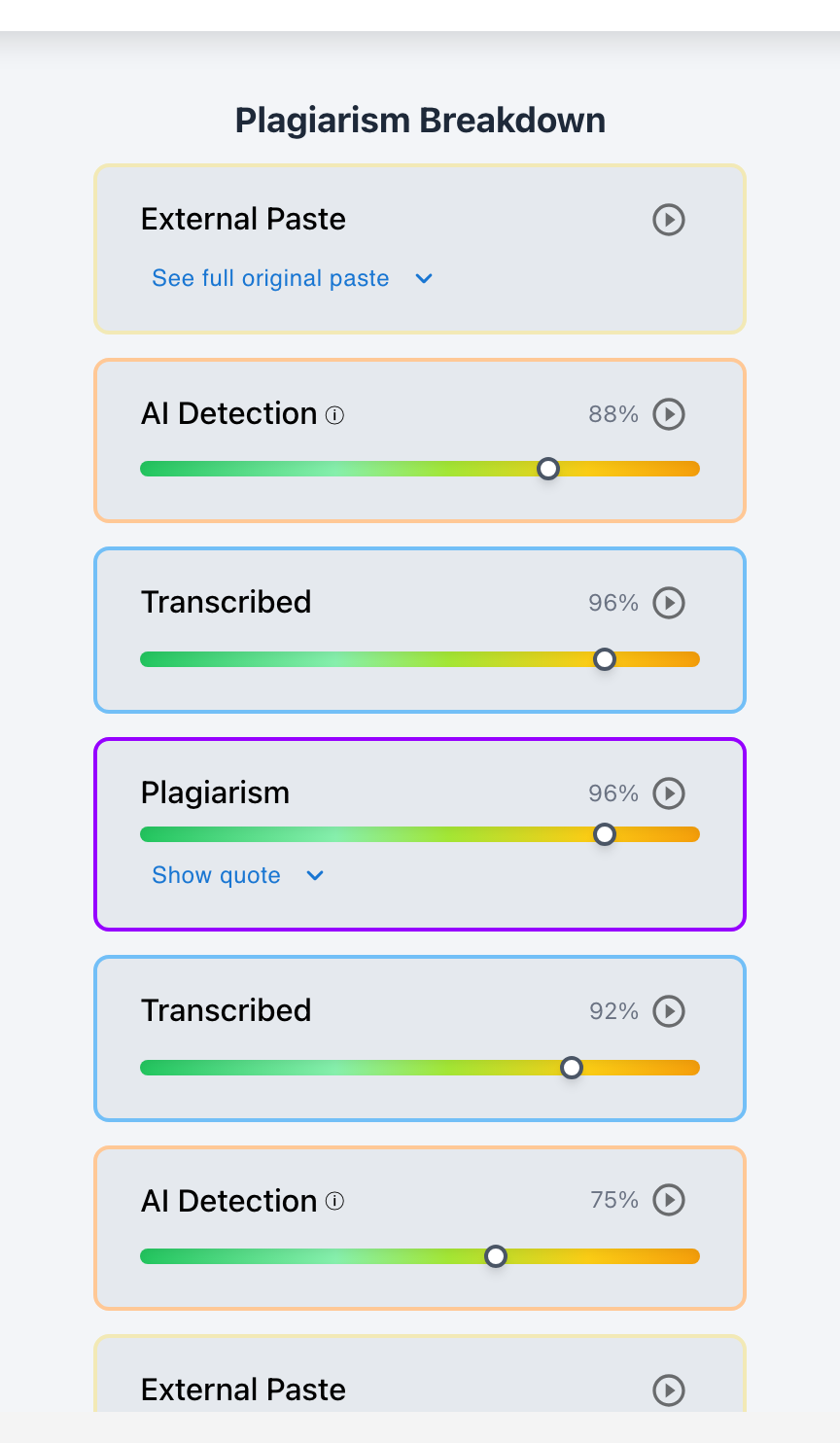
Using ChatGPT to provide high-level feedback or highlight typos is generally acceptable—but pasting a draft into ChatGPT and asking it to "rewrite this in formal academic English" is considered academic misconduct across most institutions.
The distinction lies between feedback (the AI acts like a writing center tutor pointing out weak transitions) and generative rewriting (the AI generates new sentences, vocabulary, and syntax that replace the student's authentic writing). When an AI rewrites an essay, the student is no longer the author of the text on the page.
Understanding where editing ends and ghostwriting begins—and using essay writing playback to verify human composition—ensures students use technology ethically while preserving their authentic voice.
Checkmark Plagiarism clarifies editing boundaries by pairing essay writing playback with AI detection, plagiarism detection, autograding, and integrations with Canvas and Google Classroom.
The 3 Levels of AI Essay Editing
Level 1: Constructive Feedback
Acceptable: Asking AI: "Is my thesis clear? Where are my arguments weakest?" The student reads suggestions and writes their own revisions.
Level 2: Targeted Proofreading
Borderline: Asking AI to identify grammar errors. Acceptable if the student fixes them manually; risky if AI replaces full clauses.
Level 3: Generative Overhaul
Academic Misconduct: Prompting AI: "Rewrite my rough draft to sound like a college paper." The resulting text is machine-authored.
Why Generative Rewriting Crosses the Line
When ChatGPT rewrites an essay, it does far more than fix punctuation:
- Syntactic Replacement: It replaces the student's authentic sentence structures with its own statistical language patterns.
- Artificial Lexical Density: It injects signature AI vocabulary ("delve," "tapestry," "crucial") that does not match the student's voice.
- Authorship Transfer: The student did not formulate the sentences submitted for evaluation, violating academic integrity codes.
How Essay Writing Playback Exposes Generative Rewriting
Students often believe rewriting their own rough draft with AI is undetectable. However, Checkmark Plagiarism's essay writing playback captures the exact physical creation timeline:
- The Rewritten Paste: Playback shows an initial rough draft suddenly replaced by an instant wholesale paste of 1,400 polished words at 11:15 PM.
- Zero Keystroke Evolution: Proves that the polished syntax was not composed or typed incrementally by the student.
Read more in how Checkmark writing process analysis works.
Comparison: Ethical AI Feedback vs. Unauthorized AI Rewriting
Ethical AI Feedback (Student Authorship)
- Student prompts: "Give me 3 tips to improve my conclusion."
- Student reads critique and types revisions manually.
- Writing playback shows continuous typing and editing.
- Student's authentic voice and phrasing are preserved.
Unauthorized AI Rewriting (Cheating)
- Student prompts: "Rewrite this essay in academic tone."
- Student copies and pastes the entire AI output into the doc.
- Writing playback shows wholesale text paste in seconds.
- Prose exhibits signature low burstiness and AI cliches.
A 5-Step Protocol for Teachers
Educator Protocol for Suspected AI Rewriting:
- 1. Publish clear rules in your syllabus distinguishing AI critique from generative rewriting.
- 2. Require all drafts and revisions to be completed within the LMS document editor.
- 3. Review essay writing playback logs to identify wholesale replacement paste events.
- 4. Compare the submission against historical in-class student writing baselines.
- 5. Hold a brief conference asking the student to define advanced vocabulary orally.
How Checkmark Plagiarism Clarifies Editing Boundaries
Checkmark Plagiarism combines **AI detection, essay writing playback, static AI detection, plagiarism detection, autograding, and Canvas/Google Classroom integrations** to give educators complete visibility into whether an essay was edited by hand or overhauled by an AI model.
Frequently Asked Questions
Is it cheating if I write the rough draft and ChatGPT rewrites it?
Yes. If ChatGPT generates the actual sentences, paragraphs, and vocabulary in the final submission, it constitutes authorship fraud and unauthorized assistance.
How can I use ChatGPT for editing without cheating?
Ask ChatGPT for broad feedback (e.g., "Is my second argument convincing?") and make all changes yourself by typing your own words.
Why does AI rewriting trigger AI detectors?
Because ChatGPT injects its own statistical language patterns (low burstiness and flat perplexity) into the rewritten text, creating a machine-generated profile.
How does writing playback catch AI-rewritten essays?
Playback logs capture the moment the student pasted the complete rewritten text into the document in one instant event with zero typing time.
Can students use ChatGPT to fix spelling mistakes?
Yes. Correcting spelling and basic punctuation is standard proofreading and is acceptable on standard assignments.
What should a teacher do if a student admits they used ChatGPT to rewrite a draft?
Acknowledge their honesty, explain why generative rewriting violates authorship standards, and allow them to revise the paper in their own authentic voice.
How does comparing previous student writing help?
It reveals whether the sudden jump in vocabulary and sentence complexity represents authentic student growth or external AI rewriting.
What if a student cannot define words in their edited essay?
Inability to define terms used in their own paper proves that the student accepted AI rewrites without understanding the underlying vocabulary.
How does Checkmark Plagiarism integrate with Canvas LMS?
Checkmark Plagiarism embeds visual writing playback replays and AI probability heatmaps directly inside Canvas SpeedGrader.
How does this standard help students in the long run?
It ensures students develop their own writing and critical thinking abilities rather than becoming dependent on automated text generation.
Preserve the Integrity of Student Authorship
Using AI as a reflective mirror to strengthen your own writing is empowering; allowing AI to replace your words is self-defeating. By pairing clear editing boundaries with essay writing playback, educators defend authentic student voice and meaningful scholarship.
Checkmark Plagiarism supports this comprehensive approach with AI detection, essay writing playback, static AI detection, plagiarism detection, autograding, and integrations with Canvas and Google Classroom.
See how Checkmark pairs essay writing playback with multi-signal detection to distinguish authentic student revisions from generative AI rewrites. View a sample report or request a demonstration.