
Yes. Using AI to rewrite a paragraph is considered academic misconduct if done without instructor authorization—because having an artificial intelligence engine rewrite your sentences transfers rhetorical agency, vocabulary selection, and syntactic structure from the student to the machine, misrepresenting machine-generated prose as personal student mastery.
A frequent rationalization among students is that partial AI use is harmless: "I wrote the essay myself, but I got stuck on the introduction and conclusion, so I just had ChatGPT rewrite those two paragraphs to make them sound better." In academic assessment, the ability to revise, clarify, and articulate complex thoughts is the core learning objective of writing. Outsourcing the most challenging paragraphs of an essay to generative AI bypasses the critical thinking process. Checkmark Plagiarism's Paragraph-Level AI Classifier pinpoint-flags isolated AI-rewritten blocks within otherwise human documents.
Below is a comprehensive guide on why AI paragraph rewriting violates academic integrity and how teachers can detect and address it.
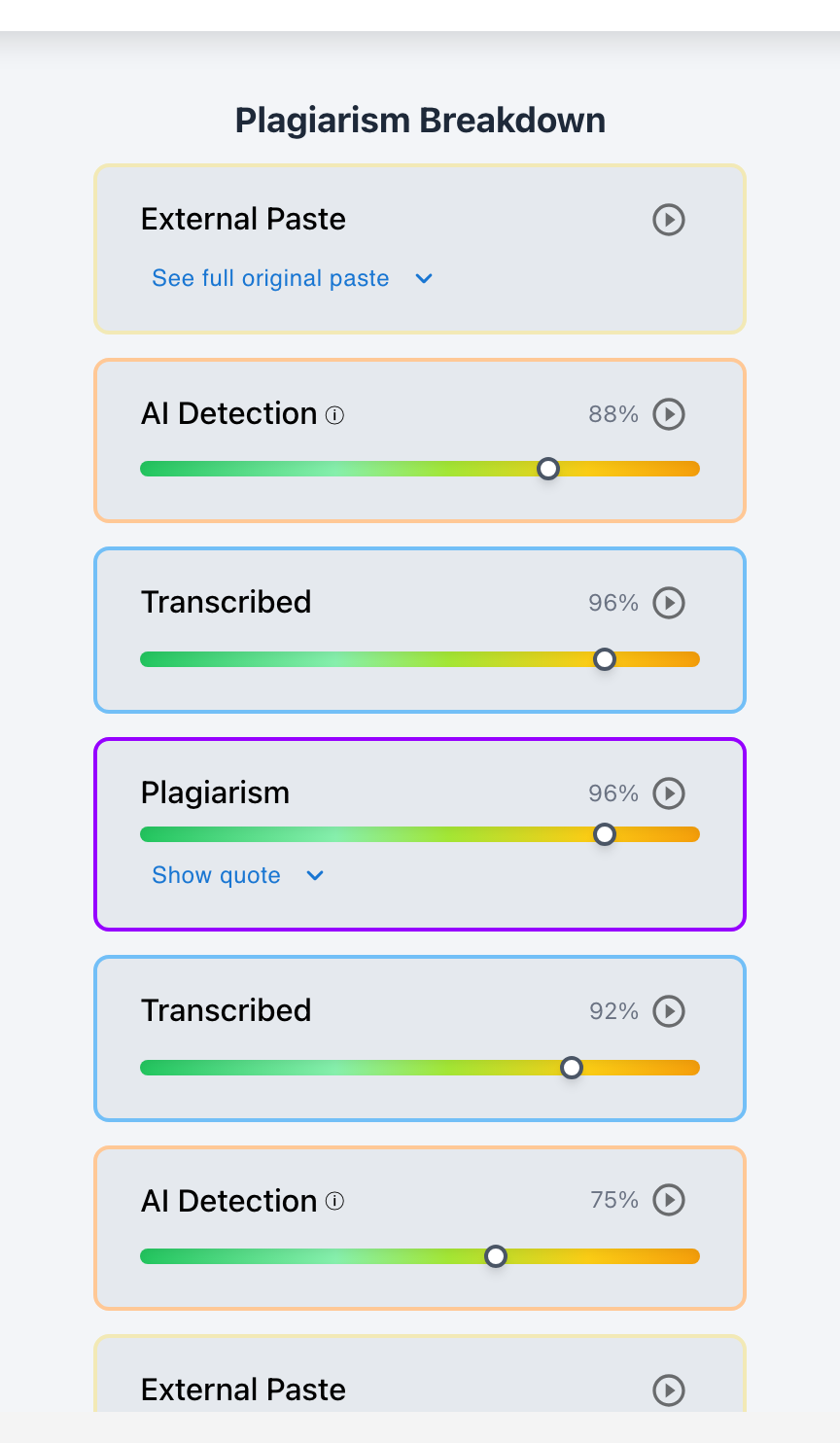
Checkmark Plagiarism detects paragraph-level AI rewriting by pairing AI detection with essay writing playback, plagiarism detection, autograding, and integrations with Canvas and Google Classroom.
The 4 Reasons AI Paragraph Rewriting Crosses the Line
1. Transfer of Rhetorical Agency
When AI rewrites a paragraph, it chooses the metaphors, transitions, clause hierarchy, and tone. The resulting rhetoric belongs to the model, not the student.
2. Bypassing Revision Mastery
Learning to transform clunky rough thoughts into elegant arguments is the fundamental skill taught in writing courses; AI rewriting bypasses this struggle.
3. Undisclosed Mixed Authorship
Submitting an essay without disclosing that specific paragraphs were machine-generated constitutes deceptive authorship misrepresentation under honor codes.
4. Stylometric Discontinuity
The AI-rewritten paragraph creates a jarring stylistic spike in vocabulary and syntactic burstiness compared to the surrounding human paragraphs.
What AI Paragraph Rewriting Looks Like in Document History
Understanding how process telemetry exposes isolated AI rewriting:
- The "Delete-and-Paste" Fingerprint: In Checkmark Playback, the student types a rough 80-word paragraph, pauses for 3 minutes (switching to ChatGPT), highlights the entire paragraph, and replaces it with a 150-word synthetic paragraph in a single paste event.
- The Perplexity Drop: While the student's surrounding paragraphs show high human perplexity and varied sentence lengths, the rewritten paragraph exhibits ultra-low perplexity and formulaic triadic structures.
- Oral Check-In Test: When asked to explain a sophisticated phrase in the rewritten paragraph, the student cannot explain what it means in context.
Read more in how Checkmark writing process analysis works.
Comparison: Authentic Student Self-Revision vs. AI Paragraph Rewriting
Authentic Student Self-Revision (Honest Learning)
- Student re-reads rough sentences and self-edits.
- Playback shows active backspaces, word swaps, and re-typing.
- Maintains consistent personal voice throughout.
- Student speaks fluently about their revised arguments.
AI Paragraph Rewriting (Academic Misconduct)
- Rough draft pasted into ChatGPT for instant polish.
- Playback shows large paste payload replacing rough text.
- Jarring jump to collegiate syntax and AI buzzwords.
- Student cannot explain complex vocabulary orally.
A 5-Step Educator Protocol for Investigating Mixed Paragraphs
Paragraph Rewriting Audit Checklist:
- 1. Open the student's submission in Checkmark Plagiarism inside Canvas SpeedGrader.
- 2. Review the Paragraph Heatmap: look for isolated bright red 90%+ AI probability blocks.
- 3. Inspect the Writing Playback timeline: locate the exact moment the flagged paragraph was inserted.
- 4. Check if the paragraph entered via a single 0.05-second clipboard paste replacing prior text.
- 5. Hold a 2-minute conference: "Can you walk me through how you revised this specific paragraph?"
How Checkmark Plagiarism Powers Paragraph-Level Forensics
Checkmark Plagiarism combines **AI detection, essay writing playback, static AI detection, plagiarism detection, autograding, and Canvas/Google Classroom integrations** to evaluate each paragraph independently, pinpointing isolated AI rewrites with surgical accuracy.
Frequently Asked Questions
Is it cheating if I only used AI for the conclusion?
Yes. If the assignment requires independent student writing, having AI generate or rewrite any paragraph without authorization constitutes academic misconduct.
Can AI detectors find a single AI paragraph in a human essay?
Yes. Checkmark evaluates text on a sentence-by-sentence and paragraph-by-paragraph basis, highlighting isolated AI sections within human essays.
What if a student used QuillBot to rephrase their own words?
Automated paraphrasing tools like QuillBot replace student syntax with machine patterns; Checkmark flags this as synthetic text and logs the paste event.
How does writing playback prove a paragraph was rewritten by AI?
Playback shows the original rough text being deleted and immediately replaced by a complete, pre-formatted synthetic block in a single paste.
How does Checkmark Plagiarism integrate with Canvas LMS?
Checkmark provides certified LTI 1.3 integration, SpeedGrader sidebar embeds, two-way grade passback, and single sign-on (SSO).
What should a teacher do when one paragraph is written by AI?
Acknowledge the honest effort in the rest of the paper, require a self-written revision of the flagged paragraph, and apply appropriate policy deductions.
Why do students rewrite paragraphs with AI?
Students often experience cognitive fatigue near the end of an essay or struggle to write introductions/conclusions, turning to AI as an easy shortcut.
What is the difference between human tutoring and AI rewriting?
A human tutor asks guiding questions so the student writes the sentence; AI writes the sentence directly, removing the student's intellectual labor.
How can teachers design assignments that discourage paragraph rewriting?
Incorporate reflective synthesis requirements or in-class revision workshops where students revise their rough drafts by hand.
Why is preserving individual voice essential in student writing?
Because authentic writing reflects unique personal insight, and relying on AI produces homogenized, robotic prose that erodes critical thinking.
Protecting Authentic Synthesis and Student Growth
Writing is a journey of refining rough thoughts into clear expressions. By identifying AI paragraph rewriting with precision and encouraging authentic self-revision with Checkmark Plagiarism, educators ensure that every paragraph reflects genuine student effort and intellectual growth.
Checkmark Plagiarism supports this comprehensive approach with AI detection, essay writing playback, static AI detection, plagiarism detection, autograding, and integrations with Canvas and Google Classroom.
See how Checkmark pairs paragraph-level AI heatmaps with writing playback to evaluate mixed-authorship essays. View a sample report or request a demonstration.