
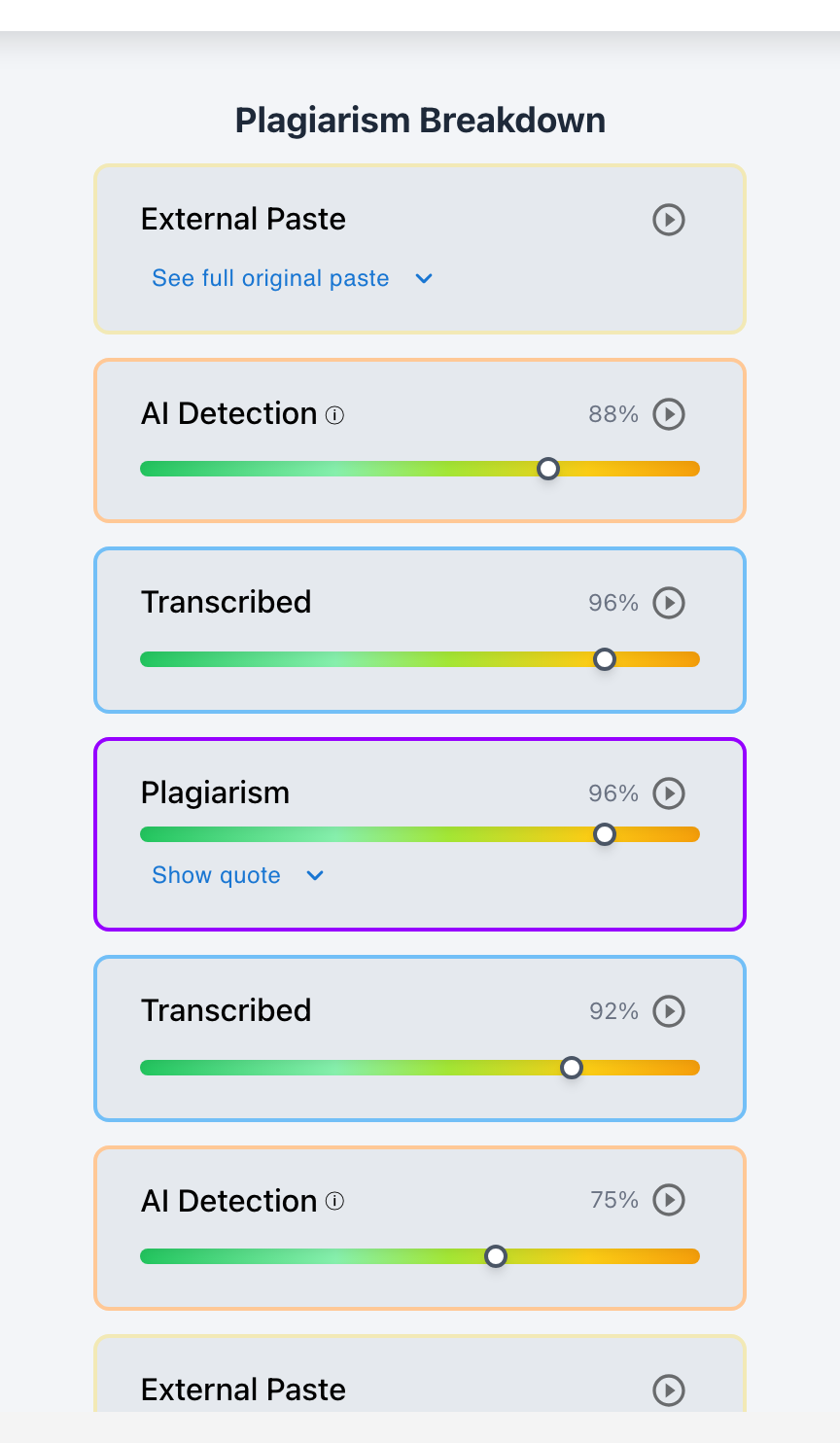
Yes. Retyping AI-generated content word-for-word is unequivocally academic misconduct under secondary and higher education honor codes. Academic integrity is defined by original intellectual authorship—the cognitive work of formulating arguments, synthesizing evidence, and drafting prose—not the mechanical physical act of striking keys on a keyboard.
When confronted about AI-generated submissions, students occasionally argue a technical loophole: "I didn't copy and paste it; I typed every single letter myself, so it's my work." This argument fundamentally confuses mechanical data entry with intellectual creation. Just as manually copying a chapter from a textbook or transcribing an essay written by a paid ghostwriter is blatant plagiarism, typing out ChatGPT's response constitutes submitting machine-authored work under false pretenses.
Below is a comprehensive policy and ethical analysis of why retyping AI content violates academic standards.
Checkmark Plagiarism supports institutional integrity policies by pairing AI detection with essay writing playback, plagiarism detection, autograding, and integrations with Canvas and Google Classroom.
The 4 Ethical & Policy Pillars That Define Retyping as Misconduct
1. The Principle of Intellectual Authorship
Grades evaluate a student's cognitive mastery, critical thinking, and synthesis. Typing someone else's thoughts—human or artificial—demonstrates zero learning.
2. Equivalence to Ghostwriting
Hiring a tutor to write an essay and typing up their draft is universally recognized as cheating; using an AI generator as a digital ghostwriter is identical.
3. Deceptive Intent (Evasion Tactics)
Deliberately retyping AI text to bypass clipboard paste tracking demonstrates clear intent to conceal unauthorized assistance from the instructor.
4. Misrepresentation of Effort
Submitting an uncredited AI generation misrepresents machine capability as personal academic achievement, violating institutional honor codes.
What School Academic Honor Codes Actually Say
Modern institutional integrity policies explicitly address unauthorized assistance:
- Definition of Plagiarism: "Plagiarism includes submitting the words, ideas, or structural phrasing of another entity—including generative artificial intelligence models—without proper attribution."
- Input Method Irrelevance: Honor codes govern content origin, not keyboard input methods. Whether an essay entered a document via clipboard paste, speech dictation, or physical typing is legally irrelevant to whether misconduct occurred.
- The Burden of Provenance: Students are expected to demonstrate cognitive ownership of their work through rough notes, draft histories, and oral comprehension.
Read more in how Checkmark writing process analysis works.
Comparison: Legitimate Typing vs. Deceptive AI Retyping
Legitimate Typing (Authentic Scholarship)
- Student formulates thesis, outline, and arguments.
- 15% to 30% backspaces as thoughts are refined.
- Student can explain, defend, and summarize their ideas.
- Demonstrates genuine cognitive growth and learning.
Deceptive AI Retyping (Academic Misconduct)
- Machine formulates thesis, outline, and arguments.
- <2% backspaces; mechanical data entry only.
- Student cannot define vocabulary or explain thesis.
- Zero cognitive engagement; violates academic honor code.
A 5-Step Educator Protocol for Addressing Retyped AI Cases
Policy Enforcement Checklist:
- 1. Open the student's submission in Checkmark Playback to review the combined AI score and typing cadence.
- 2. Document the evidence: export the Checkmark report showing low backspaces and high AI probability.
- 3. Schedule a supportive conference: focus on the definition of intellectual authorship.
- 4. Explain the policy: "Academic integrity measures the thinking behind the words, not the physical striking of keys."
- 5. Apply standard course policy (e.g., required revision, rewrite on new prompt, or academic referral).
How Checkmark Plagiarism Powers Policy Enforcement
Checkmark Plagiarism combines **AI detection, essay writing playback, static AI detection, plagiarism detection, autograding, and Canvas/Google Classroom integrations** to provide schools with clear, objective evidence that upholds institutional honor codes.
Frequently Asked Questions
Is retyping ChatGPT considered plagiarism or cheating?
Yes. Submitting machine-generated ideas and text as your own work is academic dishonesty regardless of whether it was typed or pasted.
What is the difference between typing and authorship?
Authorship is the cognitive creation of ideas, arguments, and syntax. Typing is merely mechanical data entry; typing someone else's words does not make you the author.
Can a student be disciplined for retyping AI text?
Yes. Institutional policies penalize unauthorized AI use based on content origin and misrepresentation of work, not input mechanics.
How does Checkmark prove that text was retyped from AI?
Checkmark correlates high linguistic AI probability scores with transcription speed anomalies and sub-2% backspace rates in Essay Playback.
What if a student used AI to brainstorm an outline and then typed it?
If course policy permits AI brainstorming, using AI for outlining is acceptable provided the student drafts original prose (which exhibits healthy 15–30% backspaces).
How does Checkmark Plagiarism integrate with Canvas LMS?
Checkmark provides certified LTI 1.3 integration, SpeedGrader sidebar embeds, two-way grade passback, and single sign-on (SSO).
What should an AI policy state regarding retyping?
Policies should explicitly clarify that "retyping or transcribing AI-generated content is considered unauthorized assistance and subject to academic review."
Why do students try to justify retyping?
Because students confuse the physical labor of typing with intellectual effort, attempting to find a loophole in paste-tracking systems.
What questions help students understand why retyping is wrong?
Ask: "If you typed up a paper written by your older sibling, would that be your work? Why is AI any different?"
Why is writing playback essential for honor code defense?
Because playback provides concrete physical evidence of transcription cadence, eliminating subjective arguments and ensuring fair outcomes.
Upholding the Value of True Intellectual Labor
Education is about cultivating the human mind. By establishing clear policies and using Checkmark Plagiarism to verify authentic drafting effort, educators protect the integrity of the learning process and ensure that true intellectual achievement is honored.
Checkmark Plagiarism supports this comprehensive approach with AI detection, essay writing playback, static AI detection, plagiarism detection, autograding, and integrations with Canvas and Google Classroom.
See how Checkmark pairs multi-signal detection with writing playback to uphold academic integrity policies. View a sample report or request a demonstration.