
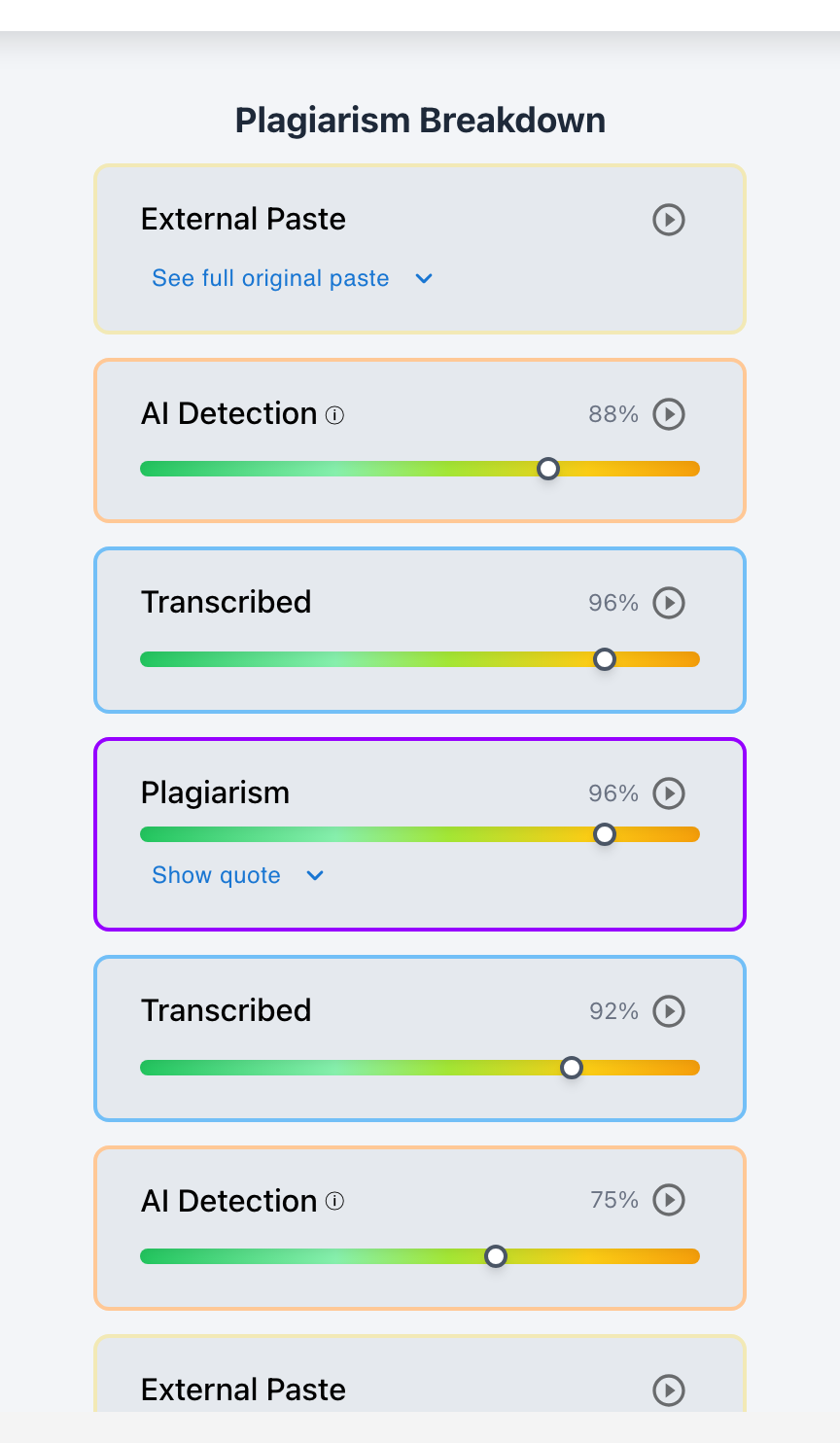
Writing an essay in a single sitting is NOT inherently suspicious—many honest students procrastinate and complete papers in focused 3- to 4-hour "binge-drafting" sessions. However, it BECOMES suspicious when the single sitting lasts under 15 minutes, exhibits zero backspaces, and contains a wholesale clipboard paste.
Every writing instructor is familiar with the late-night procrastinator: the student who opens a blank document at 8:00 PM the night before a deadline and writes straight through until midnight. In document history, this shows up as a single session on a single calendar date. While writing across multiple days is pedagogically ideal, single-sitting drafting is completely natural human behavior. The key to evaluating a single-sitting essay is looking at active typing duration, character deletion rates, and keystroke rhythm using Checkmark Playback.
Below is a comprehensive guide on distinguishing honest single-sitting binge-writing from unauthorized AI generation.
Checkmark Plagiarism powers session forensics by pairing essay writing playback with AI detection, plagiarism detection, autograding, and integrations with Canvas and Google Classroom.
The 4 Diagnostic Signals of Authentic Single-Sitting Writing
1. Realistic Active Duration (3+ Hours)
The student spent 3 to 4.5 continuous active hours on the keyboard, reflecting the true physical time required to research, think, and compose 1,500 words.
2. Healthy Backspace Baseline (15–30%)
The playback timeline reveals thousands of character deletions, fixed spelling typos, restructured topic sentences, and rewritten thesis statements.
3. Natural Cognitive Pauses (45–120s)
Keystroke telemetry captures periodic thinking pauses between paragraphs where the student was consulting sources, organizing notes, or outlining next steps.
4. Zero Wholesale Clipboard Inflows
Text emerged incrementally character-by-character; any paste events were limited to short, properly cited research quotations or bibliography entries.
Why Single-Sitting AI Generation Looks Completely Different
When AI is used to produce a single-sitting essay, the telemetry exhibits immediate red flags:
- The 8-Minute Paper: The entire document was opened, populated, and submitted in under 10 minutes total active time.
- Zero Self-Correction: Shows 0% backspaces or deletions—sentences appear in final, polished form from the very first character.
- Wholesale Paste Signature: The timeline graph shows a single vertical spike where 1,200 words were inserted in 0.05 seconds from the clipboard.
Read more in how Checkmark writing process analysis works.
Comparison: Honest Binge-Writing vs. AI Shortcut in a Single Sitting
Honest Single-Sitting Binge-Drafting
- 1 session lasting 3 hours and 42 minutes.
- 22% backspaces with active sentence rewrites.
- Variable typing speed with cognitive pauses.
- Word count grows gradually across the 3.5 hours.
AI Shortcut in a Single Sitting
- 1 session lasting 6 minutes total.
- <1% backspaces; zero sentence revisions.
- 1,200 words inserted via 1 single paste event.
- Word count jumps from 0 to 1,200 instantly.
A 5-Step Educator Protocol for Single-Sitting Essay Audits
Single-Sitting Audit Checklist:
- 1. Open the student's submission in Checkmark Playback inside Canvas SpeedGrader.
- 2. Check the Total Active Typing Time metric: verify whether it exceeds 2.5+ hours.
- 3. Review the Deletion / Backspace Rate: ensure it falls within the healthy 15–30% human range.
- 4. Watch the 15-second accelerated video replay: look for natural word-by-word composition.
- 5. If active hours and backspaces are verified, grade the essay normally without penalty for procrastination.
How Checkmark Plagiarism Powers Fair Session Auditing
Checkmark Plagiarism combines **AI detection, essay writing playback, static AI detection, plagiarism detection, autograding, and Canvas/Google Classroom integrations** to ensure that honest procrastinators are protected while genuine shortcuts are accurately identified.
Frequently Asked Questions
Is writing an essay the night before in one sitting considered cheating?
No. Procrastinating and writing an essay in one sitting is a time-management issue, not an academic integrity violation, provided the student typed and composed the work themselves.
How long should it take a student to write a 1,000-word essay in one sitting?
A legitimate human composition of a 1,000-word research essay in a single sitting requires between 2.5 and 4.5 active hours of keyboard engagement.
What does Essay Playback look like for an honest procrastinator?
It shows a long, steady drafting curve spanning several hours with active backspaces, sentence restructuring, and thinking pauses.
Can a student fake 3 hours of writing in one sitting?
Simulating 3 hours of natural keystrokes, typos, backspaces, and pauses requires more physical effort than actually writing the paper honestly.
What if a single-sitting essay has a high AI score?
Checkmark Playback proves whether the high score is a false positive: if the student spent 3.5 hours typing with 25% backspaces, dismiss the AI alert immediately.
How does Checkmark Plagiarism integrate with Canvas LMS?
Checkmark provides certified LTI 1.3 integration, SpeedGrader sidebar embeds, two-way grade passback, and single sign-on (SSO).
How can teachers encourage students to write across multiple sessions?
By requiring scaffolded checkpoints (topic outline due week 1, annotated bibliography week 2, rough draft week 3, final submission week 4).
Does Checkmark track idle time when a tab is left open?
Yes. Checkmark filters out inactive idle time, calculating true active keystroke engagement.
Can students see their session timeline in Canvas?
Yes. Students can review their writing playback to reflect on their drafting pacing and verify their authentic effort.
Why is active drafting time better evidence than session count?
Because session count only measures calendar frequency, whereas active drafting duration measures the actual physical human labor invested in writing.
Differentiating Procrastination from Cheating
A student who pulls a late-night writing binge has invested real intellectual labor that deserves fair assessment. By analyzing keystroke duration and revision depth with Checkmark Plagiarism, teachers can confidently distinguish between honest late-night effort and unauthorized AI shortcuts.
Checkmark Plagiarism supports this comprehensive approach with AI detection, essay writing playback, static AI detection, plagiarism detection, autograding, and integrations with Canvas and Google Classroom.
See how Checkmark pairs session writing playback with multi-signal detection to evaluate single-sitting essays. View a sample report or request a demonstration.