
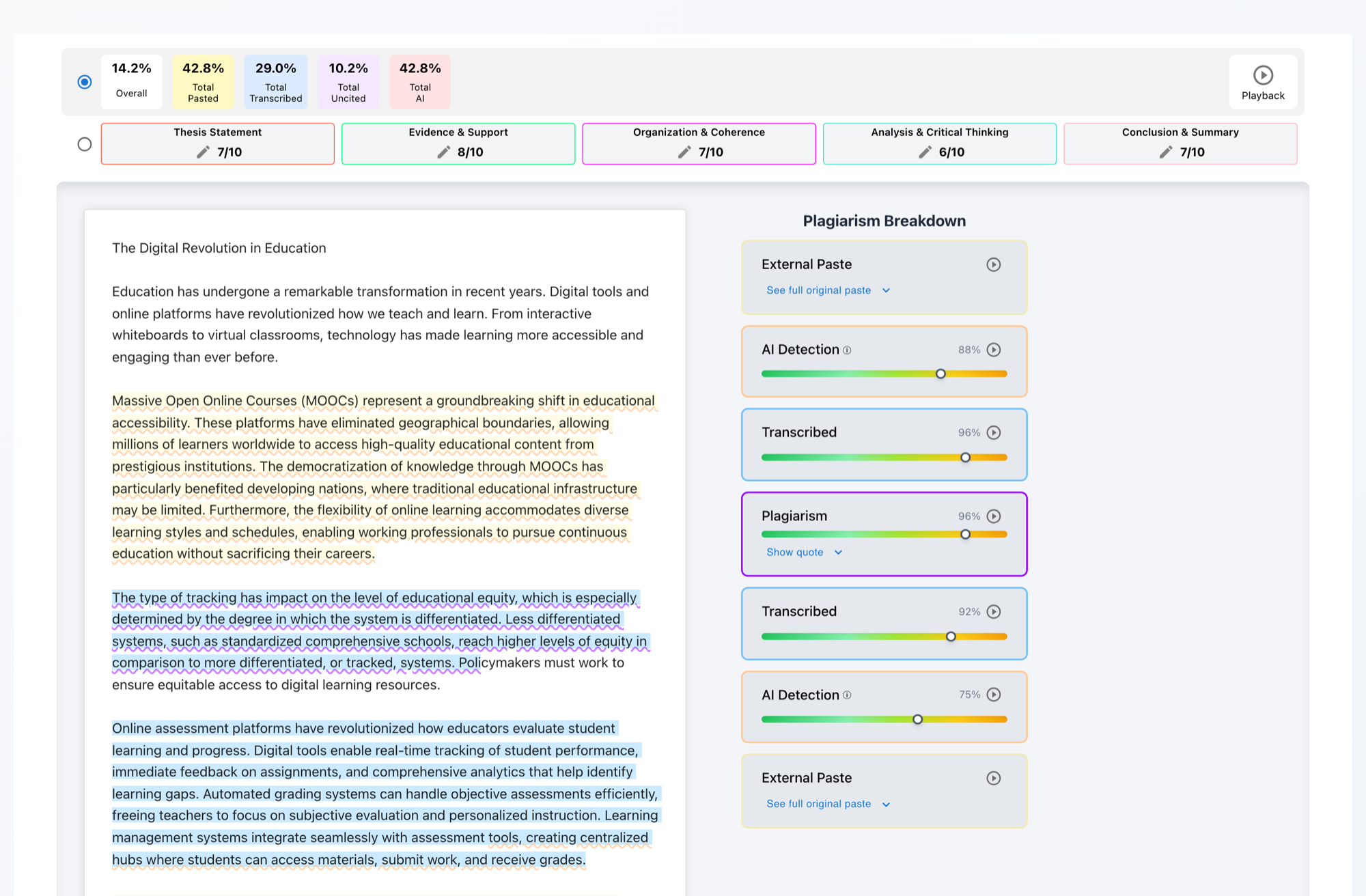
Teachers check for plagiarism by comparing student work against online sources, publications, previous submissions, and other student papers. They also review citation practices, writing style, document history, and the student’s writing process. A plagiarism score alone is not usually enough to confirm misconduct.
When an instructor reviews an essay or research paper, identifying uncredited material is rarely a single button-press event. While automated software plays a key role in modern classrooms, experienced educators combine digital tools with professional judgment, contextual evidence, and direct conversation. Effective student plagiarism detection relies on distinguishing between raw matching text, legitimate citation, unintentional paraphrasing errors, and deliberate dishonesty.
This guide explains the complete process middle-school, high-school, and higher-education instructors use to evaluate student writing, review evidence, and ensure fair academic integrity reviews.
What Do Teachers Look for When Checking for Plagiarism?
Before running a document through software, teachers often notice subtle red flags during routine reading and grading. Experienced educators develop a strong instinct for when prose does not align with a student's established writing voice.
Common warning signs include:
- Sudden shifts in vocabulary or tone: A paper that transitions from conversational middle-school prose into dense academic jargon within a single paragraph.
- Formatting inconsistencies: Mixed font families, trailing hyperlinked text, erratic line spacing, or gray background shading characteristic of text copied directly from web browsers.
- Citations the student cannot explain: References to specialized academic monographs, out-of-print books, or paid journal databases that high school or undergraduate students rarely access.
- Sources outside assignment boundaries: A paper citing secondary literature that contradicts the assigned reading list or ignores the specific prompt parameters.
- Unsupported claims or advanced phrasing: Flawlessly structured arguments utilizing advanced rhetorical devices that contrast sharply with the student's in-class discussions or timed writing.
- Missing revision history: An assignment submitted as a completed document with zero drafting history, missing outlines, or instant paste creation.
Note for educators: Stylistic warning signs are reasons to investigate further, never final proof of cheating. A change in tone may simply indicate that a student sought tutoring, spent extra time editing, or improved their skills.
1. Source Matching and Plagiarism Checkers
Modern educational institutions rely on specialized software tools as a baseline layer for plagiarism detection. These platforms convert student text into searchable strings and cross-reference them against comprehensive databases.
A typical plagiarism checker for teachers compares submitted papers against:
- Public Web Content: Current and archived web pages, online encyclopedias, blogs, news sites, and homework-help repositories.
- Academic Publications: Millions of peer-reviewed journal articles, scholarly books, conference proceedings, and research databases.
- Student Paper Repositories: Previously submitted assignments from the same school, district, or global institutional database to prevent peer copying between classes or terms.
- Class & Course Archives: Submissions turned in by current classmates for the same assignment prompt.
When a match is found, the software flags the passage and calculates an overall similarity percentage. However, automated source matching frequently highlights legitimate content, including properly quoted text, standard citations, assignment prompt text, bibliographies, and common industry phrases. That is why teachers evaluate the report context rather than treating a numerical percentage as a final verdict.
2. Reviewing the Plagiarism Report
Instead of taking a similarity percentage at face value, instructors examine a detailed plagiarism report for teachers to determine the nature of each highlighted match.
During a thorough report review, an educator examines:
- The Source of the Match: Is the match coming from an academic paper, a commercial essay bank, a study guide, or a peer submission?
- Passage Length & Continuity: Is the overlap a single 15-word phrase, or is it three consecutive paragraphs lifted verbatim?
- Quotation & Attribution: Did the student place quotation marks around the matched text and include a clear citation?
- Wording Similarity: Is the passage copied word-for-word, or does it reflect close paraphrasing without proper attribution?
- Pattern of Matches: Does the paper contain dozens of small, uncited fragments scattered throughout (mosaic plagiarism), suggesting systematic uncredited borrowing?
- False Positives: Did the software flag the assignment prompt question, standard cover page text, or a common bibliographic reference?
Whenever possible, teachers open the original source link provided in the report to compare the original author's intent against how the student presented the material.
3. Checking Citations and Paraphrasing
A major part of evaluating academic work is distinguishing intentional dishonesty from improper citation mechanics or poor paraphrasing habits.
Teachers look out for several distinct forms of attribution errors:
- Direct Copying Without Quotation Marks: Including an author's exact words with a parenthetical citation, but omitting quotation marks.
- Close Paraphrasing (Patchwriting): Swapping a few synonyms while keeping the original author's sentence structure intact.
- Missing or Incorrect Citations: Incorporating specific statistics, studies, or unique arguments without citing the source.
- Self-Plagiarism: Reusing a paper or major section submitted for a previous class without permission from the instructor.
- Peer Copying: Sharing documents with a classmate or copying parts of another student's assignment.
Example 1: Properly Cited Match (Not Plagiarism)
Student Text:
"As historian James McPherson observed, 'The Civil War defined us as what we are today, while at the same time opening a vista on what we might become' (McPherson, 1988, p. 8)."
Teacher Evaluation:
Although the software highlights this 24-word match with 100% similarity to the original book, the student placed the text in quotation marks and cited the source correctly. This is legitimate academic citation, not plagiarism.
Example 2: Closely Paraphrased Source (Improper Paraphrasing)
Original Journal Source:
"Photosynthesis in C4 plants operates with significantly higher water-use efficiency under arid climatic conditions."
Student Text:
"Photosynthesis in C4 plant species functions with much higher water efficiency in dry weather conditions."
Teacher Evaluation:
The student changed only three words ("plants" to "plant species", "operates" to "functions", "arid climatic" to "dry weather") while copying the exact clause structure without a citation. The teacher will compare these passages side-by-side and review proper paraphrasing with the student.
4. Reviewing Writing History and the Writing Process
Modern digital document tools have transformed how schools check for plagiarism. Looking solely at final text matches misses crucial context about how an essay was constructed. Reviewing writing history plagiarism detection provides objective evidence of authentic drafting.
When examining document history in Google Docs, Word, or tracked LMS editors, teachers inspect:
- Document Timelines: Did the essay develop over hours or days across multiple editing sessions, or was it created in a single 3-minute burst?
- Drafting Progression: Can the teacher see natural typing, sentence deletion, restructuring, and typo correction over time?
- Large Copy-and-Paste Events: Did major sections of text arrive in a single paste block from an external source?
- Transcription Patterns: Did the student type steadily without stopping or revising-a classic pattern when retyping text directly from a secondary screen, phone, or paper document?
- Revision Between Drafts: Did the student incorporate early feedback, outlines, and structural edits between preliminary and final submissions?
Writing history evidence offers protection for both teachers and students. If a student is flagged for similar phrasing by software, showing a 3-hour detailed edit timeline with active revision quickly proves genuine authorship.
5. Comparing the Work With Previous Assignments
When an instructor suspects an assignment may not be a student's own work, they often compare the paper against the student's prior submissions.
Teachers evaluate consistency across:
- Vocabulary and Grammatical Habits: Recurring spelling quirks, comma placement tendencies, or characteristic transition phrases.
- Structural Style: Paragraph organization, introduction methods, and thesis construction.
- Subject Comprehension: Whether the depth of analysis in the paper aligns with the student's contributions during class discussions and lab exercises.
However, educators recognize that an improvement in writing style is not proof of misconduct. Students frequently refine their writing after receiving tutoring, visiting a campus writing center, or applying instructor feedback from previous drafts.
6. Talking With the Student
When software signals or stylistic shifts warrant investigation, teachers hold a direct, supportive conversation with the student. The goal of this meeting is fact-finding, clarification, and education rather than immediate accusation.
Educators often ask five clarifying questions during an academic integrity review:
- "Can you explain how you developed your main argument?" (Tests whether the student understands the core thesis.)
- "Which source was most useful for your research, and why?" (Verifies that the student actually read and engaged with the cited materials.)
- "Can you explain this paragraph in your own words?" (Helps differentiate between poor paraphrasing and uncredited copying.)
- "What changed between your first draft and your final submission?" (Invites the student to describe their drafting process.)
- "Can you show me the research notes, outlines, or sources you used?" (Allows honest students to present supporting evidence of their work.)
If a student can comfortably discuss their research and explain their drafting choices, any highlighted software matches are usually attributed to minor citation misunderstandings rather than deliberate cheating.
Can Teachers Detect Paraphrased Plagiarism?
Yes. While simple synonym-swapping tool output can sometimes bypass basic exact-match algorithms, teachers identify paraphrased plagiarism through multiple signals:
- Parallel Clause Structure: Sentence structures that mirror a known source line-for-line, even when individual words are substituted.
- Unusual Phrase Combinations: Specialized technical phrasing or idiosyncratic arguments copied directly from original authors.
- Side-by-Side Source Comparison: Placing the student's paragraph next to the suspected source to compare structural flow.
- Writing History Logs: Spotting large pasted blocks of text that were subsequently edited with quick synonym replacements.
Can Teachers Detect Plagiarism From AI Tools?
It is critical to distinguish between traditional plagiarism detection and AI writing review:
- AI Writing is Not Automatically Plagiarism: Text generated by an AI model is newly generated prose, not a direct match to a pre-existing web source.
- AI Output May Reproduce Existing Sources: Generative AI tools sometimes output memorized passages or uncited quotes from their training data.
- Students May Use AI to Paraphrase: Some students paste copied web text into AI rewriters to obscure traditional plagiarism matches.
- AI Scores Do Not Prove Misconduct: An AI detection percentage is a statistical confidence metric, not absolute proof. Teachers evaluate citations, writing history, assignment rules, and student explanations before making decisions.
For a detailed breakdown, read our guide on AI Detection vs. Plagiarism Detection.
What Happens When a Teacher Suspects Plagiarism?
When a teacher suspects an assignment contains plagiarized material, they follow a structured, objective process:
- 1 Review highlighted matches in the software report.
- 2 Open and compare original web or publication sources.
- 3 Verify quotation marks and parenthetical citations.
- 4 Inspect document editing history and paste timelines.
- 5 Compare the work with the student's prior assignments.
- 6 Hold a private, fact-finding conversation with the student.
- 7 Follow institutional academic-integrity guidelines.
- 8 Document all evidence and record the final decision.
School policies ensure students have an opportunity to respond to findings before any formal academic penalty or disciplinary action is applied.
Why a Plagiarism Percentage Is Not Proof
A similarity percentage represents total overlapping words divided by total document length. It does not evaluate context, authorization, or student intent.
Common examples where a paper naturally produces a high similarity percentage without misconduct include:
- Literature Reviews & Research Papers: Assignments requiring extensive direct quotes from primary historical documents or scientific studies.
- Shared Assignment Templates: Lab report forms, study guide questions, or worksheets where every student includes identical prompt text.
- Bibliographies & Reference Lists: Standardized MLA, APA, or Chicago style citations that match existing database records exactly.
- Common Domain Terminology: Standard definitions, mathematical formulas, or institutional names.
Because of these factors, the specific location and context of matched passages matter infinitely more than the raw similarity number.
How Checkmark Helps Teachers Review Plagiarism
Checkmark provides teachers with a comprehensive, multi-evidence workflow that combines traditional source matching with modern writing process tools inside your existing LMS setup.
With Checkmark, educators can seamlessly evaluate:
- Web & Peer Source Matches: Side-by-side quote comparison linked directly to original internet sources.
- Passage-Level AI Indicators: Calibrated confidence metrics mapped line-by-line across the essay.
- Writing Process Playback: Complete keystroke edit history replay showing how the assignment was drafted over time.
- Copy-Paste & Transcription Audits: Instant identification of massive external paste blocks or rapid manual screen transcription.
- LMS Workflow Integration: Direct access inside Google Classroom and Canvas LMS SpeedGrader.
Frequently Asked Questions
Do teachers check every assignment for plagiarism?
Practices vary by instructor, school policy, and assignment type. Major research papers, essays, and capstone projects are almost universally checked using automated software, while short informal responses may only be checked if a teacher notices suspicious writing shifts.
Can teachers tell if students copy from another student?
Yes. Plagiarism detection software compares submissions against internal institutional repositories and current classmate submissions. Even if students are in different class periods, matching text between student files will trigger high-similarity highlights.
Can teachers detect plagiarism from books?
Yes. Automated tools index millions of digitized books, textbooks, and academic journals. Even if a physical book is not fully indexed online, experienced teachers often recognize copied text through changes in tone, specialized vocabulary, or manual web searches.
Is a high plagiarism score always bad?
No. A high score often reflects legitimate quotations, long reference lists, or repeated assignment prompt text. Teachers review the specific highlighted passages to determine if the material was properly cited.
Can a student be falsely accused of plagiarism?
Yes, false positives can occur when software flags common phrasing or properly cited quotes. That is why reports should always be evaluated alongside revision history, draft logs, and a direct conversation with the student.
See how Checkmark helps teachers evaluate student writing with more context than a similarity score alone. View a sample report or request a demonstration.