
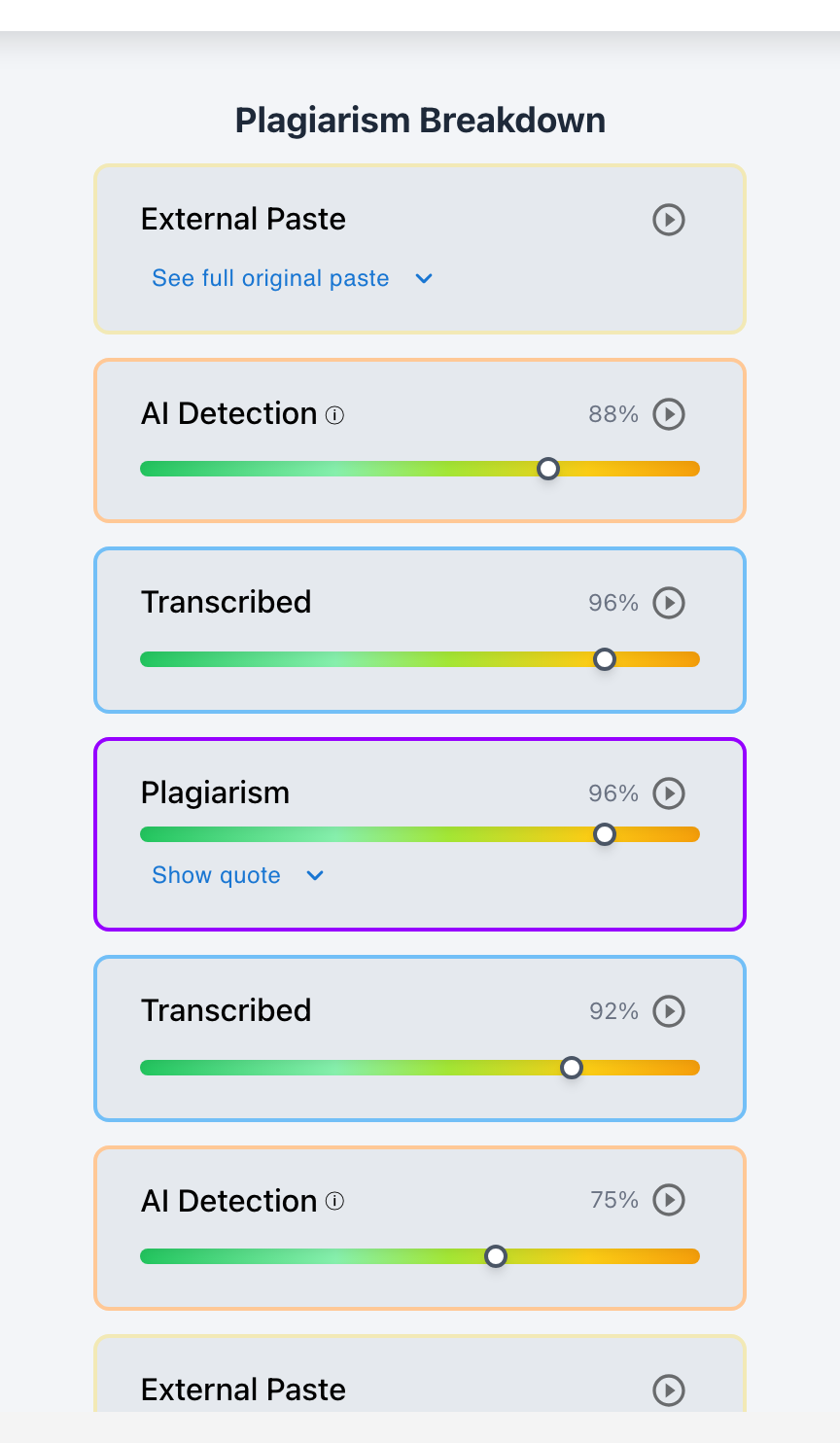
Between two student essays answering the exact same prompt, an overall peer similarity score of 0% to 12% is completely normal (reflecting shared prompt phrasing, standard citations, and common topic keywords). Similarity becomes suspicious when peer overlap exceeds 20% to 25%—or when any single passage contains a continuous cluster of 30+ identical words—signaling shared outlines, unauthorized collaboration, or direct peer copying.
When an entire class writes on the same prompt—such as analyzing The Great Gatsby or summarizing a biology lab experiment—some natural textual overlap is inevitable. Students will quote the same famous lines, cite the same textbook chapters, and repeat key academic terms. However, there is a clear mathematical and linguistic threshold where natural prompt coincidence ends and collusion begins. Checkmark Plagiarism automatically filters out prompt boilerplate and highlights passage-level clusters to help educators interpret peer similarity with mathematical precision.
Below is a comprehensive guide on similarity score thresholds, statistical benchmarks, and forensic analysis.
Checkmark Plagiarism evaluates peer similarity thresholds by pairing plagiarism detection with AI detection, essay writing playback, autograding, and integrations with Canvas and Google Classroom.
The 4 Peer Similarity Threshold Bands
Band 1: 0% – 12% (Normal Coincidence)
Status: Clean. Overlap consists entirely of prompt restatements, standard assignment headers, bibliography formatting, and common historical terms.
Band 2: 13% – 24% (Elevated / Shared Quotes)
Status: Review Quotes. Both students selected identical primary source quotes. If analysis surrounding quotes is unique, the paper is authentic.
Band 3: 25% – 49% (Suspicious Collusion)
Status: Investigate. Multiple consecutive sentences match, or both papers share an identical 4-part outline and evidence progression.
Band 4: 50%+ (Definitive Peer Plagiarism)
Status: Severe Violation. Large multi-paragraph blocks or the entire core thesis were shared, copied, or co-written between the two students.
Why Passage Clustering Matters More Than Global Percentage
Understanding the difference between diffuse matches and concentrated copying:
- Diffuse 15% Match (Safe): 15% similarity spread across 20 tiny 4-word fragments (e.g., "in the novel The Great Gatsby") is completely benign.
- Concentrated 15% Match (Severe Plagiarism): 15% similarity concentrated entirely in a single 250-word body paragraph copied word-for-word from a classmate represents direct cheating.
- Checkmark Passage Clustering: Checkmark flags continuous matching passages regardless of whether the overall score is 8% or 60%.
Read more in how Checkmark writing process analysis works.
Comparison: Coincidental Prompt Overlap vs. Peer Collusion
Coincidental Prompt Overlap (Benign)
- Matches isolated to quotes and prompt keywords.
- Sentence syntax and analysis are completely different.
- Writing Playback shows multi-hour independent drafting.
- Overall peer similarity falls below 15%.
Peer Collusion / Copying (Integrity Violation)
- Matching analytical commentary outside of quotes.
- Identical thesis phrasing and argument sequencing.
- Writing Playback shows rapid transcription or paste.
- Continuous matching passages of 30+ words.
A 5-Step Educator Protocol for Peer Similarity Audits
Peer Similarity Evaluation Checklist:
- 1. Open the student's submission in Checkmark Plagiarism inside Canvas SpeedGrader.
- 2. Enable "Exclude Prompt & Template Text" to strip out coincidental assignment instructions.
- 3. Inspect the Passage Cluster report: check for continuous matches over 30 words.
- 4. If peer match exceeds 25%, open the Side-by-Side Comparison card to inspect shared sentences.
- 5. Cross-examine with Writing Playback to verify whether both students drafted independently.
How Checkmark Plagiarism Powers Threshold Intelligence
Checkmark Plagiarism combines **AI detection, essay writing playback, static AI detection, plagiarism detection, autograding, and Canvas/Google Classroom integrations** to automatically filter prompt noise and highlight concentrated peer similarity clusters in SpeedGrader.
Frequently Asked Questions
What is an acceptable similarity percentage between two classmates?
On a shared prompt, a similarity score between 0% and 12% is completely normal and expected due to shared prompt words and standard citations.
At what percentage does peer similarity become suspicious?
Peer similarity becomes suspicious when it exceeds 20% to 25%, or when two papers share a continuous block of 30+ identical words outside of direct quotes.
Can two students write the same sentence by coincidence?
Short common phrases (4 to 6 words) occur by coincidence. However, two independent writers will never produce identical 20-word analytical sentences by chance.
How does Checkmark filter out prompt instructions?
Checkmark indexes the teacher's assignment prompt and automatically excludes its phrasing from similarity calculations, eliminating false positive noise.
What is passage clustering?
Passage clustering measures the concentration of matching text in a single block rather than averaging matches across the entire document.
How does Checkmark Plagiarism integrate with Canvas LMS?
Checkmark provides certified LTI 1.3 integration, SpeedGrader sidebar embeds, two-way grade passback, and single sign-on (SSO).
What if two students used the exact same three sources?
Using the same sources is common; Checkmark evaluates whether the student's analytical sentences and thesis arguments surrounding the quotes are unique.
Can writing playback show if two students drafted together?
Yes. Playback logs drafting timestamps and keystroke creation history, revealing whether text was drafted organically or copied from a shared file.
What should a teacher do if an essay hits a 35% peer match?
Review the side-by-side match card in SpeedGrader, check the Playback telemetry, and conduct a brief conference with both students.
Why are rigid percentage cutoffs flawed in grading?
Because qualitative evidence (concentrated passage copying) is far more important than a raw global percentage number.
Data-Driven Clarity for Fair Academic Assessment
Understanding similarity thresholds allows teachers to grade with confidence. By combining automated prompt filtering, passage clustering, and writing playback telemetry with Checkmark Plagiarism, educators ensure that natural prompt overlap is dismissed while genuine collusion is addressed with complete fairness.
Checkmark Plagiarism supports this comprehensive approach with AI detection, essay writing playback, static AI detection, plagiarism detection, autograding, and integrations with Canvas and Google Classroom.
See how Checkmark pairs peer similarity clustering with writing playback to evaluate student overlap. View a sample report or request a demonstration.