
When your school or district has not yet published an official AI policy, teachers must take proactive steps to establish clear classroom expectations, anchor rules in existing authorship standards, and protect student due process.
Operating in an institutional policy vacuum leaves both teachers and students vulnerable. Students may assume that the absence of a policy means unrestricted AI use is permitted, while instructors struggle to enforce standards without administrative backing. Fortunately, teachers can establish robust, defensible classroom practices by connecting AI rules to existing plagiarism codes, requiring essay writing playback tracking, and grounding evaluation in objective physical evidence.
Below is a step-by-step roadmap for educators navigating the AI landscape independently and effectively.
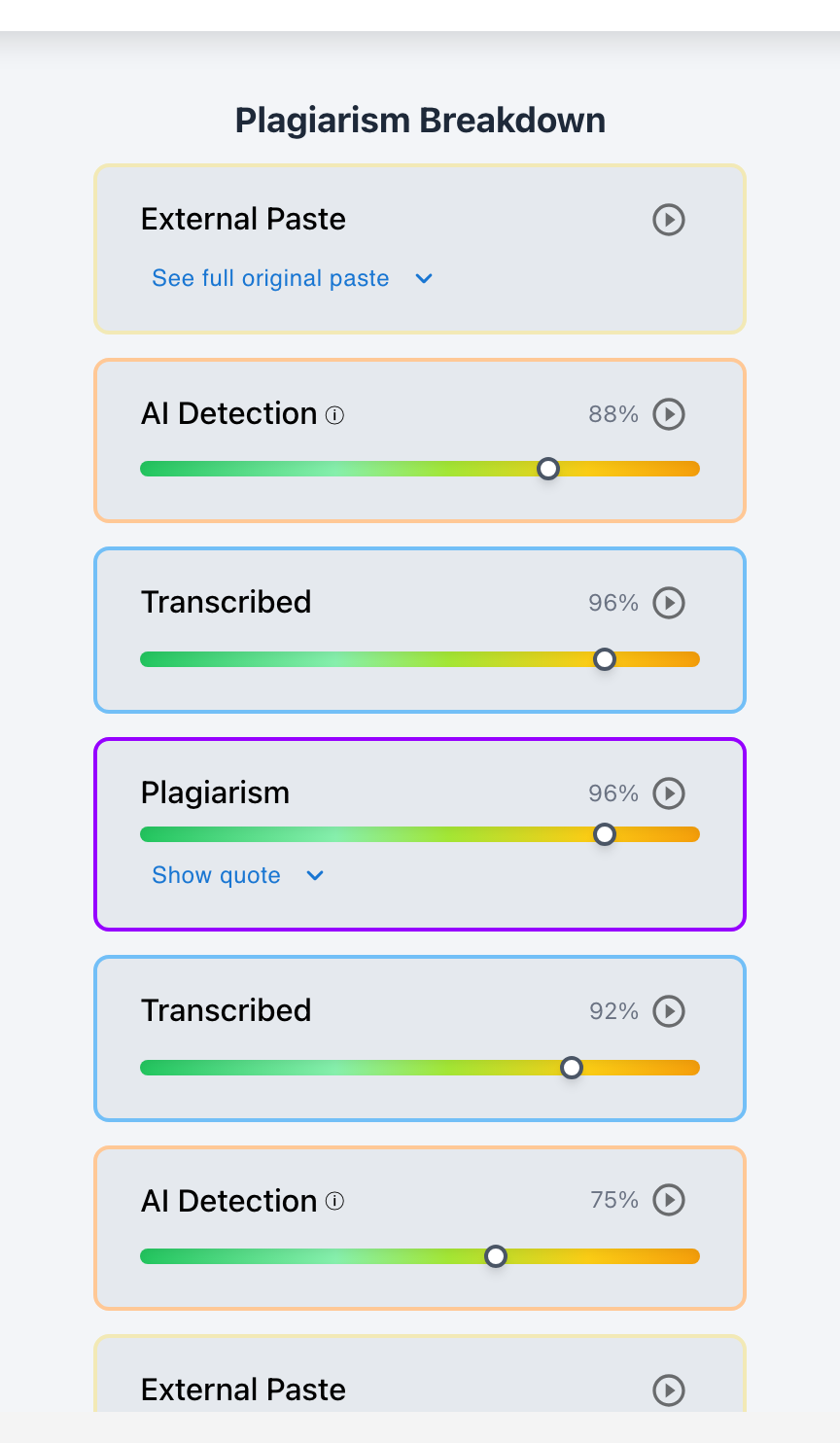
Checkmark Plagiarism empowers independent classroom integrity by pairing essay writing playback with AI detection, plagiarism detection, autograding, and integrations with Canvas and Google Classroom.
The 5-Step Classroom Action Plan for Teachers
1. Anchor in Existing Authorship Rules
Link AI rules directly to your school's existing honor code clauses on "authorship fraud," "unauthorized collaboration," and "misrepresentation of work."
2. Publish Course-Level Boundaries
Add an explicit AI clause to your syllabus and label every assignment prompt clearly (e.g., Level 1: No AI, Level 2: Brainstorming Only).
3. Require Essay Writing Playback
Make drafting within your LMS editor mandatory, creating an automated record of active keystrokes, typing time, and paste events.
4. Collect In-Class Writing Baselines
Administer a 30-minute proctored writing diagnostic during Week 1 to establish each student's authentic unassisted voice.
5. Adopt an Educational First-Response Protocol
In the absence of district guidance, handle suspected first offenses educationally rather than punitively:
- Schedule a supportive, non-accusatory student conference to discuss the writing process.
- Allow the student to rewrite the assignment in a proctored setting for credit.
- Document the conversation and share your classroom policy with department heads to help build future institutional guidelines.
How to Defend Standards Without School-Level Policies
If a parent or administrator questions your decision, relying on an automated AI detector score is vulnerable to dismissal. However, presenting objective physical evidence is unassailable:
- Essay Writing Playback Logs: Showing an instant wholesale paste of 1,400 words at 11:30 PM with zero active drafting time.
- Citation Audits: Showing that three cited academic journal articles do not exist in JSTOR or Google Scholar.
- Baseline Discrepancy: Demonstrating that the take-home essay shares none of the syntactic habits of the student's proctored in-class diagnostic.
Read more in what is better evidence than an AI detector score?
Sample Classroom Policy for Teachers
Classroom-Level AI Policy Statement:
Course AI & Authorship Policy:
"In this class, writing is evaluated as an expression of authentic student thought. Unless explicitly designated as an AI-assisted assignment, all text, analysis, and citations must be composed independently by the student. Submitting text generated or paraphrased by AI tools violates our school's standard academic integrity policy regarding authorship misrepresentation.
All essays must be composed in our LMS document editor with writing playback active. Submissions showing zero keystroke history or unexplained wholesale pastes will require an in-person oral check-in before grades are recorded."
Comparison: Vulnerable Teacher Response vs. Defensible Classroom Protocol
Vulnerable Response (High Risk)
- No written classroom policy provided to students.
- Issues a zero based solely on an 85% AI detector score.
- Has no document creation logs or draft history.
- Easily overturned on appeal by administration.
Defensible Classroom Protocol (Low Risk)
- Explicit syllabus clause published on Day 1.
- Uses writing playback to verify keystroke history.
- Audits citations in academic databases for hallucinations.
- Supported by proctored in-class diagnostic baselines.
A 5-Step Checklist for Independent Educators
Educator Independent Integrity Checklist:
- 1. Add a clear AI clause to your syllabus linking to existing school honor codes.
- 2. State explicit AI permissions on every individual assignment prompt.
- 3. Administer a Week 1 in-class diagnostic writing sample to establish baselines.
- 4. Require all major drafting to occur within the LMS editor with writing playback active.
- 5. Resolve first-time integrity issues through supportive oral check-ins and proctored rewrites.
How Checkmark Plagiarism Empowers Classroom Autonomy
Checkmark Plagiarism combines **AI detection, essay writing playback, static AI detection, plagiarism detection, autograding, and Canvas/Google Classroom integrations** to give individual teachers complete, defensible integrity verification, even when institutional policies are still developing.
Frequently Asked Questions
Can a teacher enforce an AI ban if the school has no policy?
Yes. Instructors have academic authority over their course requirements and can anchor AI rules in existing school policies regarding authentic authorship and unauthorized assistance.
What if a student argues: 'The school doesn't have a rule against ChatGPT'?
Explain that school honor codes have always required students to submit their own original work. Using AI to generate an essay violates core authorship standards regardless of new tech.
How can I protect myself from administrative pushback?
Rely on objective physical evidence—writing playback logs showing wholesale paste events and non-existent citations—rather than automated detector percentages.
What should I do if a student's parents challenge an AI penalty?
Present the student's writing playback timeline, compare the paper against their in-class baseline, and show search records proving cited sources are fake.
How does writing playback help teachers without school policies?
Playback logs provide indisputable physical proof of how the document was assembled, eliminating subjective debate about whether the text was typed by the student.
Should I share my classroom AI policy with my department head?
Yes. Sharing your syllabus language helps colleagues adopt consistent standards and often serves as the foundation for a future school-wide policy.
How should I handle a first-time AI offense without school guidance?
Use an educational approach: hold a private conference, explain the authorship expectation, and allow a supervised rewrite for revised credit.
Can I require in-class writing if the school has no policy?
Yes. Teachers have full pedagogical authority to assign in-class essays, diagnostic prompts, and proctored writing exercises.
How does Checkmark Plagiarism integrate with Canvas LMS?
Checkmark Plagiarism embeds visual writing playback timelines and dual AI/plagiarism reports directly inside Canvas SpeedGrader.
How does this proactive approach help students?
It removes confusion, sets clear expectations, and ensures students understand the ethical boundaries of technology in academia.
Leadership Begins in the Classroom
Teachers do not need to wait for institutional committees to establish fair, rigorous, and supportive AI standards. By publishing clear classroom rules, collecting in-class baselines, and verifying creation with essay writing playback, educators lead the way in protecting authentic scholarship.
Checkmark Plagiarism supports this principled standard with AI detection, essay writing playback, static AI detection, plagiarism detection, autograding, and integrations with Canvas and Google Classroom.
See how Checkmark pairs essay writing playback with multi-signal detection to establish defensible classroom integrity standards inside your LMS. View a sample report or request a demonstration.