
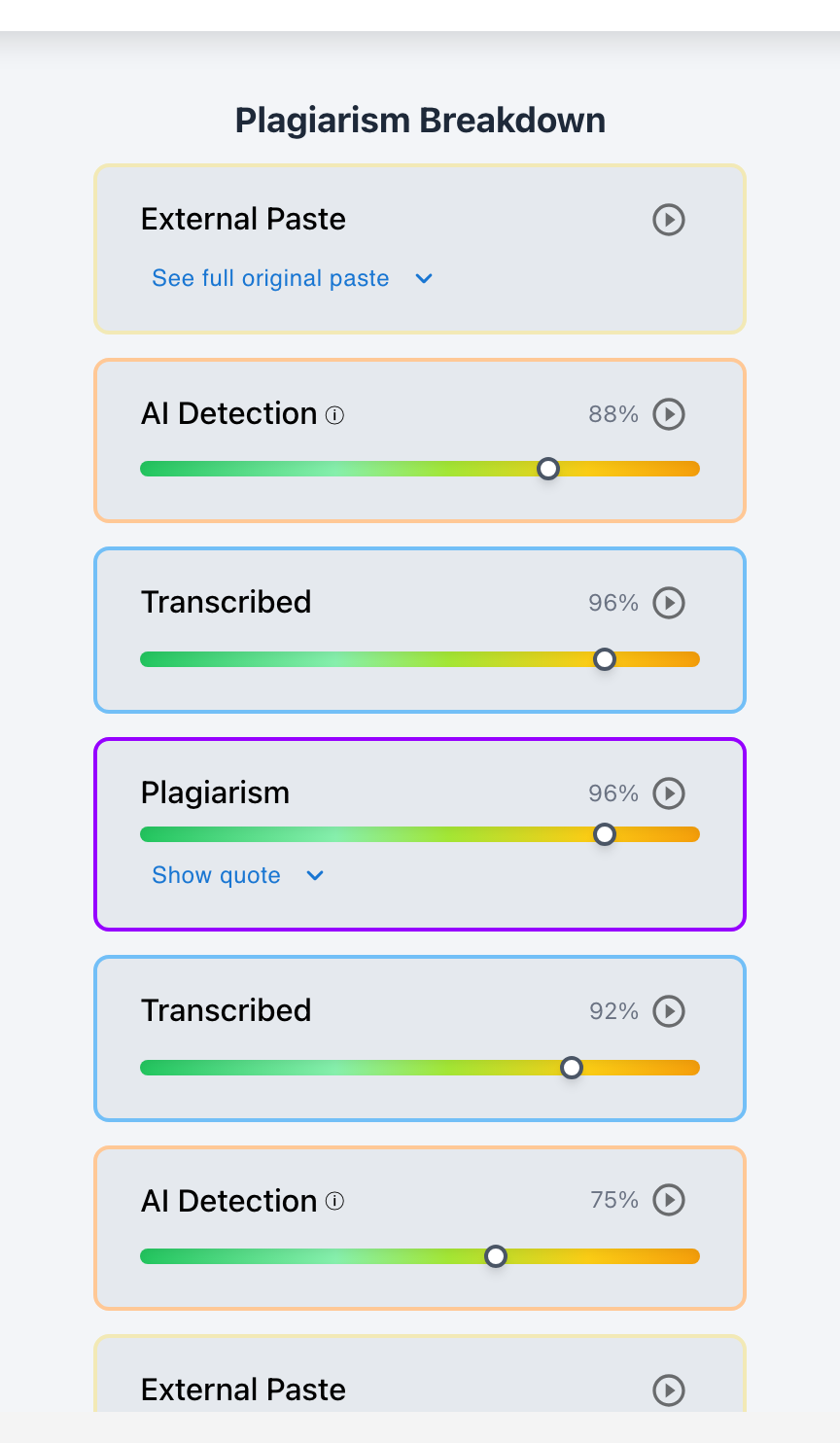
Teachers should evaluate disclosed AI assistance through a 4-step pedagogical framework: first, cross-verify the student's disclosure statement against physical keystroke telemetry in Checkmark Playback (confirming the actual AI usage matches what was declared); second, assess the depth of independent human contribution (ensuring core analytical synthesis was student-authored); third, grade the student's critical evaluation of the AI output; and fourth, conduct an oral check-in to confirm genuine conceptual mastery.
As education shifts from prohibition to transparent integration, requiring students to submit an AI Disclosure Statement (or "AI Acknowledgment Appendix") has become best practice across secondary and higher education. However, receiving a paper with a disclosure raises new grading questions: "If a student admits they used ChatGPT to brainstorm or polish transitions, how do I grade it fairly compared to students who used no AI at all?" Rewarding honesty while maintaining high standards requires evaluating the authenticity of the human intellectual labor. Checkmark Plagiarism automates disclosure verification directly inside Canvas SpeedGrader.
Below is a comprehensive guide on designing, evaluating, and grading assignments with disclosed AI assistance.
Checkmark Plagiarism evaluates disclosed AI use by pairing AI detection with essay writing playback, plagiarism detection, autograding, and integrations with Canvas and Google Classroom.
The 4-Step Framework for Evaluating Disclosed AI
Step 1: Telemetry Cross-Verification
Compare the student's declared AI usage (e.g., "used AI only for grammar") against Checkmark Playback to verify whether drafting hours and paste logs match the claim.
Step 2: Assess Human Intellectual Agency
Evaluate whether the student conceived the thesis, researched primary evidence, and formulated conclusions independently, using AI strictly as a tool.
Step 3: Evaluate Critical AI Curation
Review how the student filtered, questioned, and corrected AI suggestions rather than passively accepting machine output without critical reflection.
Step 4: Oral Defense & Concept Mastery
Hold a brief 2-minute conference: ask the student to explain why they adopted or rejected specific AI suggestions during drafting.
What a Standard AI Disclosure Statement Contains
An effective disclosure appendix includes four standardized elements:
- Tool & Model Used: Specific platform (e.g., ChatGPT-4o, Claude 3.5 Sonnet, Grammarly).
- Purpose of Assistance: Specific stage of writing (e.g., "Ideation and finding counterarguments for Section 2").
- Prompts & Revisions: The exact prompt fed to the model and a description of how the student modified the resulting text.
- Reflection on Utility: A 2-sentence student reflection on whether the AI suggestion was helpful or flawed.
Read more in how Checkmark writing process analysis works.
Comparison: Transparent Disclosed AI vs. Deceptive AI Disclosure
Transparent Disclosed AI (Honest Scholarship)
- Disclosure accurately matches Playback telemetry.
- 3+ hours of active human typing recorded.
- Student used AI only for permitted brainstorming/grammar.
- Student defends all arguments and sources orally.
Deceptive AI Disclosure (Misleading Shield)
- Claims "only used AI for grammar," but pasted whole essay.
- Playback shows <10 minutes total document time.
- AI generated the entire thesis and analysis.
- Student uses disclosure as a shield to evade penalties.
A 5-Step Educator Protocol for Disclosed AI Assessment
Disclosed AI Assessment Checklist:
- 1. Open the student's submission in Checkmark Plagiarism inside Canvas SpeedGrader.
- 2. Read the student's attached AI Disclosure Statement.
- 3. Open Writing Playback: confirm that the declared usage matches actual keystroke duration and paste events.
- 4. If disclosure matches telemetry, score the essay according to the rubric's human intellectual criteria.
- 5. If disclosure minimizes full AI generation, conduct a conference to address the disclosure discrepancy.
How Checkmark Plagiarism Powers Disclosure Verification
Checkmark Plagiarism combines **AI detection, essay writing playback, static AI detection, plagiarism detection, autograding, and Canvas/Google Classroom integrations** to automatically match student disclosure statements against empirical keystroke drafting telemetry.
Frequently Asked Questions
Does disclosing AI use protect a student from getting a zero?
Disclosure protects against deception charges, but if the student disclosed that AI wrote the entire essay when independent writing was required, the paper cannot receive credit for unperformed human labor.
How does a teacher verify if an AI disclosure is truthful?
Checkmark Playback proves whether the student actually spent hours typing an original draft (as claimed) or pasted full paragraphs generated by AI.
Should students receive extra credit for transparent disclosure?
While honesty should be commended, grades should reflect mastery of course learning objectives rather than the mere act of disclosing tool use.
What if a student used AI in a way that was prohibited by the syllabus?
Disclosing an unauthorized shortcut is honest, but the teacher should still require a non-AI rewrite to ensure the course learning objective is met.
How does Checkmark Plagiarism integrate with Canvas LMS?
Checkmark provides certified LTI 1.3 integration, SpeedGrader sidebar embeds, two-way grade passback, and single sign-on (SSO).
What is 'critical AI curation'?
It is the process where a student evaluates AI-generated ideas critically, discarding errors and refining suggestions with personal scholarship.
How can teachers create a standard AI disclosure template?
Provide a simple 4-line appendix in your syllabus asking for the tool name, purpose, prompt used, and reflection.
Does Autograder support AI disclosure rubrics?
Yes. Checkmark Autograder can evaluate AI disclosure completeness and assess human analytical depth against the teacher's rubric.
What if an AI detector flags an essay that has an honest disclosure?
The detector score is expected if AI was used for style polish; Playback validates the disclosure by proving the underlying human draft was authentic.
Why is disclosure verification essential for future education?
Because encouraging honest disclosure builds trust, prepares students for professional AI workflows, and rewards intellectual integrity.
Cultivating Transparency and Scholarly Integrity
The future of education is built on honesty and transparent tool usage. By requiring AI disclosure statements and verifying them with keystroke playback in Checkmark Plagiarism, educators foster an environment where students can explore emerging technology with integrity, accountability, and pride.
Checkmark Plagiarism supports this comprehensive approach with AI detection, essay writing playback, static AI detection, plagiarism detection, autograding, and integrations with Canvas and Google Classroom.
See how Checkmark pairs AI disclosure verification with writing playback to grade transparent student work. View a sample report or request a demonstration.