
Transparent disclosure is the foundation of ethical AI use in education: it transforms technology from a secretive cheating shortcut into an open, accountable scholarship practice.
When course policies permit AI for brainstorming, feedback, or coding assistance, students must document and disclose that assistance clearly. An unacknowledged AI-generated paragraph is plagiarism; the same paragraph, properly cited and accompanied by an AI Disclosure Statement, represents transparent academic inquiry.
Below is a practical guide for students and educators on how to structure, write, and verify AI disclosure statements across all major citation styles and assignment formats.
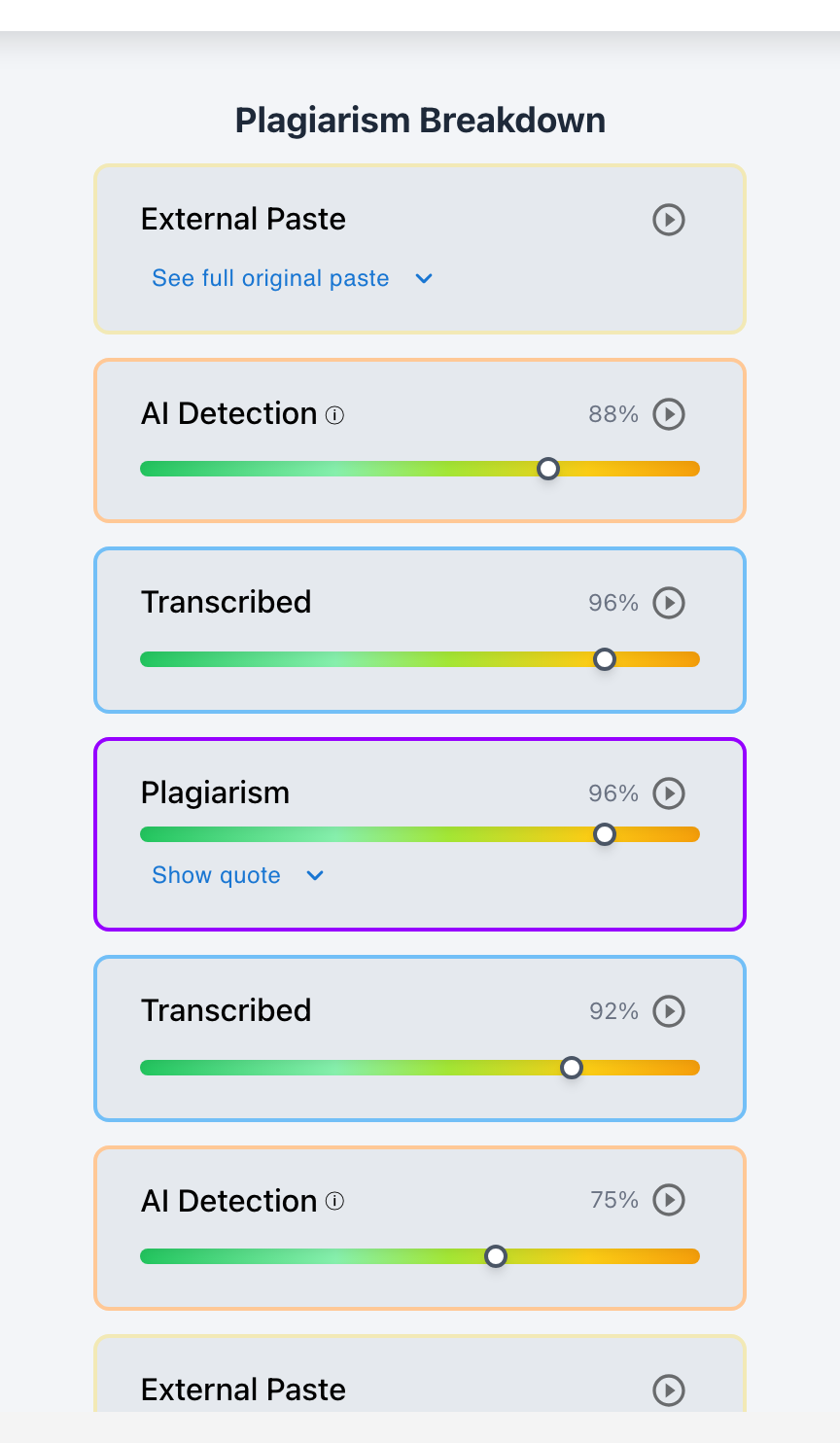
Checkmark Plagiarism supports transparent disclosure by pairing essay writing playback with AI detection, plagiarism detection, autograding, and integrations with Canvas and Google Classroom.
The 4 Components of an AI Disclosure Appendix
1. Tool Name & Model Version
State the exact tool and version used (e.g., "OpenAI ChatGPT (GPT-4o)" or "Anthropic Claude 3.5 Sonnet") and access date.
2. Specific Scope of Assistance
Clearly describe how the tool was used: brainstorming topic ideas, generating outline suggestions, or reviewing grammar.
3. Exact Prompts Entered
Include the verbatim text of prompts submitted to the AI so the instructor can see the exact interaction.
4. Human Critical Reflection
Briefly explain how you evaluated, modified, or rejected the AI's suggestions to craft your own authentic final text.
Sample AI Disclosure Statement Template
Standard Student AI Disclosure Appendix:
AI Disclosure Statement:
Tool Used: OpenAI ChatGPT (GPT-4o), accessed August 10, 2026.
Purpose: Brainstorming counterarguments and identifying logical gaps in my rough draft outline.
Prompts Entered: "What are 3 common counterarguments to the claim that urban vertical farming reduces agricultural carbon emissions?"
Student Reflection: ChatGPT suggested energy consumption of artificial lighting as a major counterpoint. I researched this point independently in JSTOR, found peer-reviewed data from [Author] ([Year]), and wrote Section 3 in my own words. All final sentences and analysis are 100% my own composition.
How to Cite Generative AI in APA and MLA Styles
1. APA 7th Edition Format
In-Text: (OpenAI, 2026)
Reference List: OpenAI. (2026). ChatGPT (Aug 10 version) [Large language model]. https://chatgpt.com
2. MLA 9th Edition Format
In-Text: ("Describe the causes")
Works Cited: "Describe the causes of the French Revolution" prompt. ChatGPT, model GPT-4o, OpenAI, 10 Aug. 2026, chatgpt.com.
How Essay Writing Playback Verifies Disclosure Accuracy
Submitting an AI disclosure is an honor pledge; Checkmark Plagiarism's essay writing playback provides the objective verification:
- Confirming Brainstorming Claims: If a student claims they only used AI for brainstorming, playback confirms hours of active typing as the student composed sentences independently.
- Catching Under-Disclosure: Flags if a student claimed "minor brainstorming" but writing playback reveals a 1,200-word instant paste from an external source.
Read more in how Checkmark writing process analysis works.
A 5-Step Disclosure Protocol for Educators
Educator Implementation Checklist:
- 1. Provide the standardized AI Disclosure Appendix template on the assignment prompt.
- 2. Require all submissions to include either a completed disclosure or a "No AI Used" pledge.
- 3. Review essay writing playback logs to verify that composition matches the claimed disclosure.
- 4. Audit cited sources in academic databases to confirm all references are authentic.
- 5. Reward students for transparent disclosure and critical evaluation of AI outputs.
How Checkmark Plagiarism Streamlines AI Disclosure
Checkmark Plagiarism combines **AI detection, essay writing playback, static AI detection, plagiarism detection, autograding, and Canvas/Google Classroom integrations** to make AI disclosure seamless, automated, and verifiable directly inside your LMS.
Frequently Asked Questions
When is a student required to disclose AI use?
Whenever generative AI is used for brainstorming, outlining, code debugging, or editing beyond standard spellcheck, unless course policy explicitly forbids AI entirely.
Does disclosing AI use protect me from plagiarism penalties?
Disclosure ensures transparency, but it does not allow you to submit AI-written text if the assignment requires 100% human authorship. Always check course rules.
Where should the AI disclosure statement be placed?
At the end of the essay, directly after the bibliography or Works Cited page, as an "Appendix: AI Usage Statement."
Do I need to cite ChatGPT if I only asked it to define a word?
No. Basic dictionary definitions do not require formal AI disclosure unless AI generated substantial research concepts for the paper.
What if I forget to disclose AI use?
Unacknowledged AI use is treated as academic dishonesty under standard honor codes. If you forgot, notify your teacher immediately before grades are issued.
How does writing playback verify what I disclosed?
Playback captures your active typing timeline, proving whether you typed the essay yourself after brainstorming or pasted AI text directly into the document.
Can teachers verify the prompts I entered?
Yes. Teachers can review the prompts in your disclosure and ask you during an oral check-in to explain how you evaluated the AI suggestions.
How do MLA and APA handle generative AI citations?
Both styles ask you to credit the company behind the tool (here, OpenAI) and to name the tool and its version. MLA also builds the entry around a description of the prompt and the date the content was generated, so keep a record of your prompts and when you ran them.
How does Checkmark Plagiarism integrate with Canvas LMS?
Checkmark Plagiarism displays visual writing playback replays alongside student AI disclosures directly inside Canvas SpeedGrader.
Why is teaching AI disclosure important?
It instills lifelong professional research ethics, teaching students that transparent attribution is essential in modern scholarship and industry.
Transparency Is the Cornerstone of Scholarship
Embracing transparent AI disclosure bridges the gap between modern technology and timeless academic integrity. By pairing clear disclosure standards with essay writing playback, educators foster an open, honest, and rigorous learning culture.
Checkmark Plagiarism supports this principled standard with AI detection, essay writing playback, static AI detection, plagiarism detection, autograding, and integrations with Canvas and Google Classroom.
See how Checkmark pairs essay writing playback with multi-signal detection to make AI disclosure transparent and verifiable inside your LMS. View a sample report or request a demonstration.