
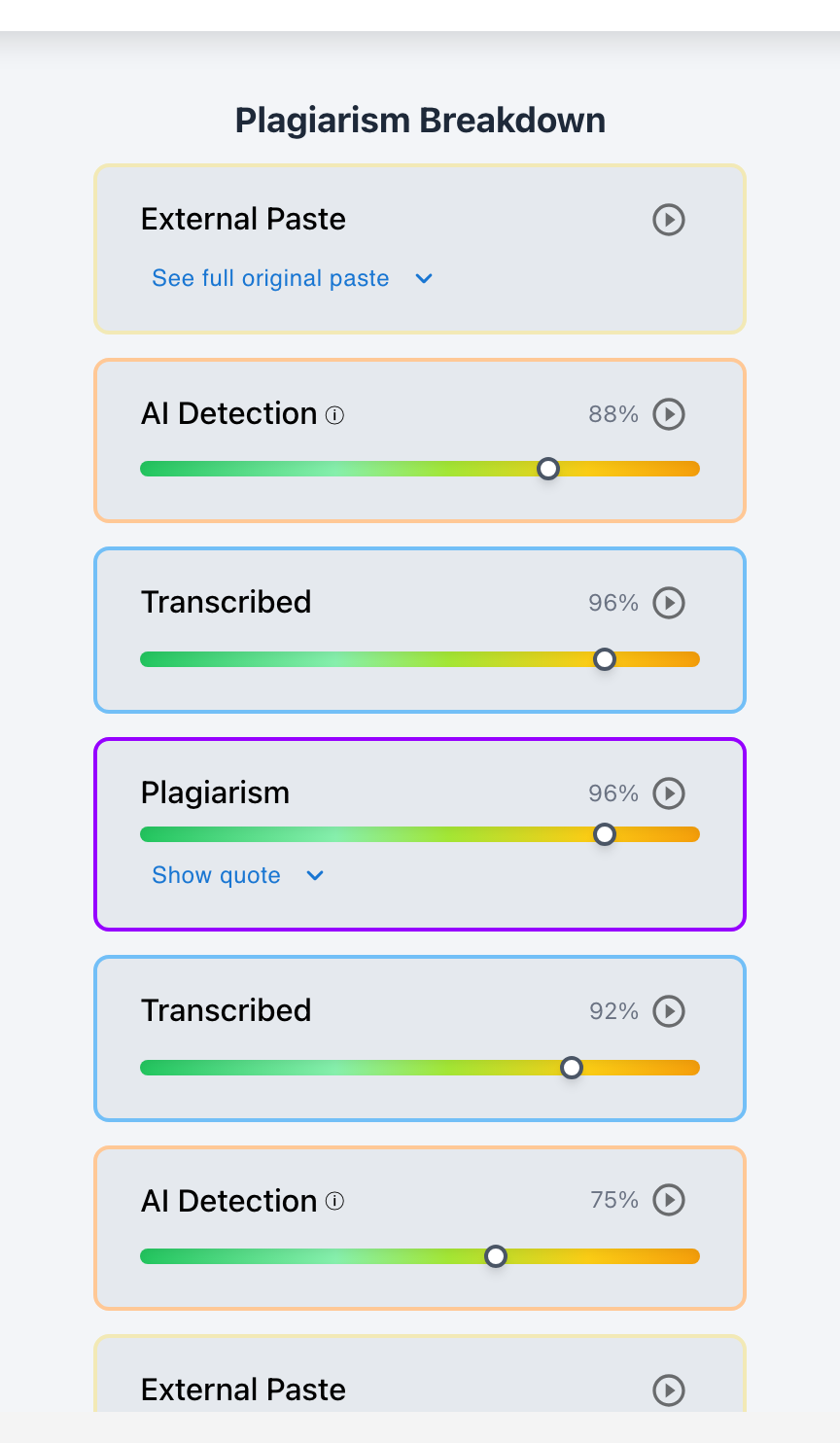
Schools should create an AI academic integrity investigation process based on a clear, 4-stage due process framework: Stage 1 (Pre-Inquiry Telemetry Screening): verify keystroke writing playback, paste event logs, and cited DOIs before approaching the student; Stage 2 (Informal Teacher Conference): conduct a supportive, private 2-minute oral check-in using diagnostic questions; Stage 3 (Administrative Escalation): submit a standardized multi-signal PDF audit dossier to the Academic Honor Committee; and Stage 4 (Formal Due Process & Appeals): allow the student to present independent drafting artifacts. Checkmark Plagiarism provides the end-to-end evidence infrastructure for this institutional process.
The rapid adoption of generative AI has caught many schools without clear, legally sound investigation procedures. When a suspected AI case arises, teachers often struggle with what evidence to gather, how to talk to the student, and who makes the final disciplinary determination. Without a structured institutional roadmap, investigations become subjective, contentious, and vulnerable to parental disputes or legal challenges. Establishing a formalized AI investigation pipeline ensures that academic standards are enforced with unwavering fairness, transparency, and legal defensibility.
Below is a comprehensive guide for school leaders, department chairs, and honor committees building an AI integrity investigation process.
Checkmark Plagiarism supports institutional investigation pipelines by pairing AI detection with essay writing playback, plagiarism detection, autograding, and integrations with Canvas and Google Classroom.
The 4-Stage Institutional Investigation Framework
Stage 1: Pre-Inquiry Telemetry Screening
The teacher inspects Checkmark Writing Playback in Canvas SpeedGrader: checking Active Typing Hours, Clipboard Paste Logs, and verifying cited DOIs before contacting the student.
Stage 2: Informal Educator Conference
The teacher holds a private, 2-minute non-accusatory check-in, asking the student to explain their core thesis and walk through their drafting process together.
Stage 3: Formal Administrative Escalation
If unresolved, the teacher exports a standardized PDF audit dossier from Checkmark, submitting the case to the Department Chair or Honor Council.
Stage 4: Transparent Appeals & Resolution
The student is granted an official appeal window to present handwritten notes, rough outlines, or original cloud version history before a final binding ruling.
The Multi-Signal Evidentiary Standard for School Policies
Defining the required evidence thresholds in institutional handbooks:
- The Prohibition on Single-Score Sanctions: School policy must explicitly state that no student can be disciplined based solely on an automated AI detector percentage.
- The "Two-Pillar Rule": Disciplinary findings require corroboration from at least two independent evidence categories: 1) Process Telemetry (paste payloads / low typing hours), 2) Citation Integrity (hallucinated sources), or 3) Oral Defense Incongruity.
- FERPA-Compliant Audit Packages: All case evidence must be compiled into standardized, exportable PDF dossiers generated directly from Checkmark.
Read more in how Checkmark writing process analysis works.
Comparison: Chaotic Ad-Hoc Inquiries vs. Checkmark Standardized Pipeline
Checkmark Standardized Pipeline (Fair & Defensible)
- Clear 4-stage roadmap followed by all faculty.
- Mandatory multi-signal telemetry requirements.
- One-click exportable PDF dossiers for committees.
- Documented due process and transparent appeal rights.
Chaotic Ad-Hoc Inquiries (Subjective & High-Risk)
- Teachers accuse students based on random web scores.
- Hostile, unstandardized student confrontations.
- No permanent record or audit trail for administration.
- Exposes school to parental disputes and legal liability.
A 5-Step Leadership Protocol for Establishing the Pipeline
Institutional Pipeline Implementation Checklist:
- 1. Draft and publish the official 4-Stage AI Investigation Policy in the student and faculty handbooks.
- 2. Deploy Checkmark Plagiarism across your Canvas LMS and Google Classroom instances.
- 3. Conduct faculty training on interpreting writing playback videos, cadence graphs, and citation logs.
- 4. Designate a standardized Honor Review Committee to review escalated Stage 3 dossiers.
- 5. Review annual integrity metrics using Checkmark's administrative dashboard to monitor policy effectiveness.
How Checkmark Plagiarism Powers Investigation Pipelines
Checkmark Plagiarism combines **AI detection, essay writing playback, static AI detection, plagiarism detection, autograding, and Canvas/Google Classroom integrations** to provide schools with the complete forensic and administrative foundation for defensible integrity investigations.
Frequently Asked Questions
Why must schools separate informal conferences from formal hearings?
Informal conferences allow educators to resolve misunderstandings or minor citation mistakes formatively, reserving formal disciplinary hearings for severe, uncooperative cases.
What role does writing playback play in Stage 1?
Writing playback allows teachers to verify whether an essay has 4 hours of genuine typing, immediately dismissing 90% of suspected cases before approaching the student.
Can a student appeal a decision made by an Honor Committee?
Yes. Due process requires an appeal window where students can present new drafting evidence to an independent academic administrator or principal.
How does Checkmark Plagiarism integrate with Canvas LMS?
Checkmark integrates via LTI 1.3, embedding investigation tools, playback videos, and dossier generators directly inside Canvas SpeedGrader.
What should happen during the Stage 2 informal conference?
The teacher shows the writing playback video, asks 3 diagnostic questions about the essay's core ideas, and gives the student an open opportunity to explain their writing process.
Who makes the final decision in escalated cases?
Final disciplinary decisions should be made by an Academic Honor Committee or designated school administrator based on the compiled multi-signal dossier.
How does a standardized pipeline protect schools legally?
By establishing objective evidence thresholds and documented due process, schools ensure decisions withstand legal scrutiny, accreditation audits, and parental challenges.
Can teachers export a complete case file with one click?
Yes. Checkmark exports standardized, FERPA-compliant PDF dossiers containing all playback links, paste timestamps, AI heatmaps, and notes.
How does Checkmark Autograder assist in the investigation pipeline?
Autograder automatically pauses grade release on submissions with high integrity risk indices, routing them into the Stage 1 screening workflow.
Why is due process essential in the age of generative AI?
Because generative AI requires nuanced evaluation: clear due process protects honest students from false accusations while holding intentional misconduct accountable.
Building Trust Through Structured Due Process
A school's integrity is defined by the fairness of its processes. By establishing Checkmark Plagiarism's 4-stage investigation roadmap, institutions eliminate ambiguity, guarantee rigorous due process for every student, and uphold academic excellence with unwavering integrity.
Checkmark Plagiarism supports this comprehensive approach with AI detection, essay writing playback, static AI detection, plagiarism detection, autograding, and integrations with Canvas and Google Classroom.
See how Checkmark powers structured academic integrity investigation pipelines. View a sample report or request a demonstration.