
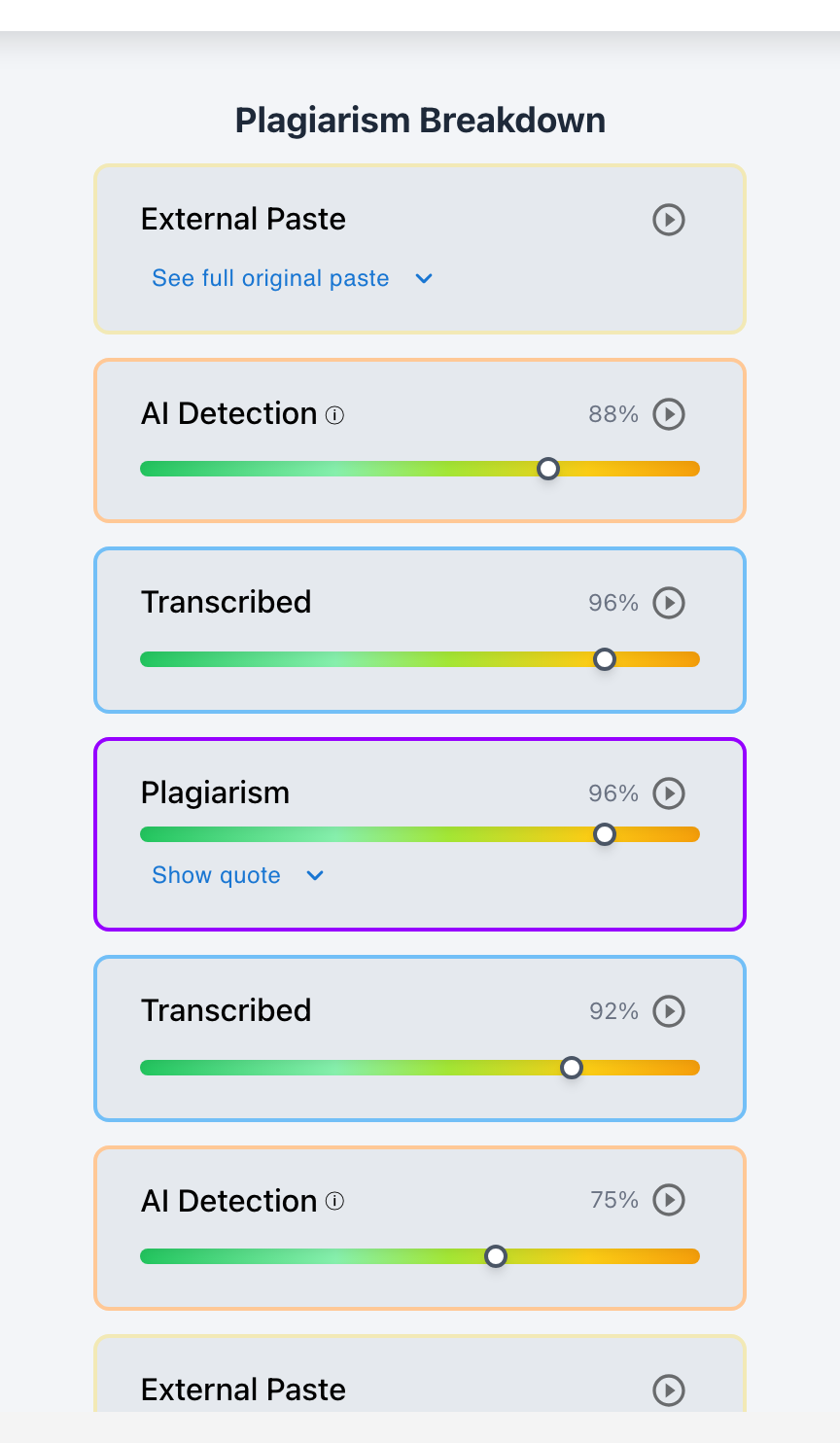
A student's writing style can naturally vary by 15% to 25% in vocabulary complexity and sentence length depending on the assignment genre (such as a personal narrative versus a formal research paper). However, a sudden 300% jump in syntactic subordination, accompanied by the total disappearance of habitual errors and zero drafting backspaces in Checkmark Playback, is statistically impossible for authentic human composition.
Teachers frequently observe that students write differently across contexts: a student might sound casual in a reflective journal entry, structured in a literary analysis, and concise in a lab report. Understanding the boundaries of expected stylistic variance versus unnatural AI/ghostwriting disruption is crucial for avoiding false accusations while maintaining rigorous academic standards. Checkmark Plagiarism establishes calibrated stylometric thresholds to help teachers differentiate natural genre adaptation from unauthorized assistance.
Below is a comprehensive guide on evaluating writing style changes across assignments.
Checkmark Plagiarism quantifies stylistic variance by pairing AI detection with essay writing playback, plagiarism detection, autograding, and integrations with Canvas and Google Classroom.
The 4 Normal Causes of Stylistic Variation
1. Genre & Register Shifts
Moving from an informal personal memoir to an APA-formatted research paper naturally increases passive voice usage and academic terminology.
2. Direct Integration of Source Quotes
Analyzing complex primary literature (e.g., Shakespeare or scientific journals) naturally introduces elevated vocabulary into surrounding student analysis.
3. Scaffolded Drafting & Tutoring
A student who visited the writing center or completed 3 rounds of peer review will submit a significantly cleaner, more polished final draft.
4. Formative Skill Acquisition
As direct instruction on transitions, sentence combining, or thesis development takes hold, student prose shows steady, incremental refinement.
When Stylistic Shifts Cross into the "Impossibility Zone"
In contrast, unauthorized third-party authorship produces stylistic ruptures that violate natural developmental curves:
- The "Zero-to-Collegiate" Jump: A student who writes at an 8th-grade readability level on proctored diagnostic prompts suddenly submits 14th-grade collegiate prose with zero intermediate progression.
- Disappearance of Idiosyncratic Habits: Habitual grammatical quirks (such as recurring comma splices or specific spelling habits) vanish completely overnight.
- The Telemetry Mismatch: The newly elevated style appears in document history with zero backspaces and an active typing duration of under 15 minutes.
Read more in how Checkmark writing process analysis works.
Comparison: Natural Genre Variation vs. Unnatural AI Disruption
Natural Genre Variation (Expected 15–25%)
- Vocabulary expands around topic-specific terms.
- Student's core rhetorical cadence remains recognizable.
- Drafting time: 3+ hours with 15–25% backspaces.
- Student fluently explains all vocabulary in person.
Unnatural AI Disruption (Statistically Impossible)
- 300% jump in lexical density and clause complexity.
- Total erasure of personal voice, humor, and habits.
- Drafting time: under 15 minutes (paste/transcription).
- Student cannot define words used in the paper.
A 5-Step Educator Protocol for Stylistic Audits
Stylistic Variance Audit Protocol:
- 1. Open the student's submission in Checkmark Playback inside Canvas SpeedGrader.
- 2. Review the Stylometric Variance Index comparing this paper to earlier semester assignments.
- 3. Inspect the Deletion Rate and Active Typing Time metrics.
- 4. Check the AI Probability Score and Paragraph Heatmap.
- 5. Hold a 2-minute non-adversarial conference: ask the student to explain the evolution of their writing style.
How Checkmark Plagiarism Powers Stylometric Forensics
Checkmark Plagiarism combines **AI detection, essay writing playback, static AI detection, plagiarism detection, autograding, and Canvas/Google Classroom integrations** to automatically calculate expected variance ranges and flag unnatural stylistic anomalies.
Frequently Asked Questions
Is it normal for a student to write much better in an essay than on a quiz?
Yes. Essays allow time for outlining, drafting, researching, and revising, which naturally produces cleaner prose than timed quiz responses.
How much can vocabulary difficulty change naturally?
Vocabulary complexity naturally fluctuates by 15% to 25% depending on whether the assignment is technical, analytical, or reflective.
What is a stylometric variance index?
It is a mathematical measure that tracks changes in sentence length, lexical diversity, and syntactic embedding across a writer's portfolio.
How does writing playback help evaluate style changes?
Playback proves whether an elevated writing style was earned through hours of iterative drafting or inserted instantaneously via external text.
What if a student worked extensively with a writing tutor?
A tutor-assisted essay will show multiple drafting sessions and high backspace rates in Playback, whereas AI generation shows instant unedited text.
How does Checkmark Plagiarism integrate with Canvas LMS?
Checkmark provides certified LTI 1.3 integration, SpeedGrader sidebar embeds, two-way grade passback, and single sign-on (SSO).
Can a sudden improvement in writing be genuine?
Yes, but genuine improvement is accompanied by active drafting hours, revisions, and the ability to explain the text orally in a brief conference.
What should a teacher do if an essay sounds like a different person?
Check the Playback telemetry and conduct a brief 2-minute oral check-in asking the student to define complex terms from their essay.
Can students fake realistic human typing when changing styles?
Simulating hours of realistic keystroke speed fluctuations, pauses, and backspaces requires more effort than writing honestly.
Why is multi-signal evidence essential for style audits?
Because combining stylometric linguistic tracking with keystroke process telemetry provides objective, defensible proof of authorship.
Distinguishing Authentic Growth from External Disruption
Student writing should grow and adapt across the school year. By analyzing stylometric variance and keystroke telemetry with Checkmark Plagiarism, educators can celebrate genuine writing growth while ensuring that academic integrity standards remain uncompromised.
Checkmark Plagiarism supports this comprehensive approach with AI detection, essay writing playback, static AI detection, plagiarism detection, autograding, and integrations with Canvas and Google Classroom.
See how Checkmark pairs stylometric variance tracking with keystroke playback to evaluate writing style changes. View a sample report or request a demonstration.