
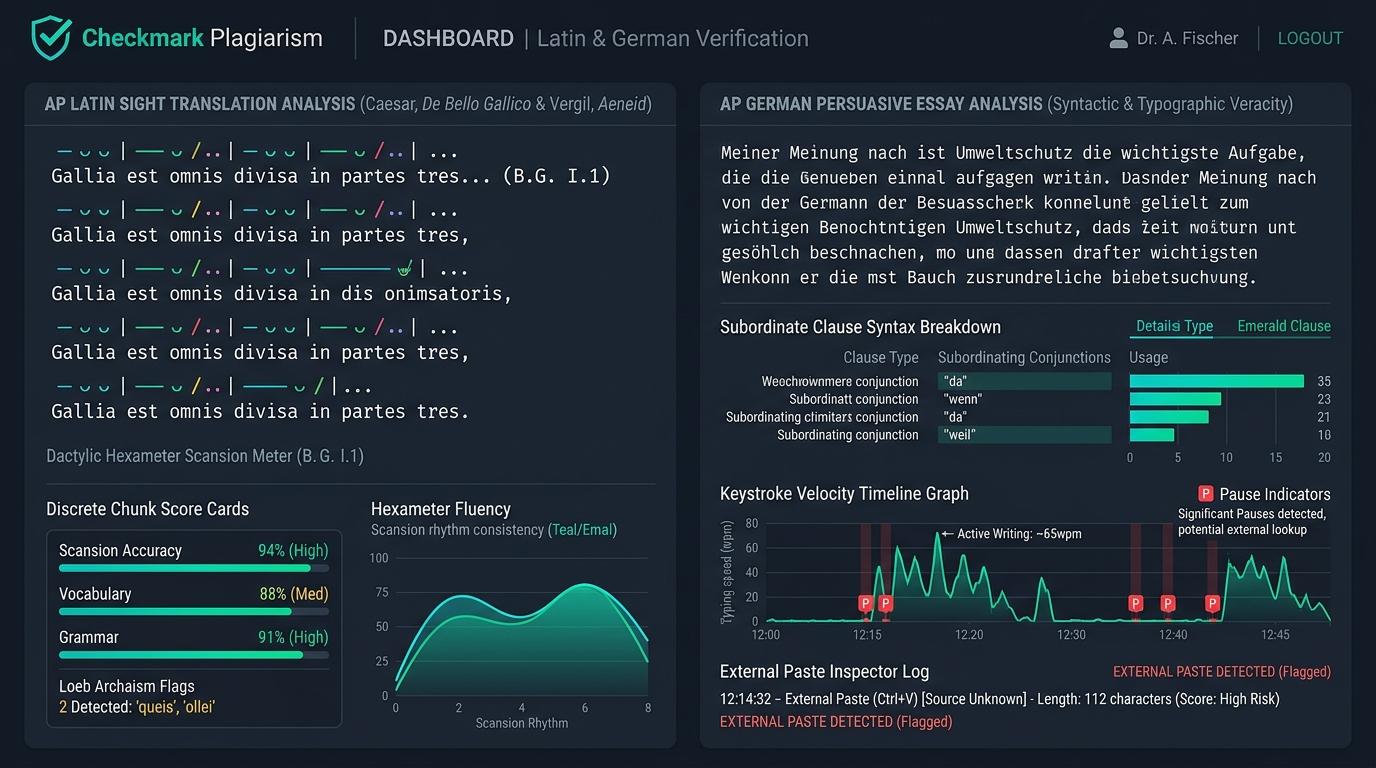
Executive Summary & World Language Integrity Mandate
In Advanced Placement (AP) Latin and AP German Language and Culture, free-response writing tasks evaluate deep morphological, syntactic, and cultural mastery. In AP Latin, students must produce verbatim literal translations scored in discrete grammatical segments across Vergil’s Aeneid and Caesar’s De Bello Gallico, scan dactylic hexameter verse, and analyze complex rhetorical figures (chiasmus, synchysis, hyperbaton). In AP German, learners synthesize multi-modal sources into persuasive essays (FRQ 2), draft formal interpersonal email replies (FRQ 1), and craft structured cultural comparisons (FRQ 4) demanding sophisticated subordinate clause syntax (Nebensatz verb-final order), modal particles (doch, ja, mal), and Subjunctive II (Konjunktiv II).
When high school educators assign digital preparatory translations or take-home analytical commentaries on 1:1 Chromebooks, academic integrity faces an unprecedented challenge: students prompting Large Language Models (LLMs) or Neural Machine Translation (NMT) tools like DeepL and Google Translate. These engines generate telltale anomalies—such as 19th-century public-domain Loeb Classical Library archaisms (whilom, ere, hither, betwixt), hallucinated metric scansion, confabulated rhetorical devices with fabricated line numbers, or hyper-formal German administrative registers (Amtsdeutsch).
Generic, black-box AI detectors fail catastrophically in world language classrooms—flagging honest students who rely on required AP transitional templates (“Laut Quelle 2...”, “Quam ob rem...”) while completely missing polished DeepL pastes. To preserve authentic second-language acquisition without adversarial accusations, high school language departments must deploy Checkmark Plagiarism’s patent-pending Essay Playback™ and External Paste Inspector. By capturing the full writing timeline—keystroke velocity, German diacritic and Latin macron keystroke dynamics, dictionary lookup pauses, and external clipboard imports—educators obtain defensible, transparent proof to guide restorative language conferences and validate student mastery.
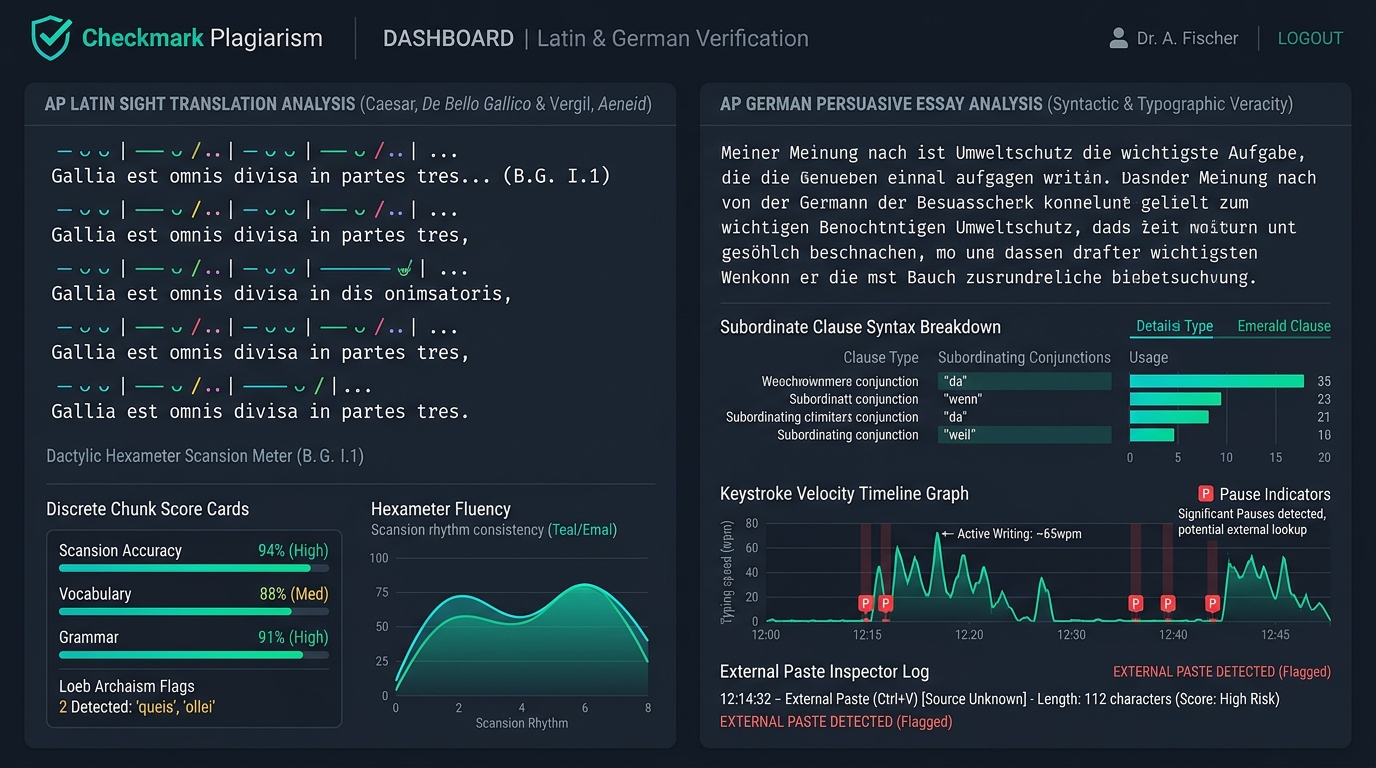
1. The High-Stakes Crucible of Sight Translation & Commentary in AP Latin and AP German
Secondary world language education at the Advanced Placement level represents a bridge between high school communicative fluency and collegiate-level textual hermeneutics. Unlike standard conversational language courses, AP Latin and AP German Language and Culture demand rigorous syntactic deconstruction, stylistic analysis, and formal academic discourse.
AP Latin (Classical Text & Sight Analysis)
- Verbatim Literal Translation FRQs: Segmented scoring across Vergil’s Aeneid and Caesar’s De Bello Gallico.
- Dactylic Hexameter Scansion: Dactyls (– ⏑ ⏑), spondees (– –), caesurae (||), and elision.
- Morphological & Rhetorical Analysis: Case identification, subjunctive clauses, chiasmus (ABBA), synchysis (ABAB), and hyperbaton.
- Contextual Free-Response Essay: Synthesizing Latin text with Roman societal values and Augustan politics.
AP German Language and Culture
- FRQ 1 (Email Reply): Formal register (Sie), addressing required queries, culturally appropriate framing.
- FRQ 2 (Persuasive Essay): 3-Source multi-modal synthesis (academic article, Destatis chart, audio podcast).
- Subordinate Architecture: Verb-final Nebensatz word order (weil, dass, obwohl), Subjunctive II (Konjunktiv II), modal particles.
- FRQ 4 (Cultural Comparison): Spoken/written structured synthesis comparing target German culture with home community.
The Unique Architecture of AP Latin Free-Response Tasks
The College Board’s AP Latin Curriculum and Exam Description (CED) centers on the close reading, literal translation, and contextual analysis of two foundational masterworks of classical antiquity: Vergil’s Aeneid (composed in dactylic hexameter epic verse) and Caesar’s De Bello Gallico (composed in unadorned, high-velocity classical military prose).
AP Latin Translation Scoring Chunk Methodology
| Scoring Chunk | Latin Text Segment | Grammatical & Syntactic Requirements for Point Credit |
|---|---|---|
| Chunk 1 | Caesar... decreverat | Subject nominative + pluperfect active verb (“Caesar had decided”) |
| Chunk 2 | his de causis quas commemoravi | Prepositional phrase + relative clause with perfect active verb |
| Chunk 3 | Rhenum transire | Direct object accusative + complementary infinitive (“to cross the Rhine”) |
| Chunk 4 | sed navibus transire neque satis tutum esse arbitrabatur | Ablative of means (navibus) + indirect statement (predicate adjective + esse) + imperfect deponent verb |
| Chunk 5 | neque suae neque populi Romani dignitatis esse statuebat | Correlative conjunctions + predicate genitives of characteristic/possession (“consistent with his dignity or that of the Roman people”) |
The College Board evaluates AP Latin translation FRQs using a strict discrete segment chunking methodology. Every word in a prescribed passage belongs to a numbered segment (typically 7 to 10 chunks per translation). To earn credit for a chunk, the student must correctly render:
- Case & Syntactic Function: Correctly distinguishing nominatives from accusatives, genitives of description, datives of reference/purpose, and ablatives absolute.
- Verb Morphology & Mood: Accurately translating tense (pluperfect vs. imperfect), voice (active vs. passive periphrastic), and mood (indicative vs. subjunctive purpose, result, or indirect question).
- Subordinate Architecture: Correctly rendering indirect statements (accusative subject + infinitive verb), cum clauses (cum circumstantial, causal, or concessive), and participial phrases.
Beyond literal translation, AP Latin students must complete Short-Answer Textual Analysis and Dactylic Hexameter Scansion. In scansion, students mark long syllables (–) and short syllables (⏑), identify foot divisions, locate the principal caesura (usually in the third foot), and recognize elision when a word ending in a vowel or -m precedes a word beginning with a vowel or h-. In rhetorical analysis, students must cite exact Latin text to prove stylistic devices:
- Chiasmus (ABBA): Inverted word order (e.g., noun A - adjective B - adjective B - noun A).
- Synchysis (ABAB): Interlocking word order reflecting entwined physical or emotional states.
- Hyperbaton: Violent displacement of words belonging together syntactically.
- Ablative Absolute: Independent participial construction framing temporal or causal background.
The Architecture of AP German Free-Response Tasks
In AP German Language and Culture, students face rigorous interpersonal and presentational communication standards aligned with the ACTFL Intermediate-High to Pre-Advanced proficiency benchmarks.
AP German FRQ 2: Multi-Modal Persuasive Essay Architecture
Authentic academic article or journalistic editorial presenting empirical claims.
Statistical infographic or data table (Destatis, Statista, Umweltbundesamt).
Broadcast interview, radio feature, or expert podcast segment (played twice).
The Scaffolding Crisis: 1:1 Chromebooks and Digital Homework Shortcuts
High school world language educators cannot develop these advanced skills through once-a-week timed paper assessments alone. Throughout the school year, teachers assign scaffolded homework:
- AP Latin: Weekly take-home sight passages from unadapted Caesar or Vergil; digital scansion worksheets on Google Docs; analytical commentaries synthesizing historical background from Book VI of the Aeneid.
- AP German: Practice email replies in Canvas LMS; asynchronous discussion boards on the Energiewende (energy transition); multi-source synthesis essay drafts prepared over 3 to 4 days.
In modern 1:1 Chromebook environments, this formative digital pipeline is highly vulnerable. When an AP Latin student faces a complex 15-line sight passage at 10:00 PM, the cognitive temptation to paste the Latin into ChatGPT, Claude, Google Translate, or DeepL is overwhelming. Similarly, an AP German student struggling to synthesize three German sources in formal prose can draft an entire essay in English, run it through DeepL, and paste a flawless C1-level German essay into Google Docs within seconds.
2. Forensic Linguistic Anatomy: How Generative LLMs and NMT Engines Contaminate Submissions
Generative LLMs and Neural Machine Translation (NMT) engines leave distinct, forensically identifiable linguistic footprints when processing classical Latin and modern German texts. Understanding these markers allows teachers to separate authentic student interlanguage from machine-generated text.
AP Latin AI & LLM Contamination Markers
- 19th-Century Loeb Archaic Diction: whilom, ere, betwixt, bespoke, thou hast, spake.
- Syntactic Smoothing: Flattening ablatives absolute and passive periphrastics into modern colloquial English.
- Hallucinated Scansion: 7-foot hexameters, missing elisions, impossible 3-long dactyls.
- Confabulated Rhetorical Tropes: Invented chiasmus (ABBA) on arbitrary lines; non-existent vocabulary citations.
AP German NMT (DeepL) & LLM Anomalies
- Hyper-Formal ‘Amtsdeutsch’: Heavy Nominalstil (“die Implementierung”) and bureaucratic Latinate syntax.
- Extended Participial Clauses: C1/C2 structures (“die von der Regierung verabschiedeten Gesetze”).
- Flawless Nested Subordination: Zero hesitation or verb-order slips across multi-clause sentences.
- Idiomatic English Calques: Direct literal translations (“das macht Sinn”, “einen Test nehmen”).
AP Latin AI Fingerprints: Loeb Archaisms, Metric Hallucination, and Rhetorical Confabulation
When a high school student inputs a Latin passage into ChatGPT, Claude, or Google Translate, the model does not translate Latin like a high schooler using a grammar-translation method. Instead, it draws from vast digitized training corpora—predominantly 19th- and early 20th-century public-domain translations from the Loeb Classical Library (e.g., H.R. Fairclough’s 1916 Vergil translation, W.A. Macdevitt’s 1898 Caesar translation, or John Dryden’s poetic renderings).
1. Loeb Archaism Contamination
High school AP Latin students write in modern, direct American English. When a student submission includes archaic 19th-century syntax and vocabulary, it is a definitive marker of AI training contamination:
- Archaic Pronouns and Verb Inflections: “thou hast”, “whosoever”, “spake”, “sware”, “doth”, “yieldeth”.
- Archaic Temporal Connectors and Adverbs: “whilom” (formerly), “ere” (before), “hither / thither / whither”, “betwixt”, “perchance”, “wherefore”, “straightway”.
- Elevated Classical Diction: Translating arma not as “arms” or “weapons”, but as “warlike gear”; translating dolor as “chagrin” or “travail”; translating moenia as “ramparts” or “bulwarks”.
2. Syntactic Smoothing Over Discrete AP Chunks
AP Latin rubrics penalize translations that smooth over grammatical structures into loose idiomatic English. Classical Latin frequently omits forms of esse (ellipsis), chains multiple ablatives absolute, or uses compressed historical infinitives.
- Organic Student Translation: Renders each case ending and participle literally, sometimes resulting in slightly clunky English that faithfully mirrors the Latin ablative absolute: “With the baggage having been left behind, Caesar ordered the soldiers to advance.”
- LLM / NMT Translation: Flattens the Latin subordination into modern, flowing prose: “Caesar abandoned his supplies and pushed forward with his troops.” While aesthetically pleasing, this fails College Board scoring chunk criteria because the ablative absolute and passive participle are erased.
3. Metrical and Scansion Hallucination
Generative LLMs process text as sub-word tokens, not acoustic or phonological units. Because LLMs lack innate understanding of Latin vowel length (macrons) and natural syllable quantity, they regularly hallucinate scansion.
Scansion Forensics: Vergil, Aeneid I.1 Scansion Breakdown
Line 1: “Arma virumque cano, Troiae qui primus ab oris”
4. Rhetorical Device Confabulation
When prompted to analyze stylistic devices in an AP Latin passage, LLMs suffer severe hallucination:
- Fabricated Line Numbers: Claiming anaphora occurs on lines 14–16 when the cited words appear on lines 8 and 22.
- Invented Chiasmus: Claiming a line contains chiasmus (ABBA) by arbitrarily pairing unrelated nouns and verbs while ignoring grammatical case and gender agreements.
- Ghost Citations: Translating Latin words that do not exist anywhere in the assigned text.
AP German AI Fingerprints: NMT Syntactic Smoothing, Amtsdeutsch, and Calque Errors
Neural Machine Translation engines like DeepL and LLMs like GPT-4 possess vast German corpora, but their output in high school assignments creates distinct developmental anomalies.
Developmental Proficiency Gap: High School AP German vs. Machine Translation
“Ich bin der Meinung, dass erneuerbare Energien sehr wichtig für unsere Zukunft sind. Wenn wir mehr Solaranlagen bauen, können wir die Umwelt schützen, weil die Kohlekraftwerke viel CO2 produzieren.”
“In Anbetracht der fortschreitenden Dekarbonisierung des Energiesektors ist eine stringente Implementierung photovoltaischer Großanlagen unumgänglich, um den anthropogenen Treibhausgasausstoß nachhaltig zu minimieren und die Netzstabilität zu gewährleisten.”
1. Register Elevation and Amtsdeutsch (Administrative German)
High school AP German students write with active verbal constructions. AI engines instinctively gravitate toward Nominalstil (nominal style) and bureaucratic phrasing:
- Using complex nominalizations (“die Implementierung”, “die Berücksichtigung”, “die Gewährleistung”) rather than active verbs.
- Generating Passive Periphrastics with sein + zu + Infinitiv (e.g., “Es ist zu beachten, dass...” instead of “Man muss beachten, dass...”).
- Constructing Extended Participial Attributes (Erweiterte Partizipialattribute): e.g., “die von der Regierung im vergangenen Jahr verabschiedeten Klimaschutzgesetze” (the climate protection laws passed by the government last year), an advanced structure virtually never drafted spontaneously by secondary learners.
2. Subordinate Clause Word Order (Nebensatz) Perfection vs. Interlanguage Slips
In authentic high school German writing, students frequently struggle with word order when stacking subordinate clauses or modal auxiliaries:
- Authentic Student Struggle: Placing the conjugated verb prematurely after coordinating or subordinating conjunctions (e.g., writing “weil ich habe keine Zeit” instead of “weil ich keine Zeit habe”, or forgetting to kick the modal auxiliary to the end of a double infinitive).
- NMT Perfection: DeepL produces flawless verb-final placement across nested relative clauses without a single hesitation, backspace, or revision cycle.
3. Literal English Idiom Calques
When students attempt to translate English idioms directly using basic online translators, telltale calques appear:
- Translating “that makes sense” as “das macht Sinn” rather than standard German “das ergibt Sinn”.
- Translating “to take a test” as “einen Test nehmen” instead of “eine Prüfung ablegen / schreiben”.
- Translating “in the first place” as “im ersten Platz” instead of “in erster Linie” or “erstens”.
Comparative Evaluation Matrix: Authentic Student Writing vs. AI / Machine Translation
| Evaluation Dimension | Authentic AP Latin (Grades 10–12) | AI / Machine-Translated Latin | Authentic AP German (Grades 11–12) | DeepL / AI-Generated German |
|---|---|---|---|---|
| Vocabulary & Diction | Standard high school vocabulary matched to Pharr or Dickinson core lists. | 19th-century Loeb archaisms (whilom, ere, betwixt, beseech). | Active high-frequency vocabulary aligned with AP thematic units. | Elevated academic Nominalstil, bureaucratic Latinate loanwords. |
| Syntax & Structure | Literal rendering of grammatical chunks; slightly clunky English to preserve cases. | Smooth idiomatic English that erases ablatives absolute and passive periphrastics. | Discrete main/subordinate clauses; occasional verb-order slips in complex Nebensätze. | Flawless nested subordinate clauses; extended participial attributes. |
| Metrical Scansion | Scans with visible hesitations; marks caesura; struggles with rare elisions. | Hallucinates foot counts (7 feet); confabulates syllable lengths; fails elisions. | N/A (Not assessed in AP German curriculum). | N/A. |
| Rhetorical Figures | Identifies simple chiasmus (ABBA) or alliteration with cited line numbers. | Hallucinates non-existent chiasmus/synchysis; invents line citations. | Connects sources using standard AP transitions (“Laut Quelle 1...”). | Uses ultra-sophisticated connectors (“Dessen ungeachtet...”). |
| Drafting Telemetry | High pause duration at case inflections; frequent backspaces; macron shortcuts. | Single 0.2s paste event; zero character-level typing or revision. | Frequent pauses at Nebensatz verbs; hesitation before case endings; umlaut entries. | Continuous 70+ WPM typing velocity or instant external clipboard paste. |
3. The Pedagogical & AP Grading Dilemma: Why Generic AI Detectors Fail World Language Classrooms
High school world language educators seeking to verify student authorship face a severe technological hurdle: generic, black-box AI detection software is fundamentally unsuited for second-language acquisition and classical translation.
The Double Failure of Generic AI Detectors in World Language Classrooms
AP German exam templates (“Laut dem Artikel in Quelle 1...”, “Zusammenfassend lässt sich...”) exhibit low perplexity and uniform burstiness, triggering false 80%+ AI flags on honest student submissions.
Neural Machine Translation (DeepL / Google Translate) translates human thought directly. NMT output lacks the token-probability signature of generative LLMs, returning misleading “0% AI” scores on 100% pasted essays.
The False-Positive Trap: Formulaic Templates and Literal Glosses
Generic AI detectors (such as Turnitin AI, GPTZero, and CopyLeaks) operate on two primary statistical metrics:
- Perplexity: A measure of how likely a given word is to follow the previous word based on standard language models.
- Burstiness: The variation in sentence length and syntactic complexity across a document.
In AP World Language classrooms, these statistical assumptions break down completely:
-
Mandated AP Sentence Stems: To ensure students earn point-rubric credit on AP German FRQ 2 persuasive essays, teachers train them to use standardized transitional formulas:
- “Laut dem Text in Quelle 1...” (According to the text in Source 1...)
- “Aus der beigefügten Grafik geht hervor, dass...” (From the attached graph, it is evident that...)
- “Zusammenfassend lässt sich sagen, dass...” (In summary, it can be said that...)
- Formulaic Latin Translation Glosses: When an AP Latin student translates Caesar’s military maneuvers (“His rebus cognitis, Caesar legatos misit...” → “These things having been learned, Caesar sent envoys...”), the translation is necessarily rigid, repetitive, and formulaic. Generic detectors misinterpret this precision as AI generation.
The False-Negative Vulnerability: Why DeepL Bypasses AI Detectors
While generic detectors falsely accuse honest students writing formulaic German, they frequently fail to detect actual machine translation.
Neural Machine Translation (NMT) engines like DeepL Pro do not generate text autoregressively from a probabilistic prompt. Instead, they perform an encoder-decoder semantic vector mapping of an English sentence written by a human. Because the underlying semantic sequence originated in a human brain, the resulting German translation possesses high lexical richness and natural human burstiness. Generic AI detectors analyze the text, detect no LLM statistical anomalies, and return a 0% AI Generated score—giving teachers a false sense of security while a student submits work they cannot speak or explain.
The Human Cost: Destructive Accusations vs. Defensible Evidence
When high school teachers rely on generic percentage scores, parent-teacher conferences and academic integrity hearings quickly become adversarial:
- The Student’s Defense: “I wrote this myself! I just used the transition words Frau Schmidt taught us on the whiteboard!”
- The Teacher’s Dilemma: The detector shows “85% AI”, but the teacher has no underlying proof, no timeline, and no text diff to substantiate the accusation.
- The Administrative Deadlock: School principals, guidance counselors, and department chairs are forced to dismiss the violation due to lack of objective evidence, eroding classroom standards and frustrating faculty.
To break this deadlock, world language educators need transparent writing process telemetry—moving from opaque probability scores to verifiable, timestamped drafting proof.
4. The High School World Language Evidentiary Matrix
To evaluate student translation and commentary objectively, high school departments should evaluate submissions across three distinct evidentiary tiers:
Tier 1: In-Class Paper Writes
- Timed 45-minute bluebook exam
- High security, zero digital tools
- Unrealistic for multi-draft essays
- Heavy manual teacher grading load
Tier 2: Generic AI Detectors
- Black-box whole-document score
- High false-positive rate on stems
- Blind to DeepL / Google Translate
- Indefensible in parent conferences
Tier 3: Checkmark Telemetry
- Keystroke session replay (1x–8x)
- External Paste Inspector (raw text)
- Umlaut & macron character dynamics
- Cognitive pause duration analysis
Key Writing Process Telemetry Metrics for World Language Teachers
When evaluating digital take-home Latin translations or German essays, Checkmark captures five core telemetry dimensions:
1. Keystroke Velocity Curves (WPM)
Organic Second-Language Drafting: Students composing in an L2 produce writing in bursts of 15 to 35 WPM with irregular peaks reflecting cognitive vocabulary retrieval.
Mechanical Transcription: A continuous, unbroken typing speed of 55 to 75+ WPM with zero pauses between complex grammatical structures proves the student is copying from a phone or second monitor.
2. Diacritic & Macron Keystroke Dynamics
German Umlauts (ä, ö, ü, ß): Captures keyboard shortcuts (AltGr, dead keys) or accent bank copies.
Latin Macrons (ā, ē, ī, ō, ū): Verifies intentional character toggles in scansion.
Pasted Flag: If 30+ diacritics appear instantly without corresponding keystrokes, text was imported externally.
3. Cognitive Pause Duration at Decision Points
Latin Sight Translation: Authentic students pause for 4 to 10 seconds when parsing ablatives absolute or nested indirect statements.
German Nebensatz: Authentic students pause at the clause terminus to conjugate and position the final verb.
4. External Paste Buffer Telemetry
Checkmark’s External Paste Inspector records exact character counts, timestamps, and the raw clipboard payload—even if the student later alters or deletes parts of the pasted text.
5. Real High School Classroom Case Scenarios
The following case studies illustrate how high school world language teachers and department chairs use Checkmark Writing Process Telemetry to resolve complex integrity questions.
Sight Translation & Rhetorical Analysis: Vergil, Aeneid II.199–211 (Death of Laocoön)
Student Submission: “Laocoön, allotted priest unto Neptune, was slaying at the customary altars a monstrous bull, when lo! from Tenedos over the tranquil deep twin serpents with immense coils press upon the sea and together speed to the shore...”
Resolution: Teacher conducts a restorative conference. Showing the student the playback timeline, the student admits prompting Claude with the Latin passage. The student completes an in-class sight re-translation for partial credit under teacher guidance.
Multi-Source Synthesis Persuasive Essay on Germany’s Energy Transition (Energiewende)
Student Submission: Well-structured 380-word essay synthesizing an article, a Destatis bar graph, and a podcast with mandatory transitions (“Laut Quelle 1...”, “Wie die Grafik verdeutlicht...”).
Resolution: The teacher completely exonerates the student. The generic detector’s 88% flag is proven to be a false positive. The student receives a well-deserved 5/5 on the AP rubric.
Grammatical Identification & Parsing: Caesar, De Bello Gallico IV.17 (Rhine Bridge)
Student Submission: Flawless morphological labels and grammatical explanations for 4 ablatives absolute and 3 indirect statements.
Resolution: In conference, teacher asks student to explain why “navibus” is ablative. Student is unable to identify noun declension or case function, confessing to transcribing ChatGPT output from their phone.
6. Step-by-Step Language Teacher Audit Protocol
High school world language teachers and department chairs can implement a standardized, four-phase audit workflow to verify translation authenticity and support student growth.
- Check Latin for Loeb archaisms (whilom, ere).
- Check German for C1 Amtsdeutsch & calques.
- Verify scansion foot counts.
- Check Total Writing Time vs. Word Count.
- Scrub Essay Playback at 2x–4x speed.
- Inspect External Paste Inspector log.
- Inspect German umlaut keystrokes (ä, ö, ü, ß).
- Verify Latin macron keyboard events.
- Identify instant bulk insertions.
- Open Playback side-by-side with student.
- Ask student to sight-read 2 lines aloud.
- Provide structured revision pathway.
Phase 1: Linguistic Anomaly Triage
Before examining digital telemetry, language educators perform a rapid pedagogical scan:
- AP Latin: Search for 19th-century vocabulary (hither, thither, perchance, spake, whilom), smoothed-over syntax that erases ablative absolutes, and short-answer commentary claiming chiasmus or metonymy where none exists.
- AP German: Check whether the essay uses high-level Nominalstil (e.g., “die Realisierung der Energiewende”) or extended participial clauses that exceed the student’s demonstrated oral competence.
Phase 2: Writing Process Telemetry Scrubbing with Essay Playback™
Open the submission in Checkmark Plagiarism and review the telemetry metrics:
- Writing Time Audit: A 350-word AP German essay or 15-line AP Latin translation requires at least 25 to 45 minutes of active cognitive work for a high school student. Submissions completed in under 5 minutes represent immediate red flags.
- Scrub Playback (1x–8x Speed): Watch the essay come together like a video. Look for organic drafting behavior: typing sentence fragments, deleting words, pausing for 5–10 seconds at complex verbs, and re-reading earlier paragraphs.
- Paste Buffer Inspection: Check the External Paste Inspector. If the student pasted 200 words from an external source, review the preserved clipboard text.
Phase 3: Diacritic and Special Character Keystroke Verification
Verify that German umlauts (ä, ö, ü, ß) and Latin macrons were keyed in using authentic keystrokes (keyboard shortcuts, alt-codes, or copy-pasting from a top-of-page accent bank). If dozens of diacritics appear instantly without corresponding keystroke telemetry, the text was composed externally.
Phase 4: Conducting Supportive Restorative Oral Debriefs
In keeping with Checkmark’s philosophy—“Stop guessing, start trusting”—teachers should never conduct adversarial interrogations. Instead, invite the student to a collaborative, formative conference:
- Share the Screen: Open Checkmark’s Essay Playback™ timeline alongside the student.
- Target-Language Sight Check: Ask the student to read two lines of their submitted Latin translation aloud or explain the German thesis in their own words: “I love how you phrased this sentence about the Energiewende. Walk me through how you chose this verb structure.”
- Restorative Growth: If the telemetry shows an external AI paste and the student cannot explain the grammar, use the moment for growth rather than an automatic punitive zero. Allow the student to re-translate an equivalent passage in class for full or partial credit under teacher guidance.
7. How Checkmark Plagiarism Empowers AP Latin and German Educators
Checkmark Plagiarism provides a comprehensive, high-school-tailored integrity and grading suite designed specifically to overcome the limitations of generic AI detectors.
Passage-Level Granular AI Sliders
Visualizes specific sentence confidence without assigning arbitrary, punitive whole-paper percentages. Isolates single suspicious paragraphs without condemning honest writing.
Patent-Pending Essay Playback™
Scrub keystroke drafting history at 1x to 8x speed. Proves authentic cognitive wrestling at Nebensatz verbs and Latin ablatives absolute vs. mechanical phone transcription.
External Paste Buffer Inspector
Captures 100% of pasted clipboard text permanently, with one-click timeline navigation to observe the exact second an external text block was inserted.
Quote-Anchored Rubric Autograding
AI-assisted first-draft scoring tied directly to College Board AP scoring rubrics, with direct one-click sync to Canvas LMS, Buzz LMS, and Google Classroom.
FERPA & COPPA Compliant Zero Retention Guarantee
Student writing is never indexed, stored in public databases, or used to train commercial AI models. School districts maintain complete ownership and sovereignty over student intellectual property.
8. Frequently Asked Questions (FAQs)
1. Why do generic AI detectors flag AP German essays that use standard transitional phrases like “Laut Quelle 1”?
Generic AI detectors measure perplexity (word predictability). Because College Board rubrics encourage specific transitional stems (“Laut Quelle 1...”, “Aus der Grafik geht hervor, dass...”), these formulaic phrases appear with high frequency in training data and exhibit low perplexity. Generic detectors mistakenly flag these standard pedagogical sentence starters as AI generation. Checkmark solves this by combining passage-level linguistic analysis with Essay Playback™ keystroke telemetry, proving the student drafted the essay organically.
2. Can Checkmark differentiate between a student looking up a single vocabulary word in an online dictionary vs. pasting an entire translated paragraph?
Yes. Checkmark’s keystroke telemetry clearly differentiates single-word dictionary lookups from full machine translation. When a student uses an online dictionary (e.g., Dict.cc, LEO, or Whitaker’s Words), the playback timeline shows a brief 5–15 second pause followed by the student typing the single word character-by-character into their sentence. In contrast, machine translation manifests as an instant paste event importing full multi-clause sentences or unbroken 60+ WPM typing with zero morphological pauses.
3. How does Essay Playback™ capture German umlauts and Latin macrons on Chromebooks?
Essay Playback™ logs every keyboard interaction, including international keyboard combinations (e.g., AltGr combinations, dead-key sequences, Unicode inputs) and document-level clipboard events. If a student uses an accent bank or Google Docs special characters, the telemetry records the exact micro-pause and character insertion. If 40 special characters appear without any corresponding keyboard events, the text was imported from an external translator.
4. What should an AP Latin teacher do if a student’s translation matches a 19th-century Loeb Classical Library translation?
Open Checkmark’s External Paste Inspector and review the document timeline. In 95% of cases, the student prompted an LLM (which defaulted to public-domain Loeb training data) and pasted the result. In a supportive conference, show the student the timeline replay and preserved clipboard content. Ask the student to explain the meaning of archaic words like “whilom” or “betwixt”. Use this evidence to guide a restorative re-translation assignment under in-class conditions.
5. Does Checkmark’s Rubric Autograder replace teacher grading on AP Free-Response Questions?
No. Checkmark operates strictly on a Teacher-in-the-Loop model. The autograder generates draft scores and quote-anchored justifications aligned with College Board AP rubrics to save teachers time. The educator retains 100% final grading authority to modify points, customize written feedback, and approve scores before syncing them directly back to Canvas, Buzz, or Google Classroom gradebooks.
6. Can students bypass Checkmark by retyping a DeepL translation from their smartphone onto their Chromebook?
No. When a student visually transcribes text from a second screen, they exhibit a distinct mechanical transcription telemetry signature: a continuous, unbroken typing speed (typically 55–75+ WPM) with virtually zero backspaces, no revision pauses at complex subordinate clauses, and no hesitation before case endings. Essay Playback™ highlights this unnatural typing rhythm, providing clear evidence for an oral debrief.
7. How does Checkmark ensure compliance with student data privacy laws (FERPA and COPPA)?
Checkmark maintains enterprise-grade security protocols. Student submissions are encrypted in transit and at rest and are never used to train commercial AI models or shared with third parties. Student data remains the sole property of the school district, fully compliant with FERPA, COPPA, and state-level student privacy statutes.