
Executive Summary & SLA Integrity Directive
In the Advanced Placement (AP) Japanese Language and Culture curriculum, Section II Free-Response writing tasks—Task 1: Interpersonal Text Chat (6 interactive prompt exchanges at 90 seconds each) and Task 2: Presentational Compare and Contrast Article (20 minutes, 300–400 Japanese characters)—evaluate a student’s spontaneous communicative competence, orthographic mastery across three distinct scripts (Hiragana, Katakana, and Joyo Kanji), and nuanced cultural synthesis. In modern 1:1 Chromebook classrooms and learning management systems (Canvas LMS, Google Classroom, Buzz LMS), secondary Japanese educators face a profound instructional challenge: high school students bypassing the cognitive struggle of second-language (L2) acquisition by feeding English drafts into Neural Machine Translation (NMT) engines like DeepL Pro or Generative AI models like ChatGPT and Claude.
Generic whole-document AI percentage detectors fail catastrophically in non-alphabetic, morphologically agglutinative languages like Japanese—generating aggressive false-positive flags on standard, repetitive pedagogical patterns (such as ~to omoimasu, ~ga suki desu, or polite desu/masu endings) while remaining completely blind to sophisticated machine-translated text.
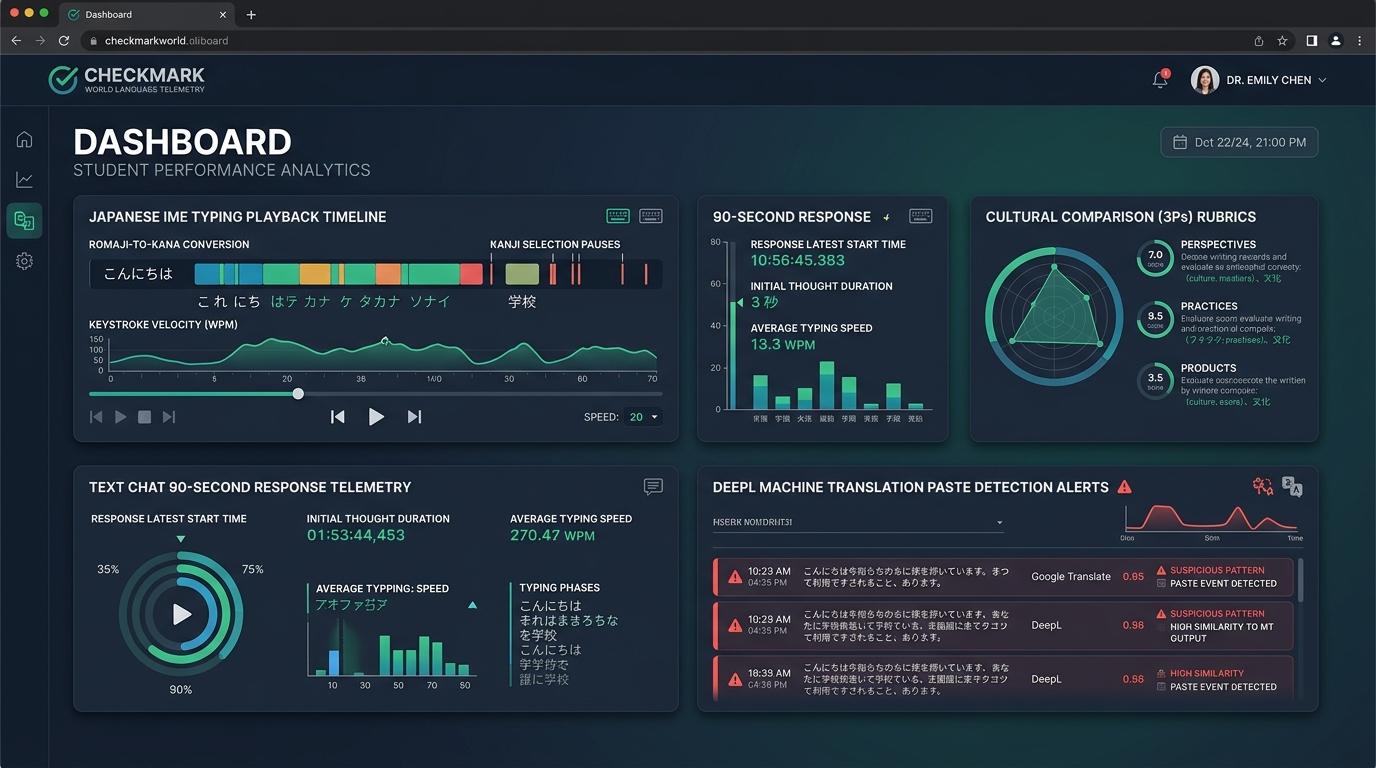
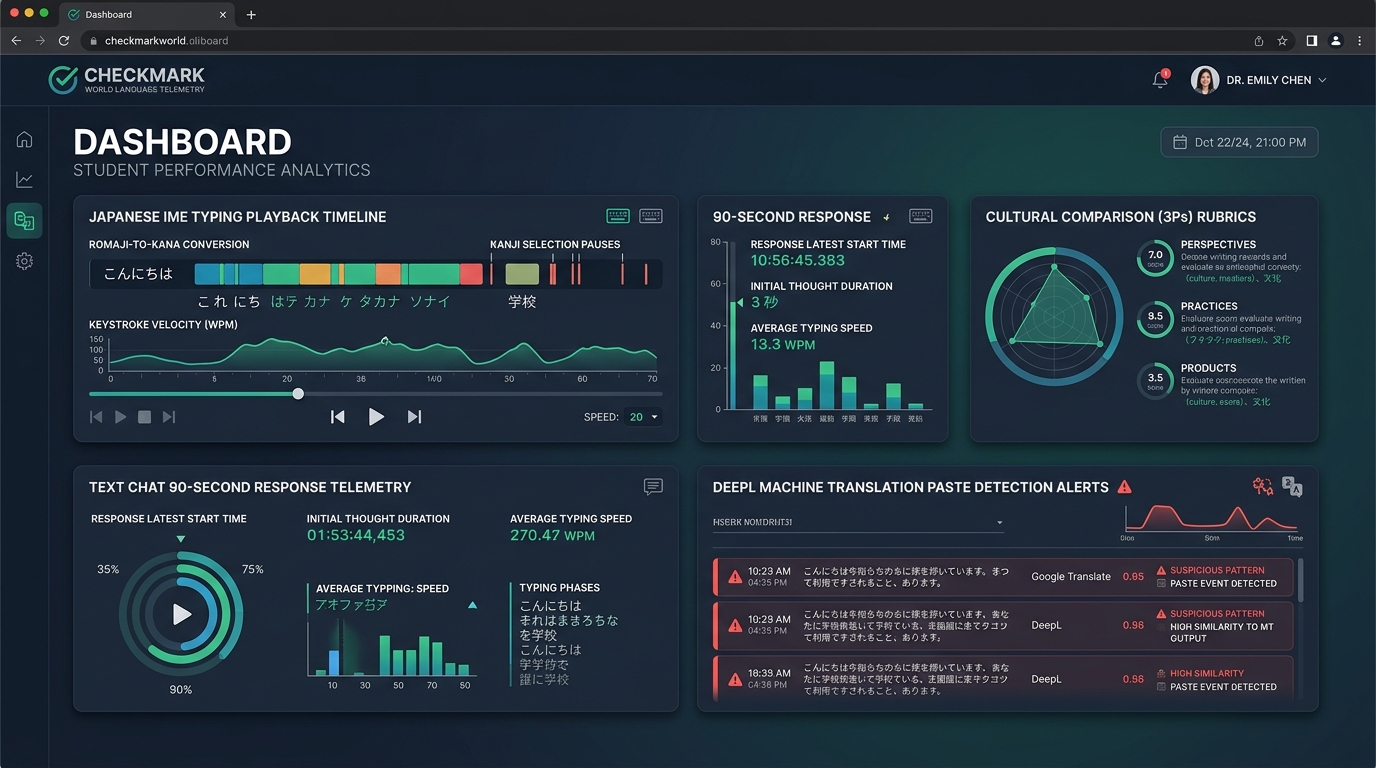
To overcome this crisis, high school world language departments must transition from opaque black-box probability scores to transparent, process-based writing telemetry. By leveraging Checkmark Plagiarism’s patent-pending Essay Playback™ and Writing Telemetry Suite, AP Japanese teachers gain granular, keystroke-by-keystroke forensic visibility into the student’s authentic composition: tracking romaji-to-kana Input Method Editor (IME) conversions, spacebar candidate selection cycles, okurigana adjustments, lexical pause intervals, and external clipboard paste payloads. This objective evidentiary framework protects honest students from false accusations, provides actionable diagnostic insight into interlanguage development, and anchors restorative target-language writing conferences in undeniable pedagogical proof.
1. The High-Stakes Architecture of AP Japanese Free-Response Writing
The College Board’s AP Japanese Language and Culture course is designed to cultivate and measure proficiency across the three communicative modes articulated by the American Council on the Teaching of Foreign Languages (ACTFL): Interpersonal, Interpretive, and Presentational. Operating at an ACTFL proficiency target of Intermediate-Mid to Intermediate-High, the AP Japanese curriculum requires high school learners to synthesize linguistic accuracy, sociolinguistic register flexibility, and deep cultural knowledge.
Within Section II of the AP Japanese Exam (which constitutes 50% of the composite exam score), students complete two computer-based written tasks and two spoken tasks. The written tasks specifically evaluate how fluidly a high school learner can negotiate Japanese orthography and express complex cultural perspectives under severe time constraints.
- Task Format: 6 Sequential Interactive Prompt Screens
- Time Allocation: Strictly 90 Seconds per Response
- Input Medium: Japanese Romaji-to-Kana IME (Henkan conversion)
- Sociolinguistic Register: Flexible (Polite desu/masu vs. Casual/Plain kudaketa)
- Stimulus Medium: Simulated Real-Time Digital Text Chat (LINE / Classroom Portal style)
- Core Deliverables:
- Immediate, context-specific communicative agility
- Answering embedded questions with rationale
- Asking appropriate follow-up questions
- Executing cultural softening strategies (Chotto tsugou ga...)
- Target ACTFL Level: Intermediate-Mid
- Scoring: 6-Point Holistic AP Scoring Rubric
- Task Format: Structured Multi-Paragraph Comparative Article
- Time Allocation: 20 Minutes Total (Planning, Drafting, Polishing)
- Length Expectation: 300 to 400 Japanese Characters
- Input Medium: Japanese Romaji-to-Kana IME (Joyo Kanji selection)
- Register Expectation: Formal Written / Consistent Plain or Polite Form
- Core Deliverables:
- Compare and contrast two cultural practices, products, or societal concepts
- Synthesize the 3Ps: Products (物), Practices (事), Perspectives (心)
- Employ cohesive transitional discourse markers (一方で, それに対して)
- Maintain strict register consistency across all paragraphs
- Target ACTFL Level: Intermediate-Mid to Intermediate-High
- Scoring: 6-Point Holistic AP Scoring Rubric
Task 1: Interpersonal Writing — Text Chat (テキストチャット)
In Task 1, students participate in a simulated real-time digital text chat with a Japanese peer, teacher, host family member, or community coordinator. The task simulates the pacing and authenticity of modern messaging platforms (such as LINE or digital classroom discussion portals):
- Format and Timing: The task presents six consecutive, independent prompt screens. For each prompt, the student has precisely 90 seconds to read the incoming Japanese message, comprehend the conversational context, formulate a response, and type their message using the Japanese Input Method Editor (IME).
- Sociolinguistic Register Agility: Prompts test whether the student can dynamically match the appropriate honorific register. If chatting with a host mother or club sponsor, the student must employ polite Teineigo (丁寧語, desu/masu forms); if conversing with a classmate or close peer, the prompt may demand casual/plain register (Kudaketa / 普通体).
- Communicative Functions: Students must ask follow-up questions, offer invitations, express preferences, accept or decline proposals with culturally appropriate softening devices (“Chotto tsugou ga warukute...” / ちょっと都合が悪くて…), provide rationales, and resolve scheduling conflicts.
- Cognitive Demand: The 90-second countdown creates intense time pressure. A student must read the prompt in Japanese script, formulate their thoughts in second-language (L2) Japanese, type phonetically in Romaji, convert the phonemes into Hiragana/Kanji candidates, resolve homophones, and submit before the timer expires.
Task 2: Presentational Writing — Compare and Contrast Article (比較・対照の文章)
Task 2 is the most demanding written assessment in high school Japanese education. Students are tasked with writing a structured article for a school newspaper, bilingual blog, or cultural journal comparing and contrasting two related cultural practices, products, or societal concepts:
- Format and Timing: Students have a total of 20 minutes to plan, draft, and revise a coherent Japanese article of 300 to 400 characters (approximately 3 to 4 well-developed paragraphs).
- Thematic Breadth: Prompts are drawn from the core AP Japanese cultural units, requiring comparative analysis across topics such as:
- Traditional vs. Modern Celebrations: Celebrating the New Year (Oshougatsu / お正月) with Osechi-ryori and shrine visits (Hatsumoude) versus Western New Year parties and countdowns.
- School Life and Daily Habits: Japanese school lunch (Kyushoku / 給食) and student cleaning duties (Souji / 掃除) versus American cafeteria systems and custodial staff.
- Dining and Culinary Practices: Traditional Japanese set meals (Washoku / 和食, Ichiju-sansai) versus Western fast food culture (Fasutofuudo).
- Gift-Giving Customs: Japanese seasonal gift traditions (Ochuugen / お中元, Oseibo / お歳暮, Omiyage) versus American holiday gift exchanges.
- Public Etiquette and Social Harmony: Japanese public transit manners, quiet zones (Manner Mode), and trash sorting rules versus Western public behaviors.
The ACTFL Cultural “3Ps” Synthesis Requirement in AP Japanese
The tangible or intangible artifacts of the target culture.
The behavioral patterns, rituals, and accepted social customs.
The underlying cultural values, beliefs, attitudes, and worldviews.
Speaking Tasks Linkage: Bridging Presentational Writing to Oral Production
The Free-Response section also includes Task 3: Spoken Conversation (4 turn-taking exchanges, 20 seconds per response) and Task 4: Cultural Perspective Presentation (4 minutes preparation, 2 minutes continuous speech analyzing a specific Japanese cultural topic). Because presentational writing (Task 2) and cultural presentation (Task 4) share the identical pedagogical objective—articulating cultural synthesis using the 3Ps framework—high school teachers frequently assign written cultural comparisons as formative rehearsal for the oral exam. When students illicitly automate their written drafts using AI or machine translation, they break the developmental pipeline required for spontaneous oral execution.
2. Japanese Orthography, Script Mechanics, and the Cognitive Load of IME Input
To evaluate student writing authenticity, secondary educators must deeply understand the intricate cognitive and technical mechanics of Japanese digital text input. Unlike alphabetic languages where one keystroke corresponds to one letter, writing in Japanese on a computer requires an elaborate, multi-stage mental and mechanical translation process.
n - i - h - o - n - n - o
にほんのぶんか
[SPACEBAR] to initiate Kanji candidate lookup
[ENTER] to commit
The Tripartite Script System: Hiragana, Katakana, and Joyo Kanji
Written Japanese is one of the most orthographically complex writing systems in the world, weaving three distinct scripts seamlessly within a single sentence:
Phonetic syllabary of 46 characters used for native Japanese words, grammatical particles (wa, ga, o, ni, de, to, kara, made), auxiliary verbs, and okurigana (inflectional endings attached to kanji roots, e.g., 食べる, 行きます, 面白い).
Phonetic syllabary of 46 angular characters used exclusively for foreign loanwords (konpyuuta, arubaito, fasutofuudo), country names (Amerika, Igirisu), scientific terms, and onomatopoeia (doki-doki, waku-waku).
Logographic characters borrowed from Chinese (~400–450 expected on the AP Exam). Balances two reading systems: On’yomi (音読み - Chinese readings in compound nouns like 文化 bunka) and Kun’yomi (訓読み - native Japanese readings like 食べる ta-beru).
Romaji Input Method Editor (IME) Mechanics: Henkan, Homophones, and Okurigana
When a high school student composes an essay on a Chromebook, MacBook, or Windows PC, they interact with the Japanese Input Method Editor (IME). The physical mechanics of typing reveal the student’s authentic linguistic processing:
Homophone Disambiguation & Candidate Menu Hesitation Pauses
Prompt Context: “Please discuss your favorite Japanese dish and eating utensils.”
Student Types: [ h ][ a ][ s ][ h ][ i ] → Buffer renders: はし
箸 without any preceding Romaji phonemes or candidate menu cycle events.
Honorific Registers: Navigating Keigo vs. Plain Form
In AP Japanese writing, sociolinguistic appropriateness (TPO: Time, Place, Occasion) dictates the grammatical register:
- Teineigo (丁寧語 - Polite Register): Characterized by sentence-ending copulas desu (です) and verb endings ~masu (〜ます), ~mashita (〜ました), ~masen (〜ません). This is the default register expected in interpersonal school and host family communications.
- Sonkeigo (尊敬語 - Respectful Language): Elevates the actions of the interlocutor or honored subject (e.g., using ossharu おっしゃる instead of iu 言う, meshiagaru 召し上がる instead of taberu 食べる).
- Kenjougo (謙譲語 - Humble Language): Lowers the speaker’s own actions to show respect (e.g., using moushiageru 申し上げる instead of iu, itadaku いただく instead of taberu or morau).
- Plain Form / Da-Dewa-Nai (普通体 / 常体): Characterized by root dictionary forms (辞書形), ~da (〜だ), ~datta (〜だった), and ~de wa nai (〜ではない). In Task 2 Compare and Contrast essays, students are permitted to use either consistent desu/masu or consistent plain form, but register mixing within the same paragraph is a severe rubric penalty.
Essential Transitional Devices for Cultural Comparison
To score a 5 or 6 on Task 2, high school writers must employ sophisticated discourse markers and cohesive conjunctions to structure their comparative claims:
Mandatory Cohesive Discourse Markers for AP Japanese Cultural Essays
| Transitional Phrase (Kanji/Kana) | Romaji / Reading | Function in Cultural Comparison |
|---|---|---|
| 一方で | ippou de | “On the one hand / On the other hand” (Core comparative pivot) |
| それに対して | sore ni taishite | “In contrast to that / In comparison” (Explicit cultural contrast) |
| 例えば | tatoeba | “For example / For instance” (Introducing 3Ps product or practice) |
| 結果として | kekka toshite | “As a result / Consequently” (Causal cultural outcome) |
| そのため | sono tame | “For that reason / Therefore” (Connecting practice to perspective) |
| また | mata | “Furthermore / In addition” (Elaborating cultural examples) |
| しかし / けれども | shikashi / keredomo | “However / Nevertheless” (Nuanced perspective qualification) |
| 〜というよりは | ~to iu yori wa | “Rather than saying ~ / More accurately” (Elevated distinction) |
| 一般的に | ippanteki ni | “Generally speaking / Typically” (Societal norm framing) |
| 〜と比べると | ~to kuraberu to | “Compared to ~” (Direct syntactic comparative clause) |
3. The Digital Classroom Dilemma: Neural Machine Translation vs. High School Interlanguage
With 1:1 Chromebook adoption and widespread use of Canvas LMS, Google Classroom, and Buzz LMS for timed writing formative assessments, high school Japanese teachers face an unprecedented challenge: the silent invasion of Neural Machine Translation (NMT) and Generative LLMs.
When a high school learner encounters linguistic anxiety or time pressure in a 90-second Text Chat or 20-minute Cultural Comparison, the temptation to draft in English and copy-paste through DeepL Pro, Google Translate, ChatGPT, or Claude is immense.
- Read prompt and process in L2 Japanese.
- Retrieve learned vocabulary (JLPT N5/N4/N3 range).
- Execute Romaji typing and IME spacebar henkan cycles.
- Resolve homophones and adjust okurigana boundaries.
- Self-correct register slips and grammatical particles (wa vs ga).
- Output: Authentic Intermediate-Mid prose with natural learner developmental quirks.
- Copy Japanese prompt into DeepL or Google Translate.
- Type complex English thoughts into translator or ChatGPT.
- Generate Japanese translation in external browser tab.
- Copy-paste completed Japanese string into LMS text box.
- Bypasses all phonetic retrieval and IME candidate evaluation.
- Output: Flawless JLPT N1/N2 Sino-Japanese kango with zero keystroke traces.
The Telltale Signatures of Machine-Generated Japanese
Machine-translated and LLM-generated Japanese text displays distinct linguistic and structural signatures that diverge radically from genuine high school interlanguage:
1. Hyper-Formal Sino-Japanese Compounds (Kango 漢語) and N1/N2 Vocabulary
High school AP Japanese students operate comfortably within the vocabulary boundaries of the Japanese Language Proficiency Test (JLPT) N5 to N3 levels (roughly 1,500 to 3,000 words). When an essay contains sophisticated JLPT N1/N2 literary kango that rarely appear outside Japanese university research papers or legal contracts, the text is almost certainly machine-generated:
「日本の伝統的な食べ物は体にいいと思います。」
Nihon no dentouteki na tabemono wa karada ni ii to omoimasu. — “I think traditional Japanese food is good for the body.”
「和食の摂取は健康寿命の延伸において極めて顕著な効能を奏すると推察される。」
Washoku no sesshu wa kenkou jumyou no enshin ni oite kiwamete kencho na kounou o sousuru to suisatsu sareru. — “It is inferred that the intake of Japanese cuisine exerts remarkably prominent efficacy in extending healthy life expectancy.”
2. Literary and Philosophical Sentence Terminations (De Aru である / Suisatsu Sareru 推察される)
While high school students are taught da (だ) for plain form and desu (です) for polite form, machine translation tools frequently render English formal essays using the scholarly “de aru” style (である・であろう・ではないか) or passive-potential academic hedging (〜と考えられる・〜と推察される). When an 11th grader writing a 20-minute timed essay produces continuous de aru structures interspersed with hyper-complex conjunctions like nagara mo (〜ながらも) or kyokumen (局面), the linguistic register is completely decoupled from secondary classroom instruction.
3. Bypassing the IME Conversion Struggle: Instant Non-Joyo Kanji
An authentic high school learner frequently hesitates when converting complex Joyo kanji, occasionally leaving difficult words in Hiragana (e.g., writing ぎゅうにゅう instead of 牛乳, or しょうがつ instead of 正月). In contrast, NMT engines output obscure, non-Joyo kanji with flawless okurigana:
- Generating 綺麗 (kirei) with full complex kanji rather than the standard high school convention きれい.
- Generating 憂鬱 (yuuutsu — melancholy/depression, 15 and 29 strokes) without a single backspace or character correction.
- Generating 齟齬 (sogo — discrepancy/discord) in a simple comparison of high school clubs.
4. Calques and Literal Transliterations of English Idioms
Machine translation frequently fails to capture Japanese idiomatic equivalencies, producing bizarre, literal word-for-word calques (Chokuyaku / 直訳):
Authentic: 「楽しい時間は早く過ぎます。」
DeepL Calque: 「楽しんでいる時、時間は飛ぶ。」
(Literally “time flies through the air” — completely unnatural in Japanese).
Authentic: 「とても簡単でした。」 / 「楽勝でした。」
DeepL Calque: 「それはケーキの一片でした。」
(Refers literally to a single slice of pastry).
4. The AP Scoring & Pedagogical Dilemma: Why Generic AI Detectors Fail
Secondary world language chairs and AP Japanese teachers often attempt to police digital submissions using generic, English-centric AI detection tools. However, applying whole-document probability scanners to high school Japanese writing creates catastrophic failure modes.
The 6-Point AP Japanese Holistic Scoring Matrix
| Score | Proficiency Level | Key Descriptors in Official AP Scoring Guidelines |
|---|---|---|
| 6 | Superior (Intermediate-High+) | Demonstrates excellence in interpersonal/presentational writing; broad vocabulary; varied, complex grammatical structures; highly appropriate register and cultural nuances; minimal, insignificant orthographic or typing errors. |
| 5 | Strong (Intermediate-High) | Fully addresses all prompt aspects with rich detail; appropriate vocabulary and grammatical variety; consistent sociolinguistic register; culturally sound; minor orthographic or particle errors that do not impede meaning. |
| 4 | Good (Intermediate-Mid) | Addresses all prompt aspects with adequate detail; understandable vocabulary; mostly appropriate grammar; generally consistent register with occasional slips; occasional kanji/kana typos or particle confusions. |
| 3 | Fair (Intermediate-Low) | Partially addresses the prompt; limited elaboration; repetitive vocabulary; basic grammatical structures; inconsistent register; awkward expressions impede flow; frequent orthographic, kana, or okurigana errors. |
| 2 | Weak (Novice-High) | Incomplete response; significant misunderstandings; extremely restricted vocabulary; fragmented grammar; severe register confusion; English syntactic interference. |
| 1 | Poor (Novice-Mid) | Barely responds; disjointed words or unprompted memorized chunks; pervasive errors prevent communication. |
| 0 | Unscorable | Blank response, completely off-topic, or written entirely in English. |
Why Generic Whole-Document AI Detectors Trigger False Alarms in Japanese
Generic AI detectors (which rely on English-trained Large Language Model perplexity and burstiness metrics) break down fundamentally when analyzing high school Japanese:
-
Aggressive False Positives on Standard Pedagogical Formulas: In world language pedagogy, high school students are explicitly trained to use predictable sentence structures to ensure clarity and demonstrate command of target grammar points (e.g.,
〜ほうがいいと思います,〜について話したいと思います,〜てはいけません). Because generic AI detectors flag low perplexity (highly predictable text) as “AI-generated,” an honest high school student applying standard classroom formulas is routinely misclassified with a 90%+ AI probability score. - Total Blindness to DeepL and NMT Translation: Generic AI detectors are trained to identify LLM autoregressive token distributions (e.g., GPT-4), not Neural Machine Translation engines. A student who runs their English essay through DeepL Pro and pastes the Japanese text will routinely receive a 0% AI score on generic tools, because the translated text exhibits the statistical linguistic dispersion of human translation corpora.
- Tokenization and Morphological Mismatch: Japanese script does not use spaces between words (Wakachigaki / 分かち書き is only used in kindergarten materials). Generic detectors that rely on whitespace tokenization fail to segment Japanese morphemes accurately, leading to arbitrary, uninterpretable statistical noise.
5. The High School World Language Evidentiary Matrix
To establish a defensible, restorative academic integrity workflow, secondary world language departments must compare the diagnostic capabilities of available assessment methods:
High School World Language Evidentiary Comparison Matrix
| Evidentiary Metric | Paper Manuscript (Genko Yoshi) | Generic Whole-Doc AI Detectors | Standard Google Docs Revision History | Checkmark Writing Telemetry & Playback™ |
|---|---|---|---|---|
| Target Environment | In-class paper write | Digital LMS text box | 1:1 Chromebook Docs | Chrome, Canvas, Buzz, Docs |
| Character Resolution | Physical handwritten stroke | None (Whole-doc %) | Coarse snapshots (minutes) | Millisecond keystroke-level |
| IME Conversion Trace | N/A (Handwritten) | Blind | Blind (Collapses conversion) | Captures Romaji → Kana → Kanji candidate selections |
| Homophone Inspection | N/A (Manual kanji) | Blind | Blind | Records candidate pause & selection hesitation times |
| External Paste Payload | N/A (Physical copy) | Blind | Shows aggregate block paste, but loses original clipboard content if edited later | Captures full external text, preserves payload even after subsequent student editing |
| False Positive Risk | Zero (Handwritten) | Catastrophic (Flags formulaic Japanese) | Low, but inconclusive on typing velocity | Near-Zero (Exonerates with authentic drafting replay) |
| Restorative Utility for Student Debriefs | High for handwriting, zero digital typing insight | Zero (Adversarial, unexplainable score) | Low (Coarse time blocks cannot prove transcription) | Transformative (Visual replay at 1x–8x speed) |
6. Step-by-Step Japanese Teacher Audit Protocol
When evaluating Section II Free-Response assignments, high school AP Japanese teachers, department chairs, and academic integrity officers should follow this standardized, pedagogically grounded five-step audit protocol.
Linguistic Register & Kanji Concordance Audit
- Check vocabulary against JLPT N5–N3 high school instructional standards.
- Flag sudden N1/N2 literary Kango compounds (e.g., 顕著, 局面, 奏する).
- Verify register consistency (Polite desu/masu vs. Academic de aru style).
Cultural Synthesis & “3Ps” Sanity Checks
- Verify alignment across Products (物), Practices (事), Perspectives (心).
- Inspect for bizarre machine-translated calques (e.g., “cake slice” or “flying time” idioms).
Keystroke Telemetry & IME Playback Replay
- Launch Checkmark Essay Playback™ (scrub timeline at 1x to 8x speed).
- Validate Romaji typing rhythm and Hiragana-to-Kanji candidate selection.
- Check for natural homophone inspection pauses (0.5s to 2.5s).
External Paste Buffer & Clipboard Payload Inspection
- Review timestamped paste events in Checkmark External Paste Inspector.
- Examine full preserved clipboard payload from external browser tabs.
Supportive Restorative Target-Language Oral Debrief
- “Stop guessing, start trusting”: Review playback timeline WITH student.
- Request student read back highlighted kanji and explain vocabulary in Japanese.
- Provide structured restorative redrafting opportunity to rebuild mastery.
Step 1: Linguistic Register & Kanji Concordance Audit
Examine the submitted text for vocabulary and syntax that deviate sharply from the student’s demonstrated classroom interlanguage:
- Lexical Complexity Scan: Does the essay use standard high school vocabulary (
便利[convenient],大切[important],面白い[interesting]), or does it suddenly employ obscure literary kango (至便[convenience],枢要[vital importance],興趣深い[deeply interesting])? - Register Concordance: Is the text written in uniform polite desu/masu form (appropriate for Task 1 Text Chat and Task 2 essays), or does it switch abruptly into cold journalistic de aru style?
- Kanji Complexity vs. Joyo Standards: Are words like arigatou written in standard Hiragana (
ありがとう) or hyper-rare kanji (有難う/滅多にない)?
Step 2: Cultural Synthesis & “3Ps” Sanity Checks
Evaluate whether the cultural analysis demonstrates authentic high school conceptual understanding:
- The 3Ps Check: Does the comparison explain why Japanese people engage in the practice (the underlying cultural perspective, such as group harmony or seasonal appreciation), or does it read like an encyclopedic Wikipedia scrape?
- Idiomatic Calque Scan: Look for literal translations of English idioms that make zero sense in Japanese culture.
Step 3: Analyzing Keystroke Dynamics and IME Intervals with Essay Playback™
Open the student’s submission in Checkmark Essay Playback™ and scrub through the writing session:
- Organic Drafting Rhythm: Genuine high school composition displays a distinct, rhythmic pattern: typing a Romaji phrase (e.g.,
k-y-o-u-s-h-o-k-u), a brief 0.5–1.5 second pause while hitting the spacebar to inspect candidate Kanji (給食), a confirming Enter keystroke, followed by particle typing (w-a→は). - Transcription Detection: If a student typed the entire essay continuously without a single spacebar candidate pause, backspace correction, or particle hesitation, they were mechanically copying text off a second monitor or smartphone screen.
- Instantaneous Paste Detection: If 350 Japanese characters appear in the LMS editor in 0.00 seconds, an external paste event occurred.
Step 4: Inspecting External Paste Buffer Payloads
Click on the flagged paste event in Checkmark’s External Paste Inspector:
- Checkmark preserves the exact raw text copied into the clipboard, even if the student subsequently attempted to rewrite or delete portions of it.
- Compare the pasted text against DeepL and Google Translate output patterns to confirm machine translation origin.
Step 5: Conducting Supportive Restorative Target-Language Oral Debriefs
High school academic integrity should foster growth, not adversarial punishment. Grounded in Checkmark’s guiding principle—“Stop guessing, start trusting”—the teacher invites the student to a supportive, private conference:
- Side-by-Side Playback Review: The teacher plays the keystroke replay alongside the student, showing exactly where text was pasted or where mechanical retyping occurred.
- Target-Language Oral Verification: The teacher gently asks the student to read their submitted kanji aloud and explain the meaning in simple Japanese:
“Kono kanji wa dou yomimasu ka? Imi o oshiete kudasai.”If the student cannot pronounce or explain a complex N1 compound (e.g., 顕著 kencho), the machine-translation origin is transparently confirmed without hostility.
(「この漢字はどう読みますか?意味を教えてください。」 — “How do you read this kanji? Please tell me the meaning.”) - Restorative Mastery Redraft: The student is given a fresh prompt to complete on genko yoshi or in-class timed playback, reinforcing authentic learning and restoring trust.
7. Real High School AP Japanese Classroom Case Scenarios
11th Grade AP Japanese Text Chat (Task 1) — Rapid-Fire Interaction vs. Instant N1 Clipboard Paste
「今週末のご予定についてのご配慮、深甚なる感謝を申し上げます。小生におきましては、甲殻類アレルギーの既往症を有しておりますので、海老および蟹の摂取を回避していただければ幸甚に存じます。」
Romaji: Konshuumatsu no goyotei ni tsuite no gohairyo, shinjin naru kansha o moushiagemasu. Shousei ni okimashite wa, koukakurui arerugii no kiou-shou o yuushite orimasu node, ebi oyobi kani no sesshu o kaihi shite itadakereba koujin ni zonjimasu.
Literal English: “I express my profound gratitude for your consideration regarding this weekend's plans. As for myself, I possess an anamnesis of crustacean allergy, so I would deem it of the utmost fortune if you could circumvent the intake of shrimp and crab.”
- Drafting Duration: Total elapsed session = 88 seconds; active typing time = 2 seconds.
- Keystroke Telemetry: Exactly 1 external paste event at 00:46 (114 Japanese characters).
- External Paste Inspector: Preserved payload matches English input translated via DeepL: “I am deeply grateful for your consideration... I have a medical history of shellfish allergy”.
- Sociolinguistic Mismatch: Uses archaic humble pronouns (小生 shousei) and ultra-formal Kenjougo/Sonkeigo completely unnatural for a teenager texting a host mother.
12th Grade AP Japanese Cultural Essay (Task 2) — Exonerating an Honest Student with Complex IME Dynamics
Initial Alert: Generic AI detector flagged essay with 88% “Likely AI-Generated” probability.
「日本の正月とアメリカの正月には、たくさんの面白い違いがあります。一方で、日本では家族と一緒に家にいて、おせち料理を食べたり、神社へ初詣に行ったりします。それに対して、アメリカでは友達とパーティーをして、カウントダウンをすることが多いです。日本の正月は静かで伝統的ですが、アメリカの正月はにぎやかだと思います。」
- Elapsed Time: 18 minutes 42 seconds (within the 20-minute limit).
- Keystroke Count: 612 keystroke events, including 42 backspaces and character edits.
- IME Conversion Trace: Continuous Romaji typing with clear candidate selection cycles:
- Typed
h-a-t-u-m-o-u-d-e→ rendered はつもうで → spacebar candidate selected 初詣 (1.4s pause). - Typed
o-s-e-t-i→ okurigana split → converted to おせち料理. - Fixed particle typo: Deleted
niand replaced withdeat 08:24.
- Typed
- External Paste Count: Exactly 0 external pastes. 100% native in-browser IME composition.
10th Grade Honors/AP Japanese Synthesis — Machine-Translated English Calques and Unnatural “De Aru” Register
「給食の摂取は生徒の栄養学的バランスを担保する上で不可欠な制度である。しかしながら、アメリカの生徒にとって、ランチを食べることはケーキの一片に過ぎない。楽しんでいる時、時間は飛ぶのである。」
Translation Analysis:
1. Uses hyper-dense academic kango (栄養学的バランス, 担保する, 不可欠) far beyond 10th grade.
2. Rigid scholarly “de aru” ending (不可欠な制度である, 時間は飛ぶのである).
3. Literal English idiom calques: “piece of cake” → ケーキの一片; “time flies” → 時間は飛ぶ.
- Single paste payload of 382 characters from an external Chrome browser tab.
- Preserved clipboard text reveals the student translated an English Google Doc paragraph via DeepL Pro: “Eating lunch is a piece of cake... time flies when having fun.”
8. Checkmark Plagiarism: The Dedicated Solution for AP World Language Educators
Checkmark Plagiarism is engineered specifically to address the intricate realities of modern digital writing, combining multi-factor linguistic analysis with patent-pending writing process telemetry.
Watch the student type in Japanese at 1x–8x replay speeds; verify Romaji-to-Kana conversion, spacebar candidate menu cycles, and okurigana edits in real time.
Pinpoint external machine translation dumps; preserves original clipboard contents even if the student later attempts to rewrite or delete every single pasted word.
Underlines specific suspicious sentences with evidence cards, replacing opaque whole-document percentage scores with transparent, sentence-by-sentence analysis.
Displays N/A on short reading warm-ups and 90-second chat prompts rather than guessing on small statistical samples.
Autogrades drafts against the 6-point AP Japanese rubric with teacher-in-the-loop control and direct LMS gradebook passback into Canvas, Buzz, and Google Classroom.
Student Japanese submissions are never used to train public commercial AI models, guaranteeing 100% student data privacy and FERPA/COPPA compliance.
Transforming Grading Workloads with Quote-Anchored Autograding
High school Japanese educators frequently teach 5 to 6 class periods across multiple levels (Japanese 1 through AP Japanese), managing over 120 students. Grading stacks of 300-character Japanese essays with detailed grammatical and cultural feedback can consume entire weekends.
Checkmark’s AI Rubric Autograder acts as an intelligent first-draft grading assistant:
- AP Rubric Calibration: Evaluates the essay directly against College Board criteria: Task Completion, Topic Development, Register Consistency, Grammatical Variety, and Orthographic Accuracy.
- Quote-Anchored Feedback: Connects every score justification directly to student prose (e.g., “Strong use of transitional phrase ‘一方で’ in paragraph 2, but particle ‘に’ should be ‘で’ when indicating location of action with 食べます”).
- Teacher Final Authority & LMS Sync: The teacher reviews, modifies, or approves the feedback with a single click, automatically passing finalized grades into Canvas LMS, Buzz LMS, or Google Classroom.
9. Frequently Asked Questions (FAQs)
Q1: How does Checkmark distinguish between legitimate online dictionary lookups (like Jisho.org) and unauthorized full-sentence machine translation?
Answer: Authentic dictionary use exhibits an unmistakable telemetry fingerprint in Essay Playback™. When a high school student looks up an unfamiliar word on Jisho.org or in a paper dictionary, they switch tabs, return to the document, and manually type the specific target word using their Romaji IME (or paste a single 2-to-4 character vocabulary word), followed by native syntax construction and particle placement. In contrast, unauthorized machine translation involves pasting multi-clause sentences or entire 300-character paragraphs in a single, instantaneous clipboard event. Checkmark’s External Paste Inspector reveals the exact length, structure, and preserved content of every paste event.
Q2: Why do generic AI detectors frequently give 90%+ AI scores to honest AP Japanese students?
Answer: Generic AI detectors evaluate statistical perplexity (word choice unpredictability) and burstiness (sentence length variation) calibrated on English internet text. High school world language students are taught to write using clear, structured, and grammatically consistent Japanese sentence frames (〜と思います, 〜について, 〜より〜のほうが). Because these pedagogical structures have low perplexity, generic detectors mistakenly classify authentic student writing as AI-generated. Checkmark eliminates this failure mode by relying on patent-pending keystroke dynamics and process telemetry rather than black-box statistical guesses.
Q3: How does Essay Playback™ handle Japanese heritage speakers who type much faster than non-heritage learners?
Answer: Heritage speakers type at a higher velocity, but their keystroke telemetry still displays all authentic markers of organic human composition: rapid Romaji input, natural pauses between semantic clauses, spacebar candidate menu navigation, and occasional phonetic corrections. Machine-translated text, by contrast, appears instantaneously via external clipboard dumps or displays the unnatural, rigid typing cadence of mechanical transcription without semantic hesitation pauses.
Q4: Can students bypass Checkmark by manually retyping text translated on a second monitor or phone?
Answer: No. When a student retypes machine-translated text from a second screen, they exhibit Transcription Typing Telemetry: a flat, mechanical typing speed with zero composing pauses, zero vocabulary retrieval hesitation, and zero syntactic reorganization. Checkmark’s pause duration analytics clearly differentiate organic cognitive drafting (which features bursty typing interspersed with 2-to-5 second thinking pauses) from continuous, visual transcription.
Q5: What should an AP Japanese teacher do during a parent conference if a student denies using DeepL?
Answer: Rather than arguing over an arbitrary percentage score, the teacher opens Checkmark Essay Playback™ and reviews the objective evidence alongside the parent and student. The teacher can show the exact timestamp when an external paste occurred, display the preserved English-to-Japanese translated payload, and gently ask the student to read their submitted kanji aloud in Japanese. Grounded in undeniable visual facts, the conference shifts away from confrontation toward a supportive, restorative learning plan.
Q6: How does Checkmark ensure student privacy under FERPA and COPPA?
Answer: Checkmark operates under a strict Zero-Data Retention and Zero-Training policy. Student essays, keystroke telemetry, and Japanese submissions are never used to train public or proprietary AI models. All data is encrypted in transit and at rest, fully compliant with FERPA, COPPA, and state student data privacy agreements.
Q7: Can Checkmark integrate directly with our school's 1:1 Chromebooks and Canvas LMS?
Answer: Yes. Checkmark deploys seamlessly across Google Workspace, 1:1 Chromebook browser extensions, and Learning Management Systems including Canvas LMS, Google Classroom, Buzz LMS, and Schoology via LTI 1.3 standards. Writing telemetry is captured automatically without requiring intrusive webcam surveillance or lock-down browser software.
10. Conclusion: Stop Guessing, Start Trusting in AP Japanese Writing
Mastering Japanese as an additional language is one of the most intellectually rewarding journeys a high school student can undertake. Navigating three orthographic scripts, internalizing sociolinguistic honorific registers, and articulating nuanced cultural perspectives builds cognitive agility and global empathy.
When generative AI and machine translation threaten the integrity of this developmental process, punitive black-box detectors only create distrust and anxiety. By embracing Checkmark Plagiarism’s transparent writing telemetry, patent-pending Essay Playback™, and quote-anchored rubric autograding, high school educators can protect authentic language acquisition, celebrate genuine student effort, and build a classroom culture founded on growth, clarity, and trust.
Empower Your World Language Department with Transparent Writing Telemetry
Equip your AP Japanese educators with forensic keystroke replay, IME candidate tracking, and quote-anchored rubric feedback designed for Canvas LMS, Google Classroom, and Buzz LMS.
Explore Checkmark Plagiarism