
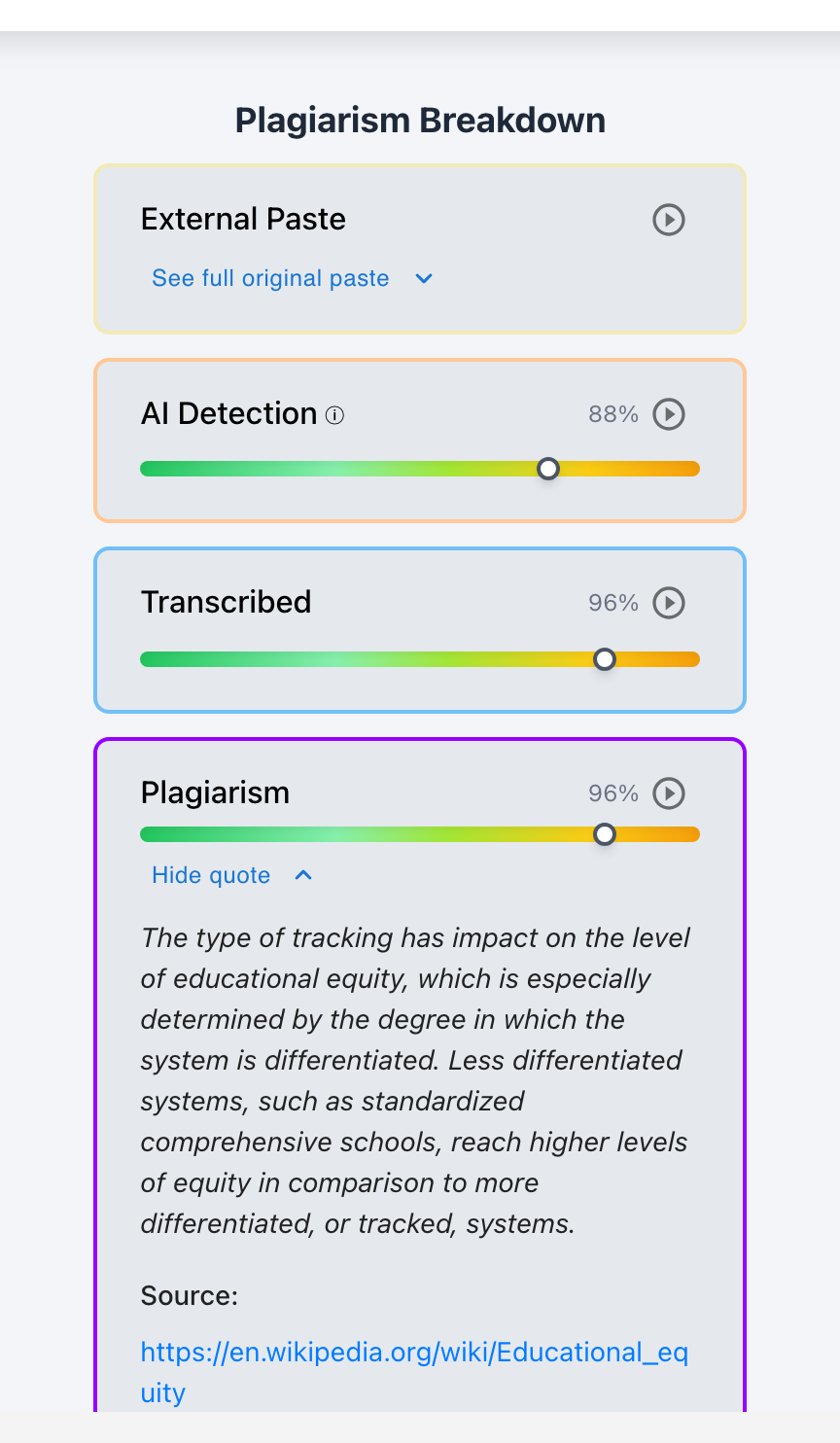
In secondary theatre arts programs, International Thespian Society (ITS) troupes, and competitive One-Act Play courses, the student director concept portfolio represents the highest tier of creative and analytical synthesis. Student directors are asked to articulate an overarching directorial vision, conduct exhaustive Stanislavskian script analyses (super-objectives, beats, and given circumstances), compile socio-cultural dramaturgical research, justify spatial blocking mechanics, and detail lighting and costume psychology. However, generative Large Language Models (LLMs) allow students to bypass deep dramaturgical thinking by generating high-sounding, academic directorial manifestos packed with graduate-level buzzwords—such as “Brechtian estrangement,” “Artaudian cruelty,” and “semiotic spatial dissonance.” These AI-generated portfolios look impressive on paper but collapse under scrutiny, exhibiting fatal disconnects from physical stage dimensions, high school cast capabilities, and shop build realities. When drama directors use generic whole-document AI percentage detectors to investigate, they encounter disastrous false positives on legitimate expressive theatrical writing while missing paraphrased AI stage rationales. Checkmark Plagiarism resolves this dilemma by pairing multi-factor passage-level detection with patent-pending Essay Playback™ and writing process telemetry. By tracking keystroke dynamics, spatial reflection pauses, clipboard paste payloads, and physical script-to-stage concordance, theatre educators can defend artistic integrity, uphold Educational Theatre Association (EdTA) standards, and conduct restorative production debriefs that ground student directors in authentic stagecraft.

Checkmark Plagiarism empowers high school drama directors and Thespian advisers by combining patent-pending Essay Playback™ with passage-level AI confidence sliders, side-by-side dramaturgical source verification, quote-anchored EdTA rubric autograding, and direct LMS sync for Canvas LMS, Google Classroom, and Buzz LMS.
1. The Directing Portfolio Crisis in Secondary Theatre Arts
In high school performing arts departments, the capstone experience for advanced theatre students—whether enrolled in Theatre III/IV, AP Capstone Seminar/Research focusing on dramatic arts, IB Theatre, or preparing an Individual Event (Thespys) for the International Thespian Society (ITS) and Educational Theatre Association (EdTA)—is the Student Directing Concept Portfolio and Dramaturgical Packet.
Unlike an actor who interprets a single role, a student director must function as an artistic visionary, dramaturg, spatial architect, and production manager. Directing requires translating dramatic literature into physical, temporal human experience. To prove they possess a defensible concept before stepping into rehearsals with their peers or submitting to state competitive one-act festivals (such as Texas UIL One-Act Play, Florida State Thespians, Virginia VHSL, or Georgia GHSA), students submit extensive written dossiers justifying every artistic choice.
- Messy, iterative script wrestling: Constant line-by-line annotation, beat re-segmentation, and motive testing.
- Concrete spatial awareness: Staging explicitly designed for the school cafetorium or 40ft proscenium apron.
- Blocking anchored to peer actors: Playable transitive verbs tailored to 9th–12th grade developmental skills.
- Pragmatic lighting selections: Specific gel numbers chosen from available departmental stock (e.g., Roscolux R02 / R68).
- Drafting pauses & spatial reflection: Long writing pauses while sketching floor plans and testing sightlines.
- Deep personal thematic connection: Grounded emotional metaphor reflecting authentic adolescent experience.
- Instantaneous, frictionless synthesis: Complete 20-page dossiers generated in 60 seconds.
- Abstract graduate-level jargon: Heavy overuse of “Brechtian alienation,” “liminal spatiality,” and “semiotic dissonance.”
- Impossible physical staging demands: Non-Euclidean actor crossings that violate stage dimensions and sightlines.
- Generic color symbolism: Clichéd interpretations (“blue equals melancholy,” “red signifies rage”).
- Zero drafting deliberation: Continuous clipboard paste payloads with zero tactic revisions or spatial pauses.
- Hollow academic posturing: Paralyzed student in rehearsal unable to answer basic cast blocking questions.
The emergence of Large Language Models (such as ChatGPT, Claude, and Gemini) has dramatically altered this landscape. When faced with a 20-page portfolio deadline, a student director can input a prompt such as:
“Write an advanced high-concept directorial vision statement, Stanislavski beat breakdown, dramaturgical historical context dossier, and lighting/color psychology design rationale for Arthur Miller’s The Crucible set in a minimalist dystopian panopticon.”
Within sixty seconds, the LLM outputs a breathtakingly sophisticated directorial manifesto. It uses graduate-level semiotics, cites historical court records, and quotes German theatre theorists.
However, on the actual stage, the illusion shatters. The student director arrives at rehearsal unable to give actionable motivational verbs to their 10th-grade actors, utterly bewildered by the lighting patch schedule, and unable to explain why their blocking notes require three actors to stand in the exact same downstage-left pool of light while speaking to an empty upstage corner.
For high school drama teachers, department chairs, and Thespian troupe advisers, this scenario presents an urgent pedagogical dilemma:
- The Surface Academic Veneer: LLM-generated stage rationales sound intensely scholarly, easily deceiving traditional text-based rubrics while masking a complete absence of spatial and practical theatrical comprehension.
- The High Stakes of Thespian & One-Act Adjudication: Competitive festivals enforce strict academic integrity standards. Submitting an AI-ghostwritten prompt book or concept packet risks school disqualification, loss of Thespian troupe charter standing, and disciplinary sanctions.
- The Danger of Flawed AI Percentage Detectors: Generic, black-box AI detectors evaluate text solely on probabilistic sentence predictability. Because theatre students write with heightened emotional metaphors, specialized stage vocabulary, and non-traditional phrasing, static detectors frequently flag authentic, vulnerable student portfolios as “AI-generated,” while failing to detect edited LLM text.
Theatre education requires an objective, non-punitive audit protocol that combines writing process telemetry (Essay Playback™) with script-to-stage physical concordance checks.
2. Anatomy of the High School Directing Concept Portfolio & Dramaturgical Packet
To audit student director documentation effectively, secondary drama educators must understand the core analytical components that make up a standard Educational Theatre Association (EdTA), International Thespian Excellence Awards (Thespys), or State One-Act Play director’s notebook.
Central thematic metaphor/spine (Harold Clurman model), core dramatic question, aesthetic lens (heightened realism vs. expressionism), and adolescent audience bridge.
Given circumstances (time, place, society), character super-objectives, transitive playable verbs (Stanislavskian tactics), and French scene entrance/exit charting.
Historical, socioeconomic, and political world-of-the-play research, playwright biography, landmark production history, and contemporary thematic relevance.
Ground plans (Proscenium vs. Thrust vs. Arena), sightlines, composition planes, vertical levels, actor traffic patterns, and proxemic tension mapping.
Gel color temperatures (warm vs. cool wash), gobo textures, angles of incidence, motivational vs. atmospheric shifts, and inventory dimmer feasibility.
Color-coding character alliances and status shifts, garment silhouette/texture distressing, practical quick-change logistics, and shop budget limits.
2.1 The Production Concept Statement (The Director’s Vision)
The concept statement is the artistic thesis of the production. It defines the “spine” of the play (in Harold Clurman’s formulation) or the central metaphor through which the director interprets the text. In high school portfolios, this section articulates:
- The core dramatic question the production seeks to answer.
- The visual and tonal style (e.g., heightened realism, theatrical expressionism, minimalist absurdism).
- The intended emotional and intellectual impact on the high school and community audience.
2.2 Script Analysis & Dramatic Mechanics
Rooted in Stanislavskian and post-Stanislavskian methodology, this section requires deep line-by-line textual mining:
- Given Circumstances: Environmental factors, political climate, religious influences, and immediate antecedent action.
- Super-Objectives & Obstacles: What each character wants across the span of the entire narrative, and the internal/external forces preventing them from getting it.
- Beat-by-Beat Breakdown & Tacticking: Dividing scenes into operational “beats” (units of intention) and assigning active, playable transitive verbs (e.g., to beguile, to eviscerate, to shield, to interrogate) rather than passive states of being (to be sad, to be angry).
- French Scene Breakdown: Tracking every character entrance and exit to map cast density and dramatic pacing.
2.3 Historical & Socio-Cultural Dramaturgy Dossier
The dramaturgical packet serves as the factual and thematic anchor for the cast and creative team. It compiles:
- Period-accurate research detailing the socioeconomic, cultural, and historical realities of the play’s setting.
- Literary analysis of the playwright’s biography, historical influences, and original production reception.
- Production history analysis: How past professional and landmark educational revivals staged key conceptual challenges.
- Thematic translation: Connecting historical dilemmas (e.g., the McCarthyite panic of The Crucible, or the Great Depression despair of The Glass Menagerie) to modern adolescent experiences.
2.4 Scenic & Spatial Blocking Justifications
Directing is the art of storytelling through three-dimensional space. The blocking rationale explains:
- Stage Geometry & Facility Selection: How the staging adapts to the physical performance space (a traditional 40-foot proscenium with dead fly space, an intimate three-quarter thrust, or a flexible black box arena).
- Compositional Triangles & Focal Points: Utilizing body positions (full front, profile, quarter-turned), stage planes (upstage, midstage, downstage), and vertical levels (platforms, steps, ramps) to establish character power dynamics.
- Proxemics & Spatial Tension: The emotional distance between actors on stage and how physical movement communicates subconscious psychological shifts.
- Architectural Sightlines & Traffic: Mapping practical entrances, exits, and clearances around stage furniture and unit set pieces.
2.5 Lighting & Color Psychology Design Rationales
Lighting serves two masters: visibility and atmosphere. Student directors must specify:
- Color Temperature & Gel Selections: Justifying specific gel numbers (e.g., Roscolux R02 Bastard Amber for motivational warmth vs. R68 Parry Sky Blue for cold emotional detachment).
- Gobo Textures & Angles of Incidence: Using breakup patterns (foliage, venetian blinds, prison bars) and steep side-lighting to carve out isolation or psychological distress.
- Intensity & Timing Transitions: Aligning light cue shifts with internal script beat changes and climactic moments.
2.6 Costume & Makeup Renderings Commentary
The visual progression of characters through fabric and color:
- Establishing color palettes that signal factional alliances, family bonds, or ideological divergence.
- Garment silhouette and texture progression (e.g., crisp, rigid tailoring that becomes wrinkled, torn, and distressed as the character deteriorates psychologically).
- Practical backstage considerations: Quick changes, tear-away fasteners, and hair/makeup hygiene under stage lighting.
3. The “LLM Directorial Manifesto”: Hallmarks of AI-Generated Stage Rationales
When high school students use generative AI to draft their director portfolios, the resulting text exhibits a distinct set of stylistic, theoretical, and practical anomalies. In high school theatre pedagogy, this is known as the “LLM Directorial Manifesto.”
| Dimension | Authentic High School Director | AI-Generated “Manifesto” |
|---|---|---|
| Theoretical Tone | Direct, earnest, conversational; grounded in classroom acting terminology and personal passion. | Pretentious, hyper-academic; loaded with graduate-level post-structuralist literary theory. |
| Vocabulary Usage | “Wants”, “tactics”, “energy shift”, “crosses downstage”, “warm special”, “clearing sightlines”. | “Brechtian estrangement”, “liminal spatiality”, “semiotic dissonance”, “hegemonic dialectic”. |
| Spatial Awareness | Specific to school auditorium dimensions; respects physical proscenium borders and wing backstage storage. | Abstract, non-Euclidean staging; ignores physical sightlines, stage apron boundaries, and actor masking. |
| Cast Capabilities | Tailored to peer actors (9th–12th graders); uses active playable verbs and concrete physical actions. | Demands impossible psychological embodiment, micro-scapular tensions, and esoteric physical biomechanics. |
| Shop Feasibility | Accounts for $300 budget, 2x4 platforms, stock muslin flats, and strict 7-minute UIL One-Act strike rules. | Proposes motorized hydraulic lifts, 4K wrap-around scrim projections, and pyrotechnics violating fire codes. |
| Drafting Dynamics | Iterative; heavy backspaces on blocking; 45–120s reflection pauses while checking floor plan ground plans. | Instantaneous text ingestion or frictionless, uniform typing stream with zero spatial deliberation pauses. |
3.1 The Pretentious Academic Lexicon Dump
The most immediate red flag in an AI-generated directing packet is an explosion of graduate-level literary and theatrical theory vocabulary. High school students who struggle in class to explain the difference between a “cross” and a “counter-cross” suddenly submit portfolios featuring:
- “Brechtian Verfremdungseffekt and dialectical alienation of the spectator”
- “Artaudian visceral cruelty and metaphysical spatial violence”
- “Liminal architectural zones and post-structuralist semiotic dissonance”
- “Grotowskian biocentric kinesthetics and Meyerholdian biomechanics”
- “The hermeneutic circle of the text deconstructing late-capitalist hegemonic structures”
While high school IB Theatre students or advanced AP Capstone researchers may legitimately engage with Bertolt Brecht or Antonin Artaud, LLMs use these terms as ornamental filler. The AI inserts theoretical terminology without connecting it to concrete physical choices on the stage.
3.2 The Fatal Physical Stage Disconnect
LLMs possess vast semantic knowledge about theatrical history, but they possess zero spatial embodiment or geometric reasoning. They do not know what it feels like to stand on an unraked high school stage with dead spots in the overhead wash.
Common spatial hallucinations in AI directing portfolios include:
- Impossible Blocking Geometry: Directing three actors to maintain unbroken eye contact while simultaneously performing opposing linear crosses downstage left and upstage right on a shallow 16-foot apron.
- Proscenium-Thrust Confusion: Writing blocking rationales that instruct actors to “play to the vomitoria and address the three-sided audience” when the student’s ground plan is explicitly drawn for a traditional single-front proscenium auditorium.
- Sightline Blindness: Staging critical emotional climaxes (such as Proctor tearing his confession in The Crucible) behind a towering upstage set piece or on the extreme offstage periphery where 40% of the audience in the house cannot see the actor’s face.
“In this climactic confrontation, John Proctor traverses the liminal threshold between Upstage Right and Downstage Left in a continuous spiral motion, generating centrifugal socio-political tension. Meanwhile, Abigail Williams occupies the apex of the stage pyramid on the extreme downstage apron, radiating authoritarian dominance while simultaneously remaining fully visible in profile to the entire three-sided house, establishing a dynamic dialectic of gaze.”
- Proctor cannot “traverse in a continuous spiral motion” across a 24-foot stage packed with a 6-person court table without knocking over furniture.
- If Abigail is at the extreme apron in profile, she is completely masking Proctor from the entire stage-left audience section.
- The school auditorium is a standard proscenium house—there is no “three-sided house” or vomitorium.
3.3 The Rehearsal & Actor Capability Void
Directing high school peers requires empathy, clear pedagogical communication, and practical rehearsal technique. When student directors authentically write their packets, they focus on playable actions:
“I need Marcus (playing Danforth) to stop yelling and instead use a quiet, conversational whisper to intimidate Mary Warren. His objective is ‘to corner a rabbit.’”
In contrast, LLM-generated directorial packets provide passive, intellectualized emotional descriptions that no high school actor can perform:
“The actor portraying Danforth must synthesize the cold bureaucratic inexorability of the state with an internalized neurosis of patriarchal decline, projecting ontological certitude through micro-tensions in the scapular girdle.”
During rehearsal, a student director armed only with an AI-generated portfolio stands paralyzed at the tech table. When their peer asks, “What do I do with my hands when I deliver this monologue?” the student director has no practical answer because their portfolio contains only philosophical abstractions.
3.4 Generic “Universalized” Symbolism
LLMs rely on statistical cliches when asked for design and color psychology rationales. Across hundreds of student submissions, AI-generated lighting and costume packets repeat the exact same stock tropes:
- Blue: “Represents melancholy, isolation, and unattainable purity.”
- Red: “Signifies burning passion, violent aggression, and moral corruption.”
- White/Gray: “Represents the sterile conformity of oppressive societal structures.”
- Gobos: “A venetian blind or window-pane gobo is projected onto the floor to symbolize psychological entrapment.”
An authentic student director justifies color based on the unique thematic universe of their specific play and their school’s actual lighting inventory:
“Our drama club only has twelve Altman 6-inch fresnels and eight Source Four ellipsoidals. Because we don't have enough dimmers for a full cool wash, I'm using two R68 high-side specials from the FOH catwalk to isolate Blanche whenever the polka music plays, contrasting with the warm R02 practical lamps on her vanity.”
3.5 Disregard for Physical Shop, Budget, and Competition Constraints
High school theatre exists within rigid practical boundaries: a finite departmental budget (often under $500 for a student-directed one-act), student technical crews who can only build during after-school shop hours, and strict competitive festival rules.
AI portfolios routinely specify:
- Automated motorized turntables and hydraulic elevator platforms.
- 4K laser projection mapping across three-story translucent scrims.
- Pyrotechnic flash pots and heavy water effects that violate school fire codes.
- Elaborate multi-location realistic set changes for state One-Act Play competitions that have a strict 7-minute setup/strike time limit and require all scenery to fit within an 8x10-foot storage box.
4. The High Stakes of Artistic Integrity: EdTA, Thespys, and One-Act Play Regulations
The necessity of auditing student directing portfolios is not merely an internal classroom grading concern; it is directly tied to the national standards and legal/ethical regulations governing secondary educational theatre.
National Core Arts Standards for Theatre (TH:Cr1.1.HSI-III Envision, TH:Cr2.1 Develop/Stage, TH:Cn11.2 Cultural/Historical). AI concept generation circumvents foundational artistic inquiry standards.
Thespian Excellence Awards Solo/Group Directing category requires 100% student-originated Director’s Notebook and oral defense. Ghostwritten portfolios lead to immediate disqualification.
Mandatory prompt book inspections and rigorous post-performance adjudicator oral critiques. Unearned blocking choices collapse under adjudicator line-by-line cross-examination.
Rigorous external moderation for IB Director’s Notebook and AP Seminar dramatic inquiry portfolios, governed by institutional Honor Boards and academic integrity charters.
4.1 Educational Theatre Association (EdTA) National Core Arts Standards
The EdTA National Core Arts Standards establish clear performance benchmarks for high school directors:
- TH:Cr1.1.HSI–III (Creating - Envision/Conceptualize): “Formulate dramatic concepts and staging ideas for a theatrical production based on deep textual interpretation.”
- TH:Cr2.1.HSI–III (Creating - Develop): “Collaborate with design teams and actors to translate conceptual metaphors into practical stage realities.”
- TH:Cn11.2.HSI–III (Connecting - Cultural/Historical Context): “Research and integrate historical, cultural, and political contexts into artistic decision-making.”
When a student delegates concept creation, beat analysis, or dramaturgical research to an LLM, they bypass every standard in the Creating and Connecting strands. They are not learning to direct; they are learning to prompt.
4.2 International Thespian Excellence Awards (Thespys) Directing Event
In the Solo/Group Directing category of the ITS Thespys, student directors submit a comprehensive Director’s Notebook and conduct an oral defense before professional adjudicators.
- The notebook must contain the student’s original production concept, script breakdown, blocking diagrams, design pitches, and rehearsal logs.
- If an adjudicator or troupe director discovers that the notebook was generated by AI, the student faces immediate disqualification under EdTA academic honesty guidelines, revocation of Superior ratings, and forfeiture of International Thespian Festival invitations.
4.3 State One-Act Play Competitions (e.g., Texas UIL, Florida, Virginia, Georgia)
In state high school one-act play competitions, integrity standards are rigorously policed:
- Prompt Book Audits: Contest managers inspect the official prompt book before load-in. The book must contain verified, student-annotated cues, blocking diagrams, and legal cut scripts.
- Adjudicator Oral Critiques: Following the 40-minute performance, state-certified adjudicators conduct public critiques. When an adjudicator asks a student director, “Why did you cross the lead downstage during the lighting transition in Beat 4?” an AI-dependent student freezes. The adjudicator immediately recognizes that the student lacks artistic ownership of the staging.
4.4 Why Generic AI Percentage Detectors Fail Theatre Directors
When drama teachers suspect AI generation in a concept portfolio, their first instinct is often to upload the document into a standard campus AI scanner (e.g., Turnitin AI Writing Detector or GPTZero). This approach frequently results in pedagogical disaster:
- Catastrophic False Positives on Expressive Theatrical Writing: High school theatre students are trained to write with passion, sensory metaphor, poetic cadence, and specialized theatrical jargon. Probabilistic detectors flag these authentic human creative stylistic flourishes as “unusual” and trigger 80%–95% AI false alarms on honest, dedicated drama students.
- Blindness to Lightly Edited AI Stage Rationales: When a student copies an LLM-generated concept packet and spends fifteen minutes swapping character names, adding a few slang words, or reordering sentences, static detectors drop their score to 0% AI—allowing complete cognitive fraud to pass undetected.
- Absence of Actionable Evidence: An opaque percentage score (e.g., “This packet is 74% AI”) is legally and pedagogically indefensible during a parent conference or administrative honor code hearing. A drama teacher cannot explain how the software arrived at that number.
Theatre educators need verifiable behavioral telemetry (“receipts”) that show how the portfolio was drafted over time.
5. The High School Theatre Evidentiary Matrix
To evaluate student directing portfolios with scientific rigor and pedagogical fairness, theatre arts departments must compare traditional audit methods against advanced process telemetry.
| Audit Capability / Evidentiary Dimension | Paper Prompt Book Binder | Generic AI Detectors | Google Docs Version History | Checkmark Visual & Process Telemetry™ |
|---|---|---|---|---|
| Spatial Reflection & Pausing Telemetry (Measures thinking pauses while viewing floor plans) |
❌ None (Static final ink) |
❌ None (Text only) |
❌ None (30-min batches) |
✅ 100% Measured (Millisecond IKI logs) |
| Keystroke-by-Keystroke Drafting Playback (Visualizes character tactic typing & deletions) |
❌ None | ❌ None (Black box) |
❌ None (Macro snapshot) |
✅ Full 1x–8x Replay (Complete timeline) |
| External Clipboard Paste Buffer Preservation (Captures full LLM payload even if edited later) |
❌ None | ❌ None | ❌ Blind to raw clipboard | ✅ Retains Original Paste Text & Timestamp |
| Script-to-Stage Concordance Verification (Cross-references text with blocking margins) |
⚠️ Manual (High labor) |
❌ None | ❌ None | ✅ Linked Two-Way Evidence Cards |
| Granular Passage-Level Confidence Sliders (Separates concept paragraph from research quotes) |
❌ None | ❌ Blanket % Score Only | ❌ None | ✅ Isolates Specific Theatrical Paragraphs |
| Immunity to “AI Humanizers” & Rephrasers (Bypasses QuillBot / Undetectable AI surface text) |
❌ Irrelevant | ❌ Easily Bypassed | ❌ Partial | ✅ 100% Immune (Temporal keystrokes) |
| Protection for Honest Expressive Theatre Students (Guards against false positives on poetic vision) |
⚠️ Subjective Teacher Bias | ❌ Massive False Positives | ⚠️ Unclear | ✅ Exonerates with Verifiable Typing Replay |
| EdTA & One-Act Rubric Autograding with LMS Sync (Quote-anchored feedback pushed to Canvas/Google) |
❌ Manual Weekend Work | ❌ None | ❌ None | ✅ Direct Grade Passback (Teacher Final Control) |
6. Step-by-Step Drama Teacher Audit Protocol: From Prompt Book to Keystroke Replay
High school theatre educators and Thespian troupe advisers can implement a rigorous, 5-step investigative workflow to audit student director portfolios, resolve suspected AI dishonesty, and maintain supportive student relationships.
Cross-reference written concept statements with ground plans and margin cues.
Audit claims against physical school facility, dimmer grid, budget, & 7-min strike.
Scrub 1x–8x replay to inspect spatial thinking pauses, tactic edits, & bursts.
Examine raw clipboard captures to identify pasted LLM manifestos vs. citations.
Conduct a non-punitive conference on stage apron focusing on directorial intent.
Step 1: Script-to-Stage Concordance Audit
Before opening an integrity report, conduct a baseline concordance check between the written portfolio and the student’s working prompt book:
- The Margin Cross-Check: Open the student’s script cut. Do the written beat transitions in the portfolio match the physical blocking notations in the script margins?
- Ground Plan Alignment: Examine the student’s floor plan ground plan. If the portfolio calls for a “sterile, oppressive court chamber dominated by a massive judicial bench,” does the ground plan actually show a 4x8 platform, or is it a stock sketch copied from the internet?
- Character Tactic Continuity: Pick three random dialogue lines. Ask the student director: “In your packet, you wrote that Mary Warren’s tactic here is ‘to placate.’ How does her physical movement to Downstage Left in your blocking demonstrate that tactic to the audience?”
Step 2: Physical Stage & Shop Reality Checks
Evaluate whether the student’s design rationales conform to the physical constraints of your secondary school theatre space:
- Lighting Grid Audit: If the student specifies a “high-intensity 4-point backlight system with saturated magenta gobos,” cross-reference your school’s actual dimmer board. Does your high school theatre have enough non-dim circuits, instruments, and gel sheets in stock to execute this design?
- Set Strike & Safety Audit: For competitive One-Act Play classes, calculate the strike time of the proposed set. Can two 10th-grade student stage managers strike the entire scenic structure in under 7 minutes without power tools? If not, the rationale was likely drafted in a theoretical vacuum by an LLM.
Step 3: Analyzing Keystroke Telemetry & Spatial Thinking Pauses with Essay Playback™
Using Checkmark Plagiarism’s Essay Playback™, replay the student’s writing session at 2x to 8x speed. Authentic directing portfolio composition exhibits a distinct cognitive rhythm:
──► [Types: “Downstage Left table”] ──► [Backspaces 12 chars: “No, Downstage Right near fire”]
──► [Types: “because Abigail is blocking the doorway Upstage Center.”]
──► [90s PAUSE: Student deliberates on actor sightlines & power balance]
──► [3 minutes of surface skimming: Student fixes 2 typos and adds teacher’s name to header]
──► [Zero revision of staging mechanics, zero spatial deliberation pauses, zero tactic changes]
- Spatial Thinking Pauses: When writing blocking rationales, an authentic student pauses for 30 to 120 seconds between paragraphs. During these pauses, the student is looking back and forth between their Chromebook screen, their paper ground plan, and the physical script.
- Tactic & Verb Backspacing: An authentic director constantly edits their vocabulary. In Playback, you will see the student write “Proctor tries to make her feel bad,” backspace the entire sentence, and replace it with “Proctor shames Mary Warren into submission.”
- The Mechanical Ingestion Red Flag: If Essay Playback reveals that 3,000 words of dense dramaturgical analysis appeared in 0.2 seconds via an external paste event, or were typed in a continuous 90-words-per-minute stream with zero backspaces or spatial pauses, the text represents transcription from a secondary screen (phone/tablet) running an LLM.
Step 4: Inspecting External Paste Buffer Payloads
Open Checkmark’s External Paste Inspector. Checkmark captures and permanently preserves the full, raw text of every external clipboard paste event—even if the student spent hours rephrasing, deleting, or scrambling the text afterward.
- Check whether the pasted payload contains LLM conversational introductory artifacts (“Certainly! Here is an in-depth, graduate-level directorial concept for Arthur Miller’s...”).
- Verify whether the paste was a legitimate block of quoted historical research from the Folger Shakespeare Library or an unreferenced AI-generated stage analysis.
Step 5: Conducting Supportive Restorative Production Debriefs “At the Prompt Table”
The goal of an academic integrity audit in theatre arts is never punitive destruction; it is pedagogical restoration. A student director who relies on AI usually does so out of acute performance anxiety, feeling overwhelmed by the massive responsibility of leading their peers.
Hold the conference in the theatre—sitting at the tech table or on the edge of the stage apron with the Chromebook running Checkmark Essay Playback alongside the printed script:
“Let’s pull up Checkmark’s Essay Playback for your Scene 3 Dramaturgy section. I love the ambition of this concept, but looking at the keystroke timeline, I see a 1,500-word block pasted in at 11:42 PM that uses phrases like ‘Grotowskian biocentric kinesthetics.’ When we watched your rehearsal yesterday, you were struggling to give Marcus clear blocking notes. Let’s talk about what happened here.”
“I panicked. I had never directed a multi-character scene before, and I didn’t know how to make my portfolio sound smart enough for the Thespys judges. So I asked ChatGPT to write the concept statement.”
“I completely understand that pressure. Directing is terrifying because you’re responsible for the whole room. But the judges don’t care about graduate school buzzwords; they care about YOUR vision for these specific high school actors on THIS stage. Let’s delete this AI section right now. Take twenty minutes with your script, sit in the house, look at the stage, and write in your own words: What does John Proctor want in this room, and where does he walk?”
7. How Checkmark Plagiarism Empowers High School Theatre Arts Departments
Checkmark Plagiarism provides a comprehensive, purpose-built suite of tools engineered specifically to meet the evidentiary, pedagogical, and administrative needs of secondary performing arts educators.
Evaluates text with granular confidence sliders. Isolates directorial concept paragraphs from historical quotes, script dialogue, and bibliography entries. Immune to surface paraphrasing.
Scrubbable video-style drafting replay. Visualizes spatial deliberation pauses, Stanislavskian tactic verb backspaces, and distinguishes authentic thought from secondary-device transcription.
Captures exact raw text from the external clipboard at the exact millisecond of insertion. Preserves original LLM text even after heavy manual student rephrasing or synonym swapping.
Pre-scores EdTA and Thespys directing rubrics with editable drafts. Automatically anchors feedback by quoting student prose directly. 100% teacher scoring authority with direct LMS passback.
7.1 Multi-Factor Passage-Level AI Detection
Unlike primitive tools that generate a single, misleading whole-paper percentage (e.g., “72% AI”), Checkmark underlines specific suspicious sentences directly within the student’s concept portfolio.
- Calibrated Confidence Sliders: Each flagged passage displays an evidence card showing whether the syntax exhibits typical human cadence (varied sentence length, natural theatrical vocabulary) or typical statistical AI patterns (uniform clause lengths, high lexical predictability).
- Isolation of Script Quotes & Dramaturgical Citations: Checkmark automatically identifies and isolates legitimate quoted dialogue and historical citations, ensuring they do not artificially distort the AI analysis.
- Honest Guardrails on Short Director Notes: For short scene reflections under 150 words (such as daily rehearsal journal entries), Checkmark displays
N/Arather than guessing on insufficient sample sizes.
7.2 Patent-Pending Essay Playback™ (1x–8x Replay)
Essay Playback™ is the ultimate tool for theatre teachers investigating complex portfolios. It allows the director to scrub through the entire writing history like a video:
- Spatial Rhythm Visualization: Watch the student draft their blocking rationale in real time. See every moment they paused to check their prompt book, every line they deleted, and every tactic verb they revised.
- Exoneration of Creative Writers: When an honest student writes an intensely poetic, avant-garde concept statement that triggers a false alarm on generic detectors, the drama teacher can open Essay Playback to prove 100% organic, keystroke-by-keystroke human creation—instantly resolving parent disputes and protecting student morale.
7.3 External Paste Buffer Inspector & Text Preservation
When a student director copies text from an outside window into Google Docs or the LMS essay editor, Checkmark intercepts the clipboard payload:
- Stores a timestamped snapshot of the exact text pasted.
- Preserves the original paste payload permanently, even if the student subsequently spent 45 minutes manually deleting buzzwords or swapping synonyms.
- Provides a one-click “Jump to Playback” button that takes the teacher directly to the exact millisecond in the timeline when the paste occurred.
7.4 Quote-Anchored Rubric Autograding with LMS Passback
Evaluating 25 multi-page directing portfolios takes entire weekends. Checkmark’s AI Rubric Autograder accelerates this workflow while keeping the drama teacher in full pedagogical control:
- EdTA & Custom Rubric Integration: Upload standard EdTA National Core Arts Standards rubrics, State One-Act Play director rubrics, or custom departmental criteria directly from Canvas LMS, Google Classroom, or Buzz LMS.
- Quote-Anchored Feedback Cards: Checkmark generates first-draft criterion scores accompanied by written justifications that quote the student’s exact prose (e.g., “Under ‘Spatial Blocking Feasibility,’ the student director provided clear sightline justifications on page 4: ‘Proctor’s cross to Downstage Right maintains a 45-degree angle to keep Mary Warren in profile...’”).
- Teacher Final Authority: All AI-generated scores remain editable drafts until the drama director reviews, modifies, and approves them.
- One-Click Gradebook Sync: Pushes finalized scores and written feedback directly back into the Canvas, Buzz, or Google Classroom gradebook with a single click.
7.5 Privacy, FERPA Compliance, and Zero Student Data Training
High school student playwrights and directors create original intellectual property and share deeply personal reflections in their portfolios. Checkmark guarantees:
- Zero Model Training: Student portfolios, scripts, and dramaturgical packets are never used to train public or proprietary AI models.
- FERPA & COPPA Compliance: Secure, enterprise-grade cloud infrastructure with encryption at rest and in transit.
8. Real High School Classroom Case Scenarios
The following case studies illustrate how high school theatre arts departments utilize Checkmark Plagiarism and writing process telemetry to resolve directorial integrity dilemmas.
An 11th-grade student submitted an 18-page portfolio packed with graduate theory (“Artaudian visceral violence”). In rehearsal, the student was paralyzed, unable to tell Danforth where to stand.
External Paste Inspector revealed an 1,850-word paste event at 11:42 PM Sunday containing raw LLM conversational header (“Here is a profound directorial rationale...”).
Teacher sat with student on stage apron. Student admitted anxiety over Thespys judging. Director guided student to delete AI text and re-author concept using playable verbs. Scene earned Excellent rating at festival.
🔴 “91% AI-Generated”
Flagged student’s poetic metaphor (“fragile prism of refracted cobalt shadows”) as statistical machine anomaly.
🟢 100% Human Composition
3 hrs 42 min drafting time, 418 backspace events, long pauses calibrating gel codes, and organic sentence restructuring.
Department chair dismissed integrity referral, apologized to student, and submitted portfolio to International Thespian Excellence Awards, where it received a Superior rating.
Student assistant director submitted a scenic justification proposing motorized rotating ramps and hydraulic lifts, violating the strict 7-minute UIL One-Act strike rule.
Passage slider flagged scenic rationale at 98% AI confidence. Playback proved entire scenic section pasted in 0.4s with zero typing history.
Director pulled out physical UIL unit set wooden miniatures. Student arranged blocks on table while justifying blocking, then authentically drafted a compliant scenic rationale.
9. Frequently Asked Questions (FAQs)
1. How does Checkmark differentiate between legitimate dramaturgical research quotes and pasted AI text?
Checkmark’s multi-dimensional engine performs two-way source matching against billions of web pages, digital theatrical archives, and academic encyclopedias alongside process telemetry. When a student pastes a verified historical quotation from a published source, Checkmark matches the text to its original source in the Plagiarism Breakdown sidebar, applies dedicated citation styling, and allows the teacher to verify proper MLA/APA attribution. Conversely, when an LLM generates a synthetic block of text, Checkmark’s passage-level linguistic analyzer and external paste buffer inspector flag the text as an unreferenced, synthetic payload.
2. Can student directors use generative AI ethically during the initial concept brainstorming phase?
Yes, when guided by clear departmental policies. An ethical workflow allows students to use AI as a sparring partner for initial thematic brainstorming (e.g., exploring non-traditional historical settings or generating preliminary research reading lists). However, the actual script analysis, beat breakdown, Stanislavski tactics, ground plans, and blocking justifications must be authentically authored by the student. Checkmark’s Essay Playback allows teachers to verify that while initial ideation may have occurred, the drafting, spatial problem-solving, and synthesis were executed organically by the student on their keyboard.
3. What if a student director claims they wrote their entire portfolio offline in a notes app and pasted it in?
Submitting large external paste payloads without prior teacher approval violates standard academic integrity protocols. Secondary theatre departments should establish clear syllabus guidelines requiring all portfolio drafting to occur within the designated LMS editor or Google Docs on school-issued Chromebooks. If an offline paste occurs, the teacher can use Checkmark’s External Paste Inspector to review the raw payload and conduct an in-person viva voce debrief at the prompt table, asking the student to verbally explain the staging logic, sightlines, and tactic choices within the pasted text.
4. Why do generic AI percentage detectors frequently flag theatre students' authentic writing?
Generic detectors rely on probabilistic language models that measure “perplexity” (word predictability) and “burstiness” (sentence length variation). Theatre students write with heightened emotional metaphors, poetic cadences, non-linear thoughts, and specialized dramatic vocabulary (e.g., cyclorama, proscenium, objective, tactic, gobo). Because this style diverges from standard expository essay patterns, black-box detectors misclassify authentic human dramatic passion as machine-generated. Checkmark solves this by grounding all evaluations in verifiable keystroke telemetry (Essay Playback™).
5. How does Checkmark integrate with the International Thespian Excellence Awards (Thespys) directing rubrics?
Checkmark includes pre-built and customizable rubric templates aligned directly with the EdTA National Core Arts Standards and ITS Thespys Directing adjudication rubrics. Teachers can sync these rubrics directly from Canvas LMS, Google Classroom, or Buzz LMS. Checkmark’s AI autograder evaluates the student’s portfolio against each rubric criterion, generating quote-anchored justifications tied directly to the student’s prose, while leaving final scoring authority entirely in the hands of the drama director.
6. How does writing process telemetry protect neurodivergent theatre students?
Neurodivergent students (such as those with ADHD, dyslexia, or autism spectrum profiles) frequently compose in non-linear bursts—writing blocking for Scene 4 before Scene 1, rapidly cycling between paragraphs, or making frequent large deletions as they visualize spatial relationships. Generic AI detectors often misinterpret these irregular textual patterns as synthetic anomalies. Checkmark’s Essay Playback captures the complete temporal history of the student’s composing journey, providing undeniable proof of genuine, highly focused cognitive labor and protecting neurodivergent students from unwarranted accusations.
7. Does Checkmark store or share student scripts with public AI models?
No. Checkmark maintains a strict Zero-Training, Zero-Retention Architecture. Student playwriting drafts, directing portfolios, and dramaturgical packets are never used to train public or proprietary machine learning models. Checkmark is fully compliant with FERPA, COPPA, and state-level student data privacy laws, ensuring that young artists' intellectual property and personal reflections remain private and secure.
Conclusion: Stop Guessing, Start Trusting in High School Theatre Arts
Directing a high school theatrical production is one of the most transformative leadership experiences a secondary student can undertake. It requires young artists to develop emotional empathy, spatial intelligence, collaborative stamina, and analytical rigor.
Allowing generative AI to ghostwrite student director concept portfolios robs young theatre artists of the cognitive struggle that builds authentic artistic agency. Conversely, relying on opaque, probabilistic AI percentage detectors creates a culture of suspicion, stifles creative risk-taking, and falsely penalizes passionate student writers.
By combining passage-level multi-factor AI detection, external paste payload inspection, and patent-pending Essay Playback™, Checkmark Plagiarism provides high school theatre directors with the objective, transparent evidence needed to safeguard artistic integrity.
Drama educators no longer have to guess whether a concept statement was generated by a machine or drafted through genuine human sweat. With Checkmark, theatre directors can verify authentic student stagecraft, protect vulnerable creative voices, and guide the next generation of Thespians with confidence and trust.
Empower Your Theatre Arts Department with Process Telemetry
Equip your drama faculty, Thespian troupe advisers, and one-act directors with keystroke playback, paste inspection, and quote-anchored rubric autograding.