
Playwriting assignments in secondary theater arts and dramatic writing courses demand high levels of emotional vulnerability, idiosyncratic character voice development, and non-linear line-level experimentation. However, the rise of generative Large Language Models (LLMs) allows students to instantaneously output complete scenes, one-act plays, and dramatic monologues formatted in perfect industry standard. When theater educators suspect unauthorized AI generation, conventional “black-box” AI text detectors fail catastrophically—flagging authentic, stylized adolescent dialect and avant-garde theatrical pacing as “AI-generated” while remaining blind to humanized or pasted machine scripts. Checkmark Plagiarism resolves this dilemma for Fine Arts faculty through Writing Process Telemetry and patent-pending Essay Playback™. By capturing chronological keystroke dynamics, non-linear character-voice revision bursts, inter-keystroke timing intervals, and raw external clipboard paste buffers, Checkmark delivers objective, defensible evidence (“receipts”). This non-punitive, educator-led approach empowers theater teachers to verify authentic dialogue drafting, preserve student creative risk-taking, and conduct restorative table-read conferences grounded in empirical drafting history rather than probabilistic guesswork.

Checkmark Plagiarism provides the evidentiary foundation for dramatic arts education by combining patent-pending Essay Playback™ with passage-level AI confidence sliders, side-by-side similarity comparison, quote-anchored rubric autograding, and direct LMS integrations for Canvas LMS, Google Classroom, and Buzz LMS.
1. The Playwriting Integrity Crisis in Secondary Fine Arts
High school theater arts programs, dramatic writing intensives, and creative writing electives have long occupied a unique, sacred space in secondary education. Unlike standard five-paragraph expository essays or structured research papers, a script is not merely an arrangement of facts—it is an acoustic score for human performance.
When a student playwright sits down to draft a ten-minute one-act or a character monologue, they engage in a deeply vulnerable cognitive process. They experiment with vernacular dialects, unspoken subtext, pregnant pauses, rhythmic line breaks, comedic timing, and messy thematic revelations.
- Messy, non-linear drafting: Jumps between character lines, experiments with punchlines, backspaces repeatedly.
- Phonetic slang & dialect: Captures hyper-local adolescent cadence, regional expressions, and acoustic rhythm.
- Line-level deletions & rhythm testing: Trims wordy speeches into punchy stage dialogue and silent beats.
- Subtext & awkward pauses: Balances what characters say against what they actively conceal.
- High emotional vulnerability: Draws on real student fears, identity questions, and familial dynamics.
- Instantaneous text dump: Generates multi-page scenes with flawless margins in under five seconds.
- Standardized, sterile diction: Homogenizes distinct character voices into uniform, polite American prose.
- Symmetrical conversational turns: Predictable “ping-pong” two-sentence exchanges with zero friction.
- On-the-nose moralizing: Characters directly announce their psychological motives and resolve conflicts neatly.
- Zero cognitive struggle: Bypasses the foundational artistic process of finding one’s dramatic voice.
The proliferation of LLMs (such as ChatGPT, Claude, and Gemini) has introduced an unprecedented threat to dramatic writing pedagogy. With a single prompt—“Write a dramatic 5-minute scene between an estranged father and son in standard Samuel French format with stage directions”—an AI tool can instantly synthesize a grammatically pristine script formatted with proper character slugs, parentheticals, and dialogue blocks.
For theater teachers, the dilemma is acute:
- The Surface Plausibility Trap: AI-generated scripts look structurally complete on the page, satisfying formal requirements (character headings, stage directions, dialogue margins) while lacking soul, authentic conflict, and genuine dramatic subtext.
- The Fragility of Student Vulnerability: Accusing a young playwright of cheating based on an opaque, probabilistic software score destroys the trust essential for dramatic performance and creative risk-taking.
- The Collaborative Ripple Effect: In theater education, writing is directly tied to performance. When an actor or director is assigned an AI-generated script for rehearsal, the entire ensemble suffers from flat characterization and hollow dramatic stakes.
To safeguard dramatic writing curricula, theater arts departments require an evidentiary framework that looks beyond the static text on the page to examine the chronological human behavior that created it.
2. Dramatic Writing Pedagogy vs. The “LLM Theatrical Accent”
Understanding why writing process replay is indispensable requires examining the fundamental mechanics of dramatic composition and how LLM-synthesized scripts betray predictable, algorithmic artifacts.
| Dramatic Feature | Authentic Human Drafting | AI-Generated Script Dump |
|---|---|---|
| Character Idiolect | Asymmetrical vocabularies; phonetic vernacular; regional slang variations; idiosyncratic grammar. | Uniform sentence lengths; sterile, overly articulated academic diction; sanitized speech patterns. |
| Turn-Taking Cadence | Interrupted lines, overlapping fragments, monosyllabic reactions, awkward non-sequiturs. | Symmetrical ping-pong exchanges; predictable multi-sentence paragraphs; unnatural politeness. |
| Subtext & Pauses | Heavy drafting pauses before dramatic reveals; deleted lines; physical silence markers. | Explicit verbalization of internal motivations; zero unspoken subtext; on-the-nose psychology. |
| Stage Directions | Pragmatic physical actions; spatial choreography; blocking revised in tandem with dialogue. | Parenthetical emotional directives before every line: (smiles warmly), (sighs sadly). |
| Resolution Arc | Ambiguous endings; unresolved tension; messy, authentic human conclusions. | Moralizing summation; neat therapeutic closure; aphoristic concluding lines. |
| Drafting Telemetry | High IKI variance; erratic burst rates; frequent backspacing & line restructuring. | Zero typing history; instantaneous clipboard paste or flat metronomic transcription. |
2.1 The Craft of Dramatic Writing: Voice, Subtext, Timing, and Beats
Authentic playwriting is defined by specific technical elements that reflect real-time cognitive wrestling:
- Character Voice Differentiation (Idiolect): In a well-crafted play, no two characters sound alike. A world-weary grandmother speaks with different rhythmic cadence, syntactic complexity, and colloquialisms than an anxious high school freshman.
- Subtext (The Unspoken Drama): Characters rarely state their exact feelings directly. Real dramatic tension exists in the chasm between what a character says and what they mean or do.
- Dramatic Beats & Timing: A “beat” is the smallest unit of dramatic action where a character shifts tactics to achieve an objective. Human writers pause, deliberate, restructure, and delete lines as they calibrate the rhythm of these shifts.
- Functional Stage Directions: Stage directions in modern theater serve actor blocking, physical action, and theatrical tempo—not internal emotional exposition.
2.2 Linguistic Hallmarks of AI-Generated Scripts (The “LLM Theatrical Accent”)
Large Language Models do not experience emotional conflict, physical space, or acoustic timing. When prompted to generate dramatic scripts, they default to predictable statistical averages, exhibiting what theater educators recognize as the “LLM Theatrical Accent”:
1. Symmetrical Conversational Turn-Taking (The “Ping-Pong” Flaw)
LLMs generate dialogue with unnaturally balanced, polite turn-taking. Character A speaks two complete, grammatically balanced sentences; Character B responds with two complete, grammatically balanced sentences. Human conversations—especially dramatic ones—are messy, consisting of rapid one-word interjections, trailing thoughts, sudden overlaps, and non-sequiturs.
2. On-the-Nose Exposition and Emotional Directness
LLMs lack the capacity for dramatic subtext. Characters in AI scripts explicitly articulate their inner emotional states:
SARAH: (Gazing out the window sadly) I am feeling deeply hurt because you forgot my birthday, which symbolizes how distant our friendship has become since you joined the track team.
SARAH: (Looking at her phone) Nice shoes. New?
MARCUS: Track practice.
SARAH: Right. Must take up a lot of time. Like... all day Tuesday.
3. Flattening of Distinct Character Dialects
When prompted for regional dialects or teen slang, LLMs produce either caricature or sanitized, uniform grammar. The authentic, evolving sociolect of high school students—rich with hyper-local slang, meme references, and idiosyncratic grammar—is smoothed out into standard middle-class American prose.
4. The “After-School Special” Moralizing Resolution
LLM-generated scenes almost invariably resolve in neat, therapeutic moral consensus within three to five pages. Characters achieve mutual understanding, apologize for their shortcomings, and articulate a tidy life lesson. Authentic adolescent playwriting frequently grapples with unresolved ambiguity, uncomfortable silences, and painful, messy realities.
5. Redundant Parenthetical Directives
AI scripts rely heavily on redundant, amateurish emotional parentheticals before almost every dialogue line: (angrily), (thoughtfully), (with deep regret), (smiling warmly). Professional dramatic writing and rigorous high school rubrics teach students to reveal emotion through action and text, rather than spoon-feeding actors via parentheticals.
2.3 The Human Playwriting Signature: Messy, Non-Linear, and Phonetic
When a student authentically writes a play, their drafting process leaves an indelible, empirical signature:
- Phonetic Dialect Calibration: Students will type a line of dialogue, delete it, retype it phonetically to capture an accent, and adjust punctuation to indicate pauses.
- Line Pruning and Beat Shifting: An authentic writer will write a 10-line monologue, realize it is too wordy, cut seven lines, and insert a single stage direction:
[MARCUS sets down the letter. He doesn't look up.] - Non-Linear Jumping: Playwrights frequently jump between character responses, drafting the climax first, working backward to plant foreshadowing, and shifting blocking notes as they visualize the stage space.
3. The Artistic & Pedagogical Dilemma: Why Static AI Detectors Sabotage Creative Writing
When high school drama teachers and fine arts department chairs attempt to police scriptwriting using generic, text-only AI detectors, they cause severe pedagogical harm.
A student experiments with avant-garde theatrical pacing, repetitive poetic refrains (Beckett/Pinter style), or stylized monosyllabic exchanges. Static detectors analyze low word perplexity and flag the authentic student script as “92% AI-Generated.”
A student generates a full 10-page play using ChatGPT, runs it through an online paraphrasing tool (QuillBot/Undetectable AI), and pastes it into the LMS. Static detectors return a clean “0% AI” score despite zero human drafting effort.
Accusing an aspiring playwright based on an opaque percentage alienates the student from the arts department. When educators rely on black-box scores, students stop taking creative risks and adopt safe, bland writing styles.
When a parent or arts coordinator asks, “What specific line did the student cheat on?”, static detectors provide no audit trail, no timestamped history, and no defensible receipts.
3.1 The Chilling Effect of Black-Box Probabilistic Scoring
Theater education relies on psychological safety. Students share personal traumas, family dynamics, and social anxieties through the surrogate voices of fictional characters.
If an English or Drama teacher submits a student’s original one-act to a generic AI detector and receives an arbitrary “78% AI” flag, the teacher is forced into an adversarial posture. When accused, the student has no way to prove their innocence because traditional word processors provide no granular record of their creative labor. The result is catastrophic: honest students become cynical, disengage from theater productions, and refuse to participate in future play festivals.
3.2 The Flaw of Perplexity and Burstiness in Stylized Theatrical Dialogue
Standard AI detectors operate on two statistical heuristics:
- Perplexity: The statistical predictability of the next word in a sequence.
- Burstiness: The variation in sentence length and structure across a document.
These metrics fail completely when applied to dramatic scripts:
- Theatrical Dialogue is Naturally Repetitive: Real stage dialogue employs rhythmic repetition, refrains, comedic “rule of three” callbacks, and staccato monosyllabic responses (“No.” / “Yes.” / “Never.” / “Why?”). Generic detectors calculate this as “low burstiness” and flag it as machine-generated.
- Dramatic Pauses and Line Breaks: Scripts contain non-standard formatting, broken sentence fragments, and isolated stage directions that distort the linguistic parsing models used by commercial essay scanners.
3.3 The Failure to Catch “Humanized” AI Plays
Conversely, students who use generative AI know how to evade text-only detectors. By prompting an LLM to “write a play scene with typos and slang” or by passing the script through an automated text-spinner, the student alters the statistical perplexity. The detector gives the plagiarized script a clean bill of health.
The only unforgeable record of true authorship is the chronological human drafting timeline.
4. The Playwriting Verification & Telemetry Matrix
To evaluate student scripts fairly, fine arts educators must understand the differences between traditional theater assessment methods, generic AI detectors, and Checkmark’s multi-dimensional writing process telemetry.
| Capability / Metric | Table Reads & Workshops (Traditional) | Generic AI Detectors (Probabilistic) | Checkmark Essay Playback™ & Telemetry |
|---|---|---|---|
| Evidence Granularity | Subjective vocal cadence and acoustic intuition | Single whole-script % (e.g., “78% Likely AI”) | Keystroke-by-keystroke chronological timeline |
| Idiolect Revision History | Unobservable in final printed script | Invisible (Evaluates only static text) | Detailed logging of phrasing iterations |
| External Paste Tracking | None (Teacher sees only finished dialogue) | None (Pastes look like ordinary typed words) | Exact timestamp, char count, & raw buffer payload |
| Subtext & Timing Pauses | Actor pauses during read-throughs (post-facto) | Zero temporal analysis (No time data captured) | Precise Inter-Keystroke Interval (IKI) logging |
| Protection for Stylized Slang | High (Teacher understands creative intent) | Very Low (Flags avant-garde / slang as AI) | Absolute (Exonerates via physical typing history) |
| Defense in Disputed Cases | Relies on teacher memory vs. student claims | Indefensible black-box heuristic score | Defensible evidentiary dossier with video playback |
| LMS & Rubric Autograding | Manual paper notes in rehearsal studio | Separate third-party web paste portal | Native Canvas, Buzz LMS, & Google Classroom sync |
5. Step-by-Step Theater Teacher Script Audit Protocol
When evaluating dramatic writing submissions, secondary fine arts faculty and creative writing instructors should follow a systematic, supportive protocol that combines pedagogical observation with objective writing telemetry.
Deploy LMS-connected editor; establish transparent process expectations.
Review session time, keystroke ratios, and IKI cognitive burst variance.
Scrub 1x–8x replay to watch line-by-line character voice crafting and pauses.
Inspect clipboard buffer dumps to separate rough outlines from raw AI scenes.
Conduct restorative conference with shared playback review and coaching.
Phase 1: Pre-Submission Infrastructure & Writing Environment Setup
Authentic verification begins before the first line of dialogue is typed:
- Assign Drafting Within Connected Environments: Require students to compose their plays inside an integrated LMS (such as Canvas LMS, Buzz LMS, or Google Classroom) or the Checkmark-enabled Google Docs / Web Editor.
- Establish the “Process-First” Philosophy: Inform students upfront: “We celebrate your false starts, deleted jokes, rewritten scenes, and dramatic pauses. Your grade reflects your creative wrestling, not just a polished final script.”
- Define Authorized vs. Unauthorized AI Use: Clearly delineate classroom boundaries:
- Authorized AI Use: Brainstorming general historical settings, looking up obscure 1920s slang words, or checking theatrical formatting conventions.
- Unauthorized AI Use: Prompting an LLM to generate dialogue, write character speeches, outline scene-by-scene action beats, or rewrite student scenes.
Phase 2: Telemetry Triaging (Revision Bursts vs. Mechanical Cadence)
When scripts are submitted, the drama teacher reviews the telemetry overview dashboard:
- Total Active Time vs. Word Count: A standard 5-page one-act script (approx. 1,200 words) typically requires 2 to 5 hours of cognitive drafting time. A total active drafting time of under 8 minutes is an immediate telemetry anomaly.
- Keystroke-to-Word Ratio: Authentic creative writing produces a high keystroke-to-word ratio (often 2.5:1 to 4:1) due to frequent backspacing, punctuation adjustment, and line rewrites. A 1:1 ratio (where every keystroke appears in the final document with zero deletions) indicates manual transcription rather than original composition.
- Inter-Keystroke Interval (IKI) Variance: Human writers display erratic typing speeds—bursting through a quick line of banter, then pausing for 45 seconds to ponder a character’s reply. Monotonous, unvarying typing speeds indicate a student retyping text from a secondary screen, phone, or printed generative AI printout.
Phase 3: Deep Scrubbing with Essay Playback™ (1x–8x Replay Analysis)
The teacher opens Checkmark’s Essay Playback™ interface to scrub through the chronological drafting timeline:
During playback, the teacher observes:
- Dramatic Beat Pauses: Does the student pause before high-stakes dramatic reveals? Authentic writers take extended composing breaks when deciding whether a character confesses, lies, or walks away.
- Subtextual Rewrites: Does the student replace blunt, on-the-nose exposition with subtle, layered subtext?
- Phonetic Dialect Adjustments: Does the student tweak spelling to capture regional cadence (e.g., changing “What are you doing?” to “Whatcha doin’?”)?
- Blocking Alignment: Does the student revise stage directions in tandem with dialogue, showing that they visualize the physical stage space?
Phase 4: External Paste Payload Inspection (Unpacking Clipboard Dumps)
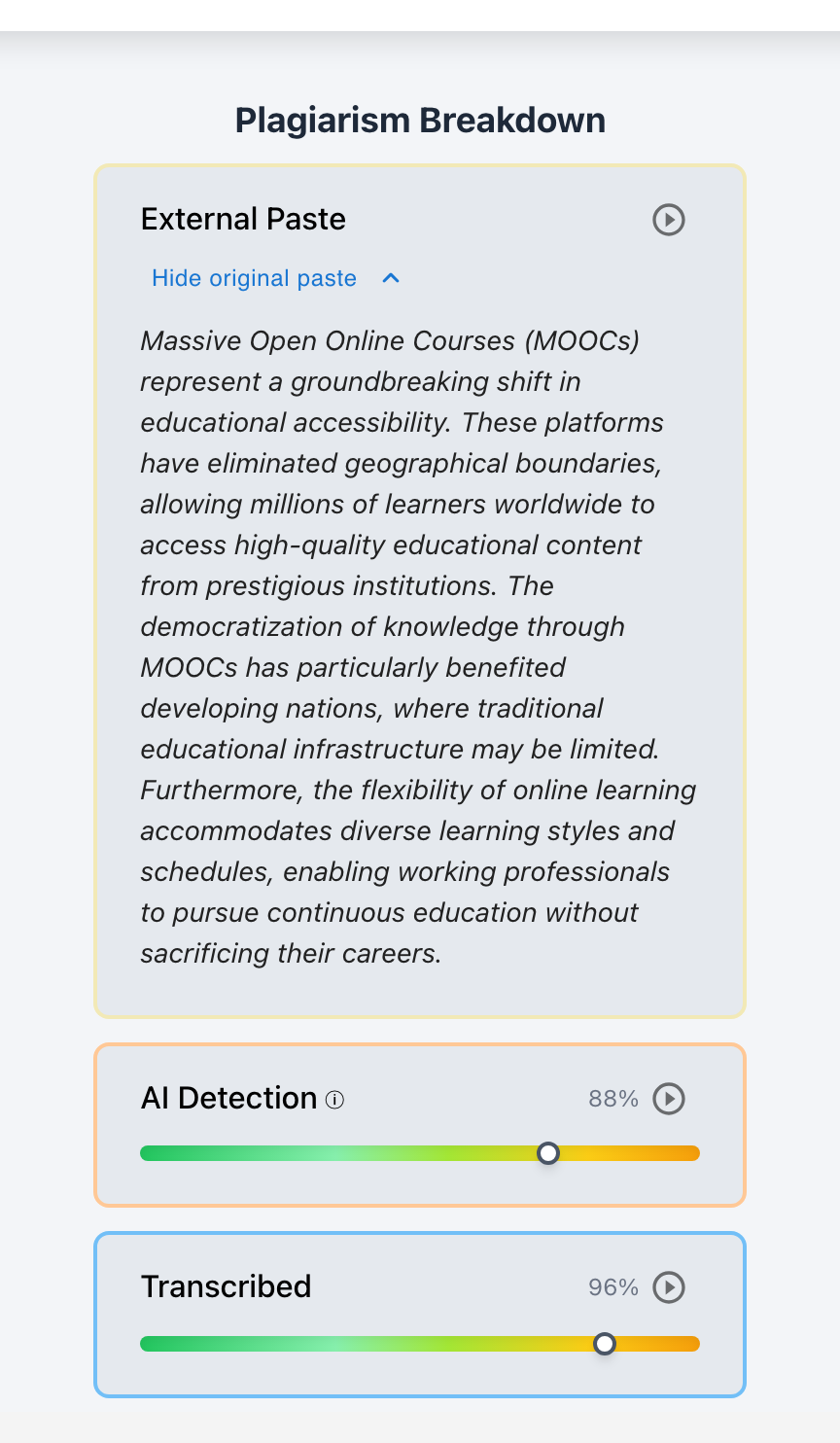
If a student pastes text into the script, Checkmark’s External Paste Inspector captures the exact timestamp, character count, and raw clipboard payload.
“HELENA: (Stepping into the spotlight, gazing mournfully into the distance) How fragile is the tapestry of youth when woven with threads of deceit! We walked these hallowed halls believing our camaraderie would withstand the vicissitudes of time. Yet here I stand...”
The teacher investigates:
- The “Instant Scene Dump”: If 400 words of complex dialogue appear in 0.4 seconds without preceding notes, the teacher clicks View Original Clipboard Buffer to inspect the full text that was copied.
- The “Patchwork Rewrite”: Even if the student subsequently spent 15 minutes editing words inside the pasted block, Checkmark preserves the raw original pasted string, proving that the structural foundation originated outside the student’s authentic session.
- Legitimate Outlines vs. Machine Generation: If the paste consists of the student’s own preliminary bullet points from a brainstorming workshop, the teacher can verify the text’s formatting and confirm legitimate drafting synthesis.
Phase 5: The Restorative Table-Read & Process Conference
When telemetry reveals unauthorized AI generation or when a student feels anxious about their writing process, the teacher conducts a supportive, non-punitive conference:
- Center on the Table Read: Begin the conference in the drama studio or classroom: “Let’s read this scene out loud together. I want to hear how you hear Helena’s voice.”
- Review Playback Together: Open Checkmark Essay Playback™ on screen. Frame the review as a discussion of artistic technique: “I love how you rewrote Arthur’s line at minute 13. Walk me through what made you change that line from shouting to a quiet whisper.”
- Address Telemetry Gaps with Restorative Coaching: If an external paste dump occurred, approach it transparently: “At minute 19, this entire monologue was pasted in at once. Tell me about where this speech came from and how you developed it.”
- Offer a Re-Drafting Opportunity: Allow the student to use the stage studio to re-draft the scene using authentic subtext, turning an academic integrity checkpoint into a masterclass in dramatic craft.
6. Real Classroom Case Scenarios
The following realistic case studies demonstrate how Checkmark’s Writing Process Telemetry resolves complex integrity questions in high school theater and creative writing courses.
🔴 “87% Probability of AI Generation”
Flagged due to unusual syntax, phonetic spelling, and repetitive rhythmic South Side Chicago slang.
🟢 100% Verified Authentic Drafting
2 hrs 45 min across 3 sessions; 4,812 keystrokes for 750 words (6.4:1 ratio); zero pastes; heavy phonetic calibration in playback.
Teacher exonerates Maya immediately. Maya receives full credit and her scene is selected for the Spring One-Act Festival. Creative risk-taking is preserved and validated.
🟡 “42% Likely AI” (Inconclusive)
Cannot determine if Shakespearean-style iambic monologue is period pastiche or machine generation.
🔴 612-Word Instant Clipboard Dump
11 min total active time; clipboard buffer retained raw LLM prompt text: “[SCENE START] Here is a dramatic Shakespearean monologue...”
Teacher shares the raw clipboard buffer in a private conference. Julian admits to writer’s block and is scheduled for a restorative studio workshop to redraft the speech from the character’s authentic core.
🟢 “12% AI” (Bypassed Detector)
Clean scan because student manually retyped text, introducing subtle character-level variances.
🟣 Metronomic Cadence (1.05:1 Ratio)
950 words in 14 min (continuous 68 WPM); flat IKI; zero deletions; typed straight top-to-bottom without dramatic pauses.
Teacher reviews playback with Tyler, who acknowledges dictating prompts into his phone and retyping the machine output. Tyler receives guided re-drafting support during drama lab.
7. Checkmark Plagiarism: The Purpose-Built Suite for Dramatic Arts Educators
Checkmark Plagiarism provides a comprehensive, multi-dimensional platform designed specifically to support creative, humanities, and fine arts pedagogy.

Watch the student’s play come to life on the screen exactly as it was drafted. Scrub forward and backward from 1x to 8x speed to observe comedic setups, character voice evolution, and stage blocking revisions.
Captures and displays the exact text on the student’s clipboard at the millisecond of insertion. Preserves original clipboard payloads even after extensive subsequent word substitutions.
Specific dialogue lines are underlined with corresponding evidence cards in the sidebar. Below ~150 words, displays N/A to prevent irresponsible guesses on short dialogue fragments.
Evaluates formatting, character arc consistency, subtext depth, and dialogue rhythm against custom rubrics. Generates quote-anchored feedback with 100% teacher editing and approval authority.
Guarantees that zero student submissions are ever used to train AI models. Student intellectual property remains private, secure, and compliant with all federal and district privacy mandates.
Seamless single sign-on and gradebook synchronization with Canvas LMS, Google Classroom, and Buzz LMS.
8. Frequently Asked Questions (FAQs) for Theater Arts Educators
Q1: How does writing process replay protect students who write in unconventional or avant-garde theatrical styles?
Traditional AI detectors rely on statistical conformity—if a student writes in repetitive absurdist loops (like Samuel Beckett) or highly fragmented urban slang, the algorithm flags the text as “low perplexity” or “unnatural syntax.” Essay Playback™ ignores statistical predictions and looks at empirical physical reality. When the teacher watches the playback, they see the student typing each line, pausing to think, deleting words, and testing rhythms. The drafting history provides definitive, unassailable proof of authentic authorship.
Q2: What if a student writes their script in a spiral notebook or on paper first and then types it into the computer?
This is a common practice in creative writing. When a student types from handwritten notes, their keystroke dynamics will reflect transcription (steady typing speed with few deletions). However, in Checkmark’s restorative framework, this is not treated as cheating. The teacher simply asks the student during the conference: “It looks like this was typed in one continuous session from outside notes. Can you show me your handwritten notebook draft?” When the student presents their physical notebook, the teacher verifies authenticity instantly.
Q3: Can a student fake authentic drafting telemetry by typing slowly from an AI-generated script on their phone?
No. Human composition exhibits distinct cognitive pauses—long pauses before emotional reveals, erratic typing bursts during rapid dialogue, and extensive backspacing/re-phrasing. When a student manually copies from a phone screen, they display transcription telemetry: a monotonous, rhythmic typing cadence with virtually zero line-level structural deletions and a flat Inter-Keystroke Interval (IKI). Checkmark easily flags transcription cadence for teacher review.
Q4: Does Checkmark flag formatting conventions or character headings as plagiarism or AI?
No. Checkmark’s multi-factor engine distinguishes between standard script conventions (such as INT. COFFEE SHOP - DAY, character name center-slugs, and parentheticals) and actual creative prose. Common dramatic formatting elements are excluded from similarity and AI scores, preventing false flags on standard playwriting layout.
Q5: How can theater departments implement Checkmark across both classroom writing and after-school drama clubs?
Checkmark integrates seamlessly with school-wide LMS platforms (Canvas, Google Classroom, Buzz LMS) and offers web-based editor tools accessible on school Chromebooks, library computers, and home devices. Drama club directors and play festival coordinators can set up dedicated workshop rooms where student playwrights compose their submissions with full telemetry tracking.
Q6: How does Checkmark handle group-written or ensemble-devised scripts?
In ensemble playwriting, multiple students collaborate on a single script. Checkmark tracks individual user sessions, showing which student drafted which character lines, when revisions occurred, and how dialogue was collaboratively refined during rehearsals. This allows teachers to assess individual student contributions accurately.
Q7: What is the best way to introduce Checkmark to high school theater students without making them feel surveilled?
Frame Checkmark as an “Artistic Time Machine” and an “Integrity Shield”:
“We use Checkmark because it records your creative journey. When we do table reads, we can look back at how your characters developed over time. Most importantly, it protects your original, creative voice so that no algorithm can ever falsely accuse you of using AI.”
Q8: How does Checkmark support English Language Learners (ELL) and neurodivergent playwrights?
Multilingual and neurodivergent writers are disproportionately misflagged by generic AI detectors due to distinctive vocabulary choices and unique syntactic structures. Checkmark eliminates this systemic bias by shifting the evaluation from linguistic predictability to physical drafting behavior. An ELL student who spends three hours composing an authentic bilingual script is 100% protected by their keystroke timeline.
9. Conclusion: Moving from Suspicion to Creative Trust in the Drama Studio
Playwriting is one of the most transformative artistic experiences a high school student can undertake. It teaches empathy, acoustic listening, psychological insight, and the courage to give voice to complex human emotions.
Generative AI will continue to evolve, producing increasingly convincing dialogue on the surface. But artificial intelligence can never replicate the human cognitive struggle, emotional vulnerability, and real-time artistic wrestling that occurs when an adolescent writer discovers their authentic dramatic voice.
By adopting Checkmark Plagiarism’s Writing Process Telemetry and Essay Playback™, high school theater educators, creative writing teachers, and fine arts department chairs can stop guessing and start trusting. With defensible keystroke evidence, raw paste buffer tracking, and teacher-guided autograding, educators can protect student vulnerability, elevate theatrical rigor, and ensure that the stories told on their stages are authentically, unmistakably human.
Transform Your High School Dramatic Writing Program with Checkmark
Discover how patent-pending Essay Playback™, raw paste buffer inspection, and quote-anchored rubric autograding protect student artistic vulnerability while upholding uncompromising dramatic writing integrity.