
Executive Summary & CTE Integrity Directive
In secondary Career and Technical Education (CTE) and Career & Technical Student Organizations (CTSOs) like DECA, comprehensive 20-page written business plans and 20-slide pitch decks represent the pinnacle of high school applied business scholarship. Preparing an Integrated Marketing Campaign (IMC), Start-Up Business Plan (ESB), Franchise Business Plan (EFB), or Business Growth Plan (EBG) requires months of collaborative student rigor—demanding primary and secondary market research (Census Bureau, Statista, BLS, IBISWorld), complex customer segmentation, detailed promotional budgets, multi-year pro-forma financial statements, and an unassailable 15-minute oral defense before business-professional judges.
However, high school marketing educators and DECA chapter advisers face an escalating crisis of authenticity: student teams turning in polished 20-page Google Docs pasted in a single multi-thousand-word block with zero visible revision history, claiming they “drafted offline in Microsoft Word, Apple Pages, or Notion on a personal laptop.” Beneath the sleek surface, these synthetic plans frequently conceal AI-generated demographic caricatures, hallucinated industry compound annual growth rates (CAGRs), and catastrophically broken pro-forma balance sheets where Assets ≠ Liabilities + Owner’s Equity.
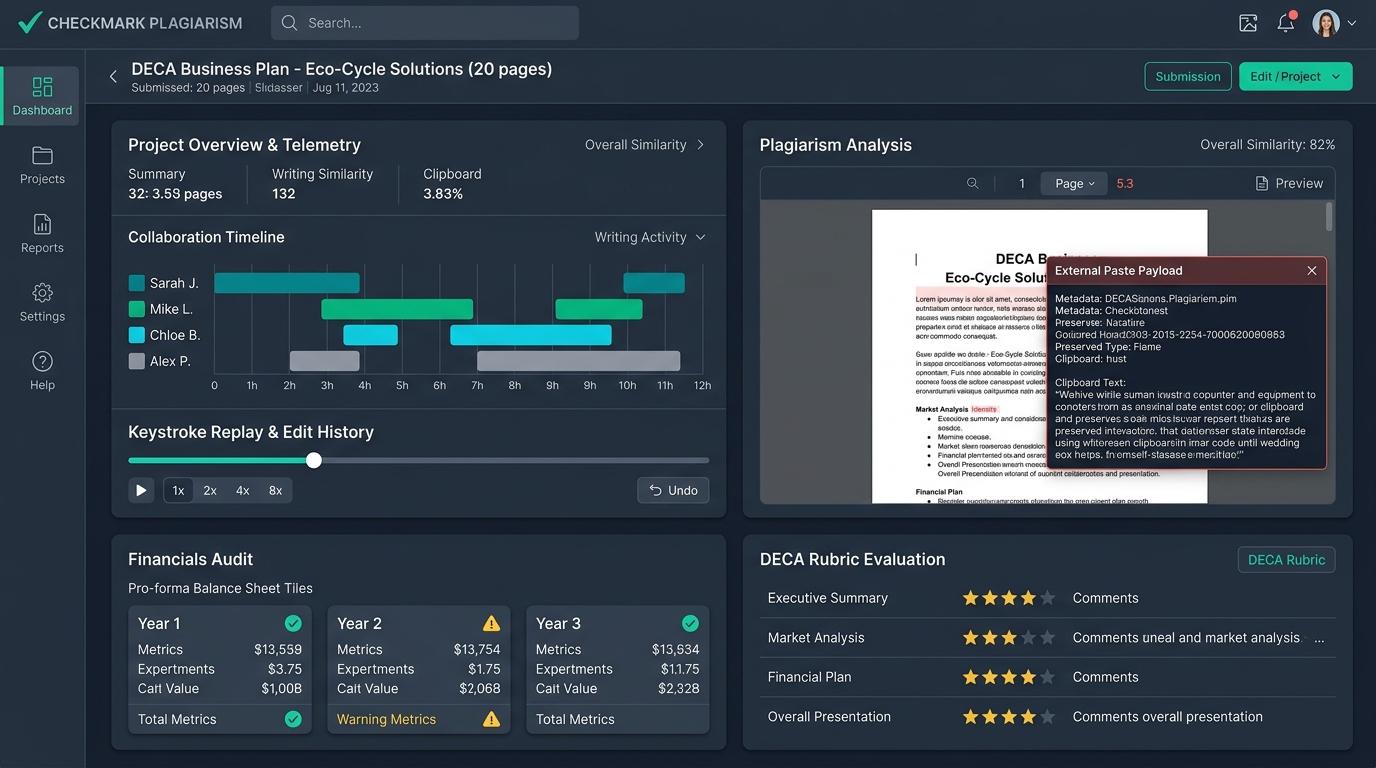
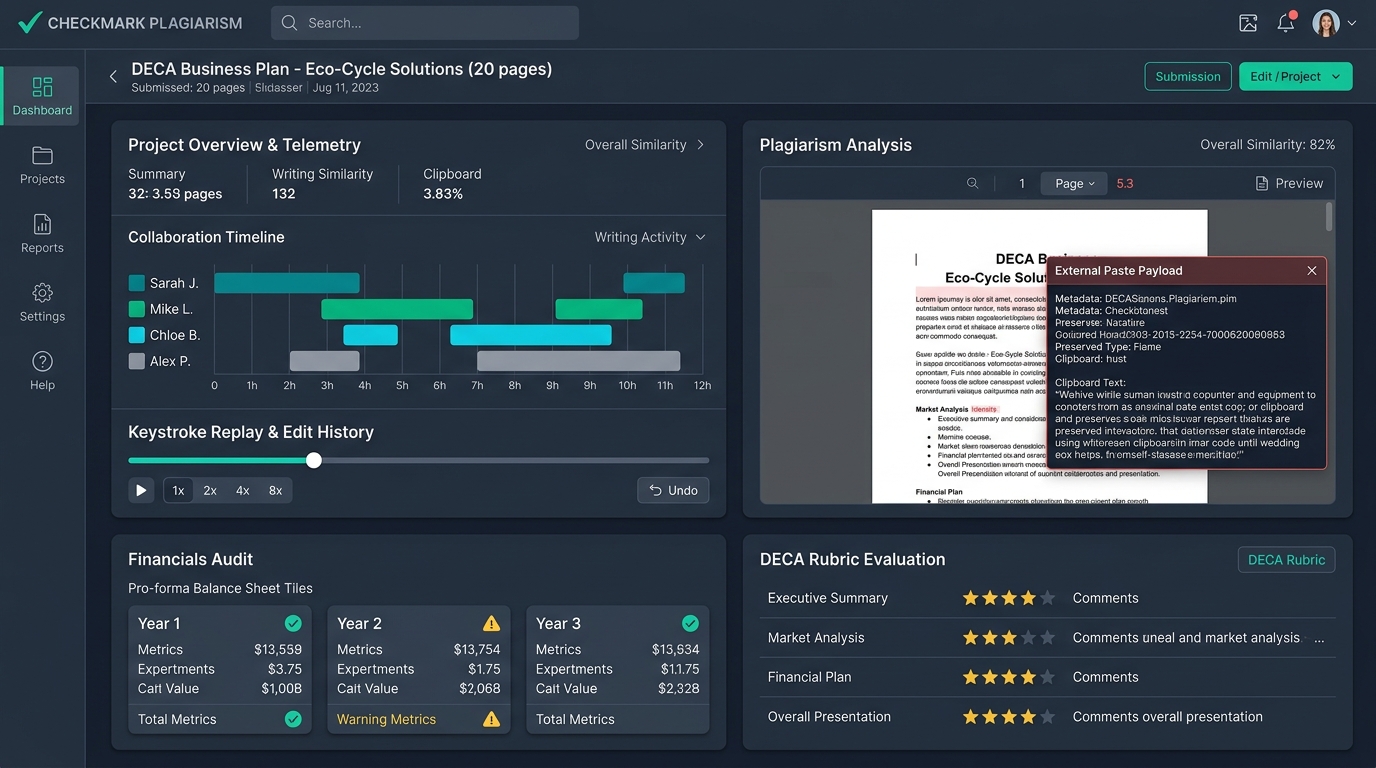
Meanwhile, generic whole-document AI text detectors create chaos by flagging legitimate marketing essays due to industry-standard vocabulary (CAC, LTV, omnichannel, conversion funnel, SWOT), while completely missing polished, AI-generated business plans. Checkmark Plagiarism resolves this dilemma by replacing black-box percentage scores with multidimensional writing telemetry: patent-pending Essay Playback™ (1x–8x keystroke replay with multi-author differentiation), external clipboard payload preservation, financial DOI concordance audits, and quote-anchored rubric autograding aligned with the official DECA Evaluation Form.
1. The Anatomy of DECA Written Events & 20-Page Business Plan Architecture
In secondary Career and Technical Education (CTE), DECA (Distributive Education Clubs of America) operates as one of the premier CTSOs, preparing over 250,000 high school students annually for careers in marketing, finance, hospitality, management, and entrepreneurship.
At the heart of the DECA competitive experience are the Comprehensive Written Events (which DECA’s current guide calls Prepared Events, with 20-page or 20-slide entries), which advance students through District, State Career Development Conferences (SCDC), and the prestigious International Career Development Conference (ICDC).
- Team Authorship: Authored collaboratively by a 1- to 3-student team over 2–5 months.
- Rigid Formatting: Strict DECA structural guidelines (required outline, sequential page numbering, and page caps).
- Core Deliverables: Primary & secondary research, 4Ps strategy, and projected financial statements.
- Technical Review: Entries are examined against DECA’s official Penalty Point Checklist.
- Penalty Points: 5 points for each page or slide over the limit and for numbering, outline, or formatting errors, and 15 points for a missing or improperly signed Statement of Assurances.
- Statement of Assurances: Mandatory signed ethics declaration certifying original student work.
- Business-Professional Judges: Live pitch to a judge who role-plays a potential source of capital, such as a bank or venture capital official (a prospective client in IMC events).
- Financial Cross-Exam: Rigorous defense of ROI, CAC/LTV assumptions, and cash flow breakeven.
- Unscripted Q&A: Probing questions testing whether students truly constructed their own models.
Major DECA Comprehensive Written Event Categories
High school business teachers manage student teams competing across several specialized written frameworks, each with strict compositional requirements:
1. Integrated Marketing Campaign (IMC)
20 SlidesEvents: IMC-Product (IMCP), IMC-Service (IMCS), IMC-Event (IMCE).
Core Elements: Campaign objectives, target market identification, marketing mix integration (4Ps), promotional media schedule, itemized campaign budget, and detailed metrics for tracking campaign effectiveness and Return on Ad Spend (ROAS).
2. Start-Up Business Plan (ESB / EIP)
20 SlidesEvents: Start-Up Business Plan (ESB), Innovation Plan (EIP).
Core Elements: Problem-solution validation, unique value proposition (UVP), regulatory and legal structure, projected financial statements, capital requirements, and break-even calculations.
3. Franchise Business Plan (EFB)
20 PagesEvents: Franchise Business Plan (EFB).
Core Elements: In-depth analysis of the franchisor’s official Franchise Disclosure Document (FDD), territorial demographics, royalty fee structures, initial franchise fee amortization, and localized local-store marketing (LSM) strategies.
4. Business Growth Plan (EBG / EIB)
20 PagesEvents: Business Growth Plan (EBG), Independent Business Plan (EIB).
Core Elements: Detailed historical financial analysis, SWOT expansion matrix, organizational restructuring, risk management protocols, and multi-channel marketing campaigns.
The Structural Architecture of a 20-Page DECA Business Plan
To understand why authorship fraud in DECA written events is both devastating and technically distinct from standard English essay plagiarism, one must analyze the modular complexity of a 20-page submission. The page ranges below are an illustrative breakdown, not DECA’s official outline, which differs by event:
| Section | Pages | Core Deliverables | CTE Analytical Competency & Common AI Hallucinations |
|---|---|---|---|
| I. Executive Summary | Pages 1–2 | Venture synthesis, mission statement, financial ask, competitive edge. | High formal density. AI Risk: Generic text detectors can trigger false-positive flags due to standard business terminology. |
| II. Business Description | Pages 3–4 | Proprietary offerings, IP, operational workflow, legal business entity (LLC, S-Corp). | Licensing & municipal compliance. AI Risk: Generates generic state statutes not applicable to the school’s actual municipality. |
| III. Target Market & Segmentation | Pages 5–7 | Demographic, Geographic, Psychographic profiling; TAM, SAM, SOM calculations. | Census Bureau & BLS concordance. AI Risk: Fabricated demographic personas and confabulated industry CAGRs. |
| IV. Marketing Mix & SWOT | Pages 8–11 | 4Ps/7Ps frameworks; Perceptual Mapping; Porter’s Five Forces; Competitor SWOT matrices. | Competitive differentiation. AI Risk: Superficial SWOT bullet points lacking pricing elasticity data or local competitor insight. |
| V. Promotional Budget & ROI | Pages 12–14 | Itemized media spend (CPC, CPM, influencer retainers); CAC, LTV, and conversion modeling. | Marketing unit economics. AI Risk: Absurd LTV/CAC ratios (e.g. 32:1) and e-commerce conversion rates of 18%+ without ad friction. |
| VI. 3-Year Pro-Forma Financials | Pages 15–18 | Monthly Year 1 Cash Flow; 3-Yr Income Statements; Balance Sheets; Break-Even Analysis. | Double-entry accounting equation. AI Risk: Assets ≠ Liabilities + Equity; omitted payroll taxes (FICA/SUTA); zero inventory holding costs. |
| VII. Milestones & Risk Mgmt | Page 19 | Gantt Chart timelines, key operational milestones, insurance coverage, supply chain contingencies. | Operational feasibility. AI Risk: Generic timelines with zero real vendor lead times or regulatory inspection milestones. |
| VIII. Appendix & Bibliography | Page 20 | Formal bibliography referencing primary interviews, surveys, and secondary databases (Statista, BLS). | DOI Concordance. AI Risk: Hallucinated URLs, non-existent report numbers, and fabricated survey sample sizes. |
2. The 20-Page Paste Dump Dilemma: What Happens When Teams Bypass the Drafting Process
For a DECA adviser managing 60 to 120 chapter members across multiple class periods and competitive flights, the arrival of completed 20-page drafts is a moment of high anticipation.
However, every experienced marketing educator has encountered the red-flag scenario: a student team submits a 6,500-word, 20-page document into Google Classroom or Canvas where the entire text was created in a 4-minute span via a single massive copy-paste action.
Authentic CTE Business Drafting
- Multi-Week Iteration: Continuous character-by-character composing across 15–30 distinct working sessions.
- Multi-Author Collaboration: Partner A writes market research, Partner B constructs spreadsheets, Partner C drafts marketing mix.
- Spreadsheet Pauses: Observable 15–45 minute pauses while students reconcile pro-forma cash flows in Google Sheets.
- Organic Revision Ratios: 18%–28% backspace and editing frequency as students adjust pricing and promotional math.
- Defensible Oral Mastery: Students confidently explain every cost line-item during judge cross-examination.
Synthetic AI Shortcut / Paste Dump
- Instantaneous Ingestion: 6,500 words injected in under 4 minutes via 1–3 massive clipboard paste operations.
- Zero Revision Telemetry: No character deletions, no structural restructuring, and zero drafting struggle recorded.
- Hallucinated Financials: Balance sheets that violate the basic accounting identity (Assets ≠ Liabilities + Equity).
- Generic Personas: Confabulated demographic caricatures with zero local census validation.
- Oral Defense Collapse: Team members freeze when asked to explain their own unit economics before judges.
The Universal Defense: “We Drafted Offline”
“We didn’t want our document to get messy, so we did all our research and typing in Microsoft Word / Apple Pages / Notion / Discord on our personal laptops at home over the weekend, and then we just copied and pasted the final draft into the school Google Doc right before the submission deadline.”
In a traditional LMS environment without forensic writing telemetry, this explanation leaves the teacher in an impossible pedagogical position. Without objective data to disprove the “offline drafting” claim, the adviser must either accept a highly suspicious submission or make an unprovable accusation that damages student rapport and sparks parental outrage.
The Anatomy of Synthetic, Hallucinated Business Plans
When Large Language Models (such as ChatGPT, Claude, or Gemini) are prompted to generate full DECA business plans, they produce documents that look impeccably professional at a glance but collapse under detailed commercial scrutiny:
Synthetic Marketing Personas & Caricatures
Generative AI excels at generating superficial demographic fluff. Instead of real customer segmentation derived from local survey data or municipal census tables, AI creates generic caricatures (e.g., “Eco-Conscious Emma: Age 24, drives a hybrid, drinks matcha, spends $45 weekly on sustainable athleisure”). These personas lack psychographic nuance, geographic boundary grounding, or realistic purchasing power friction.
Hallucinated Market Growth CAGRs
When prompted for industry trends, LLMs confabulate compound annual growth rates with hyper-specific decimals to appear authoritative. An AI-generated plan for a localized mobile car-detailing service might claim: “The North American artisanal auto care sector is projected to expand at an astonishing CAGR of 48.7% between 2026 and 2031, reaching $14.8 billion (Statista, 2025).” When checked, neither the 48.7% CAGR nor the report exists.
Broken Pro-Forma Balance Sheets
Generative AI models are linguistic prediction engines, not accounting engines. When asked to construct multi-year financial tables, LLMs generate grids of numbers that mimic the visual appearance of balance sheets but violate the fundamental accounting equation: Assets ≠ Liabilities + Owner’s Equity.
Recycled Past ICDC Entries & FDD Scrapes
Students take past international winning projects acquired from alumni or online repositories, use AI to re-skin the brand name (e.g. converting a 2022 tutoring app plan into a 2026 test-prep platform), and paste the modified text into their submission without conducting original market analysis.
3. The CTSO Competition Ethics & Academic Integrity Crisis
The stakes in high school DECA and CTSO written competitions are immense. Qualifying for ICDC can unlock thousands of dollars in collegiate scholarships, serve as the centerpiece of an Ivy League or top-tier business school application, and bring regional prestige to a high school’s CTE program.
The DECA Statement of Assurances & Academic Integrity Mandate
By signing DECA’s official Prepared Event Statement of Assurances and Academic Integrity, the student competitor(s) and the DECA chapter adviser certify, among other things, that:
- The contents of the entry are the work of the listed student authors, who are current members of the chapter.
- No part of the entry has previously been entered in competition, and it has not been submitted in another DECA event.
- Credit for all secondary research has been given to the original author through the bibliography, footnotes or endnotes.
Why Generic AI Percentage Detectors Fail CTE Educators
When faced with suspect business plans, many high school business teachers turn to generic, whole-document AI percentage detectors (such as Turnitin’s AI score or GPTZero). However, in CTE marketing and business classrooms, these tools fail completely for two opposite reasons:
The False Alarm Trap on CTE Business Terminology
Generic AI detectors evaluate perplexity (word unpredictability) and burstiness (sentence variation). In business writing, communication must be structured, concise, and loaded with standardized terms (omnichannel acquisition, Customer Lifetime Value, break-even threshold, SWOT). Generic detectors can flag honest student business plans with high AI scores simply because standard business nomenclature is low-perplexity text.
The Paraphrase / Humanizer Scrambler Blindspot
Dishonest students prompt an LLM for a 20-page business plan and pass the text through scramblers (QuillBot, BypassGPT, Undetectable AI) to introduce artificial synonym swaps (“omnichannel” becomes “multi-track client pathway”). Generic detectors see the inflated perplexity and can return 0% AI, allowing completely synthetic business plans to slip through undetected.
4. The High School CTE Evidentiary Matrix
To evaluate student business plans fairly, CTE educators need a clear framework comparing the evidentiary strength of different assessment methods:
| Evidentiary Dimension | Traditional Printed Binder / PDF | Generic AI Text Detectors | Google Docs Version History | Checkmark Process Telemetry & Essay Playback™ |
|---|---|---|---|---|
| Granularity of Evidence | None (Static final text only). | Single black-box percentage score (e.g. 78% AI). | Coarse, periodic snapshots; can miss rapid pasting. | Sub-second keystroke replay with 1x–8x playback scrubbing. |
| Handling “Drafted Offline” Claims | Cannot verify or refute claims. | Completely blind to offline vs online drafting. | Shows large unexplained text additions without origin proof. | Preserves 100% of clipboard paste payloads, timestamps, and formatting artifacts. |
| Multi-Author Collaboration Tracking | Cannot determine individual contributions. | Treats multi-author docs as a single text block. | Blends multi-user edits into coarse color highlights. | Individual author keystroke color-coding, active editing time per user, and typing speed. |
| CTE / Business Vocabulary Handling | Subjective teacher review. | High false-positive rate on standard CTE/business terms. | Neutral. | Passage-level calibrated sliders distinguish CTE terms from synthetic structures. |
| Financial & Research DOI Audit | Manual calculation check required by teacher. | Cannot detect mathematical hallucinations or broken sheets. | Cannot track spreadsheet formula construction. | Flags calculation pauses, DOI link anomalies, and math-to-text dissonance. |
| Restorative Conference Defensibility | Subjective teacher opinion vs student assertion. | Highly adversarial; parents challenge black-box scores. | Ambiguous; students claim Docs failed to save revisions. | Unassailable video-like replay of the document being constructed character-by-character. |
| LMS & Rubric Workflow | Manual pen-and-paper rubric scoring. | Standalone report disconnected from CTE standards. | Manual comment bubbles in Google Docs. | Quote-anchored rubric autograding synced directly with Canvas, Google Classroom, and Buzz LMS. |
5. Step-by-Step DECA Adviser Audit Protocol
When a DECA adviser or high school marketing teacher receives a 20-page business plan or 20-slide pitch deck with questionable revision history, they should follow this standardized, multi-phase evidentiary audit protocol:
Step 1: Financial Balance & Market Research DOI Concordance Audit
Check Year 1, 2, and 3 Balance Sheets. Verify that Total Assets = Total Liabilities + Total Owner’s Equity. Confirm that Retained Earnings on the Balance Sheet precisely matches cumulative Net Income from the Income Statement.
Check 3–5 statistical citations from Section III and the Bibliography. Does the cited U.S. Census Bureau QuickFacts table actually list that median income? Does the Statista report ID resolve to a live, matching report?
Step 2: Stakeholder ROI & Unit Economics Sanity Checks
Audit Section V (Promotional Budget) for realistic commercial friction. Calculate implied conversion metrics:
Step 3: Multi-Author Keystroke Drafting Dynamics with Essay Playback™
Launch Checkmark Essay Playback™ to examine the temporal composition history across all student authors:
Verify concurrent editing sessions where Partner A drafts Target Market while Partner B models financials in parallel.
Look for 15–45 minute inactive intervals in Docs corresponding to active Google Sheets modeling before figures are entered.
Confirm natural typing velocity (35–65 WPM) and realistic 15%–28% backspace/edit ratios on marketing strategies.
Step 4: Inspecting External Paste Buffer Payloads
If Essay Playback reveals large pasted sections, click Checkmark’s External Paste Buffer Inspector to examine the exact raw clipboard contents captured at the instant of insertion:
Step 5: Supportive Restorative Pitch Rehearsals at the Chapter Conference Table
Sit the team down without laptops. Ask each partner to explain their specific calculations and strategic rationales.
Project Checkmark’s timeline on screen neutrally: “Our telemetry shows an external paste payload. We cannot certify this draft as is.”
Grant a 72-hour window for students to conduct real secondary research and construct their pro-forma financials in Google Sheets from scratch.
6. How Checkmark Plagiarism Empowers High School CTE Educators & DECA Advisers
Checkmark Plagiarism is engineered specifically to address the complex realities of modern business, marketing, and CTSO education:
Reconstructs the entire drafting process of multi-page business plans, visualizing multi-author contributions, drafting pauses, and typing velocity character-by-character.
Captures and archives 100% of clipboard text pasted into Google Docs or Word, preserving original prompt headers or scraped text even if the student rewrites it.
Replaces whole-document percentages with paragraph-level analysis calibrated to ignore standard CTE business jargon (CAC, LTV, SWOT), eliminating false alarms.
Automatically evaluates business plans against the official DECA Written Entry Evaluation Form, generating quote-anchored scoring cards tied directly to student text.
Provides distinct, color-coded telemetry per student author, tracking individual drafting time, word counts, and revision metrics to resolve group free-rider issues.
Student proprietary business concepts and school data are NEVER used to train commercial AI models. Fully compliant with K-12 data privacy standards.
7. Illustrative High School CTE Case Scenarios
The scenarios below are illustrative composites written to show how the audit works. They do not describe specific students, schools, or competition results.
Case Scenario 1: 11th Grade DECA Integrated Marketing Campaign (IMC-Product) — The Local Eco-Apparel Brand
Pasted AI Prompt CaughtAssignment: A written Integrated Marketing Campaign plan for a local sustainable clothing brand, prepared for the DECA IMC-Product event.
- The Incident: Two juniors submitted a written plan citing a fabricated 2025 Eco-Apparel National Survey with a 61.4% Gen Z adoption rate. The team claimed they drafted offline in Apple Pages.
- The Telemetry Audit: Checkmark Essay Playback™ revealed 3 minutes and 18 seconds of total active editing time and a single paste event of 3,840 words. Checkmark’s Paste Buffer Inspector preserved the student’s raw clipboard payload: “Act as an expert DECA coach. Write an Integrated Marketing Campaign for an eco-apparel brand following the official DECA rubric...”
- The Restorative Resolution: Confronted with undeniable objective proof, the students admitted they panicked before the deadline. The adviser assigned them to interview the owner of a local boutique, collect real survey data (n = 45), and re-draft in Google Docs. The revised plan qualified for the State Conference.
Case Scenario 2: 12th Grade DECA Independent Business Plan (EIB) — False AI Flag Exoneration on Boutique Fitness Venture
False AI Alarm OverturnedAssignment: A 20-page comprehensive Independent Business Plan for a youth performance athletic training facility.
- The Incident: An ambitious senior submitted a 20-page business plan. A generic commercial AI detector flagged the submission as 88% AI-Generated due to high-density terminology. The student was facing disqualification and a zero.
- The Telemetry Audit: The adviser used Checkmark Essay Playback™ to audit the complete writing history: 34 hours and 12 minutes logged across 18 working sessions, a 21.4% revision/backspace ratio, and a 52-minute pause where the student built an extensive pricing model in Google Sheets before entering the numbers.
- The Restorative Resolution: The adviser immediately exonerated the student, signed the DECA Statement of Assurances, and shared the telemetry report with the principal. The student placed 2nd at the State Conference and advanced to ICDC.
Case Scenario 3: DECA Franchise Business Plan (EFB) — Split Authorship in a 3-Student Team
Multi-Author Telemetry AuditAssignment: A 20-page Franchise Business Plan for a quick-service restaurant (QSR) franchise.
- The Incident: In practice pitch rehearsals, Partner A and Partner B fluently defended lease terms and pro-forma cash flows, while Partner C could not explain the target market segmentation or competitor SWOT matrix.
- The Telemetry Audit: Checkmark’s Multi-Author Telemetry revealed Partner A authored 3,100 words across 14 hours (Blue Telemetry), Partner B authored 2,400 words across 11 hours (Green Telemetry), and Partner C logged 4 minutes of document time consisting of two raw clipboard pastes totaling 1,900 words from an AI tool (Orange Telemetry).
- The Restorative Resolution: Checkmark’s telemetry protected Partner A and Partner B from unfair penalties. Partner C was required to delete the pasted sections, review the actual franchisor FDD, and independently write the SWOT and marketing mix under supervision.
8. Frequently Asked Questions (FAQs for DECA Advisers & CTE Leaders)
FAQ 1: How should a DECA adviser respond when a team claims they drafted their 20-page plan offline in Microsoft Word or Notion?
Advisers should establish a clear “Process Transparency Policy” at the start of the competitive season: all official DECA written drafts must be authored natively within the school-managed Google Workspace, Canvas, or Word 365 environment where writing telemetry is active. If a team submits an unverified paste dump claiming offline composition, the adviser examines the clipboard payload using Checkmark’s External Paste Inspector. If the payload contains AI markers or markdown headers, the claim is disproven. If the payload appears to be authentic text, the adviser conducts an oral pitch defense to verify that the students understand and can justify every section of the plan.
FAQ 2: Why do generic AI detectors flag legitimate DECA executive summaries with high AI scores?
Executive summaries are designed to be high-density, formal syntheses of business objectives, financial targets, and market opportunities. They utilize concise, conventional phrasing (e.g. “The venture seeks $50,000 in initial seed capital to achieve a 22% IRR over a 3-year investment horizon”). Because generic AI detectors rely on statistical word predictability (perplexity), these standard business formulations can trigger false-positive alarms. Checkmark solves this by utilizing passage-level calibrated sliders and Essay Playback™, allowing teachers to confirm authentic keystroke drafting rather than penalizing students for writing professional business prose.
FAQ 3: What is the most common financial error generative AI makes in student business plans?
The most prevalent and unmistakable error is balance sheet inequality, where Total Assets ≠ Total Liabilities + Owner’s Equity. Large Language Models generate financial figures based on token probability rather than mathematical double-entry accounting. Other frequent AI financial hallucinations include omitting statutory employer payroll taxes (FICA/SUTA/FUTA), projecting impossible 90%+ gross margins for physical retail ventures, and ignoring inventory carrying costs in cash flow schedules.
FAQ 4: How does Essay Playback differentiate between authentic collaborative teamwork and one student carrying the entire project?
Checkmark’s Essay Playback™ assigns distinct, color-coded keystroke tracking to each registered student author on a shared document. Advisers can view an aggregated dashboard displaying: (1) Total active drafting time per student, (2) Character and word counts contributed natively by each team member, (3) Keystroke typing velocity and revision/deletion ratios per user, and (4) Specific sections authored by each individual. This eliminates “free-rider” disputes and ensures all team members contribute before the adviser certifies the team for competition.
FAQ 5: What does DECA say about academic integrity, plagiarism, and AI in written entries?
DECA requires every prepared entry to include a signed Statement of Assurances and Academic Integrity. In its December 2023 guidance on AI in competitive events, DECA stated that written entries at the International Career Development Conference would be validated with iThenticate for plagiarism and for AI use that violates the statement, and that violating the statement of assurances would lead to disqualification. A percentage score alone is a thin basis for a formal appeal, so advisers who want to document authorship before submission can use Checkmark’s timestamped keystroke playback, exact clipboard paste payloads, and side-by-side plagiarism source matching.
FAQ 6: How does Checkmark's quote-anchored rubric autograder align with official DECA Written Entry Evaluation Forms?
Checkmark allows CTE educators to select official DECA evaluation rubrics directly within the platform. The AI autograder evaluates the student business plan against DECA’s scoring levels (Novice, Developing, Proficient, and Exemplary) for each section of the evaluation form (for example, market, competition, marketing plan, and financial plan). Crucially, the autograder generates quote-anchored feedback cards linking its evaluation directly to specific sentences and tables in the student draft, giving teachers a comprehensive grading draft while maintaining teacher-in-the-loop final authority.
FAQ 7: Can high school business students use AI ethically in DECA written events without violating CTSO policies?
Yes, provided it aligns with the local chapter’s AI policy and DECA guidelines. DECA’s published AI guidance permits AI for brainstorming, improving grammar, and understanding text, and requires students to identify any AI use in their work. Ethical AI use includes brainstorming potential customer segments, proofreading student-written drafts for clarity, and asking AI to explain financial formulas (such as weighted average cost of capital or break-even thresholds). However, having an AI generate actual business plan prose, fabricate survey statistics, or construct financial tables represents authorship fraud and violates the DECA Statement of Assurances.
FAQ 8: How can high school CTE department chairs implement Checkmark across marketing, finance, and entrepreneurship courses?
CTE department chairs can deploy Checkmark district-wide across Google Docs, Canvas LMS, Schoology, and Buzz LMS via standard LTI 1.3 integration. Checkmark operates seamlessly in the background of 1:1 Chromebook and laptop environments, requiring zero software installation for students while giving all CTE teachers immediate access to writing telemetry, plagiarism matching, and rubric autograding.
9. Conclusion: Stop Guessing, Start Trusting in High School CTE Writing
Career and Technical Education empowers the next generation of entrepreneurs, marketers, and executive leaders. In high-stakes CTSO competitions like DECA, maintaining uncompromising academic integrity is essential not only for fair competition, but for ensuring that students develop real-world analytical, financial, and strategic competencies.
When a student team submits a 20-page business plan, educators should never be forced to choose between blind trust and hostile accusations. By adopting Checkmark Plagiarism, CTE teachers and DECA advisers gain the objective writing telemetry, keystroke replay, and paste payload preservation necessary to protect honest student scholars, guide restorative learning, and uphold the highest standards of competitive excellence.
Elevate Academic Integrity Across Your CTE & DECA Programs
Equip your marketing teachers, CTE department chairs, and CTSO chapter advisers with patent-pending Essay Playback™, paste buffer forensics, and DECA-aligned rubric autograding.