
Dual Enrollment (DE) and Concurrent Enrollment (CE) partnerships now account for over 20% of all First-Year Composition (FYC / ENGL 101/102) credit conferred across American higher education. However, as generative AI adoption surges, postsecondary English departments, college articulation officers, and regional accrediting bodies (Higher Learning Commission [HLC], SACSCOC, WASC/WSCUC, NECHE, MSCHE, and NWCCU) are challenging the authenticity of off-campus high school writing portfolios. When dual-credit students submit static PDF or Word files, traditional “black-box” AI detectors fail catastrophically—generating high false-positive rates on structured adolescent academic prose while remaining blind to AI humanizers and outsourced ghostwriting.
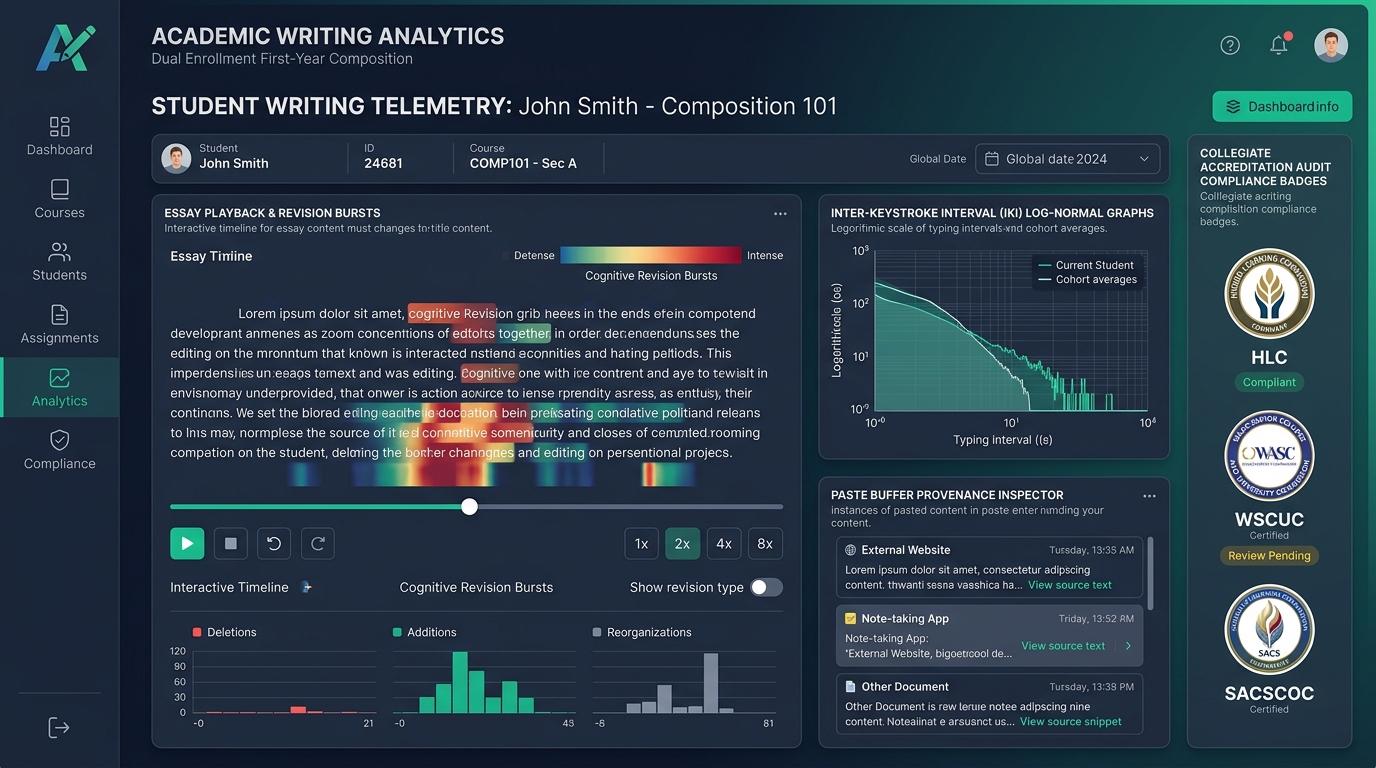
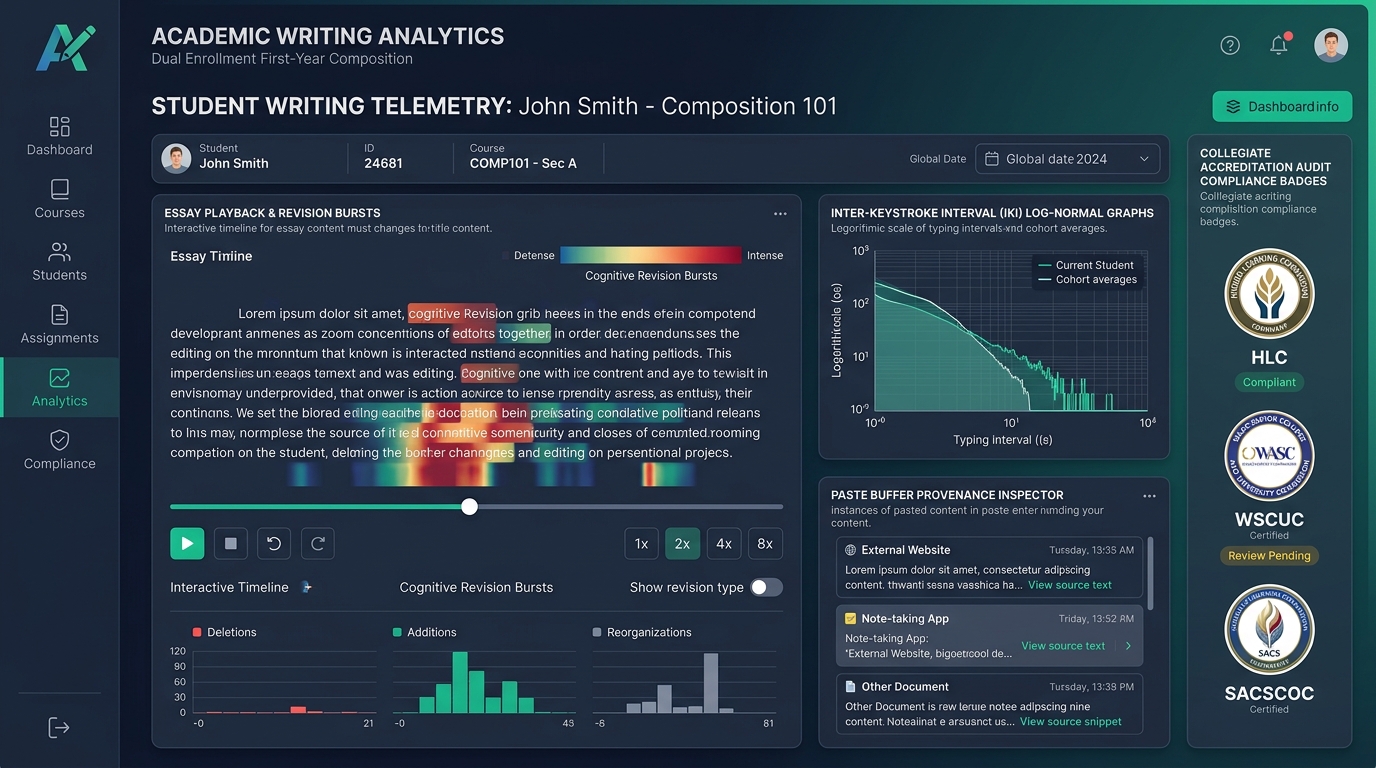
Checkmark Plagiarism resolves this institutional standoff through Writing Process Telemetry and patent-pending Essay Playback™. By capturing objective, longitudinal keystroke dynamics—including temporal drafting volume, non-linear cognitive revision bursts, Inter-Keystroke Interval (IKI) variance, and raw external paste buffers—Checkmark provides unassailable, audit-ready evidentiary dossiers (“receipts”). This non-punitive, multi-dimensional framework allows high school teachers and college department chairs to replace probabilistic suspicion with empirical trust, safeguarding collegiate rigor and ensuring seamless credit transferability for honest student writers.
Checkmark Plagiarism safeguards dual-enrollment writing programs by integrating writing process replay with sentence-level AI detection, side-by-side plagiarism proof, teacher-controlled AI autograding, and seamless LMS grade passback across Canvas LMS, Agilix Buzz LMS, and Google Classroom.
1. The Dual Enrollment Dilemma: Accreditation Rigor vs. Asynchronous Distance
Dual Enrollment and Concurrent Enrollment programs represent one of the most effective equity engines in modern education. By allowing high school juniors and seniors to earn credit-bearing college hours in foundational general education courses—most notably First-Year Composition (FYC / ENGL 101/102)—students save thousands of dollars in collegiate tuition and significantly accelerate their path to postsecondary degree completion.
Yet beneath this remarkable expansion lies a severe institutional and pedagogical crisis: the breakdown of independent authorship verification across institutional boundaries.
High School Drafting Environment
- Setting: Asynchronous home study & 1:1 school Chromebooks
- Instruction: High school dual-credit adjunct faculty
- LMS: Google Classroom / Buzz / High School Canvas
- Philosophy: Formative coaching, growth, and draft scaffolding
Articulation & Accreditation Body
- Accreditors: HLC (Crit. 3.A/4.A), SACSCOC (10.7), WASC, MSCHE
- Oversight: College English Department Chair & Articulation Dean
- Receiving End: Flagship 4-Year Research Universities
- Mandate: Demonstrable, equivalent rigor to on-campus FYC
Final submission is a flat PDF/Word file • 100% of drafting context is erased • Zero revision history transmitted • Opaque black-box AI detectors flag 76% AI • Transfer credits blocked
1.1 The Accreditation Mandate: Demonstrating Equivalent Rigor Under HLC, SACSCOC, and WASC
Regional accrediting bodies establish strict mandates governing dual and concurrent enrollment programs. Under guidelines established by the Higher Learning Commission (Criterion 3.A & 4.A), the Southern Association of Colleges and Schools Commission on Colleges (SACSCOC Standard 10.7), and the WASC Senior College and University Commission (WSCUC), postsecondary institutions must guarantee that off-campus and dual-credit offerings maintain identical learning outcomes, academic standards, and grading rigor as on-campus sections taught by full-time university faculty.
In First-Year Composition, this standard centers on the writing portfolio—a cumulative collection of multi-draft argumentative research papers, rhetorical analyses, and synthesis essays. College English Department Chairs are legally and administratively responsible for certifying that every portfolio submitted for college credit represents the independent, unassisted intellectual labor of the enrolled student.
When dual enrollment courses are delivered asynchronously or within distant high school classrooms, college administrators have historically relied on final paper submissions. In the era of Large Language Models (LLMs), however, receiving 4-year institutions and university curriculum committees increasingly view unverified off-campus portfolios with intense skepticism. If a university cannot verify that a student independently conducted the synthesis, drafted the prose, and executed substantive revisions, the institution faces accreditation sanctions or risks losing state transfer articulation agreements.
1.2 The Vulnerability of Transfer Credit Articulation
The core promise of dual enrollment is transferability. When a high school senior earns an “A” in a concurrent ENGL 101 course sponsored by a local community college, they expect that credit to transfer seamlessly to flagship state universities or private 4-year institutions.
However, higher education articulation officers are establishing stricter portfolio audit thresholds:
- Portfolio Audits on Transfer Admission: An increasing number of receiving universities require transferring high school students to submit their complete FYC portfolios for departmental review before granting general education English equivalency.
- Post-Submission AI Screening: When receiving departments run incoming portfolios through standalone AI detectors, the presence of an arbitrary probabilistic flag (e.g., “68% Probability of AI Generation”) frequently triggers an immediate denial of transfer credit, forcing the student to retake First-Year Composition at full university tuition.
- The Absence of Defense Records: When students appeal these transfer rejections, neither the high school nor the sponsoring community college possesses an empirical audit trail to substantiate how the student created the text over time.
1.3 The Asynchronous High School Environment
Dual enrollment writing occurs in a fundamentally fragmented technological landscape:
- 1:1 School Laptops vs. Home Devices: Students alternate between school-issued Chromebooks, home desktop computers, and mobile tablets.
- Offline Drafting & Patchwork Workflows: Students compose fragments during study halls, download notes in library computer labs, and assemble research papers across irregular schedules.
- LMS Disconnects: Drafts are often shared via Google Classroom or school-district portals that do not federate telemetry back into the collegiate learning management system (such as Canvas, Blackboard, or Brightspace).
When an essay is downloaded as a static .docx or exported as a .pdf for final portfolio submission, 100% of the cognitive drafting context is erased. The final document contains words on a page, but zero forensic metadata documenting the hours of research, struggling pauses, false starts, structural overhauls, and intellectual effort that produced those words.
1.4 Why Monolithic “Black-Box” AI Detectors Break Down on Emerging Writers
When educators attempt to solve this verification challenge using generic, standalone AI detection tools, the problems multiply. Monolithic detectors evaluate a static snapshot of text using probabilistic metrics (perplexity and burstiness). This methodology introduces severe, well-documented failure modes:
False Positives on Transitional Academic Writing
Adolescent writers learning collegiate rhetoric adhere strictly to structured templates (e.g., standard five-paragraph essay structure, formulaic transitions like “Furthermore” and “In summary,” balanced sentence lengths). Monolithic classifiers mistake this low burstiness for large language model generation.
Disproportionate Impact on ELL & Neurodivergent Writers
Multilingual learners and neurodivergent students (e.g., autistic or ADHD writers) frequently use uniform vocabulary and repetitive syntactic rhythms, causing generic algorithms to output catastrophically elevated AI scores on 100% authentic, independently composed student drafts.
Complete Inability to Detect “Humanized” Text
Conversely, a student who copies an entire paper from an LLM and runs it through an online “AI humanizer” or paraphraser (e.g., QuillBot, Undetectable AI) successfully bypasses traditional detectors, returning a clean “0% AI” score despite zero independent drafting effort.
Zero Primary Evidence (“The Black Box Problem”)
A score of “82% AI” provides no actionable forensic details. It cannot identify which sections were drafted organically, which were pasted from cited academic databases, or how many sessions the student invested in drafting.
To establish legitimate, defensible, and audit-proof verification for college composition portfolios, institutions must shift away from probabilistic text scoring and adopt deterministic writing telemetry.
2. What Is Writing Telemetry? The Shift from Static Output to Behavioral Provenance
Writing Telemetry is the continuous, privacy-preserving behavioral measurement of the drafting process captured at the native input layer (keystrokes, timing intervals, backspaces, cursor navigations, and clipboard events).
Rather than inspecting the static linguistic features of a completed essay after submission, writing telemetry records how the text was generated across time.
- Total Words: 2,145 words
- Timestamp: Single upload timestamp (Aug 18, 11:42 PM)
- AI Score: 78% (Opaque probabilistic guess)
- Plagiarism Match: 12% (Generic similarity scan)
- Drafting Provenance: NONE (Completely erased)
- Keystroke History: NONE
- Paste Provenance: UNKNOWN
- Composing Sessions: 8 distinct calendar sessions
- Active Writing Time: 9 hours 14 minutes
- Gross Keystrokes Logged: 16,420 discrete events
- Global Revision Bursts: 14 structural macro-revisions
- IKI Variance (Log-Normal): 1.42 (Healthy human cognitive distribution)
- Paste Buffers Captured: 6 cited quotes preserved in raw buffer
- Patent-Pending Replay: Essay Playback™ (1x to 8x)
Writing telemetry rests on a foundational cognitive reality: authentic human writing is a complex, recursive, non-linear cognitive process characterized by distinct temporal and mechanical signatures. When a student conducts genuine academic inquiry, their typing behavior leaves an indelible biometric and behavioral fingerprint that generative AI, automated paraphrasers, and copy-paste plagiarism cannot replicate.
3. The Four Telemetry Signatures of Authentic Collegiate Composition
In First-Year Composition portfolios, independent authorship is substantiated by four distinct telemetry signatures. When combined within an integrated multi-evidence dossier, these four dimensions provide mathematical and behavioral proof of original authorship.
Temporal Drafting Session Volume
- Multi-Session Spacing: Work distributed across 3 to 8+ calendar days.
- Active vs. Idle Duration: Distinguishes typing/editing from background tabs.
- Circadian Alignment: Human sleep and work schedules verified.
Non-Linear Cognitive Revision Bursts
- Macro-Structural Cuts: Sentence and paragraph-level reorganizations.
- Thesis Sentence Rewriting: Recursive adjustments based on evidence.
- Deletion Volume Ratio: 15%–35% character deletions vs. raw insertions.
Inter-Keystroke Interval (IKI) Variance
- Log-Normal Distribution: High variance in typing intervals (100ms–30s).
- Cognitive Ideation Pauses: Stalls occurring before complex synthesis claims.
- Transcription Detection: Metronomic pacing flags second-screen copying.
External Paste Buffer Audit Trail
- 100% Raw Text Capture: Stores clipboard string at the millisecond of paste.
- Jump-to-Playback Integration: 1-click timeline review of surrounding drafting.
- Source Attribution Verification: Verifies cited academic quotes vs. LLM dumps.
3.1 Signature 1: Temporal Drafting Session Volume & Longitudinal Spacing
Authentic collegiate writing does not materialize instantaneously. First-Year Composition essays (typically 1,500 to 3,000 words) require extensive cognitive labor distributed across multiple working sessions.
Telemetry systems like Checkmark distinguish between active composing time (active keystroke entry, cursor manipulation, and active editing) and idle document time (when a tab is left open in the background while the student is away). For a 2,000-word collegiate research essay, authentic independent composition typically reflects between 4 to 12 aggregate hours of active composing telemetry.
3.2 Signature 2: Non-Linear Cognitive Revision Bursts & Macro-Structural Reorganizations
The landmark writing research of Sondra Perl, Nancy Sommers, and Linda Flower established that experienced and emerging collegiate writers do not produce text linearly from the first word to the last. Authentic writing is intrinsically recursive.
[Paragraph 1] → [Paragraph 2] → [Paragraph 3] → [Paragraph 4] → [Done]
(Zero backward navigation, zero macro-structural cuts, zero thesis rewrites)
[Intro Drafted] → [Body 1 Drafted] → ↺ Jumps back to Intro to alter Thesis Statement
• [Body 2 & 3 Drafted] → ✂ Deletes 180 words in Body 1 (Replaces with new evidence)
• [Counterargument Added] → ⇄ Reorders Paragraph 2 and Paragraph 4
• [Conclusion Drafted] → ↺ Fine-tunes Topic Sentences across all sections
Telemetry monitors and visualizes these macro-structural revision bursts:
- Global vs. Surface Revisions: Surface revisions consist merely of spelling corrections or single-word synonym replacements. Macro-revisions involve deleting whole sentences, rewriting topic sentences, reorganizing paragraph sequences, and reframing argumentative premises based on new evidence.
- Deletions and Substitution Volume: Authentic First-Year Composition drafting exhibits a healthy ratio of deletions to gross character insertions (typically 15% to 35% deletion volume). A document where 10,000 characters were typed with only 50 characters deleted suggests either mechanical transcription from another screen or uncritical generation.
- Cursor Navigation Telemetry: Telemetry logs backward scrolling, text highlighting, and cursor repositioning, proving that the student actively re-read previous paragraphs to ensure cohesive argumentation.
3.3 Signature 3: Inter-Keystroke Interval (IKI) Variance & Burstiness Dynamics
At the physiological and cognitive level, typing speed is governed by Inter-Keystroke Intervals (IKIs)—the elapsed time in milliseconds between consecutive keystrokes.
- Micro-IKIs (100–280ms) for familiar character digraphs
- Word-boundary pauses (300–800ms) for lexical selection
- Sentence-level ideation pauses (2,000–30,000ms) for planning
- Log-normal statistical distribution with healthy variance
- Metronomic, flat pacing (280–350ms across whole paragraphs)
- Absence of synthesis pauses before complex arguments
- Flat statistical variance indicating student is transcribing from phone or second monitor without active thought
Telemetry algorithms analyze the statistical distribution of IKIs:
- Cognitive Processing Pauses: When human writers transition between complex ideas, synthesize opposing arguments, or formulate precise phrasing, their keystroke stream displays prominent pauses ranging from 2 seconds to over 30 seconds.
- Lexical Burstiness: Within familiar words and common morpho-syntactic structures (e.g., typing
tion,ing,the), human typing accelerates into micro-bursts (90ms–220ms). - Transcription Detection: If a student attempts to evade detection by placing a smartphone next to their keyboard and manually typing out text generated by ChatGPT, the telemetry captures an unnatural, metronomic cadence. The absence of cognitive pauses at paragraph boundaries paired with uniform keystroke velocity immediately flags mechanical transcription.
3.4 Signature 4: External Clipboard & Paste Buffer Audit Trail
In academic research writing, pasting is not only normal—it is an essential scholarly behavior. Students frequently paste research quotations from academic databases (e.g., JSTOR, EBSCOhost, PubMed), prompt questions from assignment sheets, or bibliographic citations from library catalogs.
However, traditional plagiarism scanners treat all pasted blocks with suspicion, while crude detectors fail to differentiate between a pasted primary source quote and a pasted paragraph from an LLM.
“According to the 2024 National Assessment of Educational Progress, dual-enrollment students exhibited a 14% higher four-year college completion rate compared to non-participating peers.”
- [10:14:35 PM] Adds quotation marks around the pasted excerpt.
- [10:15:10 PM] Adds lead-in signal phrase: “As researcher Elena Vance highlights in her study,”
- [10:16:05 PM] Appends MLA in-text citation:
(Vance 42). - [10:17:30 PM] Composes 3 original analytical sentences unpacking the statistical implications.
Checkmark’s Paste Provenance Inspector captures:
- Timestamped Clipboard Content: Stores the exact raw text copied into the clipboard at the millisecond of the paste event.
- Permanent Text Preservation: Preserves the original pasted string even if the student subsequently rewrites, edits, or deletes every individual word.
- One-Click Jump-to-Playback: Enables faculty and articulation officers to click a single button on any paste event to immediately view the surrounding drafting playback, verifying whether the student properly integrated and analyzed the source material.
4. The Evidentiary Matrix: Comparing FYC Portfolio Verification Models
To evaluate how writing telemetry fundamentally outperforms legacy verification methods, college English department chairs and dual enrollment coordinators can consult the following comparative evidentiary matrix:
| Verification Dimension | Static PDF / Flat File | Standalone AI Detector (e.g. 78% AI) | Checkmark Essay Playback™ Writing Telemetry Dossier |
|---|---|---|---|
| Temporal Drafting Provenance | ✗ Zero Data: Only records final file upload timestamp. | ✗ Zero Data: Evaluates static text strings in isolation. | ✓ Complete Audit Trail: Exact active hours, session counts, and longitudinal calendar distribution. |
| Cognitive Revision Tracking | ✗ Invisible: Cannot distinguish first-draft typing from recursive editing. | ✗ Blind: Treats polished, revised academic prose as AI-generated text. | ✓ Visual Replay: Reconstructs thesis revisions, paragraph reorganization, and macro-structural rewrites. |
| Keystroke Velocity & IKI | ✗ None: No keystroke or timing metadata captured. | ✗ None: Relies on superficial word prediction algorithms. | ✓ Biometric Precision: Tracks millisecond IKIs, cognitive processing stalls, and flags transcription. |
| External Paste Traceability | ✗ Unknown: Pasted blocks are indistinguishable from typed words. | &warning; Uncalibrated Flag: Flags pasted academic quotes as machine generation. | ✓ Raw Buffer Capture: Stores exact original clipboard text with timestamped playback links. |
| ELL & Neurodivergent Protection | ✗ None: High vulnerability to arbitrary accusation. | ✗ High Bias: Disproportionately flags structured or non-native syntax. | ✓ Objective Exoneration: Authenticates drafting effort and keystrokes regardless of linguistic style. |
| Defense Against AI Humanizers | ✗ Helpless: Paraphrased text appears authentic. | ✗ Easily Bypassed: Humanizer tools alter word perplexity to score 0% AI. | ✓ Immune: Paraphrasers cannot simulate 8 hours of organic recursive keystrokes. |
| Accreditation Compliance | &warning; High Risk: Lacks verifiable evidence of independent student rigor. | &warning; Vulnerable: Black-box scores cannot withstand legal or academic appeals. | ✓ Audit-Ready: Provides unassailable primary evidentiary dossiers for HLC/SACSCOC reviews. |
| Student Privacy & FERPA Safety | &warning; Variable: Risk of student data leakage across portals. | ✗ High Risk: Many vendors scrape and retain essays for model training. | ✓ Zero Data Retention: FERPA/COPPA compliant, zero training on student submissions. |
5. Real-World Dual Enrollment Case Scenarios
The Accused Scholar (False AI Flag)
High School Senior • Capstone Synthesis Essay
- Incident: Maya's 2,200-word paper flags at 84% AI on university articulation portal; transfer credit blocked.
- Telemetry Investigation: Checkmark proves 11.2 hours active writing, 6 sessions, 4 thesis overhauls, and EPA source quotes verified.
- Outcome: Hearing board dismisses all charges, validates portfolio, and grants full ENGL 101 transfer credit.
The Covert Humanizer (Evaded Plagiarism)
Dual-Credit Senior • Literary Analysis Essay
- Incident: Lucas generates 2,500-word essay using LLM, runs through paraphraser, scoring 0% AI.
- Telemetry Investigation: Checkmark reveals 3 mins 42 secs total active time, 2 raw paste events, zero non-linear edits.
- Outcome: Restorative co-viewing conference; student admits AI use and completes supervised rewrite without punitive expulsion.
Accreditation Audit Across 14 High Schools
Community College System • 1,800 Dual-Credit Students
- Incident: SACSCOC 10-year accreditation audit reviews off-campus English 101/102 writing rigor.
- Telemetry Investigation: College exports aggregate Checkmark dossiers across 14 partner high schools (8.4 active hrs avg, 3.2 revision cycles).
- Outcome: SACSCOC peer review team commends dual-credit program for exemplary rigor verification.
6. Step-by-Step Dual Enrollment Portfolio Defense Protocol
To establish a defensible, transparent, and restorative integrity process, dual-credit programs should implement the 4-Phase Portfolio Defense Protocol:
Pre-Submission Milestone Verification
- Syllabus Policy Integration: Clearly articulate in syllabus that credit is contingent upon verified drafting in monitored Google Docs, Word, or Canvas editors.
- Scaffolded Checkpoints: Topic Proposal (under <150w honest guardrail), Annotated Bibliography, Working Draft, and Substantive Macro-Revision.
Multi-Evidence Dossier Assembly
- Telemetry Aggregation: Aggregate active composing duration (4+ collegiate threshold) and multi-session calendar timeline.
- Provenance Inspection: Cross-examine side-by-side plagiarism matches and raw external clipboard paste buffers.
Restorative Co-Viewing Review Conference
- Non-Adversarial Posture: Screen-share Essay Playback™ (1x–8x) in a supportive conference.
- Student Reflection: Ask student to narrate cognitive choices during major pauses: “Tell me about what you were thinking when you reworked your thesis.”
Faculty Attestation & Articulation Sign-Off
- Digital Attestation Certificate: High school instructor and college liaison sign standardized Authorship Verification Certificate.
- Accreditation Archival: Digital dossier archived in SIS for HLC/SACSCOC audit defense, guaranteeing transfer credit articulation.
7. How Checkmark Plagiarism Empowers Dual Credit Articulation
Checkmark Plagiarism is the only academic integrity and writing assessment ecosystem purpose-built to solve the multi-LMS, cross-institutional challenges of dual enrollment education.
Patent-Pending Essay Playback™
- Replay the entire creation of an essay keystroke by keystroke at 1x, 2x, 4x, or 8x variable speeds.
- Review a 10-hour writing session in under 3 minutes with visual heatmaps of non-linear revision bursts.
- Provides incontrovertible visual evidence to exonerate honest students falsely accused by crude third-party algorithms.
Multi-Factor AI Detection with Honest Guardrails
- Underlines specific passages directly within the essay with calibrated confidence sliders (typical human writing style vs. typical AI pattern) rather than a single opaque whole-document percentage.
- Honest Guardrails: Automatically outputs
N/Aon text under 150 words (such as discussion posts, thesis statements, or short responses) to prevent false-positive flags on insufficient sample sizes. - Educator-Only Flag Statuses: Flags (Flagged, Resolved, Not Flagged) are private to educators to prevent unwarranted accusations.
Defensible Plagiarism Detection with Side-by-Side Source Proof
- Scans billions of live web pages, digital encyclopedias, open-access publications, and online articles with side-by-side quote comparisons and direct clickable links to original sources.
- Uncited Source Differentiation: Specifically flags uncredited source usage with dedicated visual styling to facilitate targeted citation coaching rather than treating bad citation formatting as intentional cheating.
- Two-Way Linked Evidence Cards: Clicking any highlighted passage in the essay scrolls directly to its corresponding evidence card in the Plagiarism Breakdown sidebar, and vice versa.
Teacher-in-the-Loop AI Autograder & Rubric Feedback
- Autogrades First-Year Composition essays against college-level rubrics (e.g., AAC&U Written Communication VALUE Rubric), generating per-criterion point breakdowns, written justifications tied to student prose, and quote-anchored feedback cards.
- Teachers retain complete final authority: edit, override, or approve feedback before publishing.
- Direct grade passback syncs scores and rubric comments straight into Canvas LMS, Buzz LMS, or Google Classroom gradebooks.
Privacy, Ethics & Zero Data Retention
- Zero Model Training: Student submissions are never used to train general AI models or commercial LLMs.
- Full FERPA and COPPA compliance with enterprise-grade encryption in transit and at rest.
8. Frequently Asked Questions (FAQ)
How does writing telemetry differentiate between legitimate spell-check corrections and AI rewriting?
Legitimate spell-check or grammar tools (such as native browser spell-checkers or basic word processor tools) generate localized, word-level or phrase-level character substitutions within an existing sentence structure. These edits leave a distinct telemetry trail of localized cursor positioning and brief pause intervals. In contrast, generative AI rewriting tools (or LLM prompt pasting) replace entire sentences, paragraphs, or multi-paragraph blocks instantaneously through external clipboard insertion without preceding drafting keystrokes.
What if a dual-enrollment student drafts their essay offline without an internet connection?
Checkmark’s client-side extensions and embedded editor tooling store keystroke telemetry, timing intervals, and editing events in an encrypted, local offline cache. When the student reconnects to the school or home Wi-Fi network, the complete chronological telemetry batch synchronizes seamlessly to the cloud dossier, ensuring offline drafting is 100% verified.
Can students bypass writing telemetry by using dictation or Speech-to-Text software?
No. Speech-to-text (STT) assistive software inputs character strings in distinct phonetic chunks corresponding to spoken breath groups and voice recognition buffer flushes (typically 3–12 words per burst, accompanied by specific operating system accessibility flags). Checkmark’s telemetry engine natively recognizes assistive dictation patterns and differentiates them from unauthorized external text pastes or continuous mechanical transcription.
How does Checkmark protect student privacy across high school and college LMS portals under FERPA?
Under 34 CFR § 99.5(a)(1), FERPA rights transfer to the student when enrolling in postsecondary courses, while parents maintain inspection rights over K-12 secondary records. Checkmark solves this dual-status paradox by deploying role-based access control (RBAC) via 1EdTech LTI 1.3 Advantage. High school instructors, college department chairs, and students access verified dossiers within their respective authorized institutional LMS environments without exposing student data to unauthorized third parties or commercial LLMs.
What minimum drafting time should college English departments require for a First-Year Composition essay?
While typing speeds and cognitive drafting styles vary across individual writers, higher education composition research indicates that an authentic 1,500-to-2,500-word collegiate research essay requires a baseline of 3.5 to 8 active composing hours distributed across at least 2 to 4 distinct writing sessions. Checkmark allows departments to establish customized formative telemetry thresholds tailored to course objectives.
How does writing telemetry support neurodivergent writers (e.g., students with ADHD or Autism)?
Neurodivergent students frequently compose non-linearly—jumping between sections, producing rapid bursts of text followed by prolonged executive functioning pauses, or deleting and rewriting large passages. While standalone probabilistic AI classifiers frequently misidentify neurodivergent writing patterns as machine-generated text, Checkmark’s writing telemetry captures the authentic cognitive effort, non-linear cursor movements, and organic keystrokes, providing objective proof that exonerates neurodivergent writers.
How does Checkmark assist high schools and colleges during regional accreditation audits (e.g., SACSCOC or HLC)?
During accreditation reviews, peer evaluation teams evaluate whether off-campus dual-credit courses maintain parity with on-campus offerings. Checkmark enables department chairs to export anonymized, aggregate telemetry reports demonstrating cross-campus drafting session volume, macro-revision depth, and standardized rubric grading consistency across all dual-credit partner high schools.
9. Strategic Action Plan for Dual Enrollment Program Leaders
To establish an unassailable standard of academic integrity and protect dual-credit transfer articulation, high school and college leaders should take immediate action:
- Update high school and college dual-credit MOUs to specify objective telemetry evidence standards.
- Replace punitive zero-tolerance AI policies with supportive, telemetry-backed portfolio defense protocols.
- Deploy Checkmark via LTI 1.3 across high school (Google Classroom/Buzz) and college (Canvas) portals.
- Establish zero-data-retention compliance documentation for FERPA/COPPA district governance.
- Train high school dual-credit faculty and college department chairs on Essay Playback™ co-viewing.
- Calibrate rubric autograding standards against the AAC&U Written Communication VALUE Rubric.
- Archive Multi-Evidence Telemetry Dossiers alongside final FYC portfolio submissions.
- Provide instant, empirical transfer verification for receiving 4-year universities and regional accreditors.
By moving beyond opaque, probabilistic AI detection and anchoring First-Year Composition portfolios in empirical writing process telemetry, educational institutions can fulfill the true promise of dual enrollment: expanding collegiate access, maintaining uncompromising academic rigor, and fostering enduring trust in student writers.