
Executive Summary
In modern Career and Technical Education (CTE), hands-on craftsmanship is only half the battle. Under the SkillsUSA National Technical Standards, competitive success across trade clusters—including Welding Fabrication, Automotive Service Technology, Precision Machining, Electrical Construction Wiring, Carpentry, HVAC/R, and Culinary Arts—mandates rigorous written deliverables. Technical portfolios, step-by-step demonstration scripts, Standard Operating Procedures (SOPs), safety hazard analyses, and project fabrication binders represent between 10% and 20% of total competition point allocations. When high school vocational students face compressed district and state competition deadlines, many turn to generative Large Language Models (LLMs) to draft their written deliverables.
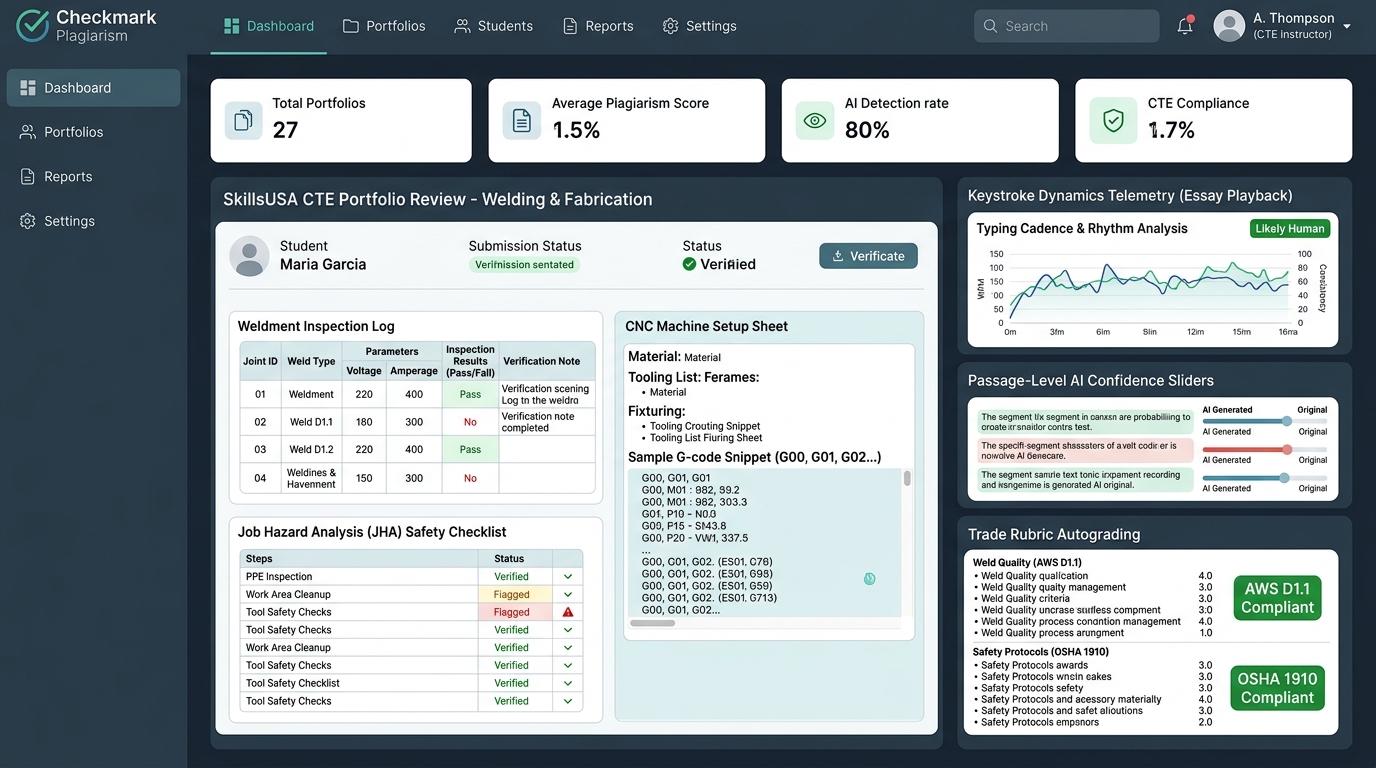
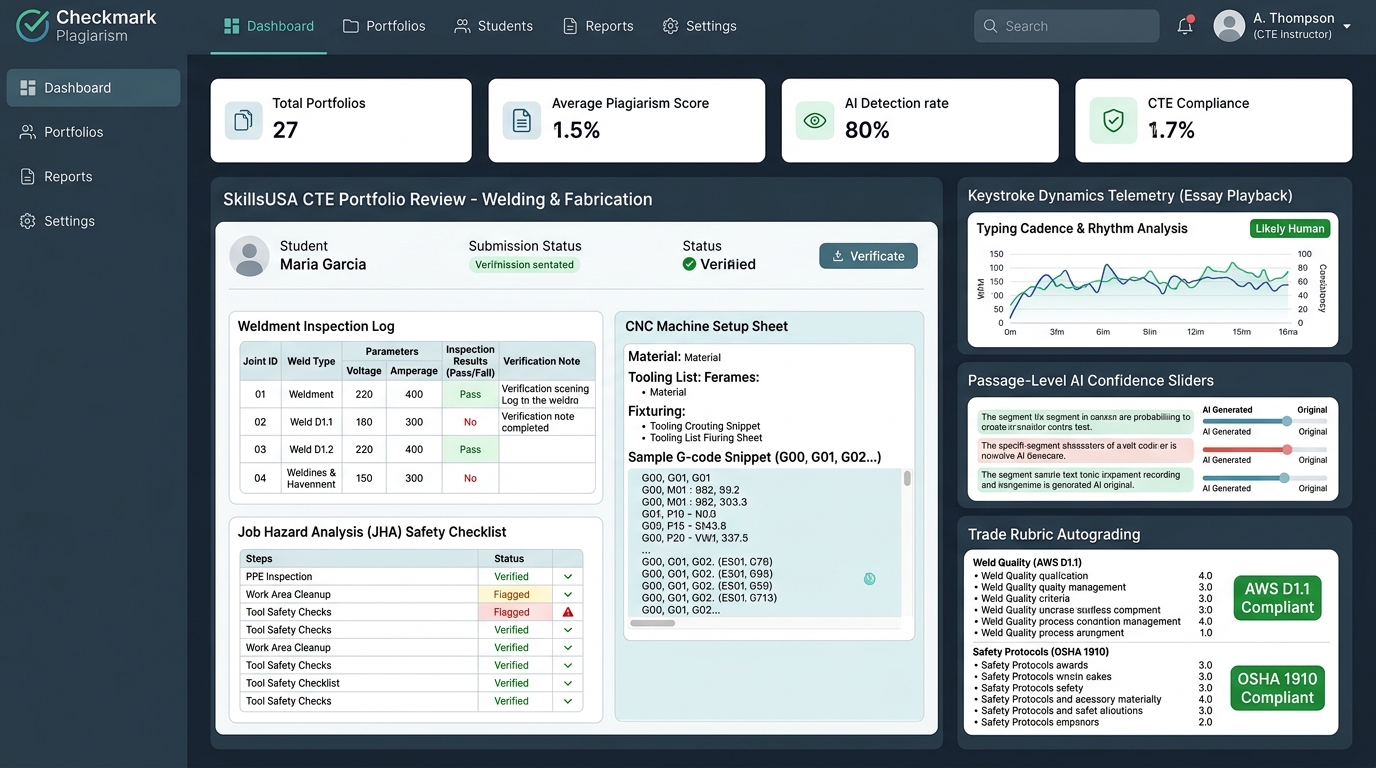
This creates catastrophic disconnects: AI generates textbook-generic SOPs that omit physical shop machinery parameters, hallucinate safety protocols that violate OSHA 1910 standards, and inject hyper-academic engineering jargon that students cannot explain during judge cross-examinations. Furthermore, generic “black-box” AI detectors fail vocational educators by falsely flagging standard trade acronyms (MIG, TIG, SMAW, CNC, CFM, DMM, GFCI, NEC, PPE) while missing outsourced or humanized demonstration scripts entirely. Checkmark Plagiarism resolves this dilemma by pairing granular passage-level AI detection with patent-pending Writing Process Telemetry and Essay Playback™. By capturing real-time keystroke dynamics, shop-to-keyboard reflection pauses, and raw external paste buffer payloads, Checkmark provides high school CTE advisers with unassailable, audit-ready proof of authentic student authorship—safeguarding competition integrity and empowering restorative workbench coaching.
1. The SkillsUSA Technical Documentation Mandate: Bridging the Shop Floor and the Competition Table
High school Career and Technical Education (CTE) programs operate at the vital intersection of tactile skill and academic rigor. Within the framework of SkillsUSA—the national career and technical student organization serving more than 400,000 high school and college students across trade, industrial, and technical pathways—technical documentation is not an optional add-on. It is a foundational pillar of trade competency.
Hands-On Shop Fabrication & Skill
- Physical weldment bead profile & root bend test
- Live engine diagnostic scanner troubleshooting
- CNC Haas VF-2 part tolerance (±0.001 in)
- 120V/240V EMT conduit bending & wire pull
Written Technical Documentation
- Professional Portfolio: Resume, trade goals, AWS/ASE/NIMS certs
- Demonstration Scripts: Step-by-step SOPs, JHA safety audits
- Showcase Binders: G-code sheets, weld logs, NEC load calculations
Oral Committee Cross-Examination
- 5–10 minute industry judge cross-examination
- Verification of student’s procedural mastery
- Probe of safety rationales & machine offsets
- Instant deduction if prose exceeds student knowledge
For high school CTE teachers and SkillsUSA chapter advisers, preparing students for regional, state, and national leadership and skills conferences requires coaching students through extensive technical writing. The SkillsUSA Championships Technical Standards specify strict written components across nearly every major competition category:
1.1 The Anatomy of SkillsUSA Written Deliverables
SkillsUSA written submissions fall into three distinct, high-stakes categories:
The Professional Development & Trade Portfolio
Every SkillsUSA competitor is required to present a standardized professional binder that establishes their entry-level trade readiness. This includes:
Tailored to industry standards (e.g., apprentice fabricator, production technician, junior HVAC installer).
Verifiable credentials including OSHA 10/30, AWS SENSE, ASE Entry-Level, NIMS Machining I, and ServSafe.
Written philosophy addressing Personal Skills, Workplace Skills, and Technical Skills Grounded in Academics.
Technical Demonstration Scripts & Standard Operating Procedures (SOPs)
In demonstration events—such as Job Skill Demonstration A, Job Skill Demonstration Open, and trade team events—students submit comprehensive scripts prior to table execution:
Numbered operational steps guiding the judge through every second of physical execution with timing benchmarks.
Mandatory PPE, electrical isolation, pinch points, and chemical SDS references under OSHA 1910 and 1926 standards.
Technical rationales for tool selection (e.g., digital micrometer vs. dial caliper, E6010 vs. E7018 rod, true-RMS DMM).
Precise industry terminology (e.g., shielding gas CFH, DMM impedance, Haas work coordinate systems) without slang.
Project Display Binders & Fabrication Workbooks
In fabrication and manufacturing competitions (Welding, Automotive, Precision Machining, Electrical Wiring, Carpentry, HVAC/R, Culinary), competitors submit exhaustive build notebooks:
Multi-pass weld logs documenting voltage, amperage, wire feed speed (WFS), travel speed, and AWS D1.1 visual checks.
Haas VF-2 setup sheets specifying coordinate offsets (G54–G59), tool length offsets (H-codes), spindle RPM, and feeds.
Branch circuit calculations, conduit fill percentages, conductor derating, and OCPD sizing governed by NFPA 70.
2. The Acute Classroom Dilemma: When LLMs Collide with Hands-On Vocational Reality
High school CTE instructors operate under unique, intense pedagogical pressures. A single vocational educator frequently manages 120 to 160 students across five to six class periods, juggling noisy shop floor safety monitoring, live equipment maintenance, consumables inventory, Perkins V compliance metrics, and dual-enrollment college grading.
When regional and state SkillsUSA competition deadlines hit the high school calendar—often coinciding with mid-term grading or industry certification testing windows—students face acute “deadline panic.” Because vocational students frequently feel far more confident operating an engine lathe, TIG torch, or multimeter than sitting at a keyboard drafting a 10-page technical portfolio, they increasingly turn to Large Language Models (LLMs) like ChatGPT, Claude, and Gemini to generate their written deliverables.
Hallucinated Machine Parameters
AI invents GMAW wire feed rates (450 IPM) disconnected from shop Miller 252 welders, or CNC spindle RPM formulas that shatter high-speed steel endmills on school belt-driven lathes.
Fictionalized OSHA Safety Protocols
AI omits mandatory OSHA 1910.147 Lockout/Tagout (LOTO) steps or suggests inspecting energized 480V terminals with hand probes, creating catastrophic competition disqualifications.
Hyper-Academic Engineering Jargon
Generates graduate-level metallurgical prose (“austenitic grain restructuring”) that a 16-year-old student cannot define when questioned by master tradesperson judges.
The Phantom Trade Showcase Binder
Produces a pristine 20-page fabrication binder documenting a complex hydraulic assembly that has zero dimensional or mechanical correspondence to the physical workpiece on the table.
2.1 Detailed Breakdown of the Four AI Failure Modes
Failure Mode 1: Hallucinated Machinery Parameters and Tool Speeds
Generative AI possesses no physical embodiment. When prompted with “Write an SOP for milling a 6061-T6 aluminum slot,” an LLM synthesizes generic online textbook parameters. It frequently outputs spindle speeds of 10,000 RPM with high-pressure through-spindle flood coolant—parameters suitable for an industrial multi-axis machining center costing $250,000, but catastrophic when attempted on a high school shop’s belt-driven Bridgeport knee mill with a maximum spindle speed of 2,720 RPM. In welding, an AI-generated SOP might mandate a shielding gas mixture of 98% Argon / 2% Oxygen for short-circuit GMAW on 1/8" mild steel, when the high school shop exclusively utilizes 75% Argon / 25% CO2 (C25) cylinders on their Miller Millermatic 252 or Lincoln Power MIG 260 machines.
Failure Mode 2: Fictionalized Industrial Safety Protocols
While LLMs can mimic the generic cadence of safety warnings, they routinely hallucinate or omit life-critical safety mandates established by OSHA 1910 (General Industry) and NFPA 70E (Electrical Safety in the Workplace). An AI-generated demonstration script for troubleshooting an industrial 3-phase motor might casually instruct the student to “inspect the terminal leads while the motor is momentarily energized,” directly violating OSHA 1910.147 Lockout/Tagout (LOTO) zero-energy state verification procedures. If a high schooler includes such a script in their portfolio, technical committee judges (who are licensed Master Electricians or Certified Safety Professionals) will immediately disqualify the entry on safety grounds.
Failure Mode 3: Hyper-Academic Engineering Jargon vs. Student Shop Vocabulary
LLMs naturally adopt the authoritative tone of academic engineering treatises. When an 11th-grade welding student asks an AI to describe their multi-pass TIG weld on stainless steel tubing, the AI produces sentences such as:
“The localized interpass heat input was stringently modulated to suppress chromium carbide precipitation along the austenitic grain boundaries, thereby mitigating galvanic sensitization across the heat-affected zone (HAZ).”
When the SkillsUSA Technical Committee judge asks the 16-year-old competitor at the demonstration table, “Why did you pause for two minutes between your root pass and your cap pass?” and the student stammers, unable to define “chromium carbide precipitation” or “sensitization,” the judge immediately recognizes that the student did not author the technical documentation. The student is penalized for academic misrepresentation.
Failure Mode 4: The Phantom Trade Showcase Binder
In team fabrication events, students must document hundreds of hours of shop build time. When pressed for time, students have used LLMs to generate entire fabrication logs—including fictionalized weld pass sequences, invented dimensional tolerances, and synthetic torque logs—that have zero geometric or mechanical correspondence to the actual steel frame sitting on the competition floor. When judges measure the physical workpiece with calipers and compare it against the binder’s stated dimensions, the fabrication workbook is exposed as an artificial fabrication.
2.2 Real High School Classroom Case Scenarios
11th Grade Automotive — The Copied Diagnostic SOP
The AI Submission: Student submitted a 15-page diagnostic binder for a CAN-bus fault on a 2018 Silverado with dual-channel lab scope waveform captures and ISO 11898 bus-line decoding.
The Shop Reality: The shop possessed Snap-on Zeus scan tools but owned no standalone Picoscope. At the workbench mock interview, the student could not power on the oscilloscope.
12th Grade Welding — The Hallucinated AWS D1.1 Root Pass
The AI Submission: Logbook claimed root pass was executed using SMAW E7018 3/32" electrode at 85A in 3G position with 1/16" root face for an AWS D1.1 structural bend test.
The Shop Reality: Adviser inspected coupon in scrap bin; student had welded an open-root E6010 cellulosic pass to achieve keyhole penetration before filling with E7018.
3. The SkillsUSA Ethics & Technical Committee Scoring Dilemma
Technical documentation integrity is governed strictly by the SkillsUSA National Technical Committee, composed of senior industry professionals, master tradespeople, union apprentice directors, and corporate engineering executives.
Citation / Format Flaw
Missing trade reference citation or formatting non-compliance with national binder guidelines.
Procedural Disconnect
Disconnect between stated SOP & shop tooling; inability to define advanced technical jargon during interview.
Authorship & Safety Violation
100% outsourced/AI demonstration script or lethal OSHA violations presented as student work.
3.1 National Technical Standards Scoring Rubrics and the 10–20% Documentation Penalty
Under the official SkillsUSA Championships scoring rubrics (typically scaled to 1,000 total points), the written portfolio, demonstration script, and fabrication notebook are weighted heavily:
- Professional Portfolio / Resume: 50 to 100 points.
- Technical Demonstration Script & Safety Briefing: 100 to 150 points.
- Shop Logbook / Blueprint / Calculation Workbook: 100 to 150 points.
In a competition where state medals and national qualifiers are frequently decided by margins of 2 to 5 points out of 1,000, an unearned documentation score—or a severe deduction for technical misrepresentation—instantly disqualifies a student from the winner’s podium.
3.2 Why Generic “Black-Box” AI Detectors Fail Vocational Educators
When high school CTE advisers attempt to verify student portfolios using standalone, whole-document AI detectors (such as generic similarity checkers or free online AI percentage checkers), they encounter catastrophic failure rates. These generic detectors evaluate static text snapshots using probabilistic metrics of word choice predictability (perplexity) and sentence structure diversity (burstiness).
This methodology collapses in Career and Technical Education due to three systemic vulnerabilities:
Standard Nomenclature Flagged
Technical documents are densely packed with standardized acronyms (MIG, TIG, SMAW, GMAW, CNC, CFM, DMM, GFCI, NEC, PPE, NFPA 70E, WFS, IPM, G00, G01). Because these terms appear in rigid low-perplexity patterns across technical manuals, generic detectors misclassify honest student trade logs as “85%–95% AI-Generated.”
Paraphrased Scripts Evade Detection
Students utilizing paraphrasing engines (QuillBot, Undetectable AI) can alter AI-generated SOPs to bypass static perplexity filters. Generic detectors assign a clean “0% AI” score to an outsourced script that the student cannot perform or explain at the demonstration table.
Neurodiverse Learners Penalized
Many outstanding CTE students are tactile, kinetic learners who struggle with standard prose fluidity. When these students write concise, formulaic, repetitive procedural steps, generic detectors flag their earnest, unembellished writing style as synthetic machine output.
4. The High School CTE Evidentiary Matrix
To evaluate student technical documentation fairly, high school CTE teachers and SkillsUSA advisers must transition from opaque, probabilistic guesses to an empirical, multi-dimensional evidentiary hierarchy.
| Evidentiary Dimension | Paper Shop Logbook | Generic AI Detector | Google Docs Version History | Checkmark Writing Telemetry™ |
|---|---|---|---|---|
| Evidence Type | Physical, handwritten notes at the workbench. | Probabilistic score on static text (e.g. “78% AI”). | Periodic cloud revision snapshots (10–30 min). | Continuous keystroke dynamics & writing telemetry. |
| Shop Machinery Concordance | High, but easily lost, torn, or grease-stained. | Zero (evaluates only vocabulary distributions). | Poor (cannot correlate text timing with machine runtime). | Complete (captures live pauses, spec lookups, parameter edits). |
| Trade Acronym & Code Immunity | High (manual handwriting). | Extremely Poor (high false positives on MIG, TIG, CNC, GFCI). | High (does not analyze text content). | Flawless (passage-level confidence sliders ignore trade codes). |
| External Paste Buffer Forensics | N/A (physical media). | Blind (evaluates pasted text identically to typed text). | Minimal (shows block appearing between snapshots). | Full Preservation (stores raw paste payload, timestamp, source diff). |
| Typing Cadence & Reflection | N/A (physical media). | Blind (zero temporal awareness). | Blind (cannot measure Inter-Keystroke Intervals [IKIs]). | Granular Keystroke Replay (1x to 8x playback of composing pauses). |
| Restorative Debrief Utility | Moderate (informal shop discussion). | Catastrophic (triggers defensive denial: “I didn’t cheat!”). | Low (coarse revision history lacks granular flow). | Optimal (timeline serves as objective anchor for shop dialogue). |
| SkillsUSA Rubric Autograding | Zero (manual paper grading). | Zero (standalone scanner). | Minimal (basic LMS attachment). | Direct LMS Sync (Canvas, Classroom, Buzz) with Quote Anchors. |
5. Step-by-Step SkillsUSA Adviser Audit Protocol
High school SkillsUSA advisers need an actionable, supportive, and non-punitive protocol to audit trade portfolios and demonstration scripts before submitting them to regional, state, or national competition committees.
Phase 1: Physical Workpiece & Binder Concordance Audit
Cross-examine the physical project (weld coupon, engine block, electrical panel) against binder photos, dimensions, weld sizes, and cut lists. Flag any discrepancy exceeding ±1/16" or parameter divergence.
Phase 2: Tool Parameter & Code Calculation Sanity Checks
Verify that stated feed rates, amperages, voltages, and wire gauges match the physical equipment in the shop (e.g., Miller Millermatic 252, Haas VF-2, NEC ampacity tables). Challenge textbook-generic anomalies.
Phase 3: Essay Playback™ Keystroke Dynamics & Reflection Audit
Scrub through the student’s drafting session at 2x–4x speed using Checkmark Plagiarism. Observe natural composing pauses (looking up manufacturer specs) vs. unnatural, steady mechanical transcription.
Phase 4: External Paste Buffer Payload Inspection
Inspect all flagged paste payloads in the Checkmark sidebar. Distinguish between legitimate pasted reference data (e.g., manufacturer torque tables) and mass-dumped AI generated demonstration scripts.
Phase 5: Supportive Restorative Workbench Debrief
Conduct a 5-minute one-on-one conference at the shop workbench using the Playback timeline. Reconnect the written text to the student’s authentic hands-on voice before the state competition committee review.
Phase 1: Physical Shop Workpiece & Technical Binder Concordance Audit
Before opening any software, the adviser must place the student’s physical trade workpiece beside the printed or digital technical binder:
- Geometric & Dimensional Verification: Compare the student’s stated fabrication cut list against the physical project using precision rules, dial calipers, or micrometers. If the binder states a tolerance of ±0.005" on a milled aluminum block, verify that the physical part matches the documentation.
- Consumable & Material Concordance: In welding, inspect the weld bead profile. If the logbook documents a 7018 low-hydrogen capping pass with a tight weave, verify that the physical weld coupon exhibits characteristic 7018 slag release and ripple patterns rather than a fast-freeze 6010 cellulosic pattern.
- Photographic & Process Alignment: Ensure that in-progress construction photographs in the binder clearly depict the student working within the school’s actual shop environment with recognizable shop equipment, safety guards, and tool serial tags.
Phase 2: Tool Parameter & Electrical/Mechanical Calculation Sanity Checks
Review the core mathematical calculations and operational parameters embedded in the documentation:
- Machine Capability Match: Verify that stated equipment parameters do not exceed shop capabilities. If an automotive student’s brake-rotor refinishing SOP specifies feed rates for an automated on-car lathe that the program does not own, flag the passage.
- Electrical Code Sanity Checks: In electrical wiring portfolios, audit branch circuit calculations:
Conductor Ampacity × Derating Factor ≥ Continuous Load × 1.25Ensure the student applied correct NEC Table 310.16 ampacity ratings and conduit fill limits (NEC Chapter 9, Table 1) rather than generic online values.
- Culinary Yield & Costing Logic: In culinary showcase portfolios, check ingredient scaling formulas. Ensure conversions from raw weight to edible portion (EP) yield reflect realistic kitchen trim loss percentages.
Phase 3: Analyzing Keystroke Drafting Dynamics with Essay Playback™
Open the student’s submission within Checkmark Plagiarism and launch the patent-pending Essay Playback™ viewer:
- Scrubbing the Timeline (1x to 8x Speed): Watch the document materialize. Authentic high school technical writing exhibits a distinct temporal rhythm:
- Burst-and-Pause Drafting: The student types three or four procedural steps, pauses for 45 to 90 seconds (reviewing their handwritten shop notes or equipment manual), and resumes typing.
- Active In-Line Revisions: The student makes typographical corrections, changes tool names (e.g., backspacing “wrench” to type “3/8-inch drive click-type torque wrench”), and rearranges step sequences.
- Detecting Mechanical Transcription (The “Second Screen” Trap): If the playback shows a steady, uninterrupted typing speed of 65 words per minute with zero composing pauses, no structural reorganization, and no character deletions, the student is likely transcribing an AI-generated script from their smartphone or a second monitor.
Phase 4: Inspecting External Paste Buffer Payloads
Click on Checkmark’s External Paste Inspector to examine every block of text introduced from outside the drafting window:
- Legitimate Technical Pastes: Students frequently copy and paste manufacturer torque specifications (e.g., “Cylinder head bolt torque sequence: Step 1: 22 ft-lbs, Step 2: 90 degrees”), safety data sheet tables, or standard G-code header blocks. Checkmark displays these raw paste payloads with exact timestamps, allowing the adviser to confirm that the student pasted reference data rather than prose.
- Illegitimate Generative Dumps: If an entire 800-word Job Hazard Analysis or a 1,200-word Welding Procedure Specification (WPS) appears in a single timestamped paste payload without subsequent editing, the adviser has definitive forensic evidence of outsourced generation.
Phase 5: Conducting Supportive Restorative Trade Demonstration Debriefs at the Workbench
Academic integrity in CTE should always be educational and restorative rather than punitive. The goal of the adviser is to prepare the student to stand confidently before industry judges:
Step 1: Open with Non-Confrontational Curiosity
“I love the physical weldment you built on the Miller 252. When I look at your demonstration script in Checkmark, I noticed this section on shielding gas flow rates and chromium carbide precipitation was pasted in last night. Talk me through what happened here.”
Step 2: Empower Authentic Trade Voice
“Let’s put the AI draft aside. You know how to set up this machine. Grab your grease-stained shop log, sit at the keyboard, and let’s write out your exact five-step setup procedure in your own words. When the SkillsUSA judge asks you why you selected 18.5 volts and 240 IPM, you will be able to answer with complete confidence.”
6. How Checkmark Plagiarism Empowers High School CTE Departments and SkillsUSA Chapters
Checkmark Plagiarism was engineered specifically to solve the limitations of traditional academic integrity software in applied, high-school, and vocational settings.
Granular Passage-Level AI Confidence Sliders
Evaluates student prose at the passage level rather than assigning whole-document percentages. Accompanied by calibrated confidence sliders comparing human writing dynamics with AI models without penalizing necessary trade terms (MIG, TIG, CNC, OSHA, NEC).
Patent-Pending Essay Playback™
Reconstructs the entire writing lifecycle. CTE teachers can scrub through a student’s drafting session like a digital video, visualizing 12 minutes spent drafting wiring calculations, erasing numbers, and refining wire gauge selections.
External Paste Buffer Inspector
Captures raw external paste payloads with exact timestamps. Even if a student subsequently rewrites every word of a pasted draft, Checkmark preserves the original text in the sidebar with a single-click “Jump to Playback” button.
Quote-Anchored SkillsUSA Rubric Autograding
Ingests official SkillsUSA competition rubrics or syncs directly with Canvas LMS, Google Classroom, and Agilix Buzz. Generates draft scores anchored directly to student quotes while preserving 100% teacher gradebook authority.
6.5 Zero Model Training and Enterprise FERPA/COPPA Compliance
High school student writing submitted to Checkmark is never used to train public or proprietary AI models. Checkmark adheres strictly to FERPA (Family Educational Rights and Privacy Act) and COPPA (Children’s Online Privacy Protection Act), utilizing enterprise-grade encryption in transit and at rest to ensure that high school vocational portfolios, student resumes, and personal contact information remain private and secure.
7. Frequently Asked Questions (FAQ)
1. How can a SkillsUSA adviser distinguish between an AI-generated SOP and a student who simply copied steps from an official machine operator manual?
Checkmark’s Plagiarism & Source Breakdown sidebar works concurrently with its AI detection engine. If a student copies text directly from a published machine manual (such as a Haas, Lincoln Electric, or Miller user guide), Checkmark highlights the text with side-by-side matching quotes and direct links to the original manufacturer documentation. If the text was synthesized by an LLM, Checkmark highlights the passage with calibrated AI confidence sliders. In both cases, Essay Playback™ reveals whether the text was typed manually with thoughtful cognitive pauses or pasted instantly in a single external buffer dump.
2. Will Checkmark falsely flag industry abbreviations like MIG, TIG, SMAW, CNC, or NEC as AI writing?
No. Generic AI detectors often trigger false positives on trade writing because technical acronyms and standardized code tables exhibit low linguistic perplexity. Checkmark solves this through passage-level granularity and structural burstiness analysis. It does not penalize students for using required, standardized trade acronyms, electrical codes (NFPA 70 / NEC), or structural welding standards (AWS D1.1).
3. How does Essay Playback™ protect honest CTE students from false accusations during state and national competitions?
When a student wins a regional or state competition, competing chapters occasionally file grievances claiming that the winner’s portfolio was written by a professional engineer, teacher, or AI. With Checkmark, the chapter adviser can pull up the student’s Essay Playback™ dossier. The playback provides an unassailable, timestamped visual recording of the student typing the portfolio over dozens of hours—complete with backspaces, draft revisions, calculation pauses, and authentic drafting struggles. This eliminates subjective suspicion and fully exonerates the student.
4. What should a CTE teacher do if a student legitimately pastes a manufacturer torque specification table into their portfolio?
Pasting manufacturer specifications, wiring pinouts, or chemical Safety Data Sheets is standard professional engineering practice. When a student pastes a specification table, Checkmark flags the external paste payload in the sidebar. The teacher can open the Paste Inspector, review the raw content, and verify that the paste is a legitimate technical reference table rather than an unearned prose essay. The teacher can then mark the flag as “Resolved” with a single click.
5. Does Checkmark work on 1:1 school Chromebooks in vocational shops and computer labs?
Yes. Checkmark is fully cloud-native and optimized for 1:1 Chromebook environments, Windows PC computer labs, and mobile tablets. It integrates seamlessly with Google Classroom, Google Docs, Canvas LMS, Schoology, and Buzz LMS, capturing rich writing process telemetry without requiring complex local software installations.
6. Can the AI Autograder grade trade portfolios according to official SkillsUSA Technical Standards rubrics?
Yes. Teachers can upload custom SkillsUSA rubrics as PDFs, Word documents, or images, or select from pre-built CTE rubric templates. Checkmark’s AI Autograder parses each rubric criterion, evaluates the student’s portfolio, and generates draft scores accompanied by quote-anchored justifications tied directly to the student’s written prose. The teacher maintains complete control to adjust any score before syncing finalized grades back to their LMS gradebook.
7. How can CTE teachers use writing telemetry to support neurodiverse or hands-on learners who struggle with written documentation?
Many vocational students have exceptional spatial and mechanical intelligence but experience anxiety when writing formal academic prose. When these students write in brief, unembellished sentences, crude AI detectors often mistake their simple phrasing for machine generation. Checkmark’s Essay Playback™ proves their authentic authorship by showing the genuine effort and time they spent typing each sentence. Advisers can use the playback during one-on-one workbench conferences to praise the student’s authentic progress and guide them in expanding their technical descriptions without fear of false accusations.
8. Conclusion: Moving from Guesswork to Trust on the Vocational Shop Floor
In Career and Technical Education, authentic competence is demonstrated at the workbench, the welding booth, the culinary line, and the diagnostic bay. But in modern trade competitions, the ability to document, explain, and defend that craft in writing is what elevates a skilled technician into an industry leader.
When high school SkillsUSA chapter advisers rely on blunt, whole-document AI detection percentages, they risk penalizing honest students, misunderstanding technical acronyms, and missing the subtle ways generative AI alienates students from their own hands-on craft.
By implementing Checkmark Plagiarism’s Writing Process Telemetry, patent-pending Essay Playback™, and quote-anchored rubric autograding, vocational educators can eliminate the guesswork. Teachers gain the objective “receipts” necessary to uphold rigorous competition standards, protect student achievements, and foster meaningful, restorative mentorship at the high school workbench.
To learn how Checkmark Plagiarism can support your high school Career and Technical Education department, SkillsUSA chapter, or regional CTE consortium, visit checkmarkplagiarism.com to schedule an interactive demonstration with our vocational education specialists.