
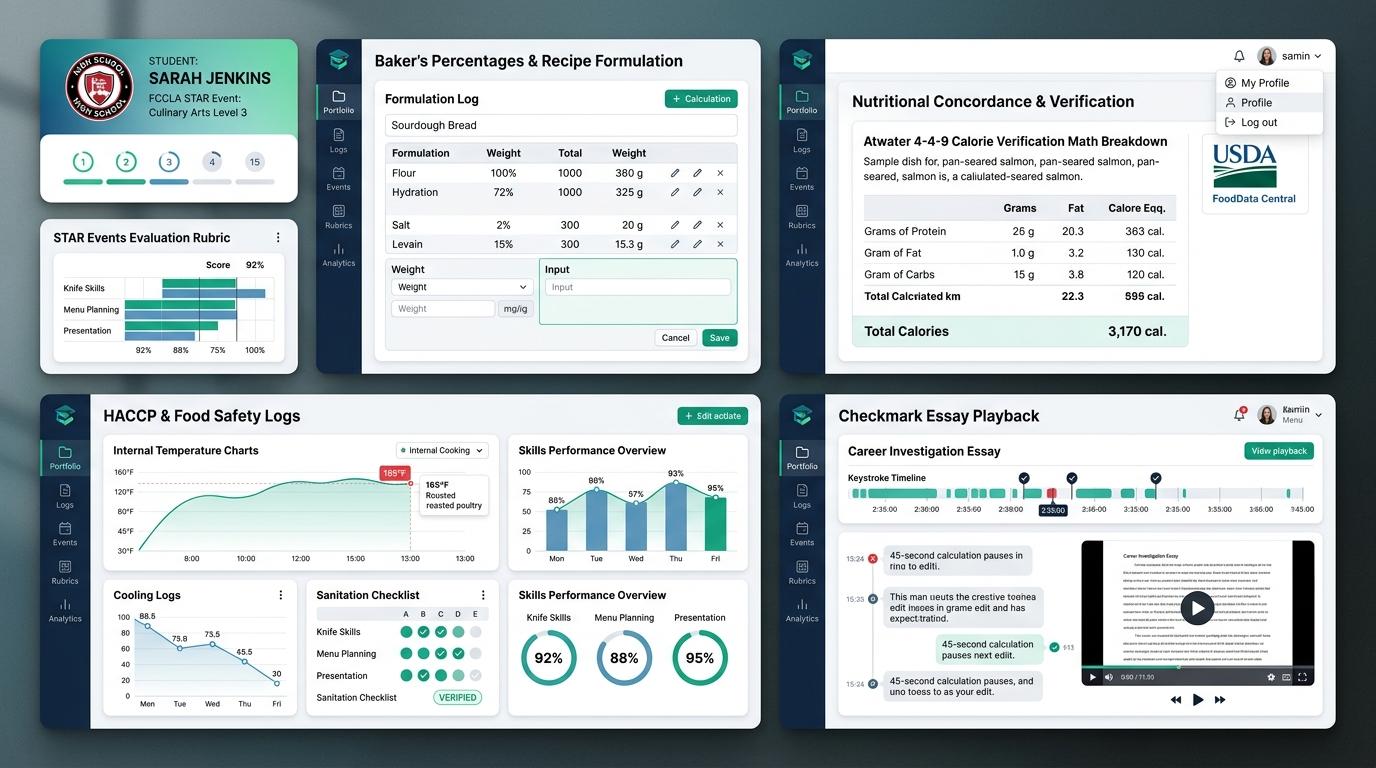
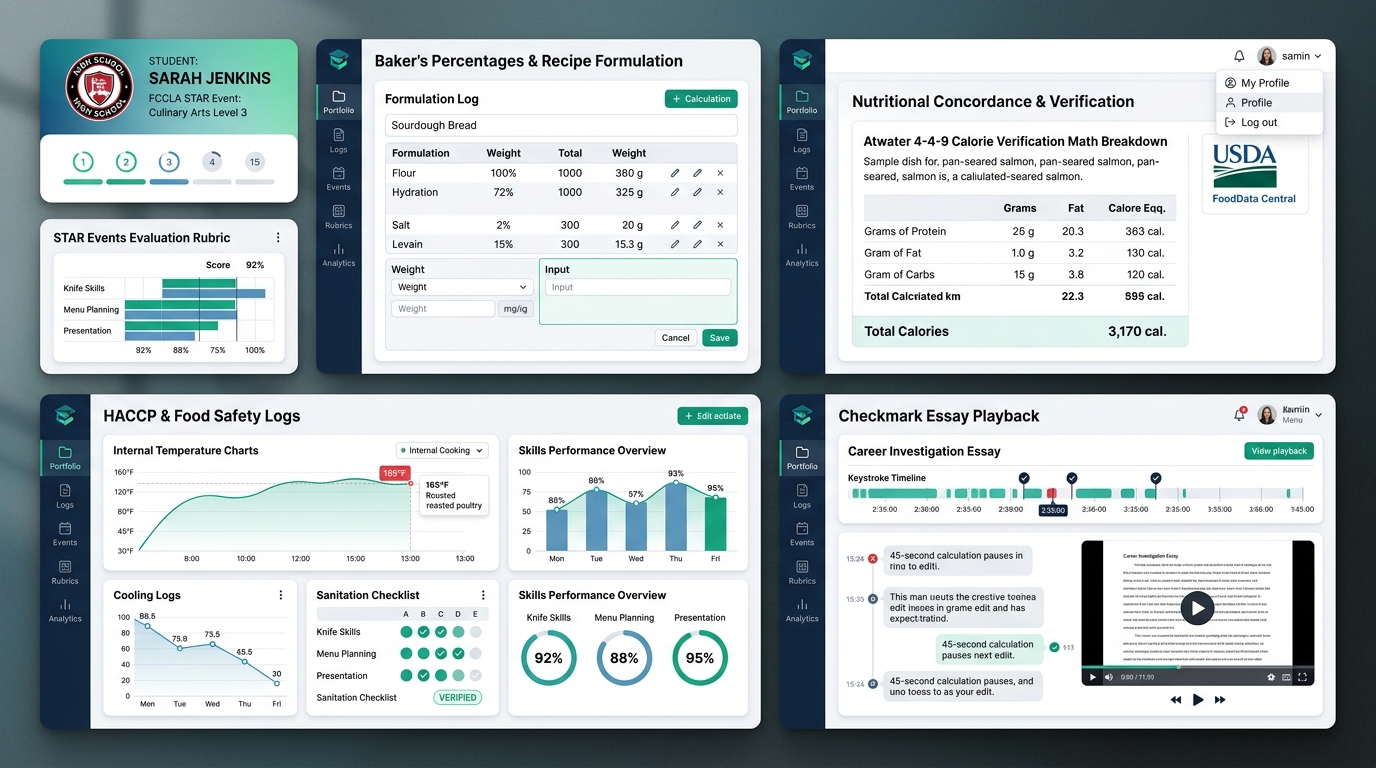
Executive Summary & CTE Integrity Mandate
In secondary Career and Technical Education (CTE) Hospitality and Culinary Arts pathways, written deliverables for portfolio-based FCCLA STAR Events such as Nutrition and Wellness, and for culinary and baking classroom projects that prepare students for practical STAR Events like Culinary Arts and Baking & Pastry, require high school students to produce rigorous, industry-aligned technical documentation. Students must demonstrate mastery across Baker’s Percentages, yield scaling, USDA FoodData Central nutritional concordance, As-Purchased (AP) versus Edible Portion (EP) food costing, HACCP time/temperature logs, and complex dietary restriction adaptations.
However, as District, State, and National Leadership Conference submission deadlines loom, high school FCCLA advisers face an escalating academic integrity challenge: students prompting Large Language Models (LLMs) to fabricate 25-to-30-page culinary portfolios overnight. These synthetic portfolios frequently contain glaring technical hallucinations—such as Atwater calorie-macronutrient mathematical contradictions (4×Protein + 4×Carbs + 9×Fat ≠ Total Calories), chemically disastrous gluten-free substitutions that collapse in commercial ovens, confabulated USDA FoodData Central IDs, and fictitious wholesale grocery invoices.
Standard “black-box” whole-document AI percentage detectors fail catastrophically in culinary education, generating destructive false positives on standardized culinary vocabulary (mise en place, HACCP, blanching, emulsification, ServSafe, convection) while remaining completely blind to fabricated nutritional stoichiometry. Checkmark Plagiarism provides high school FCS educators with a defensible, multi-dimensional verification framework: combining passage-level linguistic confidence analysis with patent-pending Essay Playback™ (1x–8x keystroke revision replay), raw external paste buffer inspection, and automated rubric alignment. This ensures high school advisers can distinguish authentic, iterative kitchen-tested recipe engineering from cut-and-paste LLM confabulation, fostering student growth and safeguarding FCCLA competition integrity.
Section 1: Planning Process
- Identify community / client dietary concern
- Set SMART culinary & nutritional goals
- Formulate kitchen testing action plan
- Document lab trials & follow-up iterations
Section 2: Recipe Formulation
- Conversion Factor (CF) yield scaling
- Baker’s Percentages (Flour = 100.0%)
- Mass (g) vs volume ingredient density
- Sensory evaluation & crumb structure logs
Section 3: Nutrition Concordance
- USDA FoodData Central (FDC ID) concordance
- Atwater 4-4-9 calorie balance check
- Micronutrient DRI tracking (Na, Fiber, Sugars)
- FASTER Act Big 9 allergen audit
Section 4: Menu Costing
- As-Purchased (AP) vs Edible Portion (EP)
- Prep trim yield percentage losses
- Cost per portion calculations
- Target Food Cost % (≤35% benchmark)
Section 5: HACCP Safety Plan
- Critical Control Points (CCPs) & limits
- 165°F poultry / 155°F ground meat internal temps
- 2-stage cooling logs (135°F→70°F→41°F)
- Sanitizer ppm & cross-contact controls
Section 6: Dietary Adaptations
- Celiac / gluten-free hydrocolloid binders
- Diabetic carbohydrate & glycemic counting
- Renal / low-sodium acidulations (<140mg)
- Vegan / plant-based fat emulsions
1. The High School Culinary Arts & FCCLA STAR Event Portfolio Architecture
Secondary Family and Consumer Sciences (FCS) education and Career and Technical Education (CTE) Hospitality pathways occupy a vital intersection between hands-on technical skill and academic rigor. Through Family, Career and Community Leaders of America (FCCLA)—the premier Career and Technical Student Organization (CTSO) for FCS students—high schoolers compete in Students Taking Action with Recognition (STAR) Events across Levels 1 through 4:
- Level 1: Through grade 8 (Middle School exploratory culinary & nutrition foundations)
- Level 2: Grades 9–10 (Secondary foundational culinary skills, food safety, & dietary planning)
- Level 3: Grades 11–12 (Advanced culinary arts, commercial baking, and clinical nutrition)
- Level 4: Postsecondary
FCCLA’s Culinary Arts and Baking and Pastry STAR Events are practical, on-site events in which participants prepare menu items given to them at the time of the event, while Nutrition and Wellness requires a portfolio, visuals, and an oral presentation. Across portfolio-based events and culinary classroom projects, success hinges on the technical portfolio. These hardcopy or digital binders represent months of mathematical calculation, food science investigation, menu engineering, and food safety planning.
1.1 Anatomy of FCCLA Written Deliverables & Culinary Competition Portfolios
To conduct a rigorous academic integrity audit, high school FCCLA advisers, FCS department chairs, and competition evaluators must understand the technical components that comprise competition-grade and classroom portfolios in culinary arts, baking & pastry, and nutrition and wellness:
A. Project Identification Page & FCCLA Planning Process Summary
Assessing community dietary health needs, school lunch nutritional shortfalls, or bakery production constraints.
Defining measurable targets (e.g., 3-course diabetic luncheon <600 kcal and food cost strictly <$4.25/serving).
Documenting who, what, where, when, why, and how the kitchen testing and nutritional analysis will occur.
Executing kitchen trials, sensory taste panels, yield tests, and nutritional calculations.
Reflecting on trial failures, sensory feedback from commercial kitchen taste panels, and recipe modifications.
B. Recipe Formulation & Yield Conversion Logs
High school culinary students must demonstrate precise mathematical competence in scaling recipes for commercial production:
Recipe Conversion Factor (CF) Formula
New Ingredient Weight = Original Weight × CF
Scaling ingredient quantities between test batches (e.g., 4 portions) and banquet-scale yields (e.g., 48 portions).
Baker’s Percentages (Flour Weight Basis)
Total Flour Weight is ALWAYS established as 100.0%
Balancing sourdough or brioche hydration (65–80%), fat (10–50%), levain (1–20%), and salt (1.8–2.2%).
| Ingredient | US Volume | Mass (Grams) | Mass (Ounces) | Density Notes & Scaling Considerations |
|---|---|---|---|---|
| All-Purpose Flour (Sifted) | 1 cup | 120 g | 4.23 oz | Aeration alters volume drastically; weight is mandatory for commercial scale. |
| Bread Flour (High Gluten) | 1 cup | 130 g | 4.59 oz | Higher protein density (12.5–14% protein vs 10.5% in AP flour). |
| Granulated White Sugar | 1 cup | 200 g | 7.05 oz | Crystalline structure; standard reference density ≈ 0.85 g/cm³. |
| Brown Sugar (Packed) | 1 cup | 220 g | 7.76 oz | Molasses moisture adds mass; density shifts significantly if unpacked. |
| Unsalted Butter (Chilled) | 1 cup (2 sticks) | 227 g | 8.00 oz | Emulsion of 80% butterfat, 16–18% water, 2% milk solids. |
| Whole Milk (3.25% Fat) | 1 cup (8 fl oz) | 244 g | 8.60 oz | Specific gravity ≈ 1.03; slightly denser than pure water (236.6 g). |
| Pure Clover Honey | 1 cup (8 fl oz) | 340 g | 12.00 oz | High viscosity and density; 1.42× the mass of equal water volume. |
| Kosher Salt (Diamond Crystal) | 1 tbsp | 8.5 g | 0.30 oz | Hollow crystal structure; half the density of Morton table salt (18 g/tbsp). |
C. Comprehensive Nutritional Breakdown & Atwater Verification
Portfolios must present granular nutritional analyses backed by empirical databases:
USDA FoodData Central Concordance
Every ingredient must be matched to an authentic FoodData Central (FDC) ID from the USDA Agricultural Research Service (ARS) database (Foundation Foods, Standard Reference Legacy, or FNDDS).
Atwater 4-4-9 Energy System
Energy sums must match stated calories within a ≤5% margin.
D. Menu Costing & Food Cost Percentage Calculations
Commercial viability requires accounting for raw product trim loss during fabrication:
As-Purchased (AP) vs. Edible Portion (EP)
Cost per EP Pound = AP Price per Pound / Yield %
Example: Whole carrots at $1.20/lb with an 82% yield cost $1.20 / 0.82 = $1.46 per edible pound.
Food Cost Percentage (≤35% Benchmark)
Target Selling Price = Portion Cost / Target Cost %
Commercial culinary benchmarks mandate a target food cost strictly between 28% and 35%.
E. HACCP Food Safety & Time/Temperature Logs
Portfolios must align strictly with ServSafe and FDA Food Code standards:
- Poultry & Stuffed: 165°F (74°C) instant
- Ground Meats: 155°F (68°C) for 17s
- Whole Cuts / Fish: 145°F (63°C) for 15s
- Stage 1: 135°F → 70°F within 2 hrs
- Stage 2: 70°F → 41°F within 4 hrs
- Total cooling time ≤ 6 hours total
- Hot Holding: ≥ 135°F (57°C)
- Cold Holding: ≤ 41°F (5°C)
- Quat San: per label (often 200–400 ppm) / Cl: 50–100 ppm
1.2 The “Competition Crunch”: High School Deadlines vs. Generative AI Pressures
The operational reality of high school CTE Culinary Arts is extraordinarily demanding. A single FCS teacher often manages 130 to 160 students across 5 or 6 class periods—ranging from introductory Foods & Nutrition to advanced ACF-aligned commercial kitchen blocks. Simultaneously, the teacher serves as the FCCLA Chapter Adviser, supervising 15 to 30 competitive STAR Event entries.
Competitors are high school juniors and seniors juggling heavy academic course loads, commercial kitchen lab duties (prepping for school district banquets, holiday catering, and bistro lunch services), after-school sports, and part-time jobs.
When the District/Regional Qualifier deadline hits in January or the State Leadership Conference (SLC) deadline arrives in March, students face intense time scarcity. Compiling a 30-page portfolio requiring 12 multi-step mathematical calculations, 15 USDA nutrient profile cross-references, and detailed HACCP flowcharts can take 40+ hours of painstaking desk work.
Under this severe pressure, students turn to generative AI tools like ChatGPT, Claude, and Gemini. With a simple prompt—“Generate a 30-page FCCLA Nutrition and Wellness portfolio for a low-sodium Mediterranean salmon dish, including recipe conversions, USDA nutritional tables, food costing, and HACCP logs”—an LLM produces an apparently flawless, professional document in 45 seconds.
1.3 The Four Critical AI Failure Modes in Culinary Nutrition Portfolios
Because LLMs operate on probabilistic next-token prediction rather than deterministic mathematical computation or food science chemistry, synthetic portfolios introduce four acute failure modes:
The 4 Critical Generative AI Failure Modes in Culinary Portfolios
The LLM generates a polished table claiming a recipe provides 380 kcal. However, it lists 38g protein (152 kcal), 48g carbs (192 kcal), and 18g fat (162 kcal). The actual Atwater sum is 152 + 192 + 162 = 506 kcal. The stated calorie count is off by 126 kcal (33.2% error) because the AI hallucinated isolated numbers that sounded plausible.
The model recommends a 1:1 direct swap of all-purpose flour with 100% almond flour in high-rise yeast brioche, claiming “identical light, airy honeycomb crumb.” In reality, almond flour lacks glutenin and gliadin to trap CO2 gas and contains high fat that destroys dough structure. Without hydrocolloids (xanthan gum) or egg-white scaffolding, the dough collapses into an oily, unleavened brick in the commercial oven.
When prompted to cite official USDA FoodData Central codes, the AI hallucinates plausible-looking numeric IDs. When audited on fdc.nal.usda.gov, the codes return a not-found error or resolve to completely mismatched food items (e.g., an olive oil citation pointing to canned pork and beans).
The LLM populates costing worksheets with uniform flat rates ($1.99/unit across all ingredients, $0.50/oz for pure saffron, $1.99/lb for pine nuts), completely ignores commercial distributor case pack sizing (Sysco/US Foods), and omits prep trim loss (treating whole pineapples as 100% edible portion).
2. Competition Ethics, Portfolio Scoring Standards, and the AI Detection Breakdown
Evaluating high school culinary portfolios requires understanding how CTSO evaluation panels operate. Unlike standard academic essay scoring, culinary and nutrition portfolio rubrics penalize technical inaccuracies with mathematical precision. FCCLA’s official STAR Event rubrics are updated annually and are available to FCCLA members through the FCCLA portal; the table below is an illustrative example of how a portfolio rubric might weight these skills, not an official rubric.
| Rubric Component | Evaluation Criteria | Max Pts | Impact of AI Hallucinations & Fabrication |
|---|---|---|---|
| Recipe Formulation & Conversion | Accuracy of yield scaling, mathematical integrity of conversion factors (CF), and precision of Baker’s Percentages. | 10 pts | Severe Deduction (0–2 pts): Contradictory ratios, inverted conversion factors, or impossible baking hydration percentages. |
| Nutritional Analysis & Accuracy | Comprehensive concordance with USDA FoodData Central, accurate macronutrient/micronutrient values, and proper Atwater energy balance. | 10 pts | Severe Deduction (0–2 pts): Atwater calorie discrepancies (>5% error) or hallucinated USDA database IDs immediately alert judges. |
| Menu Costing & Commercial Viability | Realistic As-Purchased (AP) vs. Edible Portion (EP) calculations, current wholesale ingredient costing, and correct Food Cost % (≤35%). | 10 pts | Substantial Deduction (2–4 pts): Fictitious ingredient prices disconnected from market reality or omission of trim loss. |
| Food Safety & HACCP Plan | Correct identification of Critical Control Points (CCPs), accurate ServSafe temperature thresholds, and complete 2-stage cooling logs. | 10 pts | Critical Safety Deduction (0–2 pts): Erroneous cook temperatures (e.g., poultry safe at 140°F) signal a serious food safety failure. |
| Special Dietary Adaptation & Science | Sound food chemistry justifications for ingredient substitutions (gluten-free binders, low-glycemic bulking, vegan emulsions). | 10 pts | Severe Deduction (0–2 pts): Chemically unviable substitutions (100% almond flour without binders) prove lack of lab testing. |
| Authentic Planning Process | Evidence of genuine trial-and-error, kitchen testing notes, sensory evaluation logs, and iterative adjustments. | 10 pts | Authorship Risk: FCCLA STAR Event guidelines require projects to be the work of the participant(s) only. Complete AI generation violates that requirement and most school honor codes. |
FCCLA’s published STAR Event guidelines for Nutrition and Wellness and Food Innovations state that all projects “must be the work of the participant(s) only.” (Source: FCCLA, STAR Events guideline sheets.)
2.2 Why Generic Black-Box AI Detectors Fail in Culinary Science
When high school FCS teachers suspect that a portfolio was generated by an LLM, running the text through a generic, whole-document AI percentage detector (such as Turnitin AI score, GPTZero, or CopyLeaks) creates severe complications:
1. False Positives on Standardized Culinary Jargon
Culinary arts relies on strictly standardized phrasing from ServSafe, the FDA Food Code, and classical culinary manuals: mise en place, chiffonade, blanching, emulsification, retrogradation, 165°F internal temperature for poultry. Because LLMs were trained heavily on these manuals, an honest student writing precise food safety protocols can trigger high AI-probability flags on generic detectors.
2. Blindness to Fabricated Chemistry & Stoichiometry
Generic detectors evaluate linguistic perplexity—NOT nutritional math or baking science. An AI-generated portfolio with impossible Atwater math (420 stated kcal vs 558 actual) or an unworkable almond-flour brioche will pass through an AI detector with a “0% AI” clean score if lightly paraphrased, despite being scientifically fraudulent.
3. The High School Culinary Arts Evidentiary Matrix
To establish an equitable, defensible audit workflow, high school FCS educators and FCCLA advisers require an evidentiary framework that combines physical kitchen evidence, mathematical verification, and digital writing process telemetry:
| Audit Dimension | Kitchen Binders / Prep Logs | Generic AI Detectors (0–100%) | Checkmark Telemetry & Playback™ |
|---|---|---|---|
| Granularity of Evidence | Physical paper notes and scale tare printouts. | Single opaque percentage for the entire 30-page document. | Sentence-by-sentence confidence sliders + keystroke video replay. |
| Math & Formula Verification | Manual calculator audit by teacher; highly time-taxing. | Inoperable (evaluates token predictability only). | Verifies calculation pause pacing (45–90s) and formula drafting. |
| False-Alarm Protection | High, but vulnerable to neat unverified copying. | Extremely low; flags standard ServSafe / culinary jargon. | Maximum; proves authentic typing velocity & formula drafting. |
| Paste Payload Inspection | Inoperable (cannot inspect digital clipboard events). | Inoperable (cannot see clipboard history). | Full raw clipboard payload capture with external source timestamping. |
| Revision Timeline Replay | Inoperable (only captures static final paper output). | Inoperable (static snapshot analysis only). | Complete 1x–8x playback of every calculation, edit, and deletion. |
| Gradebook & Rubric Sync | Manual red-pen grading on printed paper rubrics. | Disconnected; requires separate external portal. | One-click rubric autograding synced to Canvas, Google Classroom, Buzz. |
| Restorative Utility | Moderate; shows physical artifacts without process. | Zero; fosters defensive, hostile student conferences. | High; turns writing receipts into supportive kitchen math coaching. |
4. Step-by-Step FCCLA Adviser Audit Protocol
High school FCCLA advisers can implement a rigorous, 5-phase audit protocol to verify culinary portfolios before submitting them to District, State, or National STAR Event competitions:
Phase 1: Kitchen Prep Sheet & Portfolio Concordance Audit
- Lab Scale Reconciliation: Verify that the gram weights listed in the portfolio match the tare weights recorded on the student’s kitchen prep clipboard during lab practicals.
- Distributor Invoice Check: Cross-reference ingredient costs with the high school’s active broadline distributor order sheets (Sysco, US Foods) or local grocery receipts. If the portfolio lists “Fresh Vanilla Bean: $0.15 each,” when the CTE kitchen invoice shows $3.80 each, the costing sheet is synthetic.
- Pantry Inventory Alignment: Ensure specialty ingredients mentioned in the portfolio (xanthan gum, tapioca starch, allulose, aquafaba) actually exist in the FCS culinary pantry or were purchased for the project.
Phase 2: Mathematical Sanity Checks & Nutritional Stoichiometry
Apply: (4 × P) + (4 × C) + (9 × F).
If discrepancy between calculated energy and stated portfolio calories exceeds 5%, flag for manual review.
Verify Flour = 100.0%. Confirm hydration falls between 62%–80% for bread and 75%–95% for brioche.
Confirm Cost per EP Pound = AP Price / Yield %. Verify Food Cost % is calculated as Portion Cost / Selling Price.
Search 2 cited FDC IDs on fdc.nal.usda.gov to confirm existence and baseline values.
Phase 3: Analyzing Keystroke Dynamics & Calculation Pauses with Essay Playback™
Scrub through the student’s writing session at 1x to 8x speed to evaluate authentic cognitive velocity:
- Cognitive Calculation Pauses: Authentic formulation features 30-to-90-second pauses while using calculators or USDA tools.
- Instant Block Drops: Multi-page tables inserted in a 2-second block indicate external LLM export.
- Mechanical Transcription: Continuous typing at 70+ WPM with zero pauses on complex decimals indicates copying from a phone screen.
Phase 4: Inspecting External Clipboard Paste Payloads
- Markdown Formatting Artifacts: Check for residual LLM syntax (e.g.,
### Section 3: Nutritional Breakdown, markdown pipe tables| Ingredient | Mass (g) |). - Prompt Residue: Inspect the paste buffer for conversational artifacts: “Certainly! Here is a complete 30-page FCCLA Nutrition and Wellness portfolio...”
- FDC Link Inconsistencies: Dead hyperlinks formatted with placeholder numbers.
Phase 5: Conducting Supportive Restorative Culinary Debriefs in the Commercial Kitchen
Open Checkmark Essay Playback alongside tare logs to review data discrepancies collaboratively without accusatory language.
Hand the student a marker and calculator at the prep table to walk through Baker’s percentages or yield scaling derivations.
If a student claims an unproven substitution works, test a 100g sample in the oven. A collapsed brioche becomes a powerful food science teaching moment.
Allow 72 hours to recalculate tables using authentic USDA data and real kitchen tare weights before official CTSO competition registration.
5. Real High School Case Scenarios
The Setting: An 11th-grade student preparing an artisanal gluten-free pastry portfolio for a chapter project.
The Red Flag: The portfolio claimed a 1:1 direct substitution of all-purpose wheat flour with 100% superfine almond flour in a laminated brioche dough, claiming a “tender, flaky honeycomb crumb structure.” The nutritional breakdown reported 280 kcal per roll, but listed 12g protein (48 kcal), 28g carbs (112 kcal), and 22g fat (198 kcal)—totaling 358 kcal (27.9% calculation error).
The Checkmark Investigation: Checkmark Essay Playback revealed that the entire 4-page recipe formulation section was inserted in a single external paste of 5,800 characters at 11:42 PM on a Sunday. The Paste Buffer Inspector revealed the original prompt response from an LLM.
The Restorative Resolution: During a kitchen conference, the adviser demonstrated why almond flour contains no glutenin or gliadin to trap gas. The student tested an authentic gluten-free flour blend (brown rice flour, potato starch, tapioca flour, and 2.5% xanthan gum with whipped egg whites), corrected the Atwater math, submitted an authentic portfolio, and earned strong marks from evaluators.
The Setting: A 10th-grade student submitting a 28-page portfolio designing a 7-day low-sodium, low-glycemic meal plan for adolescent student-athletes with Type 1 Diabetes.
The Dilemma: Flagged by a generic school-wide AI detector with an “88% AI-Generated” warning. The district’s automated policy suggested disqualifying the student from the upcoming District Qualifier.
The Checkmark Investigation: The FCCLA adviser audited the paper using Checkmark’s passage-level confidence sliders and Essay Playback™. The investigation proved the student spent 6 hours and 40 minutes actively composing over 9 distinct drafting sessions. Keystroke telemetry showed extended 60-to-120-second calculation pauses as the student cross-referenced glycemic index tables and calculated sodium totals line-by-line. The generic detector had triggered false alarms on standard ServSafe food safety temperatures and ADA medical definitions.
The Outcome: The adviser presented Checkmark’s writing playback report to the CTE Director, completely exonerating the student. The student competed at the District Qualifier and earned a Gold rating.
The Setting: A team of two high school seniors preparing a commercial banquet catering proposal and food safety plan for a 200-guest school district scholarship gala.
The Red Flag: The menu costing worksheet listed fresh saffron at $0.50/oz (actual commercial wholesale cost: $65.00–$90.00/oz) and beef tenderloin at $3.20/lb with 100% edible portion yield (omitting 28% loss from silverskin/chain trimming). The HACCP plan listed turkey cooking temperature at 140°F (violating ServSafe’s 165°F critical limit).
The Checkmark Investigation: Checkmark’s Paste Buffer Inspector revealed the team had copied an LLM table directly into Google Docs.
The Restorative Resolution: The instructor conducted an authentic kitchen audit: students fabricated a real 10-lb whole beef tenderloin into center-cut filets, weighing the silverskin and fat trim to calculate the true AP/EP yield (72%). Students then audited the school’s Sysco invoices to input authentic market prices and corrected the HACCP plan to 165°F.
6. How Checkmark Plagiarism Empowers FCS Educators & FCCLA Advisers
Checkmark Plagiarism is engineered specifically to meet the instructional, mathematical, and ethical needs of secondary Career and Technical Education educators:
1. Passage-Level Calibrated Confidence Sliders
Replaces opaque whole-paper percentage scores with granular, sentence-by-sentence linguistic evaluations. Standard culinary terms (ServSafe, HACCP) remain clean while synthetic AI text blocks are pinpointed.
2. Patent-Pending Essay Playback™ (1x–8x Replay)
Watch the complete portfolio come together keystroke-by-keystroke. Verify cognitive calculation pauses during recipe scaling and distinguish authentic drafting from mechanical transcription.
3. Raw External Paste Buffer & Payload Inspection
Captures the exact text payload copied from external sources, retaining original LLM prompt outputs even if the student manually edits or reformats the text afterward.
4. Teacher-in-the-Loop Rubric Autograding & LMS Sync
Autogrades draft portfolios against custom FCCLA STAR Event rubrics, generating quote-anchored feedback and syncing finalized scores directly to Canvas LMS, Google Classroom, and Buzz LMS.
7. Frequently Asked Questions (FAQ) for FCCLA Advisers & FCS Teachers
Q1: Can culinary students use digital nutritional calculators (e.g., USDA FoodData Central, MyFitnessPal, or specialized recipe software) without triggering academic integrity violations?
Yes. Utilizing authorized digital nutritional software, USDA search tools, and spreadsheet formulas (e.g., Google Sheets or Microsoft Excel) is an industry-standard practice, provided it is allowed under each event’s guidelines. The critical distinction lies between computational tools (where the student enters verified ingredients, verifies database weights, and applies mathematical formulas) and generative LLM drafting (where an AI generates fabricated text, unverified calculations, and confabulated database codes). Checkmark Essay Playback proves authentic computational tool usage by revealing the student actively inputting verified values and calculating formulas over time.
Q2: How does Checkmark differentiate between authorized digital tool assistance and unauthorized generative AI drafting?
Checkmark analyzes the temporal and linguistic dynamics of the document. When a student uses an authorized spreadsheet or calculator, Essay Playback captures the student typing individual formula results with natural cognitive pauses, switching between browser tabs, and refining decimal values. In contrast, unauthorized generative AI use appears as instantaneous bulk pastes of multi-page text blocks containing characteristic LLM linguistic predictability and unverified Atwater mathematical contradictions.
Q3: How should FCCLA advisers audit collaborative group portfolios (e.g., 2–3 student teams in Community Service Project or Hospitality, Tourism, and Recreation STAR Events)?
Checkmark captures multi-author telemetry, tracking individual student logins, typing velocities, and edit histories across shared Google Docs or LMS submissions. Advisers can view a color-coded timeline showing which team member authored specific sections (e.g., Student A drafting the recipe scaling while Student B compiles the HACCP plan), ensuring equitable contribution and pinpointing any unauthorized external pastes to specific user sessions.
Q4: What if a student uses local grocery store receipt prices instead of commercial wholesale distributor (Sysco/US Foods) invoices?
In classroom projects and younger-level events (or schools without commercial kitchen distributor accounts), using retail grocery receipts from local supermarkets is typically acceptable if the project guidelines allow it. However, the student must document the store name, date of purchase, and container unit size in their portfolio appendix. Advisers should verify that the unit price scaling (e.g., converting a 5-lb bag of flour to recipe grams) is mathematically accurate and reflects real store receipts rather than arbitrary AI-generated numbers.
Q5: Why do generic AI detectors flag authentic ServSafe food safety logs and standard HACCP temperature charts?
Generic AI detectors rely on statistical language models that calculate the probability of word sequences. Because ServSafe standards, FDA Food Code guidelines, and HACCP temperature critical limits follow strict, universally standardized phrasing (e.g., “Cook poultry to an internal temperature of 165°F”), generic detectors flag them as AI-generated. Checkmark’s passage-level confidence sliders and Essay Playback eliminate these false positives by evaluating writing process history rather than penalizing necessary industry terminology.
Q6: How does Essay Playback protect honest high school culinary students from false accusations during State Leadership Conference evaluations?
If a state or national competition evaluator questions the originality of a highly polished student portfolio or suspects AI assistance due to advanced technical vocabulary, the FCCLA adviser can provide the Checkmark Essay Playback audit report. This report serves as an immutable, timestamped “receipt” proving that the student spent hours iteratively drafting, researching USDA codes, correcting calculations, and refining their culinary justifications.
Q7: What restorative protocol should an FCS department follow if an LLM-generated portfolio is confirmed before competition submission?
Advisers should treat AI misuse as a formative learning opportunity rather than an immediate disciplinary crisis. Meet with the student in the commercial kitchen lab, review the Essay Playback telemetry together, and explain the real-world food science and mathematical failures of the generated text (such as Atwater errors or unworkable baking chemistry). Require the student to conduct hands-on lab yield testing, recalculate their tables using authentic USDA FoodData Central data, and resubmit their portfolio within 72 hours to earn the right to represent their chapter at competition.