
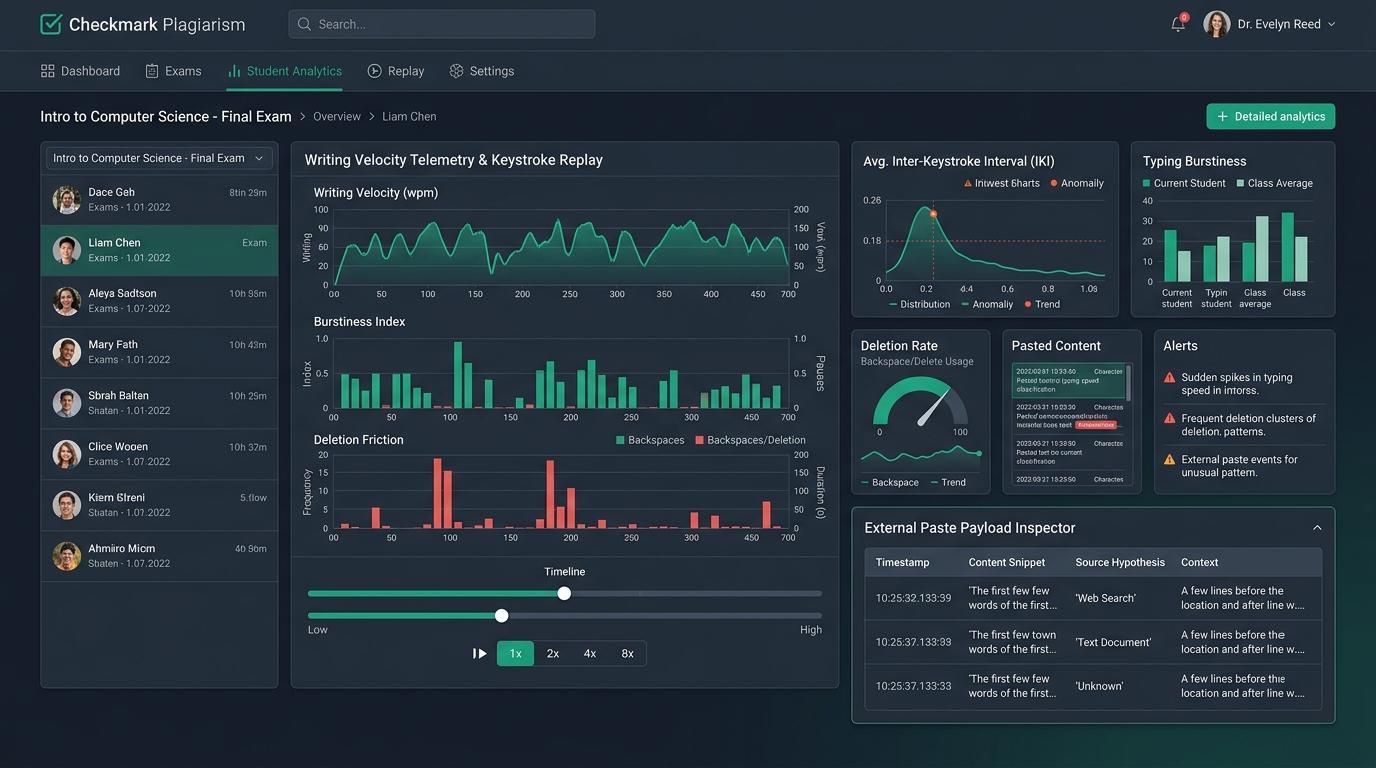
Asynchronous distance education is the lifeblood of modern community colleges, providing flexible access for working adults, student parents, and non-traditional learners. However, unproctored online essay exams face an acute integrity crisis in the generative AI era: students submitting 1,200-word analytical essays in under four minutes or transcribing LLM outputs from secondary devices at uniform mechanical speeds. Traditional responses—such as invasive webcam surveillance (which triggers severe equity, privacy, and anxiety issues) or probabilistic AI detectors (which generate unacceptable false positives on developmental and multilingual writers)—fail community college missions.
Checkmark Plagiarism provides a non-invasive, pedagogically sound solution through Writing Velocity Telemetry and patent-pending Essay Playback™. By analyzing micro-level keystroke dynamics—including Inter-Keystroke Intervals (IKI), cognitive pause distributions, deletion friction, and timestamped external paste buffers—instructors can visually scrub through the entire composing process at 1x to 8x speed. This empowers faculty to verify authentic authorship, detect unauthorized clipboard dumps and transcription fraud, protect fast human typists, and conduct restorative oral defense conferences backed by empirical, defensible evidence.
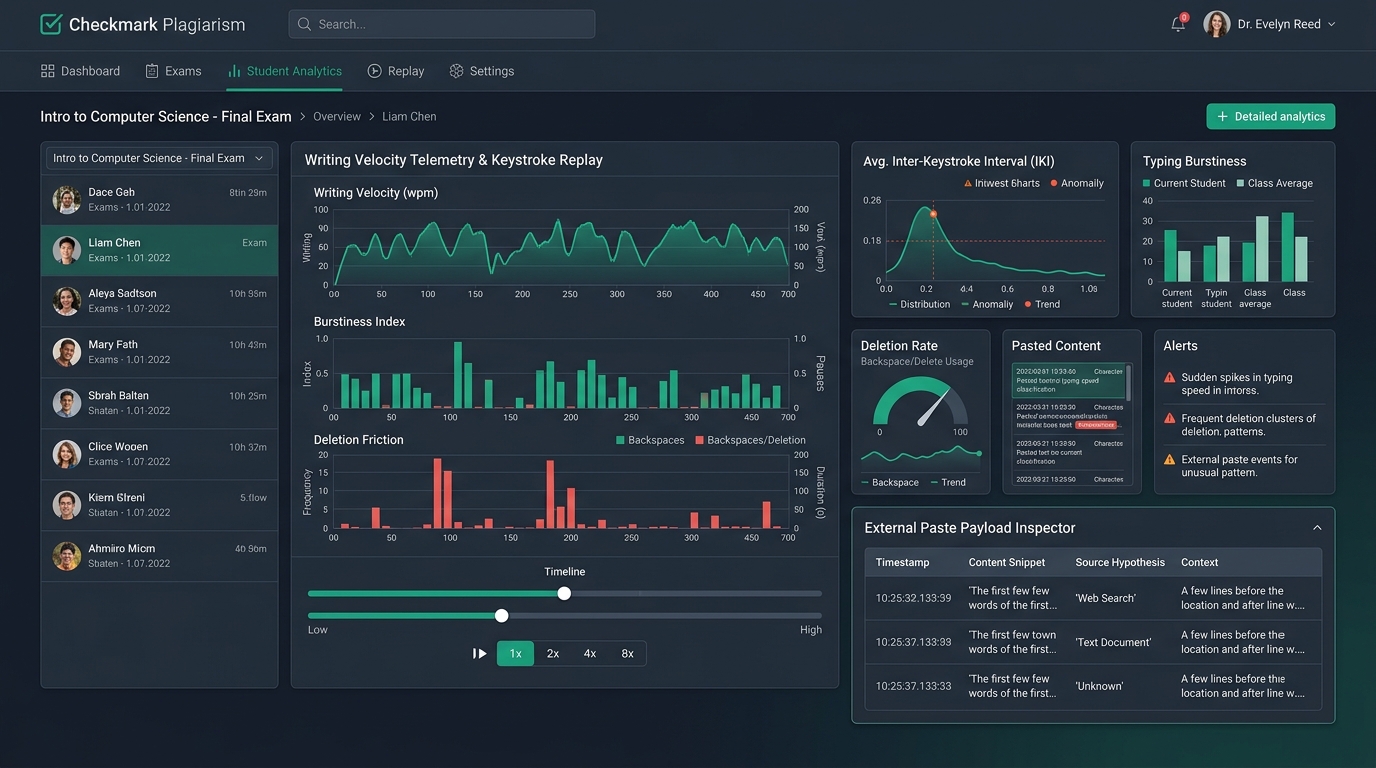
Checkmark Plagiarism empowers two-year higher education faculty and academic integrity committees by uniting patent-pending Essay Playback™, passage-level AI detection with calibrated confidence sliders, side-by-side source comparison, and quote-anchored rubric autograding inside seamless integrations for Canvas LMS SpeedGrader, Moodle, Brightspace, and Buzz.
1. The Asynchronous Assessment Dilemma in Community Colleges
Community colleges represent American higher education’s most accessible gateway. Serving roughly 38% of all undergraduate students in the United States (American Association of Community Colleges, Fast Facts 2026), two-year institutions provide upward economic mobility for non-traditional students, first-generation learners, low-income scholars, working parents, and English as a Second Language (ESL) writers.
Central to this open-access mission is the explosive growth of asynchronous online courses. Asynchronous scheduling allows learners juggling full-time jobs, military service, and family caregiving duties to complete rigorous coursework on their own schedules.
- Asynchronous testing windows accommodating shifts and parenting
- Unproctored home and mobile study environments
- Equitable, barrier-free access on Chromebooks and older PCs
- Timed midterm and final synthesis essays
- Evaluating critical collegiate thinking and textual analysis
- Accreditation compliance for transferable course credit
Instant LLM prompt responses • 0.0-second clipboard paste dumps • Second-screen smartphone transcribing • Text humanizers evading static database matching
Room scans, eye tracking, and biometric AI flag shared family living spaces, induce panic, and, at public institutions, raise Fourth Amendment privacy concerns.
Black-box percentage scores trigger severe false positives on ESL/developmental writers while offering zero primary empirical proof.
1.1 The Collapse of the Static Submission Paradigm
For decades, asynchronous online humanities and social science courses (e.g., English Composition, History, Political Science, Psychology, Sociology, and Philosophy) evaluated mastery through timed essay exams administered via Learning Management Systems (LMS) such as Canvas, Moodle, Brightspace, and Buzz. A typical exam configuration might allow a student a 60-minute window within a 72-hour availability period to compose a 750-to-1,200-word response synthesizing weekly readings and analytical concepts.
In the pre-generative AI era, static text was sufficient. If a student plagiarized, the text matched published web sources or past student papers indexed in academic repositories. Plagiarism detection tools reliably provided side-by-side matching source URLs.
Today, generative large language models (LLMs) can generate nuanced, grammatically polished, prompt-specific collegiate essays in three seconds. When a student copies a prompt into an LLM and submits the output into an LMS text area, the resulting static text file contains zero textual matches in traditional plagiarism databases.
1.2 The 1,200-Word in 4-Minute Anomaly
When community college faculty evaluate asynchronous timed submissions, they frequently encounter glaring velocity anomalies:
The Instant Dump
A student opens an 80-minute midterm at 11:14 PM and submits 1,350 words of polished prose by 11:18 PM—a net output velocity exceeding 337 words per minute.
The Static LMS Deficit
The native LMS SpeedGrader log notes 4 active minutes, but only displays the final static text. Instructors have no built-in visual proof of how the text arrived.
The Black-Box Trap
Generic AI detectors generate an opaque “85% AI” score. Confronted students claim they simply “typed fast,” resulting in an unprovable, adversarial integrity stalemate.
2. The Science of Writing Velocity Telemetry: IKIs, Cognitive Burstiness, and Friction
Writing is not merely an intellectual act; it is a complex psychomotor process governed by cognitive planning, lexical retrieval, syntactic translation, motor execution, and continuous visual-spatial monitoring. Decades of cognitive psychology and psycholinguistic research—from the foundational models of Hayes and Flower to modern computational keystroke logging—demonstrate that authentic human composing leaves an unmistakable, non-linear biometric footprint.
Semantic ideation, thesis formulation, structuring arguments.
Rapid sequential typing of familiar words, chunks, and idioms.
Typo correction, backspaces, syntactic restructuring, repositioning.
2.1 Inter-Keystroke Intervals (IKI)
The fundamental metric of writing telemetry is the Inter-Keystroke Interval (IKI): the precise duration in milliseconds ($t$) elapsed between consecutive key-down/key-up events:
In human keyboard interaction, IKIs are never static or uniformly distributed:
- Intra-Word IKI (Motor Speed): Between letters within a well-rehearsed word (e.g., typing
t-h-eorw-o-u-l-d), typical adult human IKIs range between 80 ms and 220 ms. - Inter-Word IKI (Lexical Selection): At word boundaries (the spacebar), the IKI naturally expands to 250 ms to 600 ms as the brain retrieves the subsequent lexical token.
- Cross-Clause and Syntactic Boundary IKI: At punctuation marks (periods, commas, semicolons, dashes), IKIs routinely extend to 800 ms to 2,500 ms as the writer evaluates grammatical coherence and plans the next syntactic structure.
2.2 Typing Burstiness and Log-Normal Pause Distributions
Human writing does not proceed like a steady water tap; it occurs in episodic bursts, known in cognitive linguistics as Production Bursts (P-Bursts). A P-burst is defined as a sequence of continuous keystrokes bounded by cognitive pauses exceeding an empirical threshold (typically τ ≥ 2.0 seconds).
In genuine asynchronous exam writing, an instructor observing writing velocity telemetry will see frequent short motor bursts, periodic mid-level hesitations (2–4 seconds) as the student recalls lecture concepts, and macro-level cognitive pauses (10–60 seconds) preceding major topic shifts.
2.3 Deletion, Backspace, and Revision Friction
Authentic intellectual composition is inherently messy and non-linear. As writers draft under exam conditions, their evolving thoughts conflict with their initial word choices. This produces Drafting Friction:
- Backspace & Delete Proportions: In authentic human drafting, deletion operations (backspaces, delete keys, highlighted block deletions) account for 10% to 28% of all total keystroke actions.
- Micro-Edits: Correcting accidental typos, letter inversions (e.g., typing
teh→ backspacing 3 times → typingthe), and capitalization corrections. - Syntactic Restructuring: Typing an introductory clause, pausing for 3 seconds, deleting the last four words, and replacing them with a stronger analytical predicate.
- Non-Linear Navigation: Utilizing arrow keys or mouse cursor clicks to reposition insertion points backward into previously written paragraphs to insert omitted qualifiers or fix subject-verb agreements.
3. Diagnostic Typologies: Distinguishing Genuine Human Writing from AI Dumps and Transcription Fraud
By capturing writing velocity and keystroke replay telemetry, community college educators can categorize student exam submissions into three distinct, unambiguous diagnostic profiles:
Keystrokes: [T][h][e][ ][a][r][g][u][m][e][n][t]... [Pause 4.2s] ... [Backspace x 8] [c][l][a][i][m]
Characteristics: High peak gross speed (80–100+ WPM), moderate net velocity (25–45 WPM), log-normal pause curves, 12%–24% deletion friction, dynamic non-linear cursor navigation.
Keystrokes: [Ctrl+V / Paste Event: 842 Words, 4,819 Characters in 0.04 Seconds]
Characteristics: Zero active composition time, instantaneous document population (∞ WPM), 0.0% deletion friction, full raw payload captured in External Paste Inspector.
Keystrokes: [T][h][e][ ][a][u][t][h][o][r][ ][s][t][a][t][e][s][ ][t][h][a][t] (Steady 70 WPM)
Characteristics: Metronomic IKI (~160ms ± 15ms), zero cognitive pauses (>2s) across complex academic terms, <2% deletion friction, 100% linear top-to-bottom progression.
3.1 Profile A: The Genuine High-Velocity Human Writer (Fast Touch-Typist)
Many honest students are exceptionally fast typists who can achieve peak typing bursts of 80 to 110 WPM. Skeptical instructors or crude whole-exam timers might mistakenly suspect these students due to their rapid overall completion times. Writing velocity telemetry cleanly protects and vindicates these students:
| Telemetry Metric | Profile Value (Authentic Fast Typist) | Forensic & Pedagogical Interpretation |
|---|---|---|
| Gross Writing Speed | 65 – 95 WPM | Reflects high typing proficiency and motor dexterity during active P-bursts. |
| Net Exam Velocity | 25 – 45 WPM | Reflects the dampening effect of essential cognitive planning pauses. |
| Pause Distribution | Log-Normal Curve | Extended hesitations (3s to 25s) before new paragraphs, claims, and conclusions. |
| Deletion Ratio | 12% – 24% of keystrokes | Routine typo corrections, backspaces, and rephrased clauses. |
| Typing Rhythm | Variable IKIs | Rapid intra-word speed (110ms) with marked pauses at punctuation and spaces. |
| Timeline Replay | Dynamic & Non-Linear | Visual playback reveals organic drafting, backtracking, and structural edits. |
3.2 Profile B: The Instantaneous Clipboard Payload Dump (0.0s External Paste)
The most prevalent form of asynchronous exam misconduct occurs when a student generates an essay in an external tab (e.g., ChatGPT, Claude, Microsoft Copilot) and pastes the entire output directly into the LMS exam window.
Across the 1,148 words, the writing velocity is effectively ∞ WPM with zero active composition time and 0.0% deletion friction. Checkmark’s External Paste Inspector records the exact timestamp, character count, and raw text payload of the paste event, preserving it even if the student subsequently makes minor surface edits.
3.3 Profile C: Mechanical Second-Screen / Mobile Transcription
To bypass basic paste-detection scripts and copy-paste warnings, sophisticated students employ second-screen transcription. The student positions an external smartphone, tablet, or secondary monitor adjacent to their laptop, generates the response using an LLM, and manually types out the text into the LMS window word-for-word.
While this technique defeats primitive clipboard loggers, it creates a glaring, unmistakable telemetric signature in keystroke replay: The Human Copyist Anomaly.
- Metronomic Keystroke Cadence: The Inter-Keystroke Interval exhibits an unnaturally low standard deviation (σ ≤ 20 ms). The student is not formulating ideas; they are functioning as a human optical character recognition (OCR) device.
- Absence of Cognitive Pauses: Complex, multi-syllabic academic vocabulary (e.g., “phenomenological hermeneutics” or “macroeconomic disequilibrium”) is typed at the exact same uniform velocity as basic conjunctions (“and”, “the”, “but”), with zero preceding pauses for lexical formulation.
- Linear Perfection: The student generates 1,000 words of complex, multi-clause academic prose without ever backspacing to revise a thesis, reorder an argument, or restructure a topic sentence.
4. The Non-Invasive Evidentiary Mandate: Why Surveillance Proctoring Fails Community College Equity Standards
When institutions first encountered online assessment integrity challenges, the initial commercial response was algorithmic webcam surveillance (e.g., remote proctoring vendors employing automated facial tracking, eye-gaze tracking, room scans, audio recording, and automated flagging algorithms).
For community colleges, however, invasive proctoring software has proved ethically untenable, pedagogically counterproductive, and legally perilous.
Community college students frequently live in multi-generational homes, share rooms with siblings, or study while caring for children. Automated proctoring flags ambient background movement and voices as “suspicious anomalies.”
Facial detection algorithms in commercial proctoring tools have documented bias against darker skin tones: a 2022 study (Yoder-Himes et al., Frontiers in Education) found that students with darker skin tones and Black students were flagged for instructor review more often by a widely used proctoring tool. Such tools can lock out students of color or demand excessive lighting that violates basic usability.
Continuous HD video streaming demands high-end CPU power and high-speed broadband. Students relying on loaner Chromebooks or rural hotspots suffer system crashes and dropped exam sessions.
The knowledge that an automated algorithm is tracking eye movements and facial twitches induces severe situational anxiety, impairing working memory and skewing academic performance.
In August 2022, a federal district court in Ohio held in Ogletree v. Cleveland State University that a public university’s webcam scan of a student’s home before a remote exam was an unreasonable search under the Fourth Amendment. It is a single district court decision rather than a binding appellate ruling, but it signals potential legal exposure for public colleges that require room scans.
4.1 The Benign Alternative: In-Editor Writing Telemetry
In contrast to invasive webcam surveillance, in-editor writing process telemetry (as embodied in Checkmark Plagiarism’s Essay Playback™) operates under a completely benign, privacy-first paradigm:
- Zero Biometric or Domestic Surveillance: No webcams, no room scans, no microphone recording, and no facial tracking. The student’s physical body and private living environment remain 100% untouched and unmonitored.
- Artifact-Focused Telemetry: Telemetry captures only the digital interactions occurring inside the LMS text editor itself (character insertions, keystroke timestamps, deletion events, and clipboard operations).
- Equity-Aligned: Telemetry functions identically regardless of whether the student is drafting in a crowded living room, a quiet library cubicle, or a late-night diner on a school Chromebook.
- Transparent & Restorative: Rather than generating an automated punitive flag, telemetry produces a transparent, scrubbable video record of the writing process that student and teacher can review together in a collaborative pedagogical conference.
5. The Asynchronous Exam Evidentiary Matrix
To evaluate how writing velocity telemetry contrasts with legacy academic integrity tools, consider the following comprehensive comparative matrix:
| Evaluation Dimension | Invasive Webcam Proctoring | Generic Probabilistic AI Detectors | Checkmark Essay Playback™ |
|---|---|---|---|
| Primary Data Source | Video/audio feeds, facial tracking, eye-gaze vectors | Static text snapshot evaluated for perplexity & burstiness | Microsecond keystroke dynamics, IKI, deletion friction, paste logs |
| Student Privacy & Dignity | Intrusive: Records bedrooms, ambient noise, biometrics | Neutral: Analyzes submitted text only | Privacy-Preserving: LMS editor only; zero video/audio |
| Socioeconomic & Equity Impact | Disparate Harm: Penalizes shared living spaces, low bandwidth | Disparate Harm: Elevated false-positive rates on ESL writers | High Equity: Universal compatibility with Chromebooks |
| Susceptibility to AI Humanizers | Blind: Cannot detect QuillBot or Undetectable AI | High: Bypassed easily by synonym-swapping tools | Immune: Humanizers cannot fake temporal drafting history |
| Detection of Second-Screen Fraud | Moderate: Flags off-screen eye movements (false alarms) | Zero: Static text appears humanized or unflagged | Definitive: Detects uniform ~160ms IKI cadence & zero pauses |
| Detection of Clipboard Dumps | Basic: Notes tab switching; blind to script bypasses | Zero: Only evaluates final text probability | Absolute: Records 0.0s paste payloads & raw text |
| False-Positive Risk on Fast Typists | N/A (Does not evaluate velocity) | Severe: Concise academic prose flagged as AI | Zero: Burst speed validated by cognitive pause curves |
| Admissibility in Integrity Appeals | Low: Subjective video flags contested by faculty | Unusable: Black-box percentage score rejected by senates | Audit-Ready: Visual, scrubbable keystroke receipts |
| Pedagogical Value for Faculty | Negative: Fosters hostile culture of suspicion | Zero: Provides no insight into drafting habits | Transformative: Reveals cognitive planning & revision |
6. Step-by-Step Community College Instructor Exam Audit Protocol
To implement writing velocity telemetry effectively and ethically, community college instructors and department chairs should adopt a structured, four-phase audit workflow for asynchronous online exams:
Filter submissions by Net Composition Velocity (WPM). Clear organic human writers (15–45 WPM, 10%–25% deletion ratio) for immediate content grading. Flag extreme velocity outliers (>150 WPM) and zero-pause linear transcriptions.
Launch Checkmark Essay Playback™ directly within Canvas SpeedGrader. Scrub through the drafting timeline at 4x or 8x speed to visually verify cognitive hesitations, structural backtracking, and genuine paragraph formulation.
Click flagged paste markers on the playback timeline. Review the raw pasted text in the sidebar inspector to differentiate legitimate study-outline pastes or quotes from unauthorized full-essay AI payload dumps.
Schedule a supportive 10-minute Zoom or office hour conference for ambiguous cases. Share the screen showing the playback timeline, eliminating hostility and fostering honest pedagogical dialogue.
6.1 Phase 1: Triage and Velocity Screening
Following the close of an asynchronous exam window, the instructor opens the course gradebook or Checkmark dashboard. Rather than manually inspecting every submission in identical detail, the instructor applies rapid statistical triage:
- Calculate Net Composition Velocity:
WPMnet = Total Words / Active Composition Minutes - Flag Category 1: Extreme Velocity Outliers (WPMnet > 150): Any submission of 500+ words completed in under 4 minutes indicates an instantaneous clipboard payload dump.
- Flag Category 2: Linear High-Velocity Writers (WPMnet = 55 to 90 with Deletion Ratio < 3%): Identifies potential second-screen transcription.
- Clear Normal Writers (WPMnet = 15 to 45 with Deletion Ratio 10% to 25%): Indicates typical human drafting. These submissions proceed immediately to rubric-based content grading.
6.2 Phase 2: 1x–8x Essay Playback™ Scrubbing
For flagged submissions, the instructor launches Checkmark's patent-pending Essay Playback™ directly inside the LMS grading interface (such as Canvas SpeedGrader):
- High-Speed Timeline Scrubbing (4x to 8x): The instructor fast-forwards through the drafting session in 30 to 45 seconds.
- Visualizing Cognitive Construction:
- In an authentic essay, the instructor watches the thesis emerge, sees the student hesitate, backspace, correct spelling errors, jump down to start a body paragraph, return to the introduction to adjust the scope, and gradually assemble the argument.
- In a transcribed submission, the text appears on screen with the mechanical precision of an automated teletype machine, rolling line-by-line from top to bottom with zero structural restructuring.
6.3 Phase 3: External Paste Buffer Inspection
If an instantaneous paste event appears on the playback timeline, the instructor clicks the paste marker to open the External Paste Inspector:
“The socioeconomic ramifications of the Great Migration fundamentally altered the demographic landscape of Northern industrial centers between 1916 and 1970. According to historical census records...”
6.4 Phase 4: Conducting the Supportive, Restorative Viva Voce Defense Conference
When writing telemetry indicates unauthorized generation or transcription, the instructor avoids sending aggressive, accusatory automated emails. Instead, community college faculty leverage the playback timeline as an objective, shared visual artifact during a supportive viva voce (oral defense) conference.
Instructor: “Hi Alex, thank you for meeting with me during office hours. I'm reviewing your midterm essay on the Great Migration. You raised some fascinating points regarding urban labor shifts. As part of our department's routine assessment verification for asynchronous exams, we look at the writing process playback in Canvas. Let's pull up your session timeline together on my screen.”
(Instructor shares screen showing the Checkmark Essay Playback window)
Instructor: “Here we can see the exam was opened at 10:02 PM, and at 10:04 PM, this 850-word section appeared in a single paste event. Can you walk me through your preparation and drafting process for this essay? How did you formulate this specific argument?”
This approach produces immediate pedagogical benefits:
- Eliminates Denial and Hostility: When students realize the instructor has access to objective, timestamped keystroke telemetry rather than an arbitrary “black-box AI percentage score,” defensiveness dissipates. Students openly acknowledge using external AI tools or pasting pre-generated notes.
- Enables Formative Coaching: The instructor can pivot immediately to restorative education: explaining institutional AI policies, discussing why independent composition is necessary to develop critical thinking skills, and offering an opportunity to complete an alternative proctored or oral assessment under standard departmental policy.
- Creates Defensible Institutional Documentation: If the student pursues a formal academic grievance, the instructor possesses an indisputable forensic dossier containing exact timestamps, IKIs, and paste payloads—fully protecting the faculty member and the academic senate during administrative review.
7. Concrete Case Scenarios: Adjudicating Asynchronous Exam Submissions with Telemetry
To illustrate how writing velocity telemetry operates across diverse community college classroom situations, examine three realistic scenarios:
Scenario A: The High-Speed Essayist Exonerated
POLS 101 MidtermStudent Profile: Jordan, a 20-year-old dual-enrollment student and competitive gamer with touch-typing dexterity exceeding 95 WPM.
The Incident: During a 45-minute timed asynchronous midterm on constitutional checks and balances, Jordan submitted an 880-word essay in 21 minutes. A legacy probabilistic AI detector flagged the paper with a 74% AI generation score due to Jordan's crisp, highly organized five-paragraph rhetorical style.
jusitce → justice), and restructured thesis sentences.Verdict: 100% authentic human composition. The probabilistic detector score was a false positive. Jordan was awarded full credit without enduring an agonizing, unwarranted academic dishonesty charge.
Scenario B: The Smartphone Transcription Unmasked
SOC 101 Final ExamStudent Profile: Marcus, a student enrolled in a fully asynchronous evening section.
The Incident: On a timed final exam prompt requiring analysis of Weber's theory of bureaucratic rationalization, Marcus submitted an impeccably structured 1,050-word essay. Marcus had copied the exam prompt onto his smartphone, generated a response using Claude 3.5 Sonnet, and manually typed the entire essay into the Canvas exam box on his laptop while looking down at his phone screen.
Verdict: Clear second-screen transcription. During a restorative conference, presented with the uniform velocity telemetry graph, Marcus admitted to transcribing from his phone and agreed to rewrite the exam under live supervision.
Scenario C: The Legitimate Study-Outline Hybrid
HIST 102 Open-Book ExamStudent Profile: Elena, an adult learner returning to college while working full-time.
The Incident: The instructor permitted students to utilize their own handwritten or digital lecture notes during the asynchronous open-book exam. In the first two minutes of the exam, Elena pasted 280 words into the text area, which a basic LMS clipboard alert flagged.
Verdict: Fully compliant academic practice. Checkmark's granular timeline prevented a false accusation by establishing that the paste was an authorized study aid rather than an unauthored essay payload.
8. How Checkmark Plagiarism Powers Fair, Defensible Asynchronous Exam Audits
Checkmark Plagiarism (checkmarkplagiarism.com) is built specifically around the pedagogical philosophy of “Stop guessing, start trusting.” Designed to meet the unique equity and access demands of two-year colleges, Checkmark integrates multi-factor forensic evidence into a seamless, educator-first platform.
Reconstructs the full composing session keystroke-by-keystroke. Scrub through hours of drafting in seconds. Color-coded markers highlight cognitive pauses, deletion friction bursts, and clipboard operations.
Captures exact timestamps and preserves 100% of raw pasted payloads. Side-by-side comparison tracks post-paste revisions, exposing attempts to paraphrase AI dumps.
Highlights specific passages paired with confidence sliders (Typical Human Style vs. Typical AI Pattern). Honest N/A disclaimers on short text (<150 words) eliminate unreliable guessing.
Embeds directly within Canvas SpeedGrader, Moodle, Brightspace, and Buzz. FERPA and COPPA compliant architecture guarantees student data is never used to train AI models.
9. Institutional Policy Guide: Aligning Academic Senate Policies with Writing Telemetry
To ensure legal defensibility, equity compliance, and faculty alignment, community college Academic Senates, Distance Education Committees, and Integrity Boards should incorporate the following best practices into their institutional policies:
1. Explicit Syllabus Disclosure of In-Editor Telemetry
TransparencyInform students in course syllabi that online exams utilize non-invasive, in-editor writing process tracking to verify drafting authenticity without webcams or audio surveillance.
2. Ban Standalone Black-Box AI Scores as Primary Evidence
Due ProcessAmend college academic integrity bylaws to state that a probabilistic AI percentage score alone cannot constitute primary grounds for an academic dishonesty sanction. Empirical writing process evidence (e.g., Essay Playback, paste logs) or oral defense is required.
3. Mandatory Viva Voce Conferencing Before Disciplinary Referrals
Restorative PracticeRequire faculty to conduct a restorative 10-minute oral defense conference with the student using the playback timeline before submitting formal disciplinary referrals to the Dean.
4. Clear Distinction Between Collateral Drafting & Authorship Fraud
Clear GuidelinesEstablish clear syllabus guidelines on whether students may pre-draft outlines in external software (e.g., Google Docs) and paste them into timed exams, providing transparent paste guidelines.
10. Frequently Asked Questions (FAQs)
1. How does writing velocity telemetry accommodate students with approved DSPS / Accessibility accommodations (e.g., Speech-to-Text software)?
Students utilizing Assistive Technology (such as Dragon NaturallySpeaking or Apple Voice Control) through Disabled Student Programs and Services (DSPS) produce a unique telemetric profile: text arrives in episodic spoken phrase chunks rather than individual character keystrokes. Checkmark allows instructors to tag student profiles with DSPS accommodation flags. When reviewing speech-to-text submissions, the timeline highlights natural conversational dictation pacing and acoustic pauses, preventing voice-dictated prose from being miscategorized as unauthorized copy-paste dumps.
2. Can a fast human typist be falsely flagged by writing velocity metrics?
No. While a skilled touch-typist may achieve peak motor bursts of 90 to 110 WPM, their overall net composition velocity remains dampened by natural cognitive pauses (hesitations at paragraph boundaries, idea formulation, and syntactic planning) and standard deletion friction (10% to 25% backspaces). Checkmark's Essay Playback™ visually proves the student's organic drafting progression, protecting fast human typists from the false-positive accusations commonly triggered by generic AI detectors.
3. What if a student drafts their exam in an offline text editor and pastes it into the LMS at the end of the timed window?
If a student drafts their essay in an external document (e.g., Microsoft Word, Google Docs, or Apple Notes) and pastes it into the LMS exam window, Checkmark's External Paste Inspector will log the paste event. If the student's course policy permits external drafting, the student can simply provide their native Google Docs revision history or Word version history during their restorative viva voce conference. To prevent confusion, faculty should explicitly instruct students in the exam directions to compose directly within the LMS editor.
4. Does Checkmark's keystroke replay require installing intrusive software or browser extensions on student devices?
No. Checkmark's writing telemetry operates entirely within the standard LMS web text editor (Canvas, Buzz, Moodle) via native JavaScript event listeners. Students do not need to install intrusive third-party spyware, kernel-level drivers, or browser plugins. It runs seamlessly on any device, including managed school Chromebooks, iPads, and older home computers.
5. How does keystroke replay defeat online “AI Humanizers” and paraphrasing tools?
Online AI humanizers (such as QuillBot, Undetectable AI, or HideMyAI) work by replacing words with synonyms and shuffling syntax to lower probabilistic perplexity scores on static text detectors. However, they cannot fake the human writing process. When a student generates humanized text, they must still either paste it into the exam (triggering an instant 0.0s paste flag) or manually transcribe it (generating a mechanical ~160ms IKI cadence with zero cognitive pauses). Checkmark audits the act of creation, making it completely immune to surface text manipulation.
6. What is the faculty workload impact of auditing keystroke telemetry across large community college class sections?
Checkmark minimizes faculty grading time through automated velocity triage. Faculty do not need to watch hours of real-time writing. The system automatically categorizes normal, organic human writing (which constitutes the vast majority of submissions), allowing instructors to immediately grade them via the AI Autograder or custom rubric. Instructors only need to spend 30 to 45 seconds scrubbing through the 8x playback timeline for the 2–3 anomalous submissions per section that exhibit extreme velocity or paste flags.
7. How does Checkmark comply with FERPA and student data privacy regulations?
Checkmark Plagiarism is fully FERPA and COPPA compliant. Student submissions, keystroke telemetry, and exam artifacts are encrypted both in transit (TLS 1.3) and at rest (AES-256). Crucially, Checkmark maintains a strict zero-retention architecture: student intellectual property and exam responses are never used to train public or proprietary AI models, preserving institutional data sovereignty and student digital privacy rights.
11. Conclusion: Restoring Trust and Rigor in Open-Access Distance Education
The promise of community college distance education has always been accessibility without compromise—delivering flexible, transformative collegiate learning to students who cannot attend traditional on-campus classes. Preserving this mission in the era of generative artificial intelligence requires academic integrity tools that honor the dignity and diversity of two-year college students.
By replacing intrusive webcam surveillance and unreliable black-box detectors with Writing Velocity Telemetry and Essay Playback™, community college educators can:
- Defend Collegiate Rigor: Ensure that credit conferred in asynchronous humanities and social science courses represents independent, unassisted critical thinking.
- Uphold Equity and Privacy: Eliminate discriminatory, anxiety-inducing webcam surveillance in favor of benign, in-editor telemetry that works on any device and in any home environment.
- Foster Restorative Pedagogy: Replace arbitrary suspicion and adversarial cheating accusations with transparent, evidence-based student conferences built on objective drafting “receipts.”
Ready to Bring Defensible, Non-Invasive Writing Telemetry to Your College?
Experience how Checkmark Plagiarism empowers community college faculty, protects honest writers, and streamlines asynchronous exam integrity directly within Canvas LMS and standard web browsers.