
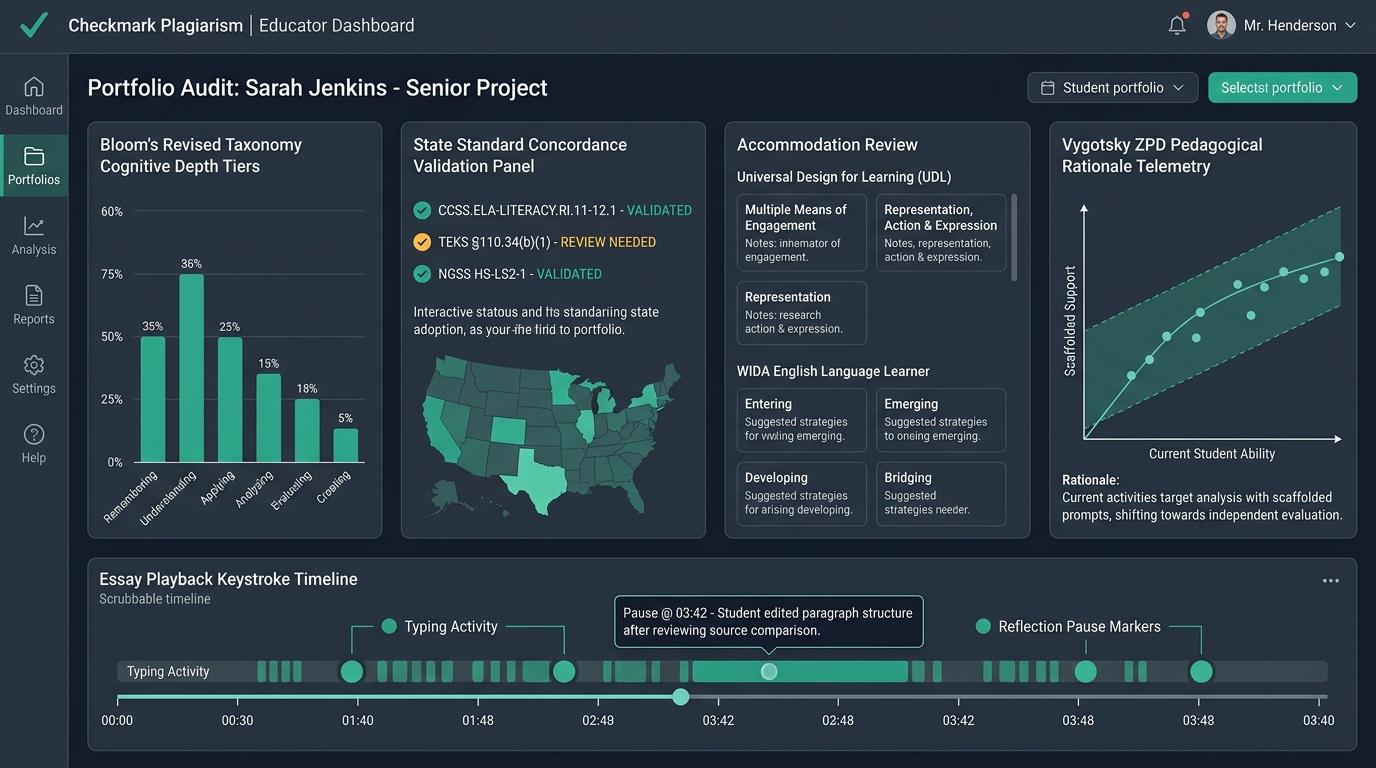
Executive Summary & CTE Integrity Mandate
In secondary Career and Technical Education (CTE) Education and Training pathways and high school Teacher Cadet / Teacher Academy programs, competitive portfolios for Educators Rising National Competitions (specifically Lesson Planning and Delivery: Arts, CTE, Humanities, and STEM, Children’s Literature, and Exploring Education Careers) require students to demonstrate authentic, professional-grade pedagogical competence. Future educators must submit rigorous 3-to-5-page written lesson plans and theoretical rationales detailing Bloom’s Taxonomy objective alignment, state academic standards (CCSS, NGSS, TEKS, SOL), Universal Design for Learning (UDL) frameworks, WIDA English Language Learner (ELL) modifications, and developmental learning theories (Vygotsky’s ZPD, Piaget, Bandura, Bruner).
However, under the crunch of regional, state, and national competition deadlines, high school teacher cadets frequently prompt Large Language Models (LLMs) to synthesize lesson portfolios. These generative AI submissions invariably exhibit fatal pedagogical flaws: hallucinated or non-existent state standard codes, cookie-cutter IEP/ELL accommodations disconnected from actual developmental levels, fabricated theoretical citations, and superficial rationales that collapse during the live 10-minute judge oral presentation and Q&A defense.
Traditional “black-box” whole-document AI percentage detectors fail catastrophically in education pathways by triggering aggressive false positives on standardized pedagogical terminology (scaffolding, formative assessment, differentiation, Bloom’s Taxonomy) while remaining blind to AI-generated instructional reasoning. Checkmark Plagiarism provides high school Educators Rising advisers with an objective, defensible verification suite: combining passage-level linguistic confidence analysis with patent-pending Essay Playback™ (1x–8x keystroke revision replay), raw external paste payload preservation, and quote-anchored rubric autograding. This enables CTE faculty to audit lesson design authenticity, protect students from false accusations, and prepare confident future teachers for podium-winning competitive defenses.
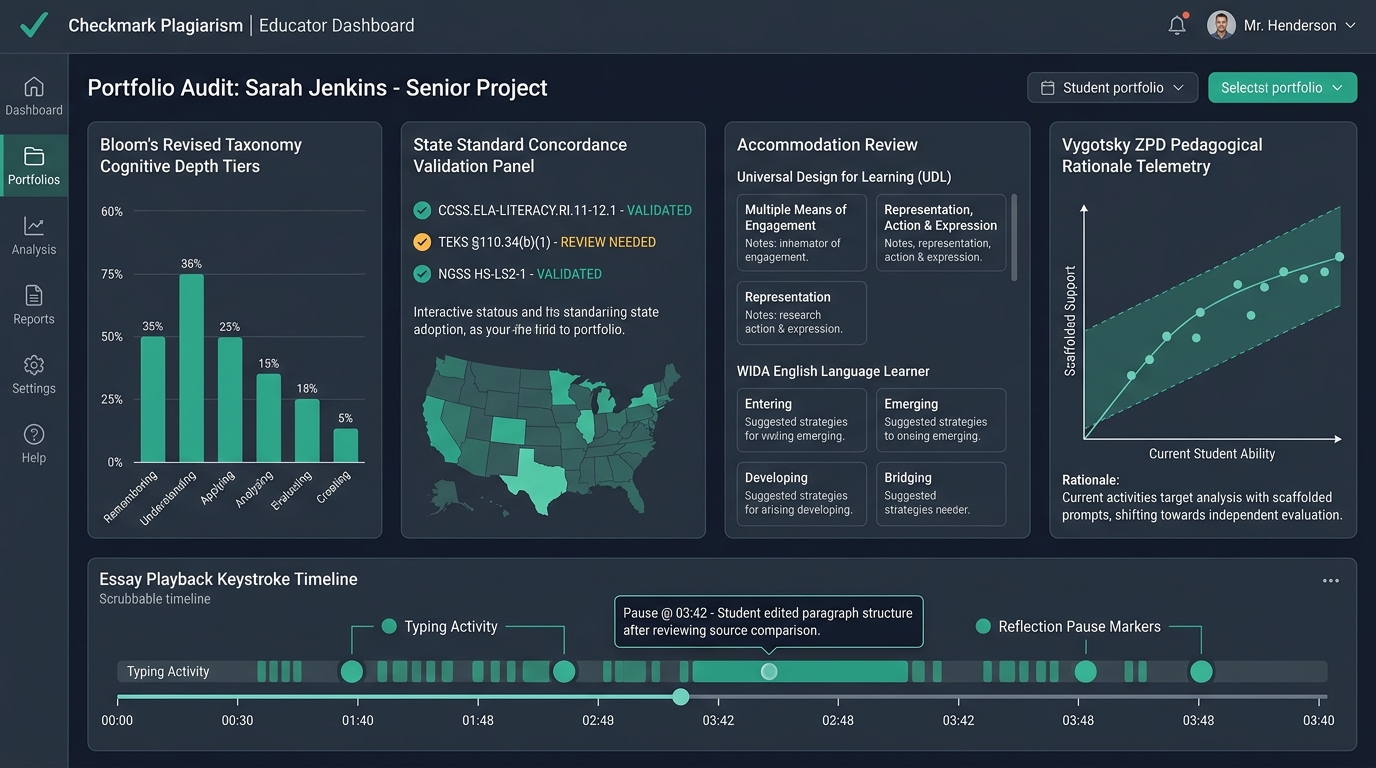
Checkmark Plagiarism equips secondary Education & Training departments, Teacher Cadet academies, and CTSO chapter advisers with an integrated suite combining patent-pending Essay Playback™, passage-level AI detection, side-by-side curricular source comparison, quote-anchored rubric autograding, and direct LMS integrations with Canvas LMS, Google Classroom, and Buzz LMS.
1. Educators Rising National Standards & Competitive Portfolio Architecture
Secondary Career and Technical Education (CTE) Education and Training programs—often designated as Teacher Academy, Teacher Cadet, Future Educators, or Teaching Professions pathways—serve as the premier pipeline for the nation’s future PK–12 teaching workforce. Affiliated nationally with Educators Rising (a division of PDK International), these programs culminate in rigorous competitive events across district, regional, state, and national leadership conferences.
High school competitors in Educators Rising participate in signature competition categories:
- Lesson Planning and Delivery (Arts, CTE, Humanities, STEM): Students design, document, and execute an authentic 30-to-45-minute lesson, submitting a comprehensive written portfolio and delivering a 10-minute presentation followed by a 5-minute judge Q&A.
- Children’s Literature (Pre-K and K–3): Competitors author, illustrate, and defend an original children’s book aligned with developmental literacy benchmarks.
- Exploring Education Careers (Administration, Non-Core, Training): Research-based job shadowing and institutional analysis portfolios.
- Impromptu Lesson Planning & Interactive Bulletin Board: Fast-turnaround instructional design challenges requiring immediate pedagogical justification.
Section 1: Curricular Design
- ABCD Measurable Objectives
- Bloom’s Revised Taxonomy Depth
- State Standard Concordance (CCSS/TEKS)
- Assessment Alignment (CFUs & Rubrics)
Section 2: Instructional Delivery
- Anticipatory Set / Schema Hook (3–5 min)
- Direct Instruction / Modeling (I Do, 10–12 min)
- Guided Practice / Peer Dyads (We Do, 10–15 min)
- Independent Practice / Closure (You Do, 10–12 min)
Section 3: Learner Scaffolding
- IEP / 504 Modification Protocols
- WIDA Can-Do ELL Descriptors (Levels 1–6)
- Gifted / Talented Extension Scaffolds
- UDL Multi-Modal Multi-Entry Architecture
Section 4: Theoretical Justification & Pedagogical Rationale (3–5 Pages Written Reflection)
1.1 Anatomy of a Competition-Grade Written Lesson Plan
To score in the top percentile on national rubrics, a high school teacher cadet’s written portfolio must strictly follow the standard lesson architecture mandated by national competition guidelines:
A. Objectives & Alignment using Bloom’s Revised Taxonomy
Objectives cannot simply state “Students will understand fractions.” They must follow the rigorous ABCD Objective Format (Audience, Behavior, Condition, Degree) anchored in measurable Bloom’s cognitive domains:
Grade 10 Biology Students / Grade 3 Dual-Language Learners / Grade 7 Algebra I Cadets.
Analyze, Differentiate, Synthesize, Construct, or Evaluate (avoiding unmeasurable verbs like know or learn).
Given a primary source excerpt, a digital PHET simulation, or a manipulative balance scale.
With 80% accuracy on the formative exit ticket, or meeting 4 out of 5 rubric criteria.
Common Core (CCSS)
ELA/Literacy (e.g., CCSS.ELA-LITERACY.RL.9-10.3) and Mathematics (e.g., CCSS.MATH.CONTENT.HSA.CED.A.1) with explicit grade-band progression.
Next Generation Science (NGSS)
Three-dimensional learning integrating Disciplinary Core Ideas (DCIs), Science and Engineering Practices (SEPs), and Crosscutting Concepts (CCCs) (e.g., HS-LS1-2).
State Curricular Frameworks
Texas Essential Knowledge and Skills (TEKS), Virginia Standards of Learning (SOL), Florida B.E.S.T., and California Content Standards.
Activating prior cognitive schema, posing a compelling driving question, or hook activity.
Explicit teacher modeling, metacognitive think-alouds, and multimodal concept presentation.
Collaborative peer structures (think-pair-share, tiered small groups) with active checks for understanding.
Authentic individual task execution allowing students to demonstrate targeted mastery.
Metacognitive debrief, student summarization, and formative exit ticket administration.
1.2 The Written Pedagogical Rationale & Reflection (3–5 Pages)
The written pedagogical rationale is the intellectual core of the Educators Rising portfolio. It represents the student’s ability to articulate why specific instructional decisions were made, linking practical classroom methods to foundational educational psychology and developmental science:
| Educational Framework | High School Cadet Application in Lesson | Hallmarked AI Generic Prompt Output |
|---|---|---|
| Vygotsky’s ZPD & Social Constructivism | Cadet designs tiered graphic organizers with graduated release of support during guided practice; peer dyads paired by WIDA proficiency bands. | LLM states “This lesson uses Vygotsky’s ZPD by having students work in groups to learn from each other in their zone.” (Lacks specific scaffolding mechanics). |
| Piaget’s Cognitive Developmental Stages | Adapts abstract chemical bonding into physical ball-and-stick manipulatives to transition 9th graders from concrete to formal operational reasoning. | LLM states “Students are in Piaget’s concrete operational stage, so hands-on activities help their cognitive growth.” (Fails to address formal operational shift). |
| Universal Design for Learning (UDL) | Provides closed captions, speech-to-text options, and dual-modality exit choices (audio recording or graphic sketch). | LLM lists generic UDL bullet points: “Provide multiple means of engagement, representation, and expression.” |
| Bandura’s Social Learning Theory | Implements instructor think-alouds and video exemplars to build student self-efficacy prior to unassisted laboratory execution. | LLM notes “Bandura’s social learning is used through teacher modeling of behavior.” (Zero operational think-aloud detail). |
2. The Acute Classroom Dilemma: Future Teacher Cadets & Generative AI Pressures
High school Education & Training instructors manage an intensely crowded schedule. A typical high school Teacher Academy teacher oversees:
- 120–150 students across multiple class periods (Child Development, Principles of Education, Instructional Practices, Practicum in Education).
- Daily field logistics: Coordinating high school cadets traveling off-campus to elementary and middle school field placements for 60 to 100 mandatory practicum hours.
- CTSO Chapter Advising: Advising an active Educators Rising chapter with 15–30 competitive entries heading into Regional, State (SLC), and National (NLC) conferences.
The “Competition Crunch”
High school cadets are high-achieving juniors and seniors balancing dual-enrollment college coursework, athletic commitments, practicum mentor duties, and college applications. When the portfolio submission deadline looms, cadets face the daunting prospect of authoring a 15-to-25-page comprehensive instructional packet including detailed lesson plans, custom rubrics, student work sample analyses, and a 4-page pedagogical justification.
Under severe deadline stress, cadets open ChatGPT, Claude, or Gemini and enter a single prompt:
“Write a complete 10th-grade Educators Rising Lesson Planning and Delivery portfolio for English Language Arts on teaching characterization in The Great Gatsby, aligned to Common Core standards, with UDL differentiation, IEP/ELL accommodations, and a 3-page pedagogical rationale citing Vygotsky and Piaget.”
Within 45 seconds, the AI outputs an apparently immaculate, highly articulate portfolio. The cadet copies the text into Google Docs, adjusts formatting, and submits the binder to their chapter adviser.
2.1 The Four Critical AI Failure Modes in Cadet Lesson Portfolios
When advisers and judges look beneath the surface of AI-generated lesson planning portfolios, four glaring, disqualifying failure modes emerge:
The 4 Critical Generative AI Failure Modes in Cadet Portfolios
Large Language Models generate text based on probabilistic token associations. When asked for state-specific standards (such as Texas TEKS, Virginia SOL, or California Content Standards), LLMs frequently confabulate alphanumeric codes that sound authoritative but are completely fabricated (e.g. TEKS ELA.10.4.C.ii). In official state databases, no such subclause exists. Submitting a non-existent standard code results in immediate point deductions under the National Educators Rising Scoring Rubric.
LLMs routinely produce generic, superficial accommodation lists (“Give 504 student extra time; provide Spanish dictionary to ELLs”) that reveal a complete lack of genuine classroom empathy and legal compliance. In contrast, an authentic cadet writes: “For Student J (WIDA Level 2 - Emerging), I provided a bilingual visual sentence frame with tiered word banks isolating character trait adjectives alongside L1 cognates.”
When prompted for theoretical justifications, LLMs frequently misapply developmental stages (e.g., citing Piaget’s “Preoperational Stage” for 11th-grade AP Chemistry students) or invent non-existent journal citations (e.g., “Vygotsky, L. (1988). Modern Scaffolding Techniques in High School Classrooms”—even though Vygotsky passed away in 1934).
At State and National Leadership Conferences, written portfolios are evaluated alongside a live 10-minute presentation and 5-minute judge cross-examination. When veteran principal judges ask: “I noticed you chose a heterogeneous fishbowl discussion for guided practice. How did your anticipatory set formative data determine who entered the inner circle first?”—cadets who used AI freeze, offer vague platitudes, and suffer catastrophic rubric point losses.
3. The CTSO Ethics & Scoring Rubric Dilemma
The Educators Rising National Competition guidelines enforce strict academic integrity policies. Competition rubrics allocate significant scoring weight to original instructional design, standard concordance, and theoretical justification:
| Rubric Dimension | Point Value | AI Generation / Integrity Vulnerability |
|---|---|---|
| 1. Lesson Plan Architecture & Objective Alignment | 20 Points | Hallucinated standard codes; unmeasurable Bloom’s verbs; unrealistic instructional pacing. |
| 2. Pedagogical Rationale & Learning Theory | 25 Points | Superficial ed-psych buzzwords; fake citations; disconnected theoretical claims. |
| 3. Differentiation & Learner Accommodations | 20 Points | Generic platitudes; missing WIDA bands; non-compliant special education modifications. |
| 4. Oral Presentation & Instructional Delivery | 20 Points | Disconnect between spoken presentation demonstration and written portfolio claims. |
| 5. Judge Cross-Examination & Q&A Defense | 15 Points | Inability to defend instructional choices or formative checks under direct questioning. |
| TOTAL COMPETITION SCORE | 100 Points | Academic Dishonesty Penalty: -20 Pts to Complete Disqualification |
“All competition participants must certify that the submitted lesson plans, curriculum artifacts, and pedagogical rationales represent their own original instructional thinking. Plagiarism, unauthorized generative AI synthesis of reflective rationales, or fabrication of classroom data constitutes grounds for severe score deductions or full event disqualification.”
3.1 Why Generic AI Detectors Fail Catastrophically in CTE Education
Faced with potential AI use, some advisers run cadet portfolios through generic “black-box” AI percentage checkers (e.g., Turnitin AI Score, GPTZero). In secondary Education & Training pathways, this approach creates profound pedagogical harm:
1. False Positives on Standard Pedagogical Jargon
Generic detectors flag standardized educational terminology: “Universal Design for Learning”, “Zone of Proximal Development”, “Bloom’s Revised Taxonomy”, “Formative Assessment”, “Anticipatory Set”, “Scaffolding”. Because these standard phrases appear frequently across educational corpuses, honest cadets who use correct academic vocabulary receive 70%–90% “AI-detected” false positive flags.
2. Blindness to Paraphrased & Humanized AI Lessons
Students using prompt modifiers (“Write in the voice of a high school junior”) or paraphrasing tools bypass generic detectors completely. The detector outputs a “0% AI” clean score, yet the lesson plan contains hallucinated standards, unworkable timings, and sterile pedagogical rationales that will fail during judge Q&A.
High school advisers cannot rely on an arbitrary percentage score to make high-stakes integrity decisions. Advisers need transparent, chronological, and defensible writing telemetry that visualizes the student’s authentic instructional design process.
4. The High School CTE Education Evidentiary Matrix
To evaluate student portfolios accurately, advisers require a multi-dimensional evidentiary framework that contrasts traditional methods with modern writing process telemetry:
| Evaluation Dimension | Traditional Paper Binders | Generic AI Percentage Detectors | Google Docs Version History | Checkmark Writing Telemetry & Essay Playback™ |
|---|---|---|---|---|
| Standard Code Verification | Manual adviser review against state databases. | Incapable; treats hallucinated codes as valid text. | Shows static text edits without code validation. | Highlights standard codes; enables side-by-side database concordance audit. |
| Pedagogical Rationale Integrity | Advisers must guess if rationale reflects student thought. | Assigns an arbitrary percentage; zero pedagogical insight. | Shows large multi-paragraph chunk additions without timing. | Visualizes reflection pauses, phrase-by-phrase construction, and ZPD justifications. |
| Keystroke & Revision Velocity | Non-existent; only final printed draft is visible. | Non-existent; analyzes only static text strings. | Coarse revision snapshots (every 15–30 min); collapses edits. | Keystroke-level replay (1x–8x); captures every deletion, word replacement, and revision burst. |
| Paste Payload Attribution | Undetectable once printed. | Blind to paste origin; easily fooled by manual typing. | Identifies large block pastes but loses original clipboard source. | Timestamped paste preservation; stores full raw clipboard payload even if cadet retypes or edits. |
| Judge Q&A Defense Preparation | Relies on simulated mock presentations. | Provides zero coaching data for oral defense. | Inadequate for diagnosing student comprehension gaps. | Pinpoints areas where cadet struggled during drafting, allowing targeted adviser Q&A coaching. |
| FERPA & Privacy Compliance | Fully compliant (physical documents). | Risky; many vendors cache student data to train models. | District-managed Google Workspace compliance. | Zero-retention architecture; student work is never cached or used to train general AI models. |
5. Step-by-Step Educators Rising Adviser Audit Protocol
High school Educators Rising advisers, CTE department chairs, and Teacher Cadet coordinators should implement this systematic 5-step audit protocol before certifying competitive portfolios for district, state, or national submission:
Verify standard alphanumeric codes against official state/national repositories (CCSS, NGSS, TEKS, SOL).
Audit IEP/504 and ELL accommodations for authentic WIDA descriptors, grade-level realism, and specificity.
Review writing telemetry at 2x–4x speed to verify authentic composing pauses, drafting struggle, and edits.
Inspect all timestamped external paste events to verify source material (curriculum guidelines vs. LLM text).
Conduct supportive, one-on-one coaching conferences to rehearse judge cross-examination defense.
Step 1: Curricular Standard Concordance Audit
Before reviewing instructional strategies, advisers must verify that every cited standard code actually exists:
- Open the state department of education curriculum repository (e.g., Texas TEA TEKS portal, Virginia Department of Education SOL database, Common Core State Standards directory).
- Cross-reference the exact alphanumeric string in the cadet’s portfolio (e.g., CCSS.ELA-LITERACY.RI.11-12.7).
- Confirm that the grade band, subject area, and standard description match the official state framework word-for-word. Any divergence in standard numbering is a high-probability indicator of LLM hallucination.
Step 2: UDL & Learner Profile Feasibility Check
Evaluate whether the student’s differentiation plan reflects genuine classroom understanding:
- WIDA English Language Proficiency Alignment: Does the plan specify the student’s proficiency level (Level 1 Entering through Level 6 Reaching)? Are the scaffolds aligned with official WIDA Can-Do Descriptors (e.g., using graphic representations for Level 2 vs. linguistic sentence stems for Level 4)?
- IEP/504 Specificity: Are the accommodations targeted to specific learning challenges (e.g., providing chunked reading guides and frequent checks for understanding for ADHD/Executive Functioning), rather than vague, one-size-fits-all bullet points?
- Pacing & Developmental Realism: Is a 45-minute lesson overloaded with 9 distinct activities that no real classroom teacher could execute? LLMs frequently pack unrealistic quantities of content into short timeframes.
Step 3: Keystroke Velocity & Reflection Replay with Essay Playback™
Using Checkmark’s patent-pending Essay Playback™, advisers can scrub through the entire writing session at 1x to 8x speed:
Authentic Cadet Drafting Profile (Checkmark Telemetry)
- Pacing: Variable typing bursts (30–55 WPM) punctuated by extended cognitive reflection pauses (45–180 sec).
- Revision: High backspace and cursor movement velocity (>15%); student rewrites learning objectives multiple times.
- Reflection Pauses: Long pauses occur during the “Pedagogical Rationale” section as cadet connects theory to practicum experiences.
Synthetic / AI-Transcribed Profile
- Pacing: Unbroken, mechanical keystroke stream (65–85 WPM) with zero reflective hesitation.
- Revision: Near-zero backspaces (<2%); words appear in perfect syntactic order without structural rewrites.
- External Paste Payload: 1,500 words inserted in a single timestamped event (0.2 seconds).
Authentic pedagogical drafting is messy. When a high school student writes a lesson rationale, they pause frequently to look up standard documents, wrestle with Vygotskian scaffolding terminology, delete awkward phrasing, and reorganize their instructional sequence. Essay Playback™ visually surfaces this natural cognitive struggle.
Step 4: External Paste Buffer & Payload Inspection
Checkmark’s External Paste Inspector captures and preserves the full text of every external paste event, complete with timestamps:
- Legitimate Pastes: Pasting the official, unedited text of a state academic standard code directly from the Department of Education website, or pasting an excerpt from a district-approved textbook.
- Unauthorized Generative AI Pastes: Pasting an entire 4-page pedagogical rationale or a complete 5E lesson plan in a single 0.2-second operation. Even if the cadet subsequently edits or rewords the pasted text, Checkmark preserves the original raw payload for adviser review.
Step 5: Restorative Microteaching Debrief & Mock Judge Q&A
If writing telemetry reveals suspicious external pastes or AI-generated sections, the adviser does not issue a punitive accusation. Instead, the adviser conducts a restorative coaching conference:
- Open the Playback Replay Together: Review the writing timeline alongside the cadet in a supportive setting.
- Conduct Mock Judge Cross-Examination: Ask the cadet to verbally explain the instructional rationale behind the flagged passages:
“Walk me through why you chose this specific formative assessment strategy during guided practice. How does it provide feedback for your Level 3 ELL students?”
- Targeted Revision & Growth: If the cadet struggles to defend the text, use the moment as an authentic learning opportunity. Guide the cadet to rewrite the rationale in their own authentic voice, drawing directly from their experiences in their elementary or middle school practicum classroom.
6. How Checkmark Plagiarism Empowers High School CTE Education Faculty
Checkmark Plagiarism is engineered specifically to meet the high-stakes needs of secondary CTE Education & Training programs, Teacher Cadet academies, and CTSO chapter advisers:
1. Passage-Level Confidence
Underlines specific sentences and paragraphs with calibrated confidence indicators. Eliminates black-box percentage scores and protects authentic educational vocabulary (Bloom’s, ZPD, UDL).
2. Essay Playback™ (1x–8x)
Reconstructs the complete writing process keystroke-by-keystroke. Visualizes authentic drafting struggle, organic revision bursts, and cognitive reflection pauses.
3. External Paste Inspector
Captures all clipboard insertions with exact timestamps. Preserves full original pasted text even if the student rewrites every sentence afterwards.
4. Rubric Autograding & LMS Passback
Evaluates draft lesson plans against Educators Rising National Scoring Rubrics. Generates criterion-specific justifications anchored in student prose; syncs to Canvas, Classroom, and Buzz LMS.
5. Enterprise Privacy & Zero-Retention Guarantee
100% FERPA and COPPA compliant. Student lesson plans, portfolios, and writing telemetries are encrypted in transit and at rest and are never cached, shared, or used to train commercial AI models.
6.1 Protecting Honest Teacher Cadets During Parent-Adviser Conferences
When an eager future educator uses sophisticated pedagogical vocabulary (e.g., metacognitive monitoring, heuristic scaffolding, phonemic awareness), generic AI detectors often flag their work as “AI-generated.”
With Checkmark, the adviser can open Essay Playback™ during a department chair or parent conference and demonstrate the student’s 4-hour, keystroke-by-keystroke composition history. The visual record of typing pauses, structural rewrites, and deliberate word choices provides incontrovertible, defensible proof of authentic student authorship.
7. Frequently Asked Questions (FAQ)
1. How does Checkmark prevent false positive AI flags on standard educational terminology like “Bloom’s Taxonomy” or “Universal Design for Learning”?
Generic whole-document detectors rely on whole-text statistical perplexity and burstiness. Because standard educational frameworks appear frequently across the internet, generic tools mistakenly identify these required phrases as AI-generated text. Checkmark uses passage-level linguistic confidence analysis combined with Essay Playback™ writing telemetry. Checkmark isolates terminology in context, allowing advisers to evaluate the surrounding authentic sentence construction and verify the physical keystrokes used to draft the passage.
2. Can cadets use generative AI ethically during competitive lesson planning preparation?
Yes, under clear adviser guidelines. Ethical AI use in CTE Education includes using LLMs as brainstorming partners (e.g., generating creative anticipatory set hook ideas or suggesting diverse primary source texts). However, the cadet must independently author the lesson objectives, select the standard codes, design the assessment rubrics, and write the pedagogical rationale. Checkmark’s writing telemetry clearly differentiates between external brainstorming and cut-and-paste authorship fraud.
3. What is the difference between Google Docs Version History and Checkmark Essay Playback™?
Google Docs native version history captures coarse, intermittent snapshots (typically every 15 to 30 minutes) and merges hundreds of edits into single static blocks. It cannot capture real-time typing rhythm, fine-grained pause durations, or the exact contents of deleted text. Checkmark’s patent-pending Essay Playback™ records every single keystroke, deletion, cursor repositioning, and paste event, allowing advisers to scrub through the writing timeline like a video at 1x to 8x speed.
4. How can chapter advisers verify that cited state standards (TEKS, CCSS, NGSS, SOL) are genuine?
Advisers should conduct a standard concordance audit during Step 1 of the audit protocol. By cross-referencing the cadet’s cited standard code against the state department of education’s official searchable database, advisers can instantly detect hallucinated standard numbers or fabricated grade-level expectations commonly produced by LLMs.
5. What should an adviser do if a cadet pasted an AI-generated pedagogical rationale into their competition binder?
Advisers should adopt a restorative, coaching-oriented approach. Use Checkmark’s paste inspector to review the timestamped payload privately with the student. Frame the conversation around competition readiness: explain that an ungrounded, AI-generated rationale will collapse under live judge cross-examination during the 10-minute presentation. Guide the cadet to rewrite the rationale using their authentic practicum experiences and real student interactions.
6. How does Checkmark integrate with high school LMS platforms like Canvas, Google Classroom, and Buzz LMS?
Checkmark integrates seamlessly via LTI 1.3 Advantage protocols and Google Workspace extensions. High school instructors can launch Checkmark directly within Canvas SpeedGrader, Buzz LMS, or Google Classroom, viewing writing process telemetries and syncing teacher-approved rubric evaluations directly into the gradebook with one click.
7. Does Checkmark store or train AI models on student lesson plans and portfolios?
No. Checkmark maintains a strict zero-retention architecture. Student submissions, lesson plans, and competition portfolios are encrypted in transit and at rest and are never cached, shared, or used to train general commercial or open-source AI models, ensuring complete compliance with FERPA, COPPA, and district data privacy agreements.
Conclusion: Stop Guessing, Start Trusting Future Educators
The mission of high school Career and Technical Education and Educators Rising chapters is to cultivate passionate, highly skilled, and reflective classroom teachers. In an era where generative AI can synthesize lesson plans in seconds, high school chapter advisers need tools that foster genuine instructional mastery rather than punitive suspicion.
By combining curricular standard audits, UDL feasibility reviews, and Checkmark’s patent-pending Essay Playback™ writing telemetry, CTE educators can move beyond the anxiety of black-box AI scores. High school advisers can verify authentic pedagogical rationales with total confidence, protect honest cadets from false accusations, and send poised, articulate future teachers to the national competition podium.
Empower Your Future Teachers with Verifiable Integrity
Equip your secondary Education & Training department with patent-pending Essay Playback™, passage-level AI detection, and quote-anchored rubric autograding. Protect student integrity and elevate competition readiness.