
Executive Summary
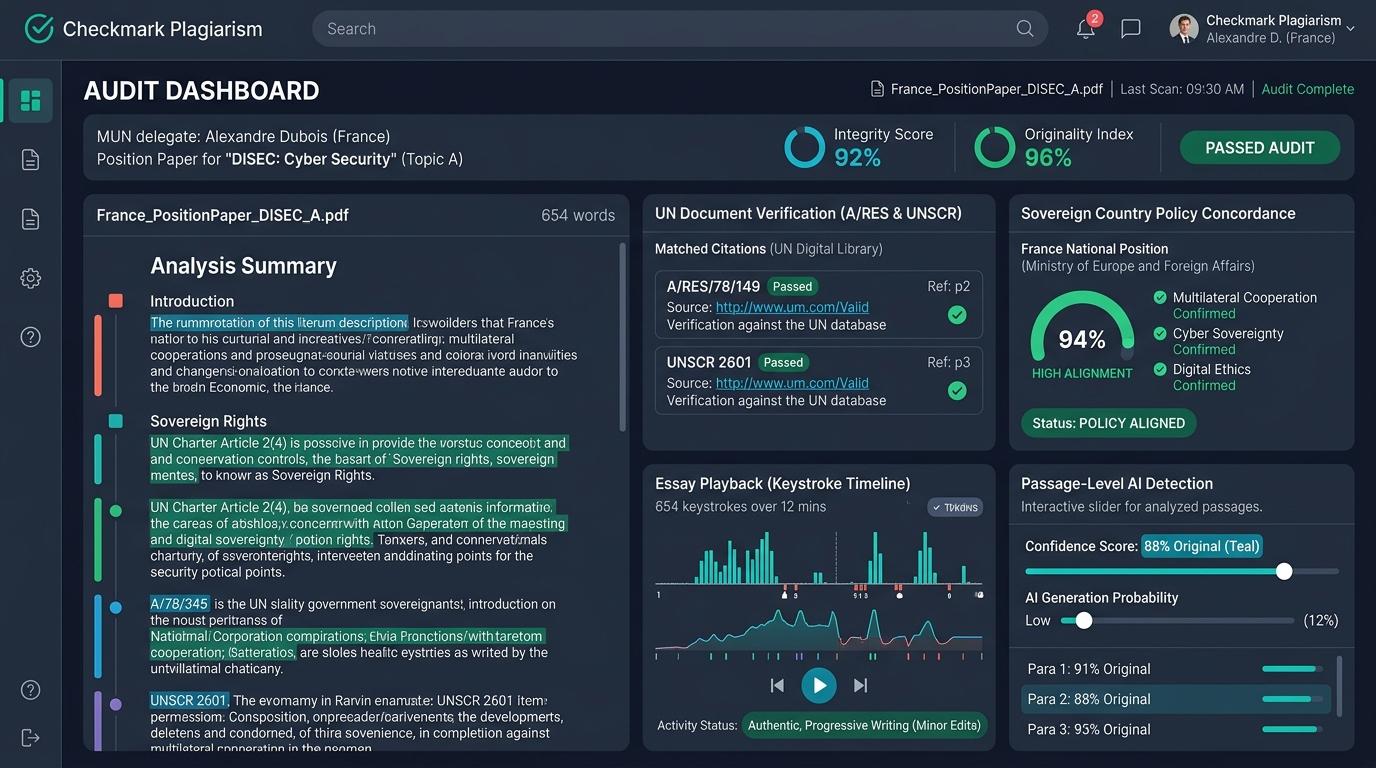
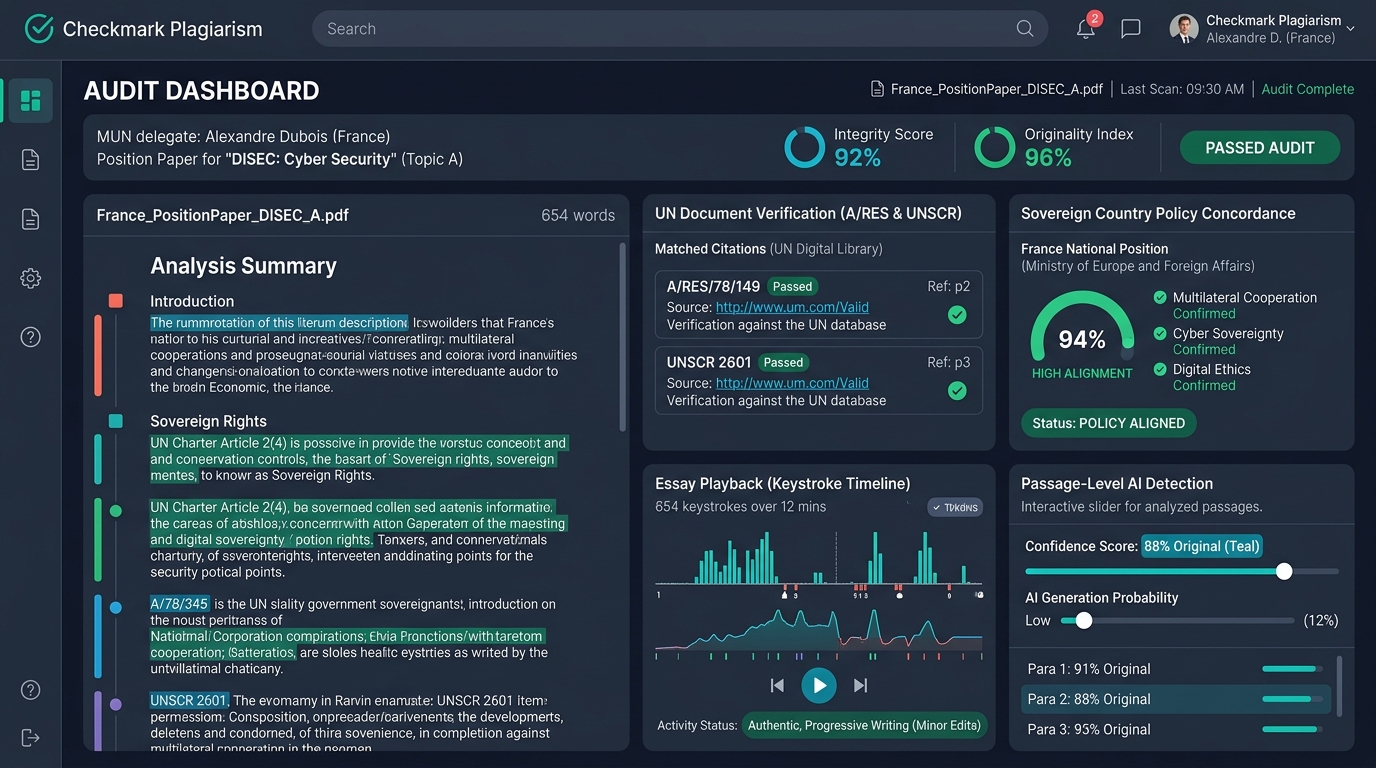
High school Model United Nations (MUN) programs represent one of the most intellectually demanding simulations in secondary social studies, requiring student delegates to conduct rigorous international law research, inhabit complex geopolitical stances, and draft authentic multilateral policy documents. However, the rapid proliferation of generative large language models (LLMs) has introduced a severe evidentiary crisis into high school MUN delegations and conference secretariats. Under tight pre-conference deadlines for research awards or during the intense pressure of unmoderated caucuses, high school delegates are increasingly prompting AI models to generate position papers and pre-write multi-clause draft resolutions. Because commercial LLMs operate on probabilistic token prediction rather than authoritative diplomatic indexing, they routinely confabulate non-existent UN resolution numbers (e.g., inventing UNSCR 2984 (2024) or A/RES/79/914), cite phantom multilateral treaties, misattribute historical voting records, and homogenize sovereign country stances into generic Western liberal platitudes—such as generating pro-sanction policies for the Russian Federation or nuclear disarmament concessions for the Democratic People's Republic of Korea (DPRK). Traditional whole-document AI percentage checkers fail completely in this setting because the formal, repetitive boilerplate of United Nations parlance (“Bearing in mind,” “Guided by the principles of the UN Charter”) inherently triggers false-positive AI scores while failing to detect fabricated international jurisprudence. Checkmark Plagiarism resolves this dilemma for MUN advisers, department chairs, and conference dais staff by delivering a multi-dimensional diplomatic integrity suite: passage-level calibrated confidence sliders, synchronized side-by-side source proof against the UN Digital Library and live treaties, 100% external paste buffer capture, and patent-pending Essay Playback™ writing telemetry (1x–8x keystroke replay) to distinguish authentic student geopolitical inquiry from synthetic diplomacy.
Delegates dissect committee background guides, sovereign foreign ministry archives, and primary UN repositories (UNTS, ODS, UN Digital Library) to establish baseline foreign policy.
Formal 1–2 page policy briefs submitted to Dais Directors for Research Award evaluation, consisting of Topic Background, Country Stance, and Actionable Proposals.
Live formal debate, regional bloc formation, and spontaneous bilateral negotiations during unmoderated caucuses to merge working papers into collaborative draft resolutions.
Multi-clause multilateral legislative draft sponsored by bloc delegates, submitted to the Dais for technical review, amendment debates, and voting procedures.
Commercial LLMs inject hallucinated resolution numbers and inverted sovereign policies during Phase 2 (Position Papers) and enable covert pre-writing dumping during Phase 3 & 4 (Unmoderated Caucuses).
1. The High School Model UN Deliverables Landscape & Diplomatic Research Architecture
High school Model United Nations is not merely an extracurricular public speaking exercise; it is an immersive academic practicum where secondary students engage with international jurisprudence, global political economy, international humanitarian law (IHL), and multilateral treaty design. Whether competing at flagship national conferences—such as the North American Invitational Model United Nations (NAIMUN), the National High School Model United Nations (NHSMUN), Berkeley Model United Nations (BMUN), Harvard Model United Nations (HMUN), or Ivy League Model United Nations Conference (ILMUNC)—or participating in regional interscholastic invitationals, delegates are assessed on their ability to conduct authentic sovereign policy research, represent their assigned nation’s vital interests faithfully, and negotiate cooperative multilateral solutions during in-person caucuses.
To understand where synthetic, AI-generated text compromises academic integrity, faculty advisers, social studies department chairs, and conference dais secretariats must analyze the specialized anatomy of Model UN written deliverables: the Position Paper and the Draft Resolution.
1.1 Position Paper Architecture: The 3-Part Research Triad
The Model UN position paper is a formal diplomatic policy brief (typically 1 to 2 single-spaced pages per agenda topic) that a delegate submits to the conference Dais prior to opening ceremonies. In secondary school curricula, AP Human Geography, AP U.S. Government, AP Comparative Government, and World History teachers frequently assign position papers as summative capstone projects that evaluate primary-source synthesis, historical perspective-taking, formal policy argumentation, and citation accuracy.
A standard, high-scoring position paper strictly follows a tripartite structure:
Topic Background & Scope
Weight: 25–30% of Text
- Defines global humanitarian, environmental, or security scope.
- Outlines historical milestones and systemic obstacles.
- Cites foundational conventions (e.g., Geneva Conventions, Paris Agreement, NPT).
Country Policy & Past Action
Weight: 35–40% of Text
- Details domestic legislation, vital security interests, and constitutional limits.
- Analyzes historical UNGA and UNSC voting patterns.
- Highlights regional alliances (e.g., NATO, BRICS, African Union, ASEAN, GCC).
Proposed Solutions & Solvency
Weight: 30–35% of Text
- Formulates realistic multi-stage policy recommendations.
- Identifies funding mechanisms (e.g., World Bank, regional trust funds).
- Respects sovereign boundaries under UN Charter Article 2(7).
When high school students write this deliverable authentically, they spend hours parsing foreign ministry communiqués, cross-referencing diplomatic speeches, and analyzing voting behavior. However, when students feel overwhelmed by competing academic deadlines (such as AP coursework, varsity athletics, or college applications), the structured nature of position papers makes them prime targets for automated LLM prompting.
1.2 Draft Resolution Mechanics: Preambulatory vs. Operative Architecture
The draft resolution represents the ultimate legislative culmination of a Model UN committee. It is formatted as a single, grammatically continuous sentence divided into two distinct sections:
- Preambulatory Clauses: These clauses establish the historical, legal, and humanitarian justification for the committee’s action. Each clause begins with an italicized participle (e.g., Affirming, Bearing in mind, Deeply disturbed, Guided by, Recalling, Reaffirming, Taking into consideration) and ends with a comma. Preambles cite the Charter of the United Nations, multilateral treaties, previous General Assembly or Security Council resolutions, and statistical findings from specialized agencies (e.g., UNHCR, WHO, IPCC, UNICEF).
- Operative Clauses: These clauses establish actionable policy mandates, institutional mechanisms, funding appropriations, and verification frameworks designed to solve the crisis. Each clause begins with an italicized, numbered third-person present-tense verb (e.g., Calls upon, Condemns, Designates, Directs, Encourages, Recommends, Requests, Urges). In the United Nations Security Council (UNSC), binding operative verbs under Chapter VII of the UN Charter (Authorizes, Demands, Decides, Imposes) carry enforceable international legal authority.
Anatomy of a Model UN Draft Resolution Clause
Notice the continuous syntax, standardized introductory verbs, and structural punctuation.
Preambulatory Clause (Legal Basis & Mandate):
“Recalling its resolution 2625 (XXV) of 24 October 1970, containing the Declaration on Principles of International Law concerning Friendly Relations and Cooperation among States in accordance with the Charter of the United Nations,”
Operative Clause (Actionable Mechanism & Solvency):
1. Urges all Member States to enhance multilateral data-sharing protocols on transboundary aquifer management through the establishment of a regional hydrologic task force, which shall:
- (a) Standardize salinity telemetry across border monitoring stations,
- (b) Submit biennial ecological integrity audits to the United Nations Environment Programme (UNEP),
- (c) Facilitate non-binding dispute mediation through regional development banks;
1.3 Primary Diplomatic Sourcing: The Evidentiary Bedrock
Authentic Model UN research requires high school students to navigate authoritative primary sources rather than commercial web summaries or encyclopedia snippets. The primary repositories of global diplomatic jurisprudence include:
- The UN Digital Library & Official Document System (ODS): The official repository of all United Nations parliamentary documentation, containing General Assembly resolutions (
A/RES/), Security Council resolutions (S/RES/), Economic and Social Council resolutions (E/RES/), and Secretary-General reports. - The United Nations Treaty Series (UNTS): A collection of the treaties and international agreements registered and published by the Secretariat pursuant to Article 102 of the UN Charter.
- International Court of Justice (ICJ) Reports: Judgments, advisory opinions, and contentious orders establishing customary international law precedents.
- National Foreign Ministry Portals & Permanent Mission Depositories: Official white papers, press releases, and speeches published by ministries such as the U.S. Department of State, the UK Foreign, Commonwealth & Development Office (FCDO), the Ministry of Foreign Affairs of the People’s Republic of China (MFA), the Ministry of External Affairs of India (MEA), and the French Ministry for Europe and Foreign Affairs (Quai d’Orsay).
When high school debaters engage directly with these primary documents, they develop sophisticated historical literacy. However, when they rely on generative AI, the distinction between authentic international law and algorithmic fiction quickly evaporates.
2. The AI Hallucination & Synthetic Diplomacy Crisis in Model UN
When high school delegates prompt generative AI models to draft position papers or synthesize resolutions, they encounter fundamental architectural limitations inherent to transformer-based large language models. LLMs do not query a verified legal database of international law; rather, they generate text through probabilistic next-token prediction.
In the specialized domain of multilateral diplomacy, this algorithmic architecture leads to severe epistemic corruptions across four primary vectors:
- Generates non-existent document symbols (e.g.,
UNSCR 2984,A/RES/82/104). - Fabricates phantom Geneva conventions and regional arms control protocols.
- Mismatches real historical dates with confabulated treaty names.
- Homogenizes distinct national stances into Western liberal democratic norms.
- Inverts real voting records (e.g. DPRK nuclear concessions; pro-sanction Russia).
- Erases sovereign reservations and domestic red lines.
- Grants coercive military peacekeeping powers to UNEP or ECOSOC.
- Authorizes economic sanctions in UNICEF or World Health Organization.
- Directly violates UN Charter Article 2(7) sovereign non-intervention.
- Delegates bypass live unmoderated caucus negotiation and compromise.
- Drop pre-fabricated 20-clause draft bundles into shared docs in 1 second.
- Coerces novice delegates into signing unnegotiated text blocks.
2.1 Confabulated Resolution Numbers & Phantom UN Treaties
Because transformer models are trained on massive corpuses of text where UN documents follow regular symbolic structures (such as A/RES/Session/Number or S/RES/Number (Year)), LLMs easily generate plausible-sounding, but completely fabricated, resolution numbers and treaty titles.
When a high school student prompts an AI model:
“Write a preambulatory clause for the UN General Assembly First Committee (DISEC) recalling previous UN resolutions on lethal autonomous weapons systems (LAWS) and the Geneva Convention protocols on emerging military AI,”
The LLM frequently outputs:
“Recalling its landmark resolution 78/412 of 14 December 2023 on the Prohibition of Algorithmic Targeting in Armed Conflict, and reaffirming the 2022 Geneva Protocol V Amendment on Autonomous Kinetic Systems...”
To a high school peer delegate or an overwhelmed conference Dais director grading 150 position papers over a single weekend, this clause appears exceptionally sophisticated. In reality:
- General Assembly resolution
A/RES/78/412does not exist (UNGA 78th session resolutions ended atA/RES/78/331). - There is no such international instrument as the “2022 Geneva Protocol V Amendment on Autonomous Kinetic Systems” (Protocol V to the Convention on Certain Conventional Weapons relates to Explosive Remnants of War, adopted in 2003).
When high school debaters build operative frameworks on hallucinated legal instruments, the simulation collapses into fictitious roleplay.
2.2 Inverted Voting Records & Fabricated Sovereign Country Policies
Large language models can exhibit a homogenization bias—a statistical tendency to generate text reflecting mainstream, Western liberal-democratic values, internationalist consensus, and benevolent humanitarian rhetoric. In Model United Nations, where delegates are explicitly assigned to represent diverse, non-Western, non-aligned, autocratic, or theocratic Member States, this bias produces disastrously inaccurate foreign policy positions.
✓ Authentic Sovereign Policy:
Rigid defense of sovereign nuclear deterrence under the Byungjin doctrine; categorical rejection of IAEA intrusive inspections; acceded to the NPT in 1985 but announced its withdrawal in 2003.
✗ AI-Generated Hallucination:
“The DPRK reaffirms its urgent commitment to the complete, verifiable, and irreversible denuclearization of the Korean peninsula and welcomes unrestricted IAEA inspections.”
✓ Authentic Sovereign Policy:
Routine deployment of the sovereign veto against Western unilateral sanctions; strict insistence on state sovereignty under UN Charter Article 2(7); non-recognition of ICC jurisdiction.
✗ AI-Generated Hallucination:
“The Russian Federation calls upon all Member States to submit to binding International Criminal Court reviews and supports targeted multilateral trade embargoes.”
✓ Authentic Sovereign Policy:
Primacy of national Islamic jurisprudence (Sharia); resistance to Western cultural universalism in UN declarations; emphasis on state sovereign cultural traditions.
✗ AI-Generated Hallucination:
“The Kingdom of Saudi Arabia enthusiastically sponsors the immediate adoption of universal secular civil rights declarations and mandates comprehensive progressive reforms.”
When high school advisers evaluate position papers containing these inversions, they are witnessing the failure of generative AI to capture sovereign nuance. The delegate has not learned foreign policy; they have simply outsourced the assignment to an algorithm that flattened global geopolitics into generic rhetoric.
2.3 Mandate Creep & Jurisdictional Impossibilities
Under the Charter of the United Nations, specific committees and principal organs possess distinct legal competencies:
- The UN General Assembly (UNGA): Can make non-binding recommendations (Articles 10, 11, 14), approve budgets, and establish subsidiary bodies, but cannot authorize coercive military force or legally binding trade sanctions.
- The UN Security Council (UNSC): Holds primary responsibility for international peace and security under Chapter VII, including binding economic embargoes (Article 41) and armed military interventions (Article 42).
- The Economic and Social Council (ECOSOC) & Specialized Agencies (WHO, UNEP, UNICEF): Coordinate functional international cooperation, provide technical assistance, and administer humanitarian trust funds.
Generative AI models routinely suffer from mandate creep, generating draft resolution clauses that violate the UN Charter. AI-drafted resolutions in UNICEF frequently authorize armed peacekeeping forces; AI-drafted resolutions in UNEP mandate naval blockades; and AI-drafted resolutions in the World Health Organization mandate sovereign border closures in direct violation of Article 2, Paragraph 7 of the UN Charter (“Nothing contained in the present Charter shall authorize the United Nations to intervene in matters which are essentially within the domestic jurisdiction of any state …”).
2.4 The Pre-Conference Pre-Writing Ban & Unmoderated Caucus Resolution Dumping
Many Model UN conferences restrict or ban pre-written resolutions. Harvard Model United Nations (HMUN), for example, states the following in the Pre-Writing Policy of its 2027 Guide to Delegate Preparation:
“Any documents written before the conference may not be submitted to the committee staff at HMUN. … All writing is expected to take place during committee sessions.”
The educational objective of this rule is to teach active caucusing, spontaneous coalition building, diplomatic compromise, and active listening.
However, generative AI has created a covert industry of “Resolution Dumping.” High school delegates arrive at conferences with AI-generated 20-clause draft resolutions stored in private cloud folders. During the very first 30-minute unmoderated caucus on Friday night, a delegate opens a shared Google Doc, pastes a 2,500-word synthetic resolution in a single second, and pressures inexperienced delegates to sign as co-sponsors before real substantive negotiations have even begun. This practice destroys the collaborative integrity of the committee and rewards deception over diplomatic skill.
3. Why Generic AI Detectors Fail MUN Advisers and Dais Secretariats
When high school faculty advisers and conference Dais staff recognize the threat of AI in Model UN deliverables, their initial instinct is often to upload position papers to generic, whole-document AI detection tools. However, commercial black-box AI percentage detectors are fundamentally unsuited for evaluating diplomatic and legal prose.
Input: Standard UN Preambulatory Phrasing (Bearing in mind resolution 2625, Guided by the Charter).
Flaw: Detector measures low perplexity and uniform sentence cadence. Penalizes honest student who spent 15 hours perfecting formal diplomatic prose.
Input: Hallucinated UNSCR 2984, inverted Russian policy, run through a paraphrasing tool.
Flaw: Detector only checks surface token distribution; has zero semantic knowledge that treaty does not exist. Fake diplomacy wins research award.
3.1 The “Diplomatic Boilerplate” False-Positive Trap
Generative AI detection software relies primarily on mathematical metrics known as perplexity (a measure of word predictability) and burstiness (the variation in sentence structure and length). Highly predictable phrasing and uniform sentence structures are flagged as machine-generated.
However, formal United Nations documentation is deliberately predictable and uniform:
- Diplomatic parlance relies on a standardized lexicon (“Expressing its appreciation,” “Taking note with satisfaction,” “Emphasizing the sovereign equality of all Member States”).
- Preambulatory clauses follow rigid grammatical patterns that have remained unchanged since 1945.
- Treaty citations and UN resolution references contain standardized numerical sequences.
When an authentic, dedicated high school student spends 15 hours meticulously formatting a position paper using proper UN editorial style, the generic AI detector flags the formal phrasing as low-perplexity text. The student can receive an unfairly high AI probability score, leading to distressing, unwarranted academic integrity accusations during delegate grading.
3.2 Epistemic Blindness to Hallucinated Law
Conversely, generic AI detectors evaluate only surface linguistic distributions; they have zero semantic awareness of factual reality.
If a student prompts an LLM to invent a completely non-existent treaty (“The 2024 Helsinki Multilateral Cyber-Defense Accord”) and generate synthetic voting statistics, the AI writes the fabrication with natural stylistic variation. A generic detector scans the passage, measures acceptable token distribution, and reports a 0% AI score.
The generic detector certifies the document as “100% human-written” even though the entire paper is based on fictitious international law. Whole-document percentage scores fail precisely where diplomatic accuracy is needed most.
3.3 Immunity of Humanized and Re-typed AI Drafts to Legacy Scanners
High school students seeking to conceal their use of generative AI routinely use paraphrasing tools (such as QuillBot or Undetectable AI) or manually re-type AI-generated text from a split-screen browser or smartphone into Google Docs.
Paraphrasers intentionally inject erratic syntax, unusual synonyms, and punctuation anomalies to artificially inflate perplexity and evade token-matching algorithms. Standard plagiarism scanners and legacy AI checkers cannot detect this manipulation. However, while paraphrasing alters surface vocabulary, it preserves the underlying hallucinated facts, inverted country policies, and pre-written resolution structures.
4. The High School Model UN Evidentiary Audit Matrix
To evaluate Model UN position papers and draft resolutions effectively, high school faculty advisers and conference secretariats require a multi-dimensional audit framework. Relying on a single metric—whether manual search or automated percentage scores—creates critical vulnerabilities.
| Audit Dimension | 1. Manual UN Search | 2. Generic AI Detector | 3. Docs Revision History | 4. Checkmark Suite |
|---|---|---|---|---|
| Resolution Symbol & Treaty Verification | Excellent Checks ODS/UNTS database |
None Blind to factual truth |
None Only shows raw text edits |
Automated & Linked Direct 2-way linked source proof |
| Sovereign Country Concordance | High Requires faculty expertise |
None Blind to policy inversions |
None No geopolitical context |
High Precision Passage-level confidence sliders |
| Pre-Writing & Caucus Paste Detection | None No timeline visibility |
None No temporal tracking |
Moderate High-level block diffs only |
Complete Telemetry Essay Playback™ + 100% paste buffer |
| UN Boilerplate False-Positive Immunity | High Adviser understands parlance |
Very Poor Flags UN format as AI |
N/A Text editor only |
Immune Granular passage scoring excludes boilerplate |
| Batch Grading Efficiency (150+ Papers) | Very Slow 20–30 min per paper |
Fast 10 sec (but inaccurate) |
Slow 5–10 min per document |
Very Fast Instant passback + AI rubric assistant |
| Restorative Conference Defensibility | Moderate Fact check only, no process proof |
Very Poor Score creates confrontations |
Moderate Raw diffs without telemetry |
Exceptional Keystroke replay + paste timestamps |
| Student Privacy & FERPA / COPPA | Safe Direct browser searches |
High Risk Trains commercial AI models |
Safe Google enterprise terms |
100% FERPA Compliant Zero model training guarantee |
5. Step-by-Step MUN Adviser Audit Protocol: Pre-Conference & In-Caucus
To protect academic integrity without resorting to punitive witch-hunts or adversarial confrontations, high school MUN advisers and conference dais directors should implement a systematic, 5-step audit protocol. This protocol combines digital document symbol verification, sovereign concordance checks, and writing process telemetry.
Step 1: UN Document Symbol & Treaty Indexing Verification
Every official document published by the United Nations carries a unique alphanumeric symbol. Advisers can instantly spot AI hallucinations by checking citations against the UN symbol taxonomy:
General Assembly Resolutions
A/RES/[Session]/[Number] (e.g., A/RES/78/240)
Session corresponds to UNGA year (78th Session = 2023–2024).
Security Council Resolutions
S/RES/[Number] ([Year]) (e.g., S/RES/2720 (2023))
Sequential numbering since 1946; year must match adoption date.
Economic & Social Council (ECOSOC)
E/RES/[Year]/[Number] (e.g., E/RES/1996/31)
United Nations Treaty Series (UNTS)
[Volume] UNTS [Reg. Number] (e.g., 1155 UNTS 331)
Step 2: Country Foreign Policy Concordance Auditing
Review Part 2 of the position paper to verify that the delegate’s stances faithfully reflect the sovereign country’s strategic doctrine.
- Non-Aligned Movement (NAM) Inversions: Developing states backing Western carbon border taxes without climate finance.
- Veto-Power Contradictions: P5 members volunteering to restrict or abolish their veto powers under Article 27.
- Sovereignty Relinquishment: Nations in territorial disputes agreeing to binding outside arbitration.
Step 3: Telemetric Writing Process Auditing with Essay Playback™
Scrub the delegate’s drafting session at 1x–8x speed using Checkmark Essay Playback™ to examine cognitive drafting telemetry:
✓ Authentic Student Writing Telemetry:
- Multi-minute pauses to read UN treaty repositories in other tabs.
- Active backspacing, clause reordering, and phrasing edits.
- Natural typing velocity variations (30–65 WPM).
✗ Synthetic AI Generation Signature:
- Single instantaneous external paste of 800–1,500 words in <2 sec.
- Zero revision history or iterative clause assembly.
- Mechanical, unbroken transcription from a phone or second screen.
Step 4: Investigating Pre-Conference Clusters & Caucus Resolution Drops
To enforce conference pre-writing bans, Dais secretariats inspect collaborative Google Docs using Checkmark’s External Paste Inspector:
- Paste Buffer Capture: Preserves 100% of clipboard text pasted into the shared doc with exact timestamps.
- Schedule Cross-Referencing: If a 20-clause resolution is pasted at 7:30 AM before committee opens, pre-writing is confirmed.
- Author Attribution: Separates real-time collaborative drafting from external text dumps.
Step 5: Conducting Restorative Delegate Debriefs & Diplomatic Coaching
Use objective telemetry receipts to guide delegates toward rigorous primary research rather than punitive accusations:
1. Open with Process Telemetry: “Let’s review your Essay Playback timeline together to look at your research milestones.”
2. Examine Discrepancies Collaboratively: “Let’s look up cited resolution symbol A/RES/79/914 together in the UN Digital Library.”
3. Explore Sovereign Geopolitics: “Let’s discuss why your country’s proposed concessions contradict its real-world foreign policy.”
4. Require Guided Redrafting: Provide primary UN treaty depositories and require the delegate to redraft in the monitored editor.
6. Checkmark Plagiarism: Purpose-Built for High School Model UN & Social Studies
Checkmark Plagiarism provides high school Model UN advisers, social studies educators, and conference secretariats with an integrated, educator-first platform designed to foster authentic diplomatic inquiry while protecting honest students.
1. Calibrated Passage-Level AI Confidence Sliders
Evaluates student operative proposals independently from standardized UN preambulatory boilerplate. Granular confidence sliders prevent false flags on formal diplomatic language, while short-text guardrails protect entries under 150 words.
2. Patent-Pending Essay Playback™ (1x–8x Replay)
Reconstructs the full drafting timeline keystroke-by-keystroke. Highlights research latency pauses when students consult UN databases and exonerates honest delegates falsely accused by legacy whole-paper percentage checkers.
3. External Paste Inspector & Buffer Preservation
Captures 100% of text pasted from outside sources and stores the unedited clipboard string with exact timestamps. Interactive “Jump to Playback” lets advisers inspect caucus resolution dumping instantly.
4. Quote-Anchored Rubric Autograding for MUN
Scores position papers against custom Model UN rubrics, generating quote-anchored feedback cards tied directly to student text. Full teacher control with one-click passback into Canvas LMS, Google Classroom, and Buzz LMS.
7. High School Model UN Position Paper Scoring Rubric & Policy Audit Checklist
To establish transparent academic integrity and research standards across high school Model UN delegations and conference committees, advisers can deploy the following comprehensive 4-tier evaluation rubric and pre-conference audit checklist.
7.1 Comprehensive Model UN Position Paper Rubric
| Criteria | Advanced Diplomat (4 pts) | Competent Delegate (3 pts) | Developing Delegate (2 pts) | Novice / Inauthentic (1 pt) |
|---|---|---|---|---|
| 1. Topic Background & Treaty History | Thorough global overview; cites verified UNTS/ODS symbols and conventions. | Accurate summary of historical context; cites 2+ valid conventions accurately. | Superficially describes topic; vague references without official symbols. | Inaccurate or absent background; cites non-existent UN resolutions or hallucinated treaties. |
| 2. Sovereign Policy & Voting Concordance | Flawless fidelity to sovereign interests, voting records, and regional bloc alliances. | Clear alignment with national interests; minor omissions in bloc alliances. | Generic national stance; weak connection to historical voting records. | Inverted foreign policy; adopts Western liberal consensus contradicting state doctrine. |
| 3. Operative Framework & Solvency | Innovative, multi-stage solutions; respects committee jurisdiction and funding solvency. | Practical and structured policy; respects committee mandate and legal limits. | Overly broad or repetitive policy; minor committee jurisdiction ambiguities. | Impossible proposals; commits gross mandate creep (e.g. military force in UNICEF; Art. 2(7) violation). |
| 4. UN Diplomatic Format & Clause Syntax | Flawless UN format; correct use of preambulatory and operative verbs. | Proper formatting; standard UN verbs; minor syntax or comma errors. | Inconsistent italicization; mixed clause structures and punctuation. | Disregards UN format; improper verbs; non-continuous sentences; conversational prose. |
| 5. Writing Process & Telemetry | Organic drafting telemetry; natural research pauses; iterative edits in Essay Playback™. | Substantial in-doc drafting; verified research notes; clean clipboard history. | Moderate drafting history with large unverified block paste events. | Instantaneous 1,000+ word paste burst; zero pauses; unedited external AI clipboard payload. |
7.2 The 10-Point Adviser Pre-Conference Audit Checklist
Official Symbol Cross-Check
All cited A/RES/, S/RES/, and E/RES/ numbers exist in the UN Digital Library.
Treaty Volume Verification
Multilateral treaties in Part 1 correspond to registered instruments in the UN Treaty Series (UNTS).
Sovereign Policy Alignment
Part 2 accurately reflects MFA foreign policy white papers and historical UN voting patterns.
P5 Veto Integrity
If representing a P5 member, paper does not advocate relinquishing or restricting veto authority.
Mandate Boundary Compliance
Operative proposals in Part 3 do not exceed the legal authority of the assigned UN committee.
Article 2(7) Non-Intervention
Operative clauses respect domestic jurisdiction boundaries unless acting under Chapter VII.
Writing Telemetry Review
Essay Playback™ reveals authentic composing cadence and research latency pauses.
Clipboard Paste Audit
External Paste Inspector shows zero unverified whole-document drops from external AI generators.
Preambulatory Syntax Check
Every preambulatory clause begins with an approved italicized participle and ends with a comma.
Operative Numbering Check
Every operative clause begins with a numbered, italicized present-tense verb and ends with a semicolon or period.
8. Frequently Asked Questions (FAQs)
1. Why do generic AI detectors flag authentic Model UN position papers as machine-generated?
Generic AI checkers calculate whole-document perplexity (word predictability) and burstiness (sentence rhythm variation). United Nations documentation and Model UN position papers inherently rely on highly repetitive, formalized diplomatic phrasing (“Guided by the Charter of the United Nations,” “Deeply concerned by the escalating crisis,” “Recalling its previous resolutions”) and standardized clause structures. Generic algorithms misinterpret this formal diplomatic boilerplate as low-perplexity, machine-generated text, producing high false-positive AI scores on honest student work. Checkmark eliminates this flaw by using calibrated passage-level confidence sliders that isolate student analysis from standard UN templates.
2. How can high school MUN advisers quickly verify whether a cited UN resolution is real or AI-hallucinated?
Advisers should use the official United Nations Digital Library (digitallibrary.un.org) or the Official Document System (ODS) (documents.un.org). Input the exact document symbol cited in the student’s paper (e.g., A/RES/78/125 for General Assembly or S/RES/2720 for Security Council). If the symbol returns zero results, or if the official title does not match the subject matter of the student’s paper, the citation is an AI-generated hallucination. Checkmark automatically identifies and links verified UN sources, saving advisers hours of manual database searching.
3. How does Checkmark’s Essay Playback™ prove a student drafted their position paper authentically?
Essay Playback™ reconstructs the entire writing session keystroke-by-keystroke. When advisers scrub through the timeline at 1x–8x speed, authentic student writing exhibits unmistakable cognitive patterns: multi-minute research pauses where students consult external UN databases, active backspacing, sentence restructuring, clause reordering, and natural typing velocity variations. Conversely, generative AI shortcuts appear as instantaneous whole-document paste events or mechanical, unbroken transcription without natural composing pauses.
4. What is the “pre-written resolution ban,” and how can conference secretariats enforce it using writing telemetry?
Many Model UN conferences restrict delegates from drafting resolution clauses before committee sessions begin. Harvard Model United Nations, for example, publishes a Pre-Writing Policy in its delegate preparation guide, and advisers should read the rules of the specific conference their delegation attends. Such rules ensure that delegates engage in genuine collaborative negotiation and compromise during unmoderated caucuses. When delegates prompt LLMs to pre-write 20-clause resolutions in hotel rooms and paste them into shared Google Docs during the first caucus session, Checkmark’s External Paste Inspector captures the timestamped paste event and preserves the original clipboard text, providing indisputable proof of pre-writing for Dais directors.
5. How should a faculty adviser handle a position paper that contains an AI-hallucinated treaty?
Advisers should adopt a restorative, educational conferencing approach. Rather than issuing an immediate disciplinary penalty or accusation of cheating, the adviser should meet with the delegate, open Checkmark’s Essay Playback™ and the UN Digital Library together, and examine the hallucinated citation collaboratively. The adviser can explain how large language models probabilistically confabulate international law and guide the delegate to locate authentic primary treaties. The student should then be required to conduct real primary research and redraft the brief in the monitored editor.
6. Can delegates bypass Checkmark by running AI-generated papers through QuillBot or “text humanizers”?
No. While text humanizers and paraphrasers alter surface vocabulary to trick legacy token-matching detectors, they cannot fabricate authentic temporal writing telemetry. If a student pastes paraphrased text into their document, Checkmark’s External Paste Inspector immediately captures the external paste payload. If the student manually re-types humanized text from a split-screen browser or phone, Essay Playback™ detects the steady, mechanical keystroke cadence devoid of natural research pauses and organic revisions.
7. Does Checkmark comply with high school student data privacy laws like FERPA and COPPA?
Yes. Checkmark is built specifically for secondary school districts and complies strictly with FERPA, COPPA, and state student data privacy statutes. Checkmark maintains a strict Zero-Model Training Policy: student essays, position papers, and research briefs are encrypted in transit and at rest, and are never used to train public or commercial artificial intelligence models.
Equip Your Model UN Delegation & Social Studies Department Today
Empower MUN faculty advisers and social studies teachers with patent-pending Essay Playback™, passage-level AI detection, and quote-anchored rubric autograding for Canvas LMS, Google Classroom, and Buzz LMS.