
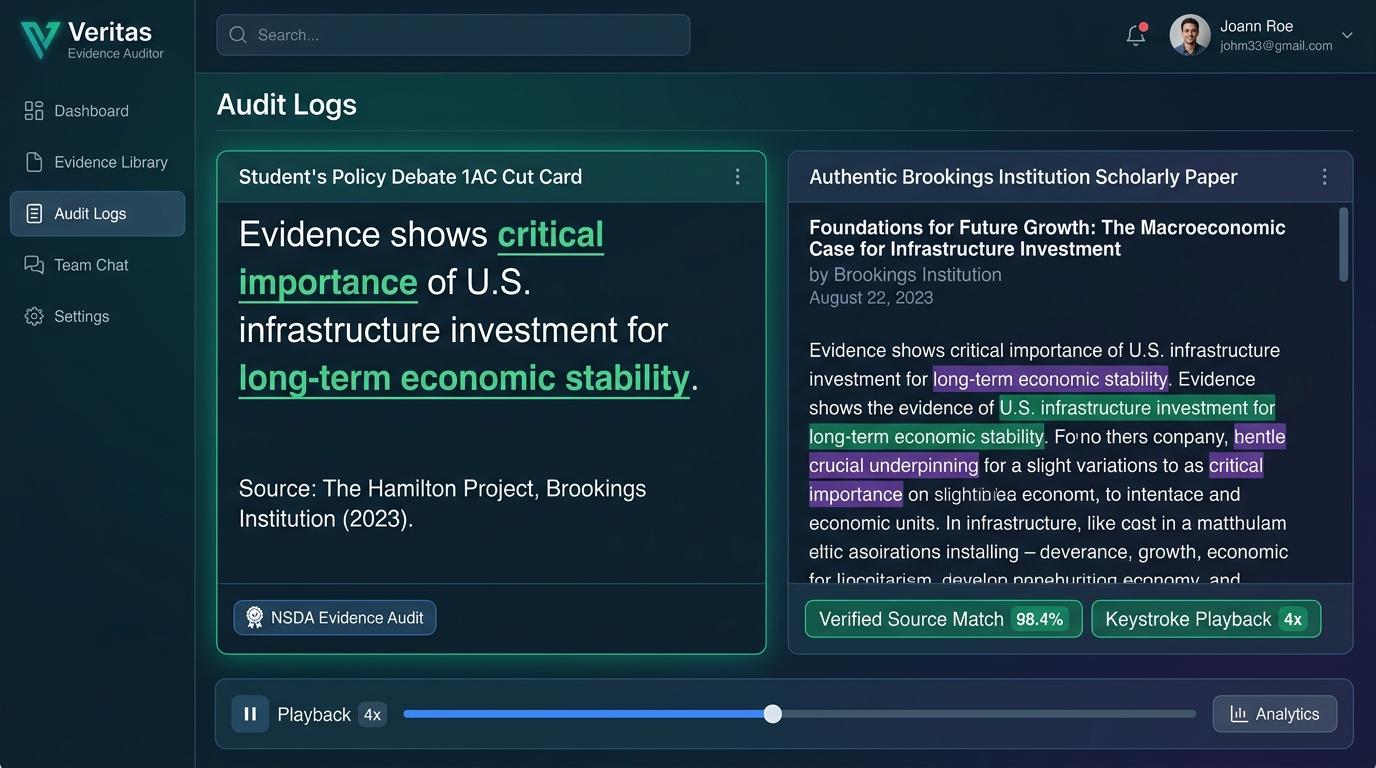
High school speech and forensics programs across Policy Debate (CX), Lincoln-Douglas (LD), Public Forum (PF), and Congressional Debate are confronting an unprecedented evidentiary integrity crisis. Under intense pre-tournament time pressure, debaters are increasingly turning to generative large language models (LLMs) to synthesize affirmative case briefs (1ACs), fabricate think-tank author credentials (e.g., Brookings, RAND, CSIS, Belfer Center), confabulate empirical statistical warrants, and produce visually flawless but completely nonexistent “cut cards.” When these synthetic cards enter tournament rounds, they can violate the National Speech & Debate Association (NSDA) evidence rules on non-existent and distorted evidence (Rule 7.2 of the High School Unified Manual), risking a lost round, tournament disqualification, and catastrophic reputational damage to high school debate programs.
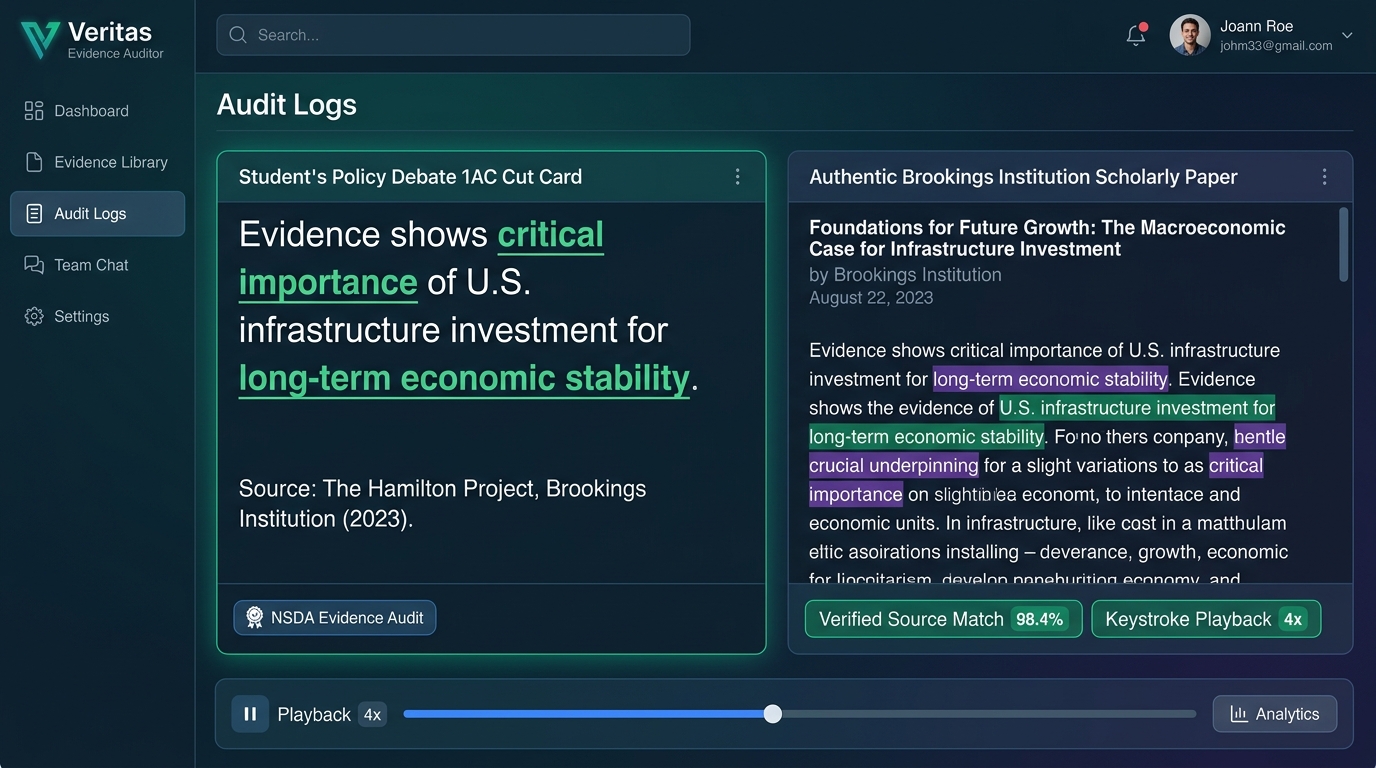
Traditional whole-paper AI percentage checkers fail completely in forensics because debate briefs naturally consist of dense technical jargon, repetitive framework formulas, and massive blocks of legitimate verbatim quoted text, triggering false-positive alarms on honest research while failing to verify whether a specific empirical warrant exists in the real world. Checkmark Plagiarism resolves this dilemma through a multi-dimensional forensic audit toolkit: synchronized side-by-side source proof that validates live web URLs and scholarly DOIs, passage-level AI confidence sliders that evaluate student-written tags separately from quoted evidence, and patent-pending Essay Playback™ writing telemetry (1x–8x keystroke replay with 100% paste buffer preservation). This comprehensive guide provides debate coaches, team directors, and tabroom officials with a systematic squad-room audit protocol to detect hallucinated scholarship, verify card authenticity, and cultivate restorative research ethics before tournament day.
Checkmark Plagiarism equips forensics directors, speech coaches, and tournament tab rooms with cutting-edge evidentiary auditing by integrating side-by-side source proof, patent-pending Essay Playback™ writing telemetry, passage-level AI detection, and teacher-in-the-loop rubric autograding into seamless Canvas LMS and Agilix Buzz LMS workflows.
1. The High School Forensics Evidence Crisis: Anatomy of the Synthetic Card
Competitive interscholastic speech and debate is widely recognized as one of the most intellectually rigorous co-curricular activities in secondary education. High school debaters analyze complex public policy, macroeconomic modeling, international relations, constitutional law, environmental science, and moral philosophy at levels often exceeding undergraduate coursework.
At the operational core of competitive debate is the evidence card—the primary evidentiary currency of forensic argumentation. A properly prepared debate card is a standardized excerpt from published scholarship, reformatted with strategic visual emphasis (underlining and bolding), and deployed during rapid oral delivery to substantiate claims.
A concise, high-impact claim authored by the debater summarizing the card's offensive thesis.
Author qualification, author surname, full date, publication title, journal volume, and verified DOI or live URL.
A continuous, unedited block of text excerpted directly from the primary source preserving surrounding context, non-emphasized prose, and qualifying parameters.
Specific words bolded, underlined, and enlarged that the competitor reads aloud under speech limits. Non-underlined words remain visible to prove no deceptive context truncation occurred.
When conducted with integrity, card cutting teaches high school students critical research literacy, information synthesis, evidentiary standards, and deep analytical reading. However, the high-stakes culture of competitive forensics—where state championships, national circuit bids, and collegiate admissions advantages hinge on having hyper-specific, highly responsive evidence—has collided with consumer generative AI.
Affirmative Case Architecture Across High School Debate Formats
To understand where hallucinated evidence enters student briefs, forensics coaches must examine the standard affirmative case structures across the primary high school debate events governed by the NSDA:
POLICY DEBATE (CX)
8-Min 1AC- Inherency: Current statutory barrier / policy failure
- Harms: Existential & systemic risk scenarios
- Plan Text: Precise federal statutory mandate
- Solvency: Expert feasibility & empirical modeling
- Advantages (1 & 2): Catastrophic terminal impacts
LINCOLN-DOUGLAS (LD)
6-Min 1AC- Value Premise: Ultimate moral end (e.g., Justice)
- Value Criterion: Decision calculus & measuring standard
- Contention 1: Deontological rights & moral duties
- Contention 2: Structural violence & oppression solvency
- Underview: Preemptions & theory shell spikes
PUBLIC FORUM (PF)
4-Min Pro Case- Framework: Core definitions & cost-benefit calculus
- Contention 1: Economic solvency & empirical stats
- Contention 2: Geopolitical deterrence & security links
- Impact Calculus: Magnitude, timeframe, probability
- Rebuttal Preps: Frontlines against standard neg arguments
In Policy Debate (CX), the 1AC (First Affirmative Constructive) requires an intricate chain of evidentiary proof establishing that existing policy cannot solve a critical problem (Inherency), that the problem causes catastrophic harms (Harms), that a specific federal mandate will function (Plan Text), and that expert modeling proves the mandate will succeed (Solvency). In Lincoln-Douglas (LD), affirmative briefs require dense philosophical warrants linking practical actions to moral frameworks (Kantian deontology, Rawlsian justice, rule utilitarianism). In Public Forum (PF), debaters construct rapid, data-heavy 4-minute cases loaded with quantitative metrics and think-tank citations.
The Mechanism of AI Evidence Hallucination in Debate
The primary vulnerability occurs late at night during pre-tournament preparation blocks. A high school sophomore or junior, staring at an incomplete 1AC affirmative brief at 2:00 AM before a weekend invitational, discovers a critical evidentiary hole:
- Their Policy affirmative lacks a definitive solvency card proving that “Direct Air Capture reduces oceanic acidification within five years.”
- Their Lincoln-Douglas case lacks a quote from a notable philosopher proving that “Rawlsian distributive justice requires universal basic housing.”
- Their Public Forum brief lacks a recent statistic showing that “A 1% increase in tariff rates leads to an immediate 4.2% spike in consumer food inflation.”
Instead of navigating academic repositories (JSTOR, Google Scholar, HeinOnline, Brookings, RAND, CSIS), the student opens a commercial large language model and enters a prompt:
“Write an affirmative debate card with a high-impact tag, an author citation from a senior fellow at the Brookings Institution or RAND Corporation published in 2025, and a 200-word paragraph with statistics proving that Direct Air Capture deployment reverses ocean acidification by 14.8% by 2030.”
Because generative language models operate on probabilistic token prediction rather than authoritative database lookup, the LLM complies instantly. It generates:
- A Confabulated Author Identity: “Dr. Sarah Lin, Senior Director of Marine Decarbonization at the RAND Corporation, 2025.” (An illustration of a confabulated identity: the name, title, and department are invented.)
- A Fabricated Publication: “RAND Strategic Marine Technologies Report, Vol. 18, pp. 44–61.” (A synthetic report title with fictional pagination).
- Manufactured Empirical Data: “Empirical telemetry across 42 coastal testbed facilities indicates a 14.8% reduction in local oceanic carbonic acid concentration within 36 months of deployment...” (Statistically precise, authoritative-sounding, but totally fictitious).
- Authentic Forensic Vernacular: Flawless incorporation of debate jargon (“terminal impact,” “irreversible tipping point,” “key internal link”).
When cut, bolded, underlined, and pasted into a master squad brief, this synthetic card is visually indistinguishable from authentic scholarly literature.
1. The Phantom Think-Tank Card
Confabulation• Generates fictitious authors at RAND, Brookings, CSIS, or Belfer Center.
• Fabricates non-existent report titles and phantom publication dates.
2. Confabulated Empirical Metrics
Data Fraud• Fabricates exact percentages, dollar figures, and sample sizes.
• Attributes real-world authority to untested synthetic data points.
3. The Reversed-Polarity Summary
Context Stripping• Student prompts AI to summarize a skeptical paper into an absolute claim.
• AI strips author caveats and qualifiers, inverting the primary conclusion.
4. Bracket Injection & Phantom Clauses
Rule 7.2.A Violation• AI generates bracketed words [...] that insert claims absent in the text.
• Synthesizes links between unrelated paragraphs to create a false warrant.
2. The NSDA Tournament Disqualification Dilemma & Evidence Rules 7.1 to 7.4
When fabricated or AI-hallucinated evidence enters tournament competition, it threatens the educational legitimacy of interscholastic forensics and exposes the entire school team to severe disciplinary penalties.
The National Speech & Debate Association Evidence Code
The National Speech & Debate Association (NSDA) High School Unified Manual outlines strict evidentiary mandates in its Evidence Rules (Rules 7.1 to 7.5) for Policy, Public Forum, Lincoln-Douglas, and Big Questions Debate (2026-2027 edition):
NSDA Rule 7.2.B (Non-Existent Evidence)
Loss + DisqualificationUnder Rule 7.2.B, “non-existent evidence” includes evidence for which the debater cannot produce the original source when requested, evidence that the original source does not actually contain, and paraphrased evidence that lacks an original source to verify it. A hallucinated author, title, or statistic fails each of these tests. Under Rule 7.4.C, a debater who uses non-existent evidence loses the debate and is disqualified from the tournament, although the tabulation committee may waive the disqualification if the source is produced within 20 minutes after the round. Under Rule 7.4.D, evidence infractions also violate the NSDA Code of Honor and can lead to notification of the school administration and chapter adviser, loss of merit points, and, at the national office’s discretion, revocation of membership.
NSDA Rule 7.2.A (Distortion)
Context Rule“‘Distortion’ exists when the textual evidence itself contains added and/or deleted word(s), which significantly alters the conclusion of the author (e.g., deleting ‘not’; adding the word ‘not’). Additionally, failure to bracket added words would be considered distortion of evidence.” An AI tool that adds, deletes, or rewrites words in a card so that the author’s conclusion changes, or that inserts unbracketed words, produces distortion under this rule, which carries the same loss-and-disqualification penalty as non-existent evidence (Rule 7.4.C).
NSDA Rule 7.1.F (Availability of Evidence)
Timely ProductionMaterial presented in the round, including evidence, cases, and written citations, must be made available to the opponent and judge on request, and the original source (a copy of the relevant pages, or the live web page) must be available in a timely fashion during the round. A debater who cannot produce the original source when requested risks a “non-existent evidence” violation under Rule 7.2.B.1.
• Full PDF / Live Webpage shown
• Text matches verbatim
• Round proceeds normally
• Debater cannot access the file in the round
• Treated as possible non-existent evidence (7.2.B.1)
• Loss recorded; disqualification may be waived if produced within 20 minutes after the round
• Hallucinated citation confirmed
• Formal allegation filed (7.3.C)
• Loss & Tournament Disqualification (7.4.C)
Why Generic AI Percentage Detectors Break Down in Forensics
Many high school forensics coaches and tournament officials, alarmed by AI rumors, attempt to audit debate briefs using commercial “whole-document” AI percentage checkers. This practice causes severe pedagogical harm and operational paralysis:
- The False Positive Trap on Debate Jargon: Debate briefs are structured with highly standardized, repetitive stylistic formulas: “Inherency: The affirmative plan is not currently enacted under federal statutory frameworks; Harms: Continued inaction leads to catastrophic grid destabilization; Solvency: Independent empirical modeling proves feasibility.” Generic AI detectors miscalculate these repetitive, low-perplexity academic constructions as machine-generated text, flagging honest debaters who spent 40 hours reading legal treatises.
- The “Quote Quagmire”: A legitimate debate 1AC consists largely of direct quotes from academic journals plus a smaller share of student-written taglines. Generic detectors analyze the entire document as a single text block, generating an arbitrary “68% AI” score that cannot tell the coach whether the tag, the card text, or the citation was synthesized.
- Evidentiary Weakness in Tabroom Appeals: A tabulation committee or tournament director cannot reasonably penalize a student based on an opaque “probability score.” A formal evidence allegation must identify a specific violation (Rule 7.3.C), which requires material proof, such as showing that the cited author never wrote the sentence, that the journal volume does not exist, or that the clipboard telemetry shows an instantaneous paste from an LLM interface.
3. The High School Forensics Evidentiary Matrix
To protect students from false accusations while safeguarding the squad from catastrophic tournament disqualifications, forensics programs must transition from manual guessing to structured evidentiary verification.
| Evidentiary Criterion | Manual Google Search (In-Round Prep) | Generic AI Checkers (Whole-Doc Percent) | Checkmark Forensic Source Audit & Telemetry |
|---|---|---|---|
| Detection of Hallucinated Author & Publication Cites | ⚠️ Variable: High friction with paywalls & broken search links in 2 minutes. | ❌ Zero: Flags stylistic jargon; cannot verify real world source existence. | ✅ Instant: Matches DOIs & live web repositories across billions of scholarly papers. |
| Isolation of Student Tags vs. Quoted Cards | ❌ Impossible: Evaluates the entire file as one undifferentiated document. | ❌ Fails: Lumps quotes and student tags into a single opaque percentage score. | ✅ Precise: Passage-level sliders for student tags vs. quoted evidence cards. |
| Verification of Underline Context & Distortion | ⚠️ Slow: Requires manual word-by-word reading of a 40-page PDF document. | ❌ Incapable: Has no text comparison or context-checking capability. | ✅ Automated: Dual-pane highlight maps omitted qualifiers and bracket additions. |
| Proof of Independent Card Cutting vs. AI Pastes | ❌ Blind: Cannot see when text was pasted or how it was constructed. | ❌ Blind: Analyzes only final static character string. | ✅ Bulletproof: 1x–8x Essay Playback™ shows research pauses and card-cutting flow. |
| Squad-Wide Cross-Matching for Contaminated Blocks | ❌ Impossible: Cannot scan across 50 Google Drive team brief files at once. | ❌ Nonexistent: No multi-file cross-comparison architecture. | ✅ Automated: Scans entire team vault to purge shared fake cards across novice/varsity. |
| Tabroom Defensibility & Appeals Documentation | ⚠️ Weak: Opponent claims “I found it on my drive.” | ❌ Weak: Black-box percentage unlikely to satisfy a tabulation committee. | ✅ Ironclad: Side-by-side source proof & keystroke log provide complete audit receipts. |
4. Step-by-Step Forensics Coach Squad Room Audit Protocol
High school debate coaches, assistant coaches, and student team captains can implement this 4-phase squad room audit protocol using Checkmark Plagiarism to verify all 1ACs, negative prep blocks, and extemp files prior to competition.
• Ingest varsity and novice affirmative briefs from Google Drive, OneDrive, or Canvas.
• Cross-match files across the entire squad to detect circulating synthetic cards.
• Checkmark auto-resolves live URLs and academic DOIs against scholarly databases.
• Flag broken, unresolvable, or hallucinated citations with 🟣 Unverified Source alerts.
• Replay drafting sessions at 1x–8x speed to inspect how cards were cut and formatted.
• Differentiate authentic research browsing/pasting from bulk synthetic block dumps.
• Conduct one-on-one coaching conferences using objective telemetry receipts.
• Guide students through proper scholarly retrieval, citation formatting, and ethical card cutting.
Phase 1: Team Drive Ingestion & Squad-Wide Cross-Matching
In most high school debate programs, evidence is shared collectively across a centralized squad Google Drive or Dropbox. When one debater cuts a hallucinated card, it quickly spreads across the entire squad's master affirmative files, negative counterplan briefs, and rebuttal prep blocks.
- Ingest Team Briefs: Connect Checkmark Plagiarism to the squad's Google Classroom or shared Google Drive. Ingest all 1AC affirmative files, 2AC frontlines, and novice starter packets.
- Execute Peer & Squad Cross-Matching: Checkmark's team-matching engine scans across all submitted documents simultaneously. If an unverified or flagged card appears in a varsity Policy brief, Checkmark instantly identifies every other student brief across the squad that contains the identical text block, preventing contaminated evidence from spreading across novice debaters.
Phase 2: Dual-Pane Source Verification & Link Health Audit
Checkmark Plagiarism automatically extracts the citation metadata from every card in the brief (Author, Date, Publication, URL/DOI) and validates it against billions of live web pages, open-access academic repositories, and digital archives.
“Direct air capture facilities, when coupled with alkalinity enhancement, demonstrate measurable reductions in localized oceanic acidity within thirty-six months of continuous operation.”
“Direct air capture facilities, when coupled with alkalinity enhancement, demonstrate measurable reductions in localized oceanic acidity within thirty-six months of continuous operation. However, scalability remains contingent on clean baseload power.”
Coaches can instantly classify cards into four standardized evidence statuses:
🟢 Quoted & Contextually Verified
The text matches an authentic primary source verbatim, the author credentials are confirmed, and the underlined selection preserves the author's true intent.
🟡 Paraphrased / Missing Brackets
The text reflects real scholarship but contains unbracketed grammatical modifications or minor paraphrasing.
🔴 Distorted / Qualifier Truncation
The card text omits crucial qualifiers (e.g., stripping out “However, catastrophic side effects are probable”), reversing author meaning in violation of NSDA Rule 7.2.A.
🟣 Unverified / AI Hallucination Alert
The author, publication title, or URL cannot be resolved to any real-world source in global databases, signaling an LLM confabulation.

Phase 3: Essay Playback™ Telemetry & Keystroke Dynamics
When an unverified card or suspicious statistical warrant is flagged, coaches do not need to rely on guesswork or confront the student with accusatory rhetoric. Instead, they open Checkmark’s patent-pending Essay Playback™ writing telemetry.
Essay Playback reconstructs the student's entire drafting session keystroke-by-keystroke, offering 1x to 8x scrubbable video replay. Coaches can observe the precise behavioral mechanics of how the debate brief was assembled:
- 10–15 Min Research Reading Pause: Document sits idle while student reads primary PDF.
- Timestamped Raw Paste Event: 250-word unformatted excerpt pasted from browser.
- Active Formatting & Underlining: Debater manually bolds and underlines key phrases over 3–5 minutes.
- Tag Formulation & Revision: Debater drafts tagline, backspacing and refining the claim.
- Zero Research Pauses: Continuous idle timeline with no evidence of external reading.
- Single Bulk Paste Event (5,000+ chars): Tag, author cite, and card text inserted in 0.2s.
- Pre-Underlined Formatting: Text appears already structured and underlined from LLM chat.
- Zero Card-Level Revision: No edits made to body prose; immediate save.

Complete Clipboard & Paste Buffer Preservation
Checkmark's External Paste Inspector captures 100% of pasted clipboard text, logging the exact timestamp, character count, and original content. Even if a student attempts to disguise an AI paste by manually retyping words or altering the font after pasting, Checkmark preserves the original raw clipboard state, giving coaches an undeniable record of what entered the document.
Phase 4: Restorative Forensic Coaching & Debrief Protocol
When an audit reveals a hallucinated citation or distorted evidence card, the coaching objective must be pedagogical restoration and research mastery, not punitive humiliation. High school debaters often turn to AI not out of malicious intent, but out of panic, exhaustion, and unrealistic preparation expectations.
“Let's review the Checkmark audit report together. The platform flagged this think-tank citation in Contention 2 because the article DOI does not resolve to an authentic publication.”
“Looking at the Essay Playback timeline, I see this entire 400-word card and citation was pasted in one block at 1:45 AM on Thursday. Walk me through how you found this source.”
Allow the student to explain the time crunch, research blockage, or prompt engineering without shame or defensiveness.
Open Google Scholar, JSTOR, or the high school library database together. Model how to search for authentic peer-reviewed literature and cut a genuine card supporting the argument.
Purge the hallucinated card from all shared squad files, ensuring no teammate enters competition with contaminated briefs.

5. Illustrative High School Forensics Case Scenarios
The following three case studies illustrate how high school forensics coaches utilize Checkmark Plagiarism to audit affirmative briefs, resolve evidence challenges, and protect debaters from false accusations.
Case Scenario 1: 10th Grade Policy Debate (CX) — The Hallucinated RAND Carbon Sequestration 1AC Card
- Context: A sophomore Policy Debate team submitted their affirmative 1AC brief on the national water resources/energy topic two days before a major regional tournament.
- The Incident: Checkmark’s dual-pane audit flagged a crucial Solvency card:
• Tag: “Direct Air Capture and mineralization halts oceanic acidification within 36 months.”
• Cite: “Dr. Marcus Sterling (Senior Marine Fellow, RAND Corporation), 2025. Oceanic Mineralization Pathways, RAND Infrastructure Report No. 412, pp. 88–104.” (fictional example) - The Investigation: Checkmark's source verification engine flagged the citation with a 🟣 Unverified Source Alert. A search of RAND Corporation directories and academic databases revealed no fellow named Marcus Sterling and no publication matching the title. Opening Essay Playback™, the coach scrubbed to 11:42 PM the previous evening. The playback telemetry showed zero research browsing pauses; instead, a single 450-word text block containing the tag, citation, and pre-formatted text was pasted directly into the document.
- The Coaching Resolution: The coach held a supportive conference before tournament check-in. When shown the playback receipt and unresolvable citation, the debater admitted prompting an AI model under time pressure. The coach guided the student through the high school's JSTOR database, where they located an authentic, peer-reviewed oceanographic study. They cut a real card, updated the 1AC, and purged the synthetic card from the squad drive—averting a catastrophic NSDA Rule 7.2.B (non-existent evidence) disqualification in Round 1.
Case Scenario 2: 11th Grade Lincoln-Douglas (LD): Fabricated Quote Attributed to a University Philosopher
- Context: A varsity Lincoln-Douglas debater prepared an affirmative case defending a human rights framework on the national bioethics resolution.
- The Incident: In Contention 1, the debater cited a high-impact moral philosophy card:
• Tag: “Individual bodily autonomy is an absolute deontological constraint that supercedes utilitarian public health calculations.”
• Cite: “Prof. Julian Vance (Chair of Ethics, a research university), 2024. Deontological Boundaries in Public Health, Vol. 39, pp. 112–129.” (fictional example) - The Investigation: Checkmark's Side-by-Side Source Proof matched the author name to a real scholar in the field, but flagged the quoted body text. The right-hand pane displayed that scholar's actual 2024 paper, revealing that the scholar's thesis argued the exact opposite: “While autonomy is vital, severe existential public health emergencies legitimately permit proportionate utilitarian state interventions.” The student had prompted an AI to “generate a quote from Julian Vance proving autonomy always overrides utility,” and the LLM confabulated a synthetic paragraph falsely attributed to the real scholar.
- The Coaching Resolution: Checkmark's dual-pane highlight clearly visualized the 🔴 Severe Evidence Distortion. The coach used this visual proof during varsity squad practice to teach the team about NSDA Rules 7.2.A (distortion) and 7.2.B (non-existent evidence) and how AI paraphrasers routinely hallucinate extreme claims to satisfy user prompts. The debater restructured their framework using legitimate Kantian scholarship.
Case Scenario 3: 9th Grade Novice Public Forum (PF) — Suspected AI Generation Exonerated by Authentic Playback
- Context: A novice Public Forum team submitted a Pro contention brief analyzing European energy independence.
- The Incident: An assistant coach ran the brief through a generic commercial AI detector, which generated an alarming “82% AI-Generated” score due to the repetitive macroeconomic phrasing (“Contention 1: Liquefied natural gas infrastructure solves supply chain volatility...”). The assistant coach prepared to sanction the freshmen debaters for cheating.
- The Investigation: The head coach opened the brief in Checkmark Plagiarism:
• Passage-Level Sliders: Evaluated the student tags separately from the cut cards. The cut cards resolved with 100% lexical match to authentic open-access European Commission policy white papers.
• Essay Playback™ Telemetry: Scrubbing through the 90-minute writing session revealed an authentic, textbook novice research process: the students spent 25 minutes reading, pasted raw paragraphs from the European Commission PDF, and spent 30 minutes slowly bolding and underlining words while backspacing and rewriting their taglines. - The Coaching Resolution: Checkmark's writing telemetry completely exonerated the novice debaters. The head coach demonstrated to the coaching staff how generic AI detectors generate false positives on technical debate evidence, preventing an unjust accusation that could have discouraged two promising freshmen from ever competing again.
6. Squad Room AI Policies & Research Standards
To prevent evidence corruption while embracing ethical technological literacy, high school speech and debate programs should establish clear, transparent policy guidelines within their team handbook.
| Category | Permitted Ethical Use | Strictly Prohibited (Risks an NSDA Evidence Rule Violation) |
|---|---|---|
| Brainstorming & Topic Analysis | • Generating practice cross-examination questions. • Mapping affirmative topic areas & policy brainstorms. |
Prompting AI to invent arguments without real-world scholarly backing. |
| Card Cutting & Source Extraction | • Using OCR tools to transcribe scanned physical books. • Formatting bibliographic citation styles (MLA/APA). |
Prompting AI to write cut cards, invent authors, or summarize texts into fake quotes. |
| Speech & Delivery Prep | • Practicing against AI speech timers or pacing drills. • Generating mock cross-examination responses. |
Using AI to generate extemporaneous speeches or rebuttal scripts in-round. |
| Evidence Storage & Squad Vault | • Requiring all team cards to store the original source PDF in drive. • Pre-tournament batch scans with Checkmark. |
Storing unverified cards in shared squad drives without primary URLs/DOIs. |
Best Practices for Forensic Program Directors:
- Mandate the “Original PDF Rule”: Require that for every card cut for a team affirmative brief, the debater must download and store the original source PDF in the squad’s shared cloud archive with the matching filename format:
[AuthorLastName]_[Year]_[TopicSlug].pdf. - Conduct Weekly Pre-Tournament Card Audits: Designate varsity research captains or assistant coaches to run 1ACs and primary prep files through Checkmark’s batch audit workbench every Wednesday prior to weekend tournaments.
- Incorporate Mock Evidence Challenges: Run practice rounds where student judges execute formal NSDA Rule 7.3 evidence allegations, training debaters to produce original digital sources and Checkmark verification receipts in under 90 seconds.
7. Frequently Asked Questions (FAQ)
1. How does Checkmark differentiate a legitimate debate quote from an AI-hallucinated citation?
Checkmark utilizes a dual-verification pipeline. First, it extracts the citation metadata (author name, publication, date, DOI/URL) and queries global scholarly indexes, academic publisher databases, and live web archives. If the citation metadata or body text does not resolve to an authentic publication, it triggers an Unverified Source Alert. Second, Checkmark evaluates the drafting session via Essay Playback™ writing telemetry, allowing coaches to verify whether the card was cut during an authentic research session or pasted in bulk from an LLM prompt.
2. Why do generic AI percentage detectors generate false positives on debate affirmative briefs?
Generic AI detectors measure whole-document statistical perplexity and burstiness. High school debate briefs naturally feature repetitive structural formatting (“Plan Text: The United States federal government should... Harms: First, structural poverty...”) and massive blocks of dense, formal academic prose quoted directly from law reviews and think-tank white papers. Generic scanners miscalculate these standardized constructions as AI-generated text, producing high false-positive percentages while failing to verify whether the underlying source actually exists.
3. What should a forensics coach do if an opponent files an evidence protest against their debater during a tournament?
The coach should immediately go to the tabulation committee (the tab room). If the team audited their briefs with Checkmark prior to competition, the coach can present the Checkmark Evidence Verification Dossier, which includes the live side-by-side match against the primary scholarly publication, the verified DOI/URL, and the timestamped Essay Playback™ telemetry proving authentic student research. This provides tabroom officials with objective, material evidence relevant to NSDA Rules 7.1 through 7.3.
4. Can debaters use AI to format citation blocks (e.g., generating MLA/APA bibliographies)?
Yes. Using AI tools to format bibliographic citations or standardize author qualification formatting is considered an authorized formatting aid under most team policies, provided that the underlying author, title, publication date, and excerpted body text are 100% authentic and drawn directly from the primary source.
5. How does Checkmark detect when a debater uses an “AI Humanizer” to rewrite a cut card?
AI text humanizers and paraphrasing tools alter word choice and sentence structures to evade traditional AI detectors. However, in competitive debate, an evidence card read as a quotation must match the original source verbatim. When a student runs a source or an AI-generated draft through a humanizer, Checkmark’s Side-by-Side Source Proof immediately detects that the text diverges from the published original, flagging it as an unauthorized paraphrase or distorted quotation under NSDA Rule 7.2.A (distortion).
6. Is student debate research stored or used to train commercial AI models in Checkmark?
No. Checkmark Plagiarism maintains strict enterprise-grade privacy standards with a Zero Model Training Guarantee. Student debate briefs, research files, and writing telemetry are never used to train public or commercial AI models. All submissions are processed securely in compliance with FERPA and COPPA regulations.
7. How can tournament directors integrate Checkmark into Tabroom workflows for dispute resolution?
Tournament directors and tabulation staff can establish a dedicated Checkmark Evidence Triage Station. When a formal evidence challenge is lodged under NSDA Rule 7.3, the challenged debater uploads their digital brief to the station. Tabroom officials can inspect the side-by-side source alignment, verify link health, and review writing playback in less than three minutes, resolving evidence protests objectively without delaying tournament round schedules.
8. Conclusion: Moving from Evidentiary Paranoia to Research Mastery
The integration of generative artificial intelligence into academic life does not signal the demise of competitive forensics; rather, it elevates the importance of rigorous, transparent evidentiary standards. When high school debaters cut cards, they are not merely preparing for weekend trophies—they are learning how to evaluate truth, interrogate public policy, and handle authoritative scholarship with integrity.
By replacing blunt, unreliable whole-document AI percentage scanners with Checkmark Plagiarism's Side-by-Side Source Proof, passage-level confidence sliders, and Essay Playback™ writing telemetry, high school forensics coaches and tournament officials can eliminate the threat of hallucinated citations, protect honest competitors, and build a culture of transparent, defensible forensic excellence.
To learn more about implementing automated debate card audits, squad drive cross-matching, and writing process telemetry for your high school speech and forensics program, explore Checkmark Plagiarism.