
In undergraduate and graduate Civil and Structural Engineering programs (BSCE, MSCE), structural health monitoring (SHM), condition assessment, and field inspection practicums represent the critical bridge between theoretical mechanics and life-safety stewardship. However, the rapid proliferation of multimodal Large Language Models (LLMs) and generative reasoning engines has introduced a profound academic and professional dilemma: students can now synthesize polished, highly articulate structural inspection field reports without ever stepping foot onto an inspection scaffold, striking a concrete deck with a sounding chain, or calibrating an ultrasonic transducer. Generative AI systems reliably confabulate crack propagation vectors, invent plausible-sounding American Association of State Highway and Transportation Officials (AASHTO) / Federal Highway Administration (FHWA) National Bridge Inventory (NBI) Condition Ratings (0–9), manufacture synthetic Nondestructive Testing (NDT) telemetry, and propose structural remediation protocols that fundamentally violate physical load-path mechanics and American Concrete Institute (ACI) or American Institute of Steel Construction (AISC) design standards.
Conventional whole-document AI text detectors and legacy plagiarism checkers fail catastrophically in engineering education. They routinely trigger disruptive false positives on standardized technical terminology, governing design equations, and code references (e.g., ACI 318, AISC 360, ASTM C876, ASTM D4580, NDT, UPV, W-flange, ksi, MPa) while remaining entirely blind to physically impossible structural hallucinations that compromise public safety and threaten ABET EAC Criterion 3 accreditation (Student Outcomes 1, 2, and 6). To safeguard engineering licensure ethics under the NCEES Model Rules and ASCE Code of Ethics, engineering faculty require an empirical, transparent, and non-punitive evidentiary audit methodology. Checkmark Plagiarism’s patent-pending Essay Playback™ delivers this capability through Writing Process Telemetry and Site Sensor Concordance. By pairing scrubbable 1x–8x keystroke video replay, 100% immutable clipboard payload inspection, passage-level calibrated AI confidence sliders with short-text guardrails, and teacher-in-the-loop rubric autograding, Checkmark empowers structural engineering educators to verify authentic cognitive synthesis from field measurements to final technical reports—protecting honest students while ensuring that graduating civil engineers are fully competent to protect the public welfare.
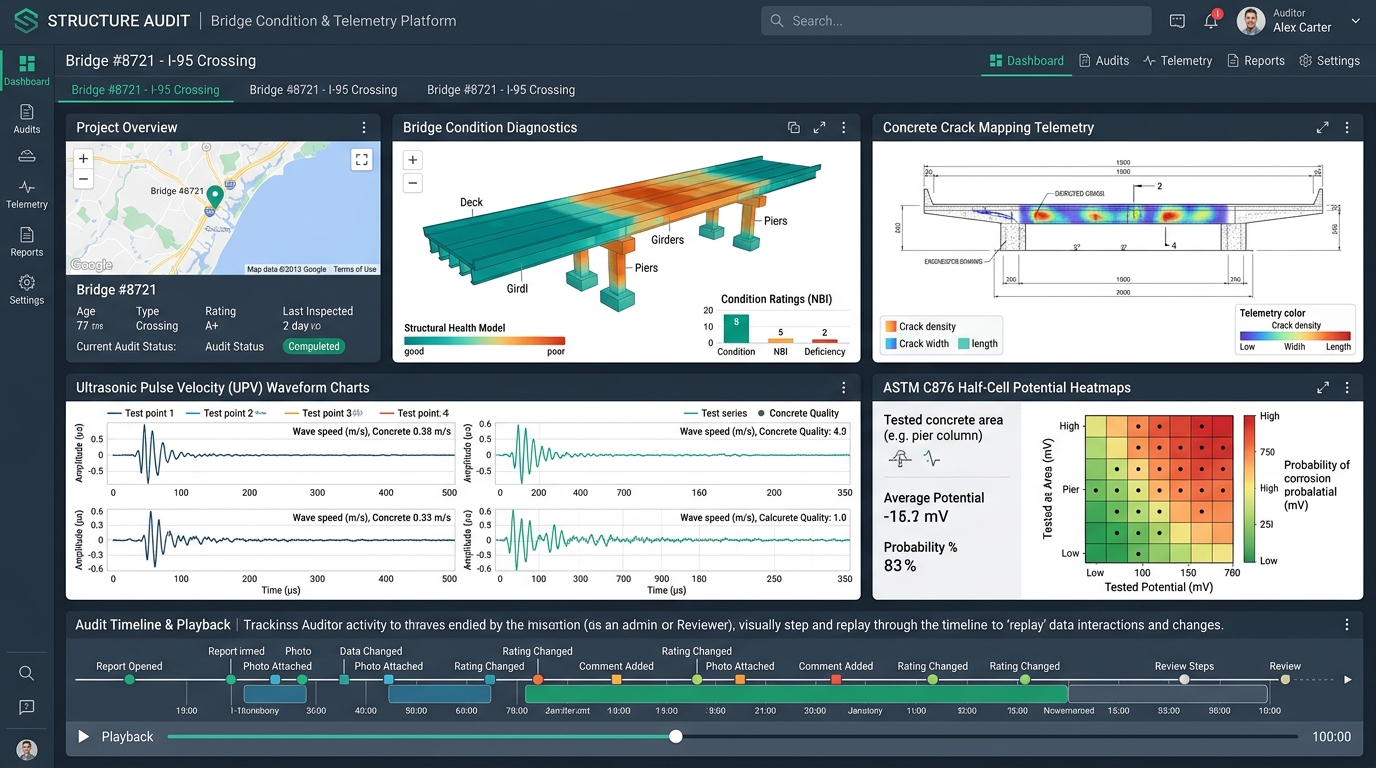
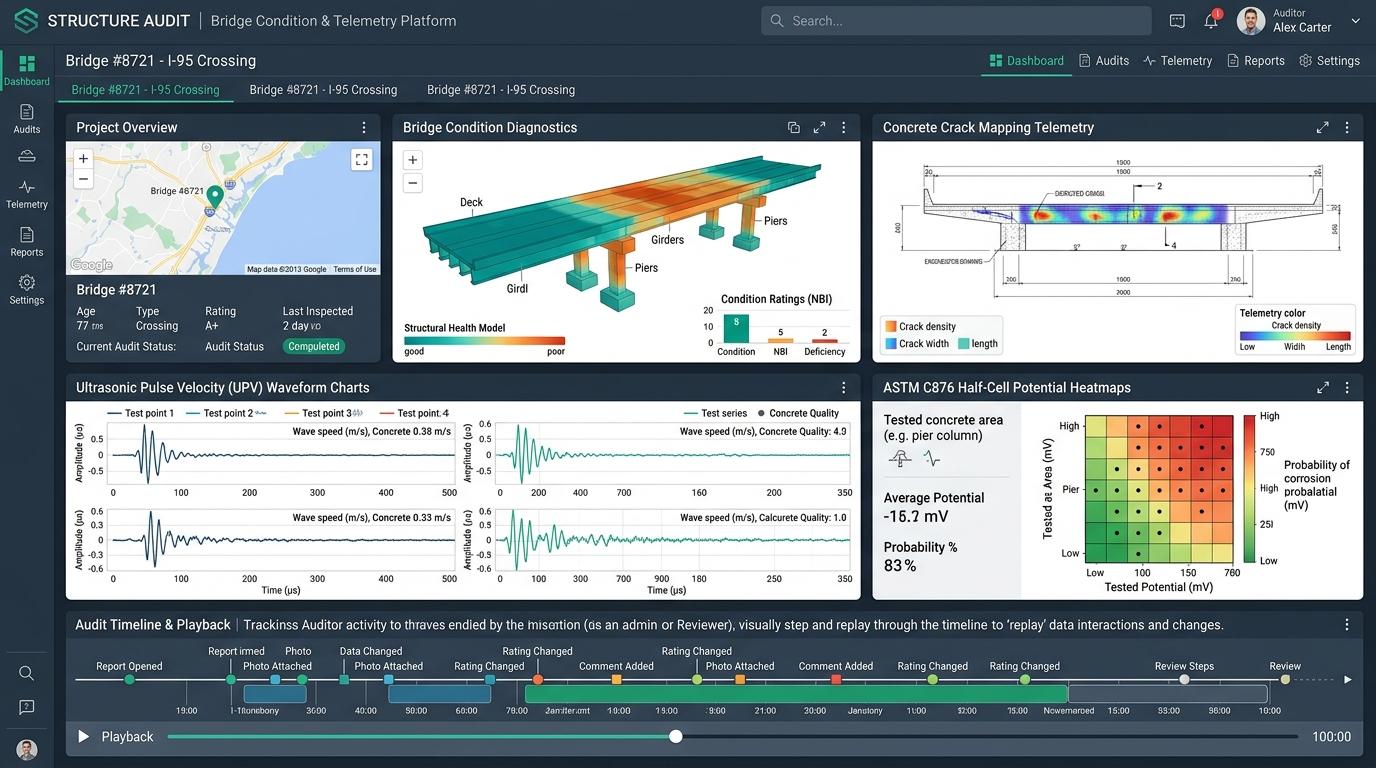
Figure 1: Checkmark's unified structural inspection audit dashboard, combining physical sensor concordance (NDT telemetry, ASTM C876 potential heatmaps) with Essay Playback™ writing process verification.
1. The Modern Structural Inspection Reporting Crisis: Generative AI in Civil Engineering Education
Field inspection and structural condition assessment are foundational pillars of civil and structural engineering education. Across senior capstone projects, forensic structural engineering electives, materials laboratory practicums, and graduate structural health monitoring courses, engineering students are tasked with examining real-world infrastructure—including reinforced concrete highway overpasses, historic steel truss spans, multi-story masonry shear walls, and post-tensioned parking structures.
In these practicums, students must execute rigorous physical assessments, record granular field measurements, and synthesize their observations into formal Structural Condition Assessment Reports. Traditionally, an exhaustive 40-page report populated with crack mapping sketches, delamination survey grids, Half-Cell corrosion potential contour plots, and AASHTO condition ratings served as undeniable proof of hands-on field diagnostic work.
Today, that pedagogical certainty has evaporated.
- Physical site walkover & acoustic chain-drag sounding (ASTM D4580)
- Raw NDT data logging (UPV wave speeds, Schmidt rebound numbers)
- Messy field logbook sketches, chalk grid coordinates & EXIF photos
- Carbonation depth phenolphthalein assays & rebar covermeter surveys
- Hours spent wrestling with raw sensor logs and structural drawings
- High-level prompt to frontier LLM (“Write a 35-page pier report...”)
- Flawless, highly articulate technical syntax and ACI/AISC citations
- Confabulated ASTM/AASHTO condition states with no site presence
- Hallucinated crack propagation vectors violating principal stress tensors
- Mechanically contradictory structural remediation checklists
A beautifully formatted, code-referenced structural engineering report that mimics professional firm deliverables but represents zero physical field labor and conceals hazardous mechanical errors.
Flags standard ASTM/AISC code references, units (ksi, MPa), and passive engineering grammar as “100% AI,” while remaining completely blind to physically impossible structural mechanics.
ABET Student Outcomes 1, 2, and 6 go unverified; unvetted engineering students advance into the Professional Engineer (PE) pipeline carrying fatal data-falsification habits.
The Mechanics of Structural Health Monitoring & Field Testing
To understand why generative AI creates such profound vulnerabilities in structural engineering curricula, one must examine the specific diagnostic methods taught in civil engineering field courses:
-
Bridge Deck Delamination Sounding (Acoustic Impact & Chain Drag):
Under ASTM D4580 (Standard Practice for Measuring Delaminations in Concrete Bridge Decks by Sounding), inspectors drag steel chains across bridge decks or strike the surface with acoustic hammers. Solid, intact concrete produces a clear, high-pitched ringing acoustic signature, whereas subsurface delaminations caused by corroding rebar expansion produce a distinctive dull, hollow “drumming” sound. Students must map these boundaries onto a scaled deck grid and calculate the total delaminated percentage of the deck surface area. -
Reinforced Concrete Corrosion Assessment (Half-Cell Potential & Carbonation):
Under ASTM C876 (Standard Test Method for Corrosion Potentials of Uncoated Reinforcing Steel in Concrete), students connect a copper-copper sulfate reference electrode (Cu/CuSO4, or CSE) to exposed rebar and take potential readings across a regular grid. Potentials more negative than −350 mV CSE indicate a greater than 90% probability of active reinforcing steel corrosion. This is coupled with carbonation testing (spraying freshly fractured concrete cores with a 1% phenolphthalein indicator solution to determine the depth where pH < 9.0, indicating loss of passivity) and electromagnetic covermeter/pachometer surveys to measure concrete cover depth (c). -
Structural Steel Weld & Connection Fatigue Cracking:
Inspectors evaluate fracture-critical steel members and weldments using ASTM E165 (Liquid Penetrant Examination), ASTM E709 (Magnetic Particle Examination), and Ultrasonic Testing (UT) to detect sub-surface fatigue cracks along heat-affected zones (HAZ), cope holes, and shear tab connections. Students must document crack length, orientation, stress cycle history, and potential prying action on High-Strength ASTM F3125 Grade A325/A490 structural bolts. -
Masonry Shear & Out-of-Plane Flexural Cracking:
In unreinforced masonry (URM) and reinforced masonry structures, students inspect mortar bed joints, head joints, and masonry units. They must differentiate between diagonal stair-step shear cracks driven by in-plane seismic or wind shear racking (τxy) versus horizontal bed-joint flexural cracking driven by out-of-plane wind loads (Mu), thermal expansion, or foundation differential settlement. -
Nondestructive Testing (NDT) Telemetry:
Students utilize ASTM C597 (Ultrasonic Pulse Velocity - UPV) to measure the transit time of longitudinal compression waves (Vp) through concrete members (where velocities < 3,000 m/s signal severe honeycombing or internal microcracking, while > 4,500 m/s indicates high-density, sound concrete) and ASTM C805 (Rebound Hammer / Schmidt Hammer) to evaluate surface hardness and estimate in-situ compressive strength (f'c).
The Synthetic Inspection Report Trap
When an undergraduate student faces a looming deadline for a 35-page bridge inspection report, modern multimodal LLMs present an irresistible shortcut. A student can upload two smartphone photos of a bridge abutment and input a brief prompt:
“Write an authoritative bridge condition inspection report for Pier 3 of the Route 104 crossing over the Blackwood River. Include ASTM C876 half-cell potential readings, ASTM D4580 chain drag delamination estimates, crack mapping using AASHTO Manual for Bridge Element Inspection condition states, ultrasonic pulse velocity data, and recommended structural repairs with ACI and AISC citations.”
In less than twenty seconds, the LLM outputs a breathtakingly formatted technical document complete with executive summaries, standard design codes, structured tables, and confident repair methodologies.
To an instructor skimming dozens of submissions, the report appears flawless. But from the standpoint of structural mechanics, materials science, and actual physical reality, the report is riddled with catastrophic fabrications.
2. The Physical & Mechanical Hallucinations of Generative AI in Structural Forensics
Generative AI models do not possess an internal physics engine, nor do they understand stress tensors, Mohr’s circle of stress, or the electrochemical thermodynamics of rebar passivation. They are probabilistic language models trained on massive text corpora. Consequently, when asked to generate structural field inspection reports, they produce predictable, dangerous mechanical hallucinations.
Inverted Crack Mechanics
- Places maximum vertical flexural cracks at the neutral axis or near simple roller supports (where M = 0).
- Orients diagonal shear cracks at angles opposing principal tensile stress trajectories.
- Confuses structural differential settlement cracks with drying shrinkage micro-crazing.
Incoherent NDT Telemetry
- Invented UPV wave speeds > 5,200 m/s in deteriorated, severely honeycombed concrete.
- ASTM C876 half-cell potentials of −550 mV CSE paired with claims of “negligible corrosion risk.”
- Schmidt hammer values converted to compressive strength without calibration curves or carbonation corrections.
AASHTO / NBI Rating Anomalies
- Assigns NBI Rating 8 (Very Good) to bridge decks with 35% delamination and exposed corroded rebar.
- Confuses whole-component NBI ratings (0–9) with AASHTO Element-Level Condition States (CS-1 to CS-4).
- Creates contradictory hybrid classifications like “Element 12 is rated NBI Condition State 2 (Poor).”
Hazardous Remediation Protocols
- Recommends rigid structural epoxy injection for active, dynamic cyclic fatigue cracks without crack-stop holes.
- Proposes un-shored hydro-demolition on prestressed girder bottom flanges, risking sudden catastrophic debonding.
- Applies impermeable vapor barriers to the negative face, accelerating subsurface freeze-thaw spalling.
Archetype 1: Inverted Crack Mechanics & Load Path Contradictions
In physical structures, crack morphology directly reflects internal stress states governed by mechanics of materials:
- In simply supported reinforced concrete beams under gravity loads, flexural cracks initiate at the bottom extreme fiber in the maximum positive moment region (Mmax at midspan) and propagate vertically upward toward the neutral axis.
- Diagonal shear cracks (web-shear or flexure-shear) develop near the supports where shear force (Vu) is maximized, inclining at approximately 45° along the trajectory of principal compressive stresses (perpendicular to principal tensile stresses σ1).
LLMs frequently generate descriptions that violate these basic governing laws:
- Describing wide vertical flexural cracks occurring directly over the roller support where bending moment M = 0.
- Locating 45° diagonal shear cracks at midspan where shear V = 0.
- Describing longitudinal splitting cracks on the tension face of a beam while attributing them to “excessive axial compressive crushing.”
- Fabricating diagonal stair-step shear cracks in a masonry wall that propagate downward toward the center of the span rather than radiating outward from the concentrated load point.
Archetype 2: Incoherent Nondestructive Testing (NDT) Telemetry
Authentic NDT data exhibits distinct physical correlations governed by materials science. LLMs assemble numbers that sound statistically plausible but are physically impossible:
-
Ultrasonic Pulse Velocity (UPV) Telemetry: Concrete has a theoretical upper-bound longitudinal wave speed governed by its dynamic modulus of elasticity (Ed), density (ρ), and Poisson’s ratio (ν):
Vp = √[ Ed (1 − ν) / ( ρ (1 + ν) (1 − 2ν) ) ]For standard 4,000 psi (27.6 MPa) structural concrete, sound field velocities typically range between 3,600 m/s and 4,400 m/s. LLMs frequently report fabricated velocities of 5,500 m/s to 6,200 m/s—velocities characteristic of solid forged steel or dense granite, not porous, field-aged concrete.
-
Half-Cell Potential / Corrosion Incoherence: Under ASTM C876 guidelines:
- Potentials more positive than −200 mV CSE &implies; < 10% probability of corrosion.
- Potentials between −200 mV and −350 mV CSE &implies; uncertain corrosion activity.
- Potentials more negative than −350 mV CSE &implies; > 90% probability of active rebar corrosion.
Archetype 3: AASHTO / FHWA NBI Condition Rating Contradictions
The Federal Highway Administration (FHWA) National Bridge Inventory (NBI) assigns condition ratings on a 0–9 scale for the Deck (Item 58), Superstructure (Item 59), Substructure (Item 60), and Culverts (Item 62):
- Rating 9: Excellent condition.
- Rating 7: Good condition; some minor problems (minor hairline cracking).
- Rating 5: Fair condition; all primary structural elements are sound but may have minor section loss, spalling, or scour.
- Rating 4: Poor condition; advanced section loss, deterioration, spalling, or scour.
- Rating 3: Serious condition; primary structural members have deterioration affecting structural capacity.
AI-generated reports frequently create jarring contradictions:
- Assigning an overall NBI Deck Rating of 8 (Very Good) while simultaneously reporting that 25% of the deck area exhibited hollow sounding under ASTM D4580 chain dragging, with 1.5 inch deep spalls and exposed, corroded transverse rebar.
- Conflating AASHTO Element-Level Condition States (where CS-4 represents critical structural capacity loss) with NBI Condition Ratings (where 4 represents Poor condition), resulting in bizarre hybrid metrics such as “Element 12 (Reinforced Concrete Deck) is rated NBI Condition State 2 (Poor).”
Archetype 4: Hazardous & Contradictory Structural Remediation Protocols
Perhaps the most alarming symptom of AI-fabricated field notes is the generation of structural repair recommendations that, if executed in practice, would cause progressive structural collapse or accelerate deterioration:
- Epoxy Injection in Active Fatigue Cracks: Recommending rigid structural epoxy injection (ASTM C881 Type I/IV) to seal moving, dynamic cyclic fatigue cracks in steel girder cope holes or expansion joint abutment seats without addressing the cyclic stress range or drilling crack-stop holes. Rigid epoxy in an active joint will simply re-crack adjacent concrete within days.
- Un-shored Hydro-Demolition on Prestressed Flanges: Proposing high-pressure water jetting (20,000 psi) to remove chloride-contaminated concrete across the bottom flange of a prestressed precast I-beam without specifying temporary falsework or structural re-shoring. Removing the bottom flange concrete debonds the prestressing strands, causing catastrophic loss of prestress transfer and immediate brittle flexural failure under dead load.
- Applying Vapor-Barrier Sealers to the Negative Face: Recommending impermeable epoxy overlays on the top surface of a concrete slab while moisture and chlorides continue to wick from an unsealed underside, accelerating freeze-thaw spalling and subsurface rebar delamination.
Comparative Evaluation: Authentic vs. AI-Generated Structural Field Observations
| Structural Diagnostic Domain | Authentic Field Inspection Dossier | Generative AI Fabricated Field Note | Engineering Pedagogical Indicator |
|---|---|---|---|
| Bridge Deck Acoustic Sounding (ASTM D4580) | Irregular, polygonal delamination boundaries sketched on a 5 ft × 5 ft chalk grid; notes varying acoustic pitch near expansion joints and wheel paths. | Symmetrical, perfectly circular or rectangular delamination zones; uniform 10.0% area estimates distributed evenly. | LLMs lack spatial awareness of water ponding, gutter lines, and vehicular wheel-line salt accumulation. |
| Rebar Corrosion Survey (ASTM C876) | Hand-logged millivolt readings exhibiting spatial gradients (e.g., −180 mV near crown transitioning to −420 mV along the curb line). | Flat, random numeric distributions without spatial gradient (e.g., alternating between −150 mV and −510 mV across adjacent points). | Real electrochemical corrosion cells form continuous potential gradient contours; AI outputs disjointed Gaussian noise. |
| Crack Morphology & Load Path Alignment | Detailed crack width measurements (mm or mils via optical comparator); crack orientation precisely matches moment-shear interaction envelopes. | Generic descriptions of “medium cracks” without measured widths; cracks located in zero-stress zones or angled incorrectly. | AI cannot compute stress transformations (σx, σy, τxy) or reconcile boundary conditions. |
| NDT Wave Speed & Surface Hardness | UPV transit times recorded with transducer placement details (direct, semi-direct); Schmidt rebound numbers calibrated against core breaks. | Raw UPV speeds quoted > 5,200 m/s in damaged concrete; Schmidt hammer values converted directly without calibration curves. | AI confabulates physical wave mechanics constants and omits required ASTM calibration adjustments. |
| Environmental & Weather Documentation | Specific ambient temperature, concrete surface temperature, relative humidity, and surface dryness notes affecting NDT sensor readings. | Generic boilerplate: “Inspection conducted under normal daylight weather.” No surface temperature logs affecting CSE thermal drift. | ASTM C876 requires temperature corrections (~0.5 mV/°F for CSE); AI ignores sensor thermal drift. |
| Photographic Evidence & Metadata | High-resolution macro photos showing crack comparators, scale rulers, chalked grid lines, and embedded EXIF metadata (timestamp, GPS). | Generic stock-like photos or AI close-ups lacking measurement scale rulers, lacking EXIF metadata, or showing wrong bridge type. | Visual hallucination and total lack of verifiable physical capture telemetry. |
3. The ABET Accreditation, Public Safety, and Professional Licensure Dilemma
In liberal arts and general humanities education, an AI-generated essay represents an academic integrity violation concerning unauthorized assistance and fair grading.
In Civil and Structural Engineering education, the submission of fabricated structural inspection reports represents an immediate threat to public safety, professional licensure integrity, and ABET accreditation.
- OUTCOME 1 (Complex Problem Solving): Identify, formulate, and solve complex engineering problems by applying principles of engineering, science, and mathematics.
- OUTCOME 2 (Public Health, Safety, & Welfare): Apply engineering design to produce solutions that meet specified needs with consideration of public health, safety, and welfare.
- OUTCOME 6 (Experimentation & Judgment): Develop and conduct appropriate experimentation, analyze and interpret data, and use engineering judgment to draw conclusions.
- ASCE CODE OF ETHICS (Canon 1): “Engineers shall hold paramount the safety, health, and welfare of the public in the performance of their duties.”
- NCEES MODEL RULES (§ 240.15): “Licensees shall be objective and truthful in professional reports, statements, or testimony.”
- NSPE CODE OF ETHICS (Rule 2.a): “Engineers shall not falsify their qualifications or permit misrepresentation of their or their associates’ data.”
- High False Positive Rate: Flags standard codes (ACI 318, AISC 360, ASTM C876, AASHTO), units (ksi, MPa), and equations as “AI writing.”
- Zero Mechanical Awareness: Completely misses physically impossible crack propagation paths, invented NDT sensor speeds, and hazardous remediation recommendations.
- Indefensible in Appeals: Opaque percentage scores fail university hearing standards and provide zero actionable coaching for honest students.
ABET EAC Criterion 3: Student Outcomes Under Threat
The Engineering Accreditation Commission (EAC) of ABET establishes rigorous student outcomes that every accredited engineering program must demonstrate through direct assessment artifacts:
- Student Outcome 1 (Complex Problem Solving): Students must demonstrate the ability to identify, formulate, and solve complex engineering problems by applying principles of engineering, science, and mathematics. When a student uses generative AI to synthesize an inspection report, they bypass the core mathematical and physical reasoning required to evaluate load capacity, moment distribution, and structural adequacy.
- Student Outcome 2 (Public Health, Safety, and Welfare): Students must apply engineering design to produce solutions that meet specified needs with consideration of public health, safety, and welfare. Fabricating inspection findings or recommending un-shored structural demolition in an academic report proves a failure to understand the life-safety stakes of civil engineering infrastructure.
- Student Outcome 6 (Experimentation & Engineering Judgment): Students must develop and conduct appropriate experimentation, analyze and interpret data, and use engineering judgment to draw conclusions. Outcome 6 cannot be satisfied if the underlying experimental data (chain drag sounding grids, half-cell potential maps, ultrasonic wave speeds) is synthesized by an LLM rather than physically acquired and interpreted by the student.
During periodic ABET accreditation audits, program evaluators inspect student work portfolios. If capstone or inspection course dossiers contain superficial, AI-generated reports lacking raw data sheets, calibration logs, and authentic calculation trails, program evaluators can issue Weaknesses or Deficiencies against Criterion 3, placing the department’s accreditation in severe jeopardy.
Professional Licensure & Ethical Liability
Civil engineering is unique among technical professions in that its practitioners hold legal responsibility for public life safety through Professional Engineer (PE) and Structural Engineer (SE) licensure.
- ASCE Code of Ethics (Canon 1): Mandates that civil engineers hold paramount the safety, health, and welfare of the public. Signing off on unverified, AI-hallucinated structural field notes directly violates this fundamental canon.
- NCEES Model Rules of Professional Conduct (§ 240.15): Requires that engineers be completely objective and truthful in all professional technical reports, statements, or testimony, and explicitly prohibits the falsification or unverified extrapolation of test data.
If university faculty fail to detect and correct data fabrication habits in undergraduate and graduate courses, students carry those destructive behaviors into professional practice—where signing off on an unverified bridge inspection report can lead to catastrophic infrastructure collapse, criminal negligence charges, and loss of life.
4. The Structural Engineering Evidentiary Matrix
To establish a fair, transparent, and legally defensible standard of academic integrity, engineering faculty must move beyond black-box probability scores and rely on multi-dimensional evidentiary concordance.
Physical Mechanics & Codes
- Crack propagation obeys Mohr’s circle stress tensors
- Load path equilibrium reconciles (∑ F = 0, ∑ M = 0)
- Code compliance matches ACI 318 / AISC 360 / FHWA NBI
- Repair specs respect dynamic expansion cycles
Sensor Data Concordance
- Raw field logbook sheets & calibration logs
- Digital photo EXIF data (GPS, timestamp, focal length)
- Spatial corrosion gradients across ASTM C876 grids
- Environmental NOAA weather cross-validation
Writing Process Forensics
- Checkmark Essay Playback™ scrubbable 1x–8x replay
- Organic calculation pause intervals (Mathcad / hand calcs)
- 100% immutable clipboard paste payload inspection
- Passage-level calibrated AI confidence sliders
The table below contrasts the diagnostic effectiveness of traditional paper logbooks, generic whole-document AI text detectors, and Checkmark’s Writing Process Telemetry & Site Sensor Concordance Suite:
| Audit Evaluation Criterion | Traditional Paper Field Logbooks | Generic Black-Box AI Detectors | Checkmark Process Telemetry Suite |
|---|---|---|---|
| Physical Mechanics Validation | Manual instructor cross-checking of field sketches against structural drawings. High faculty time requirement. | Zero capability. Cannot evaluate load paths, moment diagrams, or crack kinematics. | Automated passage flag triage paired with teacher-controlled rubric scoring of load-path mechanics. |
| NDT Raw Data Concordance | Dependent on physical paper sheets; susceptible to post-hoc manual fabrication or copying from peers. | Zero capability. Treats raw sensor tables as arbitrary text strings. | Tracks temporal synthesis from raw field data tables into technical prose; flags bulk-pasted synthetic tables. |
| Keystroke & Drafting Process Dynamics | Non-existent once the student transcribes field notes into a Word/Docs document. | Zero capability. Analyzes only the static final submission snapshot. | Patent-Pending Essay Playback™ reconstructs the complete writing timeline keystroke-by-keystroke at 1x–8x speed. |
| Cognitive Formulation & Calculation Pauses | Unobservable. Instructor cannot verify if calculations were performed organically. | Zero capability. Blind to drafting duration and editing behavior. | Visualizes natural pauses during complex engineering calculations (e.g., computing section modulus Sx or shear flow q). |
| External Clipboard & Paste Forensics | Cannot determine if text was pasted from an LLM prompt window or typed manually. | Flags pasted AI text and pasted original engineering code notes with the same opaque percentage. | 100% Immutable Paste Inspector preserves full clipboard payload, source timestamp, and jump-to-timeline replay. |
| Treatment of Standard Engineering Acronyms | N/A (Manual grading). | High false-positive rate on standard acronyms (ASTM, AASHTO, ACI, AISC, LRFD, NDT, UPV, CSE). | Calibrated Passage-Level Sliders with honest short-text guardrails (N/A under 150 words) prevent false flags. |
| Student Appeal & ABET Audit Defensibility | Subjective instructor notes; difficult to defend against formal student grievances. | Legally indefensible; black-box probabilities rejected by academic hearing boards. | Irrefutable evidentiary dossier showing exact keystroke chronology, raw data links, and transparent rubrics. |
5. Step-by-Step Structural Engineering Faculty Audit Protocol
To provide civil and structural engineering faculty with a practical, objective, and restorative framework for evaluating field inspection submissions, Checkmark recommends a four-phase Structural Engineering Faculty Audit Protocol.
- Verify EXIF timestamps and GPS coordinates on all site inspection photos
- Cross-check raw field data sheets against NDT equipment serial numbers and calibration logs
- Reconcile ambient weather logs with regional NOAA weather data on the day of inspection
- Map reported crack locations against theoretical bending moment (M) and shear (V) curves
- Verify that UPV wave speeds and ASTM C876 potential contours obey material physics laws
- Check AASHTO / FHWA NBI condition ratings against documented physical section loss
- Scrub the 1x–8x keystroke timeline to observe how raw field notes were synthesized
- Inspect clipboard paste events: Were NDT tables typed organically or dumped in 3 seconds?
- Analyze calculation pause intervals during engineering formula derivations
- Conduct a 10-minute collaborative whiteboard review with the student
- Ask the student to sketch the load transfer mechanism and explain the NDT anomaly
- Apply restorative coaching to guide professional engineering documentation standards
Phase 1: Sensor Data & Metadata Concordance Audit
Before analyzing the narrative prose, instructors should perform an initial data provenance audit:
- EXIF Metadata Validation: Inspect the digital image metadata of submitted site photos. Authentic field inspection photos contain embedded EXIF tags indicating capture timestamp, camera model, exposure settings, and GPS coordinates that match the bridge or building site during scheduled inspection hours. Fabricated reports frequently utilize web-scraped images with stripped EXIF headers or timestamps that conflict with the laboratory schedule.
- NDT Calibration & Serial Concordance: Cross-check the equipment serial numbers reported in the text (e.g., Proceq SilverSchmidt Hammer or Olympus Epoch 650 UT Flaw Detector) against the department’s actual equipment inventory checkout log. Verify that the calibration curve constants recorded by the student correspond to the specific instrument assigned to their team.
- Environmental Parameter Correlation: Compare documented ambient temperature, relative humidity, and wind conditions against historical NOAA meteorological logs for the inspection date. A student report claiming a dry, 72°F inspection on a morning with documented heavy rain and 41°F temperatures indicates synthetic generation.
Phase 2: Structural Mechanics & Load-Path Sanity Check
Conduct a targeted technical review focusing on physical equilibrium and structural kinematics:
- Bending Moment & Shear Envelope Alignment: Verify that reported crack patterns match the boundary conditions of the structure. In a continuous post-tensioned bridge girder, flexural cracks over intermediate bents must occur on the top flange (negative moment region −M), while midspan flexural cracks occur on the bottom flange (positive moment +M). AI-generated reports that place bottom-flange flexural cracks over interior pier supports fail physical sanity checks.
- Corrosion Potential vs. Visible Distress Correlation: Verify that ASTM C876 potential readings align with visual rust staining, carbonation depths, and concrete cover depth. An area reporting −500 mV CSE potentials must show corresponding evidence of delamination, section loss, or rust exudation.
- Remediation Feasibility Check: Evaluate the proposed repair protocols against ACI 546R (Guide to Concrete Repair) and ICRI Guidelines. Ensure the report does not recommend rigid materials across dynamic joints or un-shored hydro-demolition of critical load-bearing elements.
Phase 3: Checkmark Essay Playback™ Writing Process Audit
Launch the Checkmark Plagiarism integration within Canvas LMS, Buzz LMS, or Google Classroom to inspect the actual synthesis of the report:
- Timeline Velocity & Keystroke Replay: Scrub through the document timeline at 2x to 4x speed. In an authentic engineering submission, the instructor will observe an organic, non-linear drafting pattern: the student types a paragraph describing field observations, pauses for 3 to 5 minutes to reference their raw NDT spreadsheet, types out a governing equation, backspaces to correct a unit conversion (e.g., converting in2 to mm2), and gradually compiles the condition summary.
- External Paste Inspector: Inspect all highlighted paste blocks. If the entire 12-page “Condition Assessment & Structural Analysis” section was inserted in a single 2-second paste operation from an external clipboard payload, click the “View Original Paste” button in Checkmark. This reveals the exact text copied into the clipboard—allowing the instructor to see if the student pasted raw prompt responses from an external LLM interface.
- Passage-Level Calibrated AI Sliders: Examine the sidebar evidence cards. Checkmark isolates specific paragraphs (such as the remediation methodology or crack kinematics) and displays calibrated confidence sliders reflecting typical human writing vs. AI syntactic signatures—while applying short-text guardrails (
N/A) to equations and bulleted lists to avoid false accusations on engineering acronyms.
Visual inspection of Pier 2 revealed severe vertical cracking along the south face. Ultrasonic Pulse Velocity testing across the pier stem yielded an average longitudinal wave velocity of 3,850 m/s (ASTM C597-16)...
Phase 4: Restorative Structural Defense Debrief
When evidence suggests unauthorized AI generation or fabricated NDT data, the faculty member should initiate a supportive, restorative conference rather than an adversarial misconduct hearing:
- The Whiteboard Structural Mechanics Defense: Invite the student to an in-person or video conference. Ask them to sketch the structural elevation of the inspected member on the whiteboard, draw the shear force (V) and bending moment (M) diagrams, and explain how their documented crack patterns physically correspond to internal stress distributions.
- NDT Telemetry Walkthrough: Ask the student to explain the operating principle of the ultrasonic transducer used in their report, explain why a specific wave speed was recorded, and explain how the temperature correction was applied to the half-cell potential readings.
- Restorative Learning Outcome: If the student admits to using generative AI to synthesize the report due to time management stress or lack of confidence in field data, frame the resolution around professional engineering ethics. Require the student to re-inspect the member (or use validated department reference datasets), draft an authentic report with full calculation trails in Checkmark, and complete an ASCE Code of Ethics reflection on public safety documentation.
6. Real-World Civil Engineering Case Scenarios
The following three case studies illustrate how Checkmark’s multi-dimensional evidentiary suite operates in collegiate civil and structural engineering courses.
Prestressed Concrete Girder Shear Failure (Fabricated NDT Report)
- UPV wave speed reported at 5,800 m/s in severely cracked concrete (physically impossible: sound concrete tops out at 4,400 m/s; forged steel is ~5,900 m/s).
- Diagonal shear cracks near the support were described as inclining 45° downward toward the pier, directly opposing principal tensile stress trajectories for a simple span.
- Essay Playback™ revealed total document active typing time of only 11 minutes for a 38-page report.
- External Paste Inspector showed two massive clipboard dumps (14,000 characters each) copied directly from an external browser LLM chat session.
In the restorative conference, the student was unable to explain the UPV wave equation or draw Mohr’s circle for shear stress. The student completed a supervised re-inspection of a campus parking deck, logged authentic field measurements, and satisfied ABET Outcome 6 through an authentic calculation dossier.
Historic Steel Truss Fatigue Inspection (False Positive Exoneration)
- Generic commercial AI detector flagged the 28-page submission with an 88% “AI Probability” score.
- Legacy tool triggered flags exclusively on AISC 360-22 boilerplate, constant-amplitude fatigue equations (ΔFTH), and ASTM E165 dye-penetrant procedures.
- Essay Playback™ documented 6.5 hours of continuous, non-linear drafting across 4 distinct working sessions.
- Keystroke dynamics showed hundreds of organic revisions, formula manipulations, and pauses averaging 90–180 seconds while computing stress ranges (Δσ).
The student was fully exonerated with zero adversarial friction. The professor used the Checkmark evidence dossier to defend the student’s authentic work against an automated departmental alert, protecting student trust and morale.
Bridge Deck Delamination & Half-Cell Survey (Hybrid Submission Triage)
- Sections 1–3 (Field Testing & NDT Data): Fully authentic hand-logged data, accurate Half-Cell potential contours (−150 mV to −480 mV CSE), verified chain-drag acoustic maps.
- Section 4 (Remediation & Capacity Analysis): Highly generic synthesized LLM prose recommending rigid epoxy injection across active bridge expansion joints.
- Passage-Level Sliders cleanly separated Section 1–3 (Human Writing Pattern) from Section 4 (Strong AI Signature).
- Essay Playback™ confirmed organic typing for data logging and an external paste dump for the remediation section.
Teacher-controlled rubric autograding awarded full laboratory credit for experimental data acquisition (ABET Outcome 6) while assigning a targeted revision prompt requiring an authentic repair design under ACI 546R (ABET Outcome 2).
7. How Checkmark Plagiarism Empowers Civil & Structural Engineering Departments
Checkmark Plagiarism delivers an enterprise-grade academic integrity and writing forensics suite built specifically to meet the high-stakes accreditation and life-safety standards of collegiate engineering education.
Patent-Pending Essay Playback™
- Granular Keystroke Video Replay: Scrub at 1x, 2x, 4x, or 8x speed to watch students compose sentences, pause during complex calculations, and revise structural units.
- Transcription Detection: Identifies mechanical, rhythmic retyping without organic cognitive pauses (detecting second-screen copying).
- Defensible Exoneration: Provides undeniable, objective proof of authentic student labor, protecting honest students from false accusations.
100% Immutable Paste Inspector
- Full Payload Capture: Automatically captures and timestamps all text pasted into the document editor from external sources.
- Permanent Text Preservation: Preserves the exact pasted text even if the student subsequently edits, rewrites, or disguises every word.
- Direct Playback Synchronization: “Jump to Playback” button instantly shifts the video replay to the exact millisecond the paste occurred.
Passage-Level AI Confidence Sliders
- Passage-Level Granularity: Evaluates submissions passage by passage with calibrated confidence sliders rather than arbitrary whole-paper scores.
- Honest Short-Text Guardrails: Automatically displays
N/Afor passages under ~150 words, preventing false positives on equations and engineering acronyms. - Educator-Only Flag Statuses: Flags remain completely private to faculty until reviewed, preventing premature student anxiety.
Teacher-Controlled Autograder
- ABET-Aligned Rubrics: Generates formative first-draft evaluations scored against custom rubrics tied to ABET Outcomes 1, 2, and 6.
- Quote-Anchored Evidence: Every score is backed by specific quote-anchored citations from the student’s calculations and text.
- 1-Click LMS Passback: Direct gradebook integration with Canvas LMS, Buzz LMS, and Google Classroom.
8. Frequently Asked Questions (FAQ)
1. How do generic AI detectors trigger false positives on structural engineering reports?
Generic AI text detectors rely on whole-document statistical metrics such as perplexity (word predictability) and burstiness (sentence structure variation). Civil engineering reports are inherently formal, structured, and heavily populated with standardized codes (ACI 318, AISC 360, ASTM C876, AASHTO LRFD), technical abbreviations (NDT, UPV, CSE, LRFD, ksi, MPa), and standardized testing procedures. Because this professional technical vocabulary has low perplexity, legacy detectors misinterpret compliant engineering prose as AI-generated text. Checkmark eliminates this flaw by using passage-level calibrated confidence sliders and strict short-text guardrails (N/A under ~150 words) that ignore standard nomenclature and focus on broader syntactic patterns.
2. Can generative AI models create fake NDT data that passes manual faculty review?
Yes. Frontier LLMs can generate comprehensive data tables of Ultrasonic Pulse Velocity (UPV) transit times, Schmidt rebound numbers, and Half-Cell corrosion potentials that appear plausible at a surface glance. However, these synthetic datasets invariably contain physical impossibilities upon closer inspection—such as UPV wave speeds exceeding the theoretical speed of sound in concrete (> 4,500 m/s), lack of spatial electrochemical potential gradients across adjacent grid points, or crack orientations that directly oppose principal stress tensors under Mohr’s circle. Checkmark pairs writing process forensics with sensor data concordance to detect these fabrications immediately.
3. How does Checkmark's Essay Playback™ prove whether an NDT data table was authentically typed or copied from an AI prompt?
When an engineering student authentically logs field data, Essay Playback™ records an organic, non-linear drafting sequence: the student types cell by cell, pauses to cross-reference handwritten field logs, backspaces to adjust column alignments, and inputs calculation formulas over an extended time. Conversely, if the student generated the table via an external LLM prompt, Essay Playback™ shows zero cell-level drafting activity—the entire multi-row table appears instantaneously in a 1-second paste event. Checkmark’s External Paste Inspector captures the full clipboard payload, allowing faculty to view the exact text pasted from the external source.
4. How does Checkmark support ABET accreditation reviews for Civil Engineering departments?
ABET accreditation (specifically EAC Criterion 3, Student Outcomes 1, 2, and 6) requires demonstrable evidence that students can solve complex engineering problems, prioritize public safety, and conduct authentic physical experimentation and data analysis. Checkmark provides an audit-ready digital dossier for every student submission—combining the final report, passage-level integrity metrics, time-stamped Essay Playback keystroke history, and teacher-approved ABET rubric scorecards. This provides program evaluators with irrefutable proof of authentic student experimentation and engineering judgment.
5. If students use mobile inspection tablets or digital logbooks on site, how does Checkmark track their writing process?
Checkmark integrates natively across web browsers, Google Docs, Microsoft 365 / Word, Canvas LMS, and Buzz LMS. When students use mobile tablets or field laptops equipped with connected cloud editors, Checkmark continuously records keystroke telemetry, touch inputs, and timestamped revisions in the background. If students record raw field data offline in physical paper logbooks, they transcribe or paste their raw data sheets into the report editor; Checkmark captures this transcription process and allows students to attach raw image/scan artifacts with verified EXIF metadata.
6. What should a faculty member do when a student claims they drafted their inspection report offline in another application?
Checkmark’s External Paste Inspector and Essay Playback™ resolve offline drafting claims with complete transparency. If a student drafted their report in an offline text editor and pasted it into the LMS submission portal, Checkmark flags the bulk paste and stores the entire pasted payload. The instructor can then ask the student to provide the version history or file metadata from their offline editor. If the student cannot provide offline revision files and the pasted text exhibits strong AI linguistic signatures, the faculty member can initiate Phase 4 of the audit protocol (the Restorative Structural Defense Debrief) to evaluate the student’s mastery of the underlying mechanics on the whiteboard.
7. How does Checkmark protect student intellectual property and proprietary engineering designs?
Under Checkmark’s strict enterprise privacy architecture, student submissions, capstone designs, proprietary CAD data, and structural inspection notes are never used to train public or proprietary machine learning models. Checkmark is fully FERPA and COPPA compliant, utilizing end-to-end encryption in transit (TLS 1.3) and at rest (AES-256). Student data remains the exclusive property of the educational institution.
8. How does Checkmark's Teacher-Controlled Rubric Autograder reduce grading workloads for large engineering courses?
Grading 40-page structural inspection reports across multiple laboratory sections is extraordinarily time-intensive. Checkmark’s AI Autograder performs an automated first-draft evaluation against custom department rubrics, generating preliminary criterion scores, written justifications, and quote-anchored evidence cards tied directly to the student’s prose and calculations. Instructors retain complete final authority: they can review, edit, or override any score with a single click before syncing finalized grades and feedback directly into Canvas LMS, Buzz LMS, or Google Classroom gradebooks.
9. Conclusion: Preserving Public Safety and Academic Integrity in Engineering Education
The ultimate objective of civil and structural engineering education is not merely to grade papers, but to graduate ethical, competent professionals entrusted with the design, inspection, and maintenance of public infrastructure. When engineering students rely on generative AI to fabricate field inspection notes, synthesize non-existent NDT sensor data, or bypass fundamental structural mechanics calculations, the consequences extend far beyond the classroom—they compromise the integrity of the engineering profession and jeopardize public life safety.
Generic black-box AI detectors cannot solve this crisis. By triggering false positives on standard engineering codes while remaining blind to life-critical structural hallucinations, legacy tools alienate honest students and fail university hearing standards.
Checkmark Plagiarism (checkmarkplagiarism.com) provides the modern, defensible alternative that engineering educators require. By uniting patent-pending Essay Playback™ keystroke replay, immutable external paste forensics, calibrated passage-level AI confidence sliders, and teacher-in-the-loop ABET rubric autograding, Checkmark empowers civil engineering faculty to:
- Verify authentic data acquisition and structural mechanics reasoning.
- Protect honest students from unwarranted false accusations.
- Conduct restorative, educational integrity debriefs that reinforce professional ethics.
- Maintain rigorous ABET accreditation compliance across all student design outcomes.
Stop Guessing. Start Trusting.
Equip your engineering department with the transparent, evidence-based integrity tools needed to safeguard the next generation of structural engineers.