
Executive Summary
In competitive high school mock trial—governed nationally by the National High School Mock Trial Championship (NHSMTC) and across state bar foundation tournaments—the written preparation phase is the crucible where competitive rounds are won or lost. Long before student attorneys stand at the courtroom podium in their suits, they must author complex, highly disciplined written deliverables: Case Theory Briefs (unifying Theme, Legal Theory, Factual Theory, and Burdens of Proof), Witness Cross-Examination Outlines (incremental leading question progressions anchored to exact affidavit line numbers), Direct Examination Scripts, and Pre-Trial Motions in Limine.
However, mock trial coaches, attorney mentors, and civics educators face a dual crisis in the age of generative artificial intelligence. On one side, students struggling under 150-page case packets and heavy academic workloads are increasingly prompting Large Language Models (LLMs) to generate cross outlines and case briefs. These AI tools produce disastrous courtroom artifacts: dramatic "Hollywood-style" cross-examinations that violate Rule 1.2 / Rule 2.2 Unfair Extrapolation by assuming uninventable facts outside the record, hallucinate witness testimony directly contradicting signed affidavits, confuse simplified state mock trial evidentiary rules with federal procedural quirks, and omit vital line-and-page citation anchors required for rapid three-step impeachment at the podium.
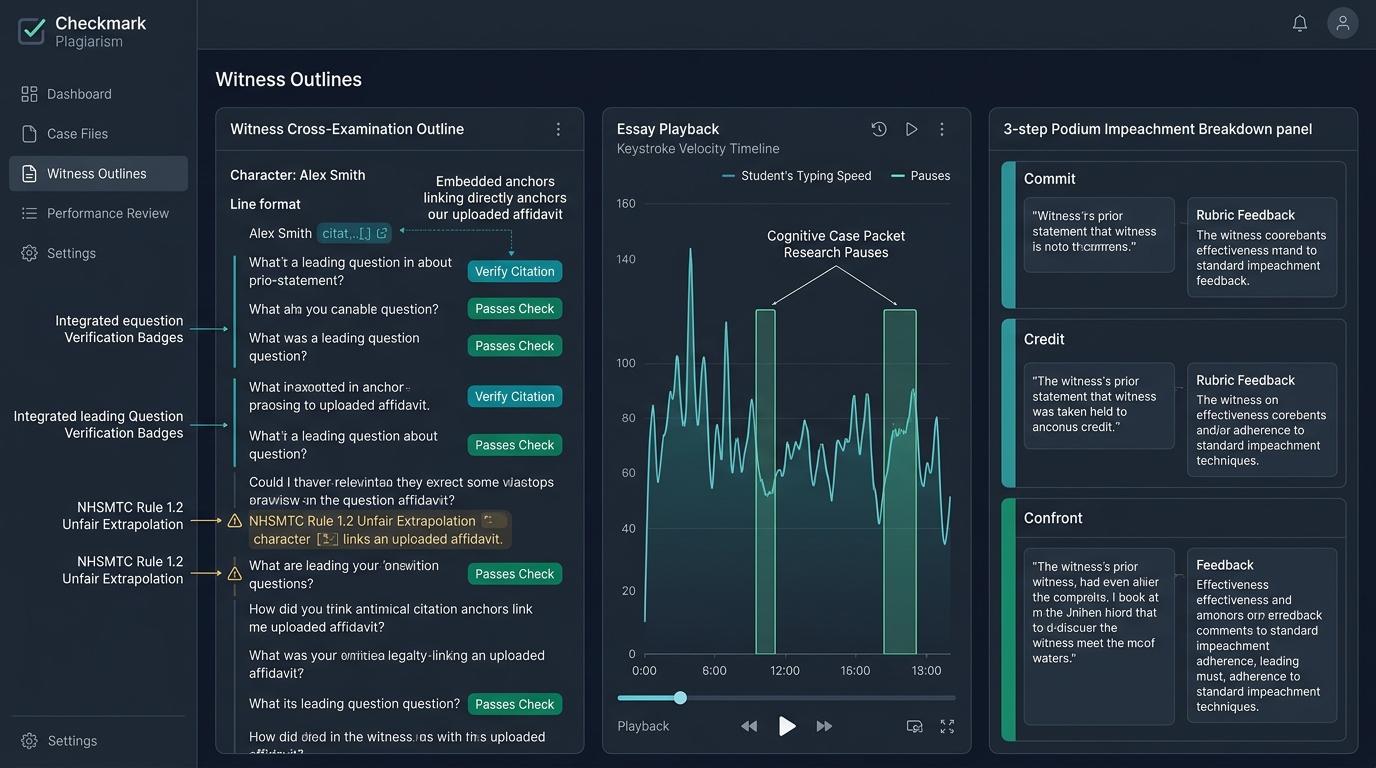
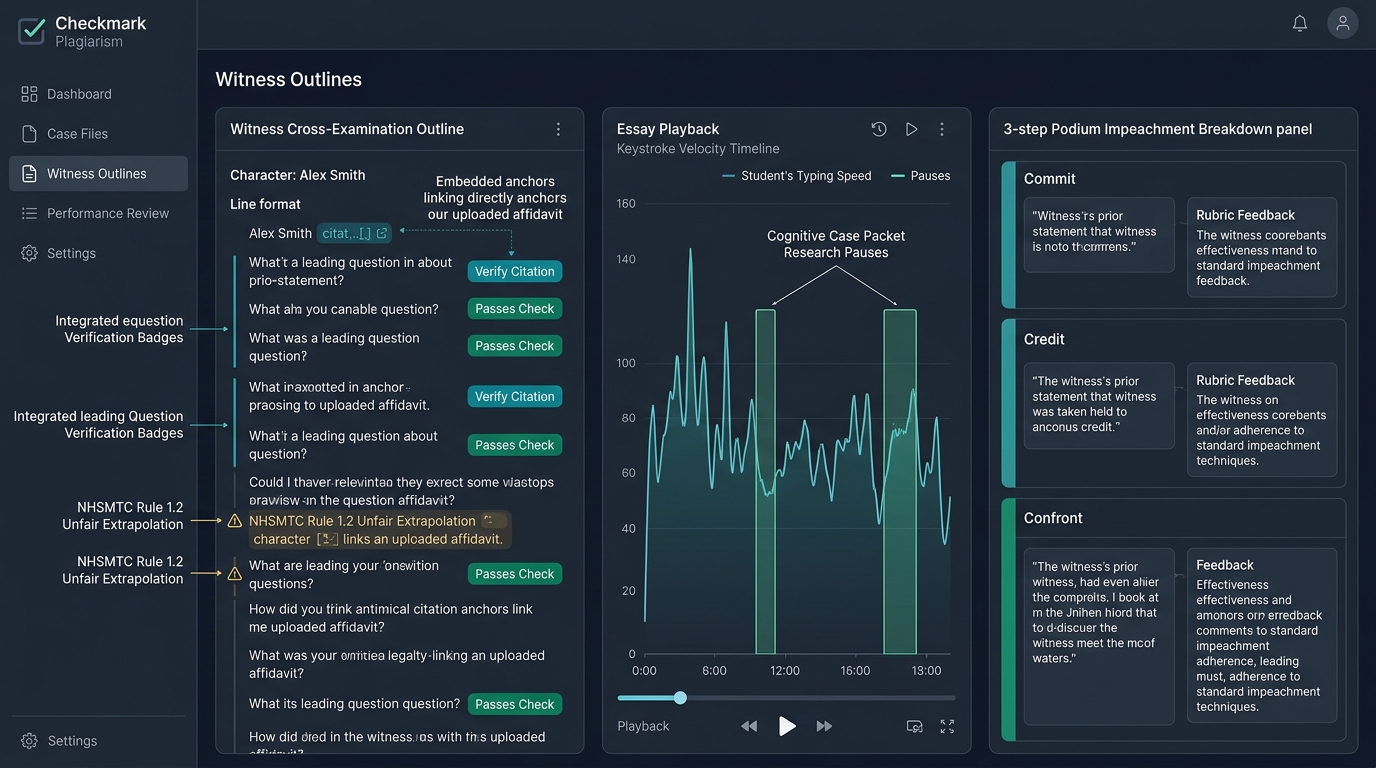
On the other side, generic whole-document AI text detectors fail mock trial educators completely. Commercial detectors trigger rampant false-positive alarms on standard legal terms of art, constitutional statutory stems, and formulaic objection phrasing ("Objection, leading," "Objection, hearsay under Rule 803(2)"), while remaining completely blind to wholesale synthetic cross outlines that mimic human structure. Checkmark Plagiarism resolves this dilemma through transparent, objective writing process telemetry. By pairing patent-pending Essay Playback™ (1x–8x keystroke replay) with full external paste buffer preservation, passage-level calibrated confidence sliders, and quote-anchored ballot autograding, coaches and teachers can verify authentic student drafting sessions, observe natural strategy pauses where students cross-reference physical case packets, and catch uninvented AI hallucinations before teams ever step into a scored courtroom scrimmage.
- 100–150 Page Tournament Packet
- Indictment / Complaint & Charges
- 10–25 Binding Stipulations
- 6 Sworn Affidavits (150 lines/each)
- Physical & Documentary Exhibits
- Case Theme: 1-sentence moral anchor
- Legal Theory: Statutory elements
- Factual Theory: Cohesive chronology
- Burden Allocation (Beyond Doubt)
- Affirmative Defense Mapping
- Cross Outlines (Leading + Citations)
- Direct Scripts (Open + Foundations)
- 3-Step Impeachment Traps
- Motions in Limine (Rule 403 / 4th Am.)
- Exclusionary Arguments
- Essay Playback™ Telemetry Audit
- Clipboard Paste Inspection
- Live Scrimmage Hostile Drills
- Podium Impeachment Execution
- Scoring Ballot Mastery
1. High School Mock Trial Written Deliverables & Case-Theory Architecture
High school mock trial is widely recognized as one of the most intellectually demanding extracurricular and curricular activities in secondary education. Combining the analytical rigor of constitutional law, the tactical precision of trial advocacy, and the extemporaneous performance of competitive forensics, mock trial transforms 9th–12th grade students into practicing litigators and credible sworn witnesses.
Yet, while spectator attention naturally gravitates toward courtroom oratory, experienced attorney coaches and teacher sponsors know that 80% of mock trial success occurs during the written drafting process.
The Anatomy of the NHSMTC Case Packet
Every season, the National High School Mock Trial Championship (NHSMTC) and state bar associations release a closed universe case packet. The packet constitutes the exclusive factual universe for the competition:
Sets the procedural posture (e.g., criminal prosecution for First-Degree Arson vs. civil liability for Wrongful Death) and case-specific limits.
10 to 25 numbered stipulations that both prosecution and defense must accept as conclusively established fact.
Three prosecution/plaintiff and three defense witnesses. Each affidavit is numbered line-by-line (Lines 1–150) under penalty of perjury.
Autopsy reports, forensic cell extractions, blueprints, financial ledgers, and time-stamped surveillance logs.
The Four Core Student Attorney Written Deliverables
To prepare for tournament competition, student legal teams must draft four distinct, highly structured written deliverables:
The Case Theory Brief
A case theory is the logical and narrative engine of the trial. An authentic Case Theory Brief answers three questions:
- Case Theme: Memorable 5–10 word moral anchor (e.g., "Greed ignited the spark; desperation fanned the flames").
- Legal Theory: Precise statutory elements mapped to evidentiary burdens (Beyond a Reasonable Doubt vs. Preponderance).
- Factual Theory: Cohesive chronological narrative explaining what happened and why it makes sense.
Witness Cross-Examination Outlines
A cross outline is an airtight script of leading statements designed to force concessions without opening the floor:
- The "One-Fact-Per-Question" Rule: Every question asserts exactly one objective fact.
- Ban on Open-Ended Interrogatives: Zero questions asking "Why?" or "Can you explain?"
- Mandatory Line Citations: Every question anchored to
[Witness Aff. p. X, lines Y-Z].
Direct Examination Scripts
Direct examinations require the attorney to fade into the background and let the witness tell the story under Rule 611(c):
- Open-Ended Elicitation: Who, What, Where, When, Why, Describe, Explain.
- Exhibit Predicates: 6-step procedural script to mark, show, approach, lay foundation, and publish exhibits.
- "Defusing the Sting": Proactively drawing out damaging flaws before cross-examination.
Pre-Trial Motion in Limine Briefs
Formal written motions applying constitutional case law and evidentiary rules to disputed evidence:
- Constitutional Thresholds: 4th Amendment search-and-seizure or 5th Amendment custodial interrogation.
- Rule 403 Balancing: Substantially more prejudicial than probative arguments.
- Rule 404(b) MIMIC: Disputing prior bad acts vs. Motive, Intent, Mistake, Identity.
Mock Trial Simplified Rules of Evidence (NHSMTC / State Rules)
High school mock trial operates under a streamlined version of the Federal Rules of Evidence (FRE). Student attorneys must internalize these rules so thoroughly that they can object within milliseconds at the podium and instantly defend their written outlines:
- Rule 401: Test for Relevant Evidence (any tendency to make a fact more/less probable).
- Rule 402: General Admissibility (relevant is admissible; irrelevant is excluded).
- Rule 403: Excluding Relevant Evidence for Unfair Prejudice, Confusion, or Waste of Time.
- Rule 404(a): Character Evidence Inadmissible to prove conformity on a specific occasion.
- Rule 404(b): Crimes, Wrongs, or Other Acts admissible for MIMIC purposes.
- Rule 602: Need for Personal Knowledge (witness may only testify to first-hand perception).
- Rule 611(b): Scope of Cross-Examination (broad scope in mock trial, not limited to direct).
- Rule 611(c): Leading Questions (permitted on cross; strictly prohibited on direct).
- Rule 613: Witness's Prior Inconsistent Statement (foundation for 3-step impeachment).
- Rule 701: Lay Witness Opinion (rationally based on perception; helpful to clear understanding).
- Rule 702: Expert Witness Testimony (qualified by knowledge, skill, experience, training).
- Rule 703: Bases of Expert Opinion Testimony.
- Rule 704: Opinion on the Ultimate Issue (limited in criminal sanity/mens rea cases).
- Rule 801(c): Hearsay Definition (out-of-court statement offered for truth of matter).
- Rule 801(d)(2): Opposing Party Statement (admissible non-hearsay exemption).
- Rule 803(1)/(2): Present Sense Impression & Excited Utterance exceptions.
- Rule 803(3): Then-Existing Mental, Emotional, or Physical Condition (State of Mind).
- Rule 803(6): Records of a Regularly Conducted Activity (Business Records).
2. The Courtroom Crisis: What Happens When High School Competitors Prompt LLMs for Mock Trial Materials
When high school students face the daunting task of reading a 140-page case packet and drafting six comprehensive cross-examinations by Monday's team practice, the temptation to copy-paste the packet into a commercial Large Language Model (e.g., ChatGPT, Claude, Gemini) is immense.
However, LLMs possess fundamental structural limitations when applied to the closed-universe, highly constrained environment of competitive high school mock trial. When students rely on raw AI generation for cross outlines and case briefs, the results are catastrophic in both scrimmage practice and scored competition.
LLM Question: "Isn't it true you were reprimanded by Internal Affairs for planting evidence in 2023?"
Courtroom Reality: Nowhere in Detective Brooks's affidavit is Internal Affairs mentioned. This is an illegal uninvented fact that triggers an immediate opposing objection or bench grievance.
LLM Question: "You found the defendant's fingerprints on the gas can, didn't you?"
Courtroom Reality: Affidavit Line 88 explicitly states: "No latent prints were recovered from the can." The AI read the word 'fingerprints' and inverted the negative condition.
LLM Pre-Trial Brief: "Under Federal Rule of Civil Procedure 26(a) and California Evidence Code § 1101, this testimony must be excluded."
Courtroom Reality: High school mock trial operates strictly under simplified NHSMTC rules. Citing FRCP or state codes signals to scoring judges that the student does not understand the competition rules.
LLM Question: "How could you possibly claim you saw the suspect when it was pitch black outside and you weren't wearing your glasses?"
Courtroom Reality: Multiple facts crammed into one compound, argumentative, open-ended question. Opposing counsel will instantly object ("Compound," "Argumentative," "Calls for a narrative").
LLM Outline: Generates 20 generic questions with zero line numbers or page references.
Courtroom Reality: When the witness pushes back ("I never said that"), the student attorney has no line reference and cannot execute a 3-step impeachment, causing total collapse at the podium.
Authentic Incremental Cross vs. AI Speechifying Comparison
Q1: "You arrived at the warehouse at 10:00 PM?" [Line 42]
A: "Yes."
Q2: "The sun had already set?" [Line 44]
A: "Yes."
Q3: "The parking lot streetlights were broken?" [Line 46]
A: "Yes."
Q4: "You were standing 60 feet away from the back door?" [Line 50]
A: "Yes."
LLM Q: "Since you arrived at 10:00 PM when it was dark and the streetlights were out 60 feet away, you couldn't see clearly, right?" [NO CITATION]
Opposing Counsel: "Objection, compound question under Rule 611."
Witness: "Well, there was full moonlight, so I could see perfectly fine."
The Collapse of the Podium Impeachment (The 3-Step "Commit, Credit, Confront" Protocol)
The ultimate test of a high school trial attorney is executing a Prior Inconsistent Statement Impeachment. When an opposing witness departs from their sworn affidavit on the witness stand, the cross-examiner must execute a rapid, four-phase procedural dance at the podium:
Lock the witness into their direct testimony without alerting them to the trap.
→ Witness: "Yes."
Establish the solemnity and authenticity of the prior sworn affidavit.
"You signed the final page?"
→ Witness: "Yes."
Read the exact line citation directly to the witness and force the concession.
→ Witness: "...Yes."
3. The Competition Ethics & Scoring Dilemma
High school mock trial tournaments enforce strict rules regarding outside assistance and student authorship:
- NHSMTC Rule 1.3 (Team Identity & Student Authorship): All case analysis, witness outlines, opening statements, closing arguments, and pre-trial briefs must be the original work product of the student team members. While attorney coaches and teacher sponsors may guide strategy, critique rehearsals, and teach evidentiary rules, they are strictly prohibited from writing questions or scripts for students.
- Scoring Ballot Reality: Scoring judges (panelists awarding 1–10 points per performance category) score heavily on courtroom poise, extemporaneous adaptation, and evidentiary mastery. A student reciting a slick, AI-generated script who collapses the moment an objection is raised receives 3s and 4s on their ballot.
Why Generic AI Detectors Fail Mock Trial Coaches
High school coaches and school academic integrity committees cannot rely on generic, black-box AI percentage detectors (e.g., Turnitin, GPTZero, CopyLeaks) to audit mock trial deliverables:
- Rampant False Positives on Legal Terms of Art: Generic detectors calculate text perplexity and burstiness. Legal drafting is inherently formulaic. Standard evidentiary phrases ("May it please the court," "Objection, relevance under Rule 401," "Pursuant to the Fourth Amendment of the United States Constitution") have extremely low perplexity and are routinely misclassified as 80%–95% AI-generated.
- Blind to Synthetic Outlines with Human Tweaks: If a student prompts an LLM for 15 cross questions and simply pastes them into Google Docs with bullet points, generic detectors often report a low score (under 20%) because bulleted question fragments lack typical prose markers.
- No Pedagogical Context: A generic percentage score provides zero actionable insight into whether the student understands the case theory, whether the citations are accurate, or whether the questions violate Rule 404(b).
The High School Legal Studies Evidentiary Matrix
To evaluate mock trial written deliverables accurately, coaches and teachers must compare available audit methodologies across key technical and pedagogical criteria:
| Evaluation Criterion | Paper Case Binders & Notecards | Generic AI Detectors | Google Docs History | Checkmark Case-Theory Telemetry |
|---|---|---|---|---|
| Audit Focus | Static physical printouts | Opaque whole-doc % score | Coarse character diff snapshots | Microscopic keystroke telemetry & 1x–8x playback |
| Affidavit Citation Verification | Manual page-flipping during practice | None (Ignores citations) | None (Cannot verify typing vs copy) | Visual concordance linking & citation pause audit |
| Handling Legal Jargon & Stems | Teacher manually reads | High False Positives (Flags legal terms) | N/A | Passage-level calibrated sliders (Zero false flags) |
| Paste Buffer Inspection | None | None | Flags large blocks without source payload | Preserves 100% of clipboard payload & prompts |
| Cognitive Strategy Visibility | None | Zero visibility into thinking process | Coarse revision jumps | Visualizes question reordering, objection defenses & pauses |
| Scoring Ballot Alignment | Manual rubric grading on paper | None | None | Quote-anchored rubric autograding synced to NHSMTC ballots |
| FERPA & Zero Training | Safe (Paper) | Variable (May train models) | Google Workspace terms | 100% FERPA/COPPA Compliant; Zero Model Training |
4. Step-by-Step Mock Trial Coach Audit Protocol
To maintain team integrity, foster genuine student mastery of trial advocacy, and ensure flawless courtroom execution, mock trial coaches and civics teachers should implement the following Five-Step Case-Theory Audit Protocol before any public scrimmage or tournament round:
Enforce the non-negotiable team rule: No question goes on a cross outline without an exact line citation. The coach scans the outline. If an outline contains 20 leading questions but zero line numbers, it fails immediately. The coach spot-checks three random citations against the master case packet to ensure zero uninvented extrapolations.
Verify question form: Is every cross question strictly leading (Rule 611)? Is every direct question open-ended? If an outline includes an out-of-court statement, the coach asks: "When opposing counsel objects to hearsay under Rule 802, what is your exact response to the judge?" The student must articulate Rule 801(d)(2), Rule 803(2), or Effect on the Listener.
Scrub through the drafting timeline at 2x–4x speed in Checkmark Essay Playback™. Verify authentic cognitive pauses (45–90 second intervals) where keyboard input ceased while the student flipped through the physical 150-page binder to confirm line numbers. An unvarying 85 WPM stream with zero pauses signals manual transcription of an LLM output from a secondary screen.
Inspect Checkmark's Paste Inspector. Distinguish between authorized case packet excerpts (e.g., copying a 3-line quote from Exhibit 4) and unauthorized bulk pastes (e.g., 30 numbered cross questions pasted from ChatGPT with conversational prompt headers). Checkmark preserves 100% of clipboard text even if subsequent edits are made.
Sit with the student at the counsel table with Checkmark's telemetry report. Run a 5-minute hostile witness drill: the coach takes the stand and intentionally contradicts the affidavit. If the student authored the outline, they immediately execute the 3-step impeachment using their line citations. If the outline was AI-generated, the breakdown provides a powerful, constructive teaching moment.
5. Real High School Classroom & Team Case Scenarios
The Setting: A competitive suburban high school mock trial team preparing for the State Bar Regional Tournament in State of Buckeye v. Dakota Young (Aggravated Arson of a commercial warehouse).
The Incident: During a team scrimmage, the student asked defense expert Dr. Alex Taylor: "Dr. Taylor, isn't it true that your consulting firm was banned from testifying in federal court in 2024 due to flawed accelerant testing?" The assistant attorney coach halted the scrimmage immediately—no such ban existed in the 130-page case packet.
The Telemetry Audit: The coach opened Checkmark Plagiarism:
- Paste Inspector: Flagged a 650-word paste event at timestamp 22:14 on a Sunday evening.
- Original Clipboard Payload: Preserved the prompt response from an external LLM: "Here is a high-impact cross-examination outline targeting Dr. Taylor's credibility, including potential prior judicial sanctions..."
- Evidentiary Violation: The student had blindly pasted an LLM-hallucinated fact that violated NHSMTC Rule 1.2. In a tournament round, this would have triggered a 10-point ballot penalty or disqualification.
The Restorative Outcome: The coach held a 1-on-1 conference, walked the student through the paste buffer, and taught them how to construct an authentic cross based on Dr. Taylor's actual affidavit concessions ($500/hour fee and 4-month delay before visiting the burn site).
The Setting: An Advanced Trial Advocacy / AP Government elective class conducting full courtroom trials in the school's simulated legal clinic.
The Incident: A senior defense attorney submitted a 6-page cross outline targeting eyewitness Casey Campbell. During the trial, when Campbell testified "I saw Dakota run past my porch," the student attorney attempted to impeach but froze, unable to tell the judge where the contradictory statement was located in the affidavit.
The Telemetry Audit: Reviewing the submission in Checkmark's Essay Playback™:
- Total document active drafting time: 3 minutes, 18 seconds.
- Two massive clipboard pastes totaling 1,120 words at minute 01:05 with zero line citations.
The Restorative Outcome: The teacher used Checkmark's playback to illustrate why advocacy cannot be outsourced. The student was assigned to rewrite the entire outline by hand, anchoring every assertion to an affidavit line citation. In the retrial scrimmage the following week, the student executed a picture-perfect 3-step impeachment, earning a 9 out of 10 on the rubric.
The Setting: A 10th-grade Intro to Law class completing a mandatory Pre-Trial Motion in Limine brief on a 4th Amendment warrantless vehicle search under the automobile exception (Carroll v. United States).
The Incident: Turnitin flagged a sophomore student's 1,200-word brief as 92% AI-Generated due to standard legal terms ("exigent circumstances," "plain view doctrine," "search incident to arrest").
The Telemetry Audit: Checkmark's writing process replay revealed:
- 1 hour, 48 minutes of active drafting over three distinct evening sessions with an 18% backspace/edit ratio.
- A 13-minute idle interval between minutes 42:00 and 55:00 while the student reviewed Supreme Court precedent handouts.
- Passage-level calibrated sliders confirmed the application paragraphs exhibited completely organic human drafting dynamics.
The Restorative Outcome: The department chair completely exonerated the student. Checkmark's objective keystroke playback proved independent authorship, preventing an unfair disciplinary record.
6. How Checkmark Plagiarism Empowers High School Legal Studies Educators & Mock Trial Teams
Checkmark Plagiarism provides a purpose-built academic integrity and writing analysis suite designed specifically to handle the structural, evidentiary, and rhetorical complexities of high school legal studies and mock trial:
Evaluates discrete sections (Statement of Facts, Legal Elements, Question Outlines, Evidentiary Objections) independently. Calibrated to recognize standardized legal terms of art and statutory stems without triggering false-positive alarms.
Reconstructs the complete writing process at 1x–8x keystroke replay. Visualizes authentic case packet research pauses, question sequence reordering, and tactical drafting revisions in real time.
Preserves 100% of clipboard text pasted from external applications, including full LLM chat dumps and prompt headers. Stores the original pasted payload even if the student subsequently rewrites every sentence.
Autogrades written briefs and outlines against NHSMTC scoring ballots (Opening Statements, Cross Outlines, Direct Foundations, Evidentiary Motions) with quote-anchored feedback cards tied directly to student text.
Seamless LTI 1.3 integration with Canvas SpeedGrader, Google Classroom, and Buzz LMS. Runs natively inside Google Docs on 1:1 student Chromebooks without requiring invasive screen-recording software.
Student legal briefs and team case strategies are NEVER used to train commercial AI models. Enterprise cloud security ensures full protection of student privacy and tournament competitive advantage.
7. Frequently Asked Questions (FAQs for Mock Trial Coaches & Legal Educators)
FAQ 1: Why do generic AI detectors frequently flag authentic mock trial briefs as AI-generated?
Generic AI text detectors measure statistical perplexity (word unpredictability) and burstiness (sentence rhythm variations). Legal writing and mock trial advocacy are inherently standardized, structured, and formal. Phrases like "Pursuant to Rule 801(d)(2) of the Mock Trial Rules of Evidence," "The prosecution bears the burden of proving each element beyond a reasonable doubt," and "Objection, calls for speculation under Rule 602" appear with high frequency across legal corpuses. Generic detectors flag these standard legal terms of art as machine-generated text. Checkmark uses passage-level calibrated analysis and keystroke writing telemetry to prevent these false-positive flags on honest student work.
FAQ 2: What is an "Unfair Extrapolation" in high school mock trial, and why do LLMs produce them so often?
Under NHSMTC Rule 1.2 and state mock trial competition rules, an Unfair Extrapolation occurs when a student attorney or witness introduces a material fact that is not included in the official case packet and cannot be reasonably inferred from the record. LLMs produce unfair extrapolations constantly because they are trained to generate plausible, dramatic narratives rather than adhering to a strictly closed factual universe. When prompted to write cross-examination questions, LLMs hallucinate prior crimes, fabricated witness quotes, or uninvented physical evidence, leading to severe tournament penalties.
FAQ 3: How does Essay Playback™ distinguish between an authentic case packet research pause and an AI transcription pause?
When a high school student drafts a cross-examination outline authentically, their typing exhibits natural "research bursts": rapid typing of a leading question, followed by a 30-to-90-second pause where keyboard input ceases while the student physically scans the 150-page printed binder to find the exact line citation, followed by typing the citation parenthetical [Witness Aff., p. 14, lines 40-42]. In contrast, manual transcription (where a student retypes an AI-generated outline displayed on a smartphone or second screen) displays an unnaturally steady, continuous typing rhythm (60–90 WPM) with zero page-flipping pauses and near-zero revisions.
FAQ 4: Can students legitimately use AI as a sparring partner to practice cross-examinations without violating academic integrity?
Yes, when structured with explicit pedagogical boundaries. Using an LLM as an interactive simulated witness during team practice (e.g., prompting the AI: "Act as hostile witness Detective Jordan Brooks based strictly on this attached affidavit, and answer my cross questions without volunteering information") is a legitimate, creative advocacy drill. However, using the AI to generate the written questions or case theory briefs themselves violates NHSMTC Rule 1.3 (Student Authorship) and deprives students of the cognitive synthesis required to master the case.
FAQ 5: What is the single most important formatting requirement coaches should enforce on student cross outlines?
The single most critical requirement is mandatory line-and-page citation anchoring for every single question (e.g., [Smith Aff., Line 42]). An outline without line numbers is practically useless in a live courtroom scrimmage because when a witness pushes back or denies a statement, the student attorney cannot execute the 3-step impeachment protocol at the podium without an exact citation.
FAQ 6: How does Checkmark's Paste Inspector help coaches during the final week before a regional tournament?
During the high-stress final week before a tournament, coaches often receive sudden influxes of revised cross outlines and closing arguments. Checkmark's Paste Inspector immediately highlights any external clipboard dumps, allowing coaches to quickly verify whether a new 800-word closing argument was drafted natively in the document over days of practice or pasted in as a single lump sum from an unauthorized external LLM generator hours before the scrimmage.
FAQ 7: How does Checkmark integrate with Google Docs, Canvas LMS, and Buzz LMS for legal studies classes?
Checkmark integrates natively with Google Docs, Google Classroom, Canvas LMS, and Buzz LMS via secure LTI 1.3 integrations and Chrome extensions. When students draft their Pre-Trial Briefs or Witness Outlines in Google Docs or LMS text editors, Checkmark operates seamlessly in the background, recording writing telemetry and paste buffers without disrupting student workflow or compromising student privacy.
8. Conclusion: Stop Guessing, Start Trusting in High School Legal Advocacy
Trial advocacy is one of the most powerful educational vehicles in modern high schools. It teaches adolescents how to dissect complex factual records, construct airtight logical arguments, think critically under intense pressure, and speak truth to power with poise and ethical integrity.
In an era where generative AI can produce superficial legal outlines with a single prompt, preserving authentic student authorship in high school mock trial is essential to protecting these vital learning outcomes.
The Checkmark Promise for Mock Trial Programs
By moving away from opaque, black-box AI percentage scores and embracing transparent writing process telemetry, Checkmark Plagiarism empowers mock trial coaches, speech and debate directors, and civics educators to:
- Exonerate honest student litigators falsely flagged by generic detectors for using standard legal terminology.
- Catch uninvented AI extrapolations and hallucinations before teams suffer devastating penalties in scored tournament rounds.
- Audit line-and-page citation mastery to ensure students are fully prepared to execute rapid, confident impeachments at the courtroom podium.
- Foster a culture of authentic preparation, teamwork, and ethical advocacy that students will carry into college, law school, and civic life.