
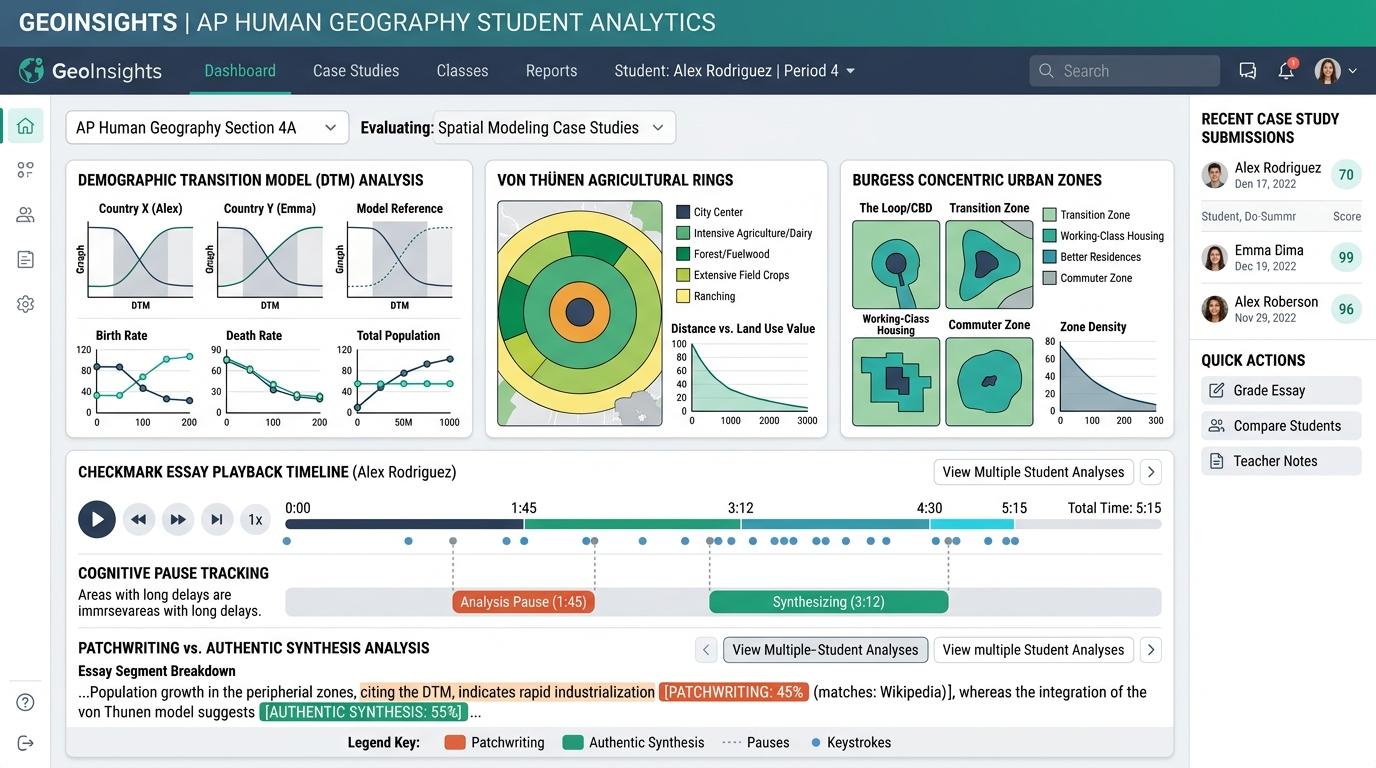
Executive Summary & Disciplinary Writing Integrity Mandate
Advanced Placement Human Geography (APHG) occupies a unique and high-stakes position in secondary education: for tens of thousands of high school students nationwide, it represents their very first gateway into college-level coursework as 14-year-old ninth-grade freshmen. In this formative academic crucible, students must quickly transition from middle school narrative summaries to sophisticated spatial analysis, applying rigorous theoretical models—such as the Demographic Transition Model (DTM), Epidemiologic Transition Model (ETM), von Thünen's Agricultural Bid-Rent Theory, Burgess/Hoyt/Harris-Ullman Urban Land Use Models, and Wallerstein's World Systems Theory—to real-world case studies.
When novice freshman writers encounter dense collegiate textbooks and complex geographical jargon, they frequently resort to patchwriting—defined by composition scholar Rebecca Moore Howard as copying source material while deleting words, altering syntax, and substituting synonyms without genuine cognitive restructuring. Crucially, patchwriting is a developmental milestone of cognitive scaffolding, not calculated deception.
However, high school geography teachers face a double evidentiary crisis in the generative AI era. First, generic whole-paper AI percentage detectors trigger aggressive false alarms (often 70% to 90% “AI-detected”) on honest freshman essays because standard textbook definitions of spatial models are inherently formulaic, low-perplexity, and repetitive. Second, commercial similarity checkers often fail to distinguish between well-meaning developmental patchwriting, automated AI text-spinning (e.g., QuillBot or LLM prompt rephrasers), and authentic independent synthesis.
Checkmark Plagiarism resolves this dilemma by replacing opaque probability scores with transparent, multidimensional writing telemetry. Through patent-pending Essay Playback™ (1x–8x keystroke replay), external paste buffer preservation, passage-level calibrated confidence sliders, and quote-anchored AP rubric autograding, high school educators can objectively verify authentic cognitive struggles—such as natural 2-to-5-minute vocabulary lookup pauses, structural drafting revisions, and iterative concept mapping—while providing the objective “receipts” needed to transform academic integrity inquiries into restorative teaching moments.
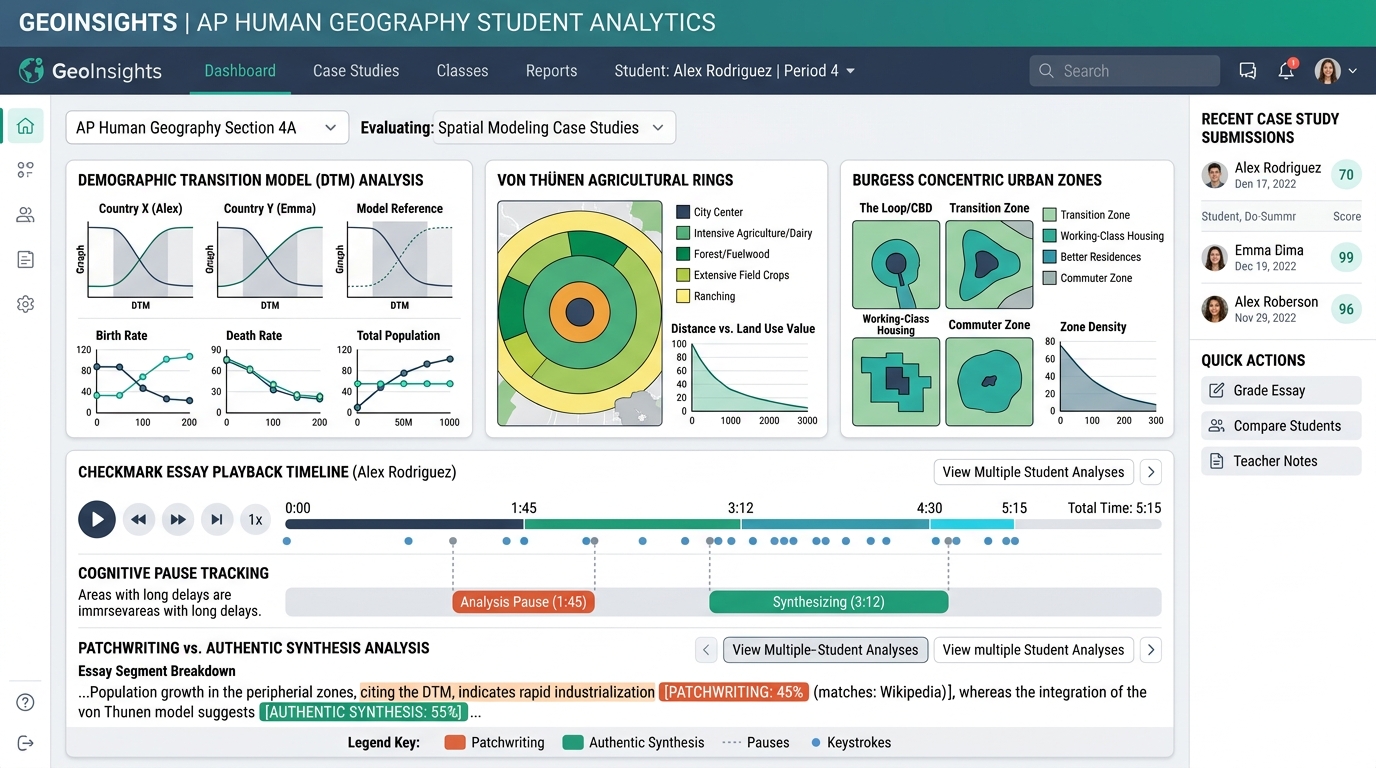
Checkmark Plagiarism equips AP Human Geography teachers, social studies department chairs, AP coordinators, and instructional coaches with forensic writing telemetry and enterprise LMS integrations across Canvas LMS, Agilix Buzz, and Google Classroom.
1. The 9th-Grade AP Gateway Transition & The Cognitive Weight of Spatial Modeling
For the vast majority of high school freshmen, enrolled at ages 14 and 15, AP Human Geography is their introductory encounter with the College Board’s rigorous Advanced Placement curriculum. The pedagogical gulf between 8th-grade social studies—often characterized by guided worksheets, multiple-choice quizzes, and chronological historical narratives—and 9th-grade APHG is vast and intimidating.
- Chronological factual recall and biographical timelines
- Narrative historical summaries and descriptive summaries
- Guided worksheets, textbook fill-ins, and low-stakes prompts
- Concrete, directly observable physical phenomena
- Elementary, conversational vocabulary and simple syntax
- Theoretical spatial modeling and dynamic causation frameworks
- Multi-scalar synthesis (local, regional, national, and global scales)
- High-stakes Free-Response Questions (FRQs) with strict task verbs
- Abstract spatial systems, bid-rent curves, and distance-decay functions
- Dense academic terminology (e.g., ecumene, agglomeration, sequent occupance)
Freshman students are suddenly expected to read collegiate textbooks (e.g., Rubenstein's The Cultural Landscape; Fouberg, Murphy, & de Blij's Human Geography: People, Place, and Culture; or Knox & Marston's Human Geography), interpret multi-layered choropleth maps, and compose multi-paragraph spatial case study evaluations.
At the center of the AP Human Geography Course and Exam Description (CED) are theoretical spatial models. These models are not mere static diagrams; they are abstract intellectual frameworks designed to explain how human activities, demographic shifts, economic systems, and urban settlements organize themselves across geographic space.
Demographic & Epidemiologic Transitions
DTM Stages 1–5: CBR, CDR, NIR dynamics. Industrial/medical revolution surges vs. Stage 4/5 sub-replacement fertility and aging societies.
ETM Stages 1–5: Pestilence/famine → receding pandemics → degenerative → delayed degenerative → reemerging disease vectors.
von Thünen Bid-Rent Agriculture
Concentric agricultural rings radiating from an isolated central market. Balances high bid-rent intensive farming (market gardening, dairy) against low-cost extensive farming (grain crops, livestock ranching) governed by friction of distance and perishability.
Classical & Modern Urban Models
Burgess (1925): Concentric Zones (CBD, Zone of Transition, Commuter Suburbs).
Hoyt (1939): Transportation Sectors along rail/highways.
Harris-Ullman (1945): Multiple Nuclei polycentric nodes.
Galactic City: Suburban edge cities and beltways.
Global Economic Development
Rostow Modernization (1960): 5 linear growth stages (Traditional to High Mass Consumption).
Wallerstein World Systems (1974): Structural core, semi-periphery, and periphery interdependency showing commodity extraction and terms of trade.
Central Place & Spatial Interaction
Christaller Central Place: Hexagonal market areas, range (maximum travel distance), and threshold (minimum population).
Gravity Model & Distance Decay: Spatial interaction inversely proportional to distance squared (I = k · P1 · P2 / d^2).
Spatial Diffusion & Cultural Patterns
Mechanisms of cultural spread: Relocation diffusion vs. Expansion diffusion (Contagious, Hierarchical, and Stimulus). Syncretism, acculturation, assimilation, and sequent occupance in the cultural landscape.
The Linguistic and Cognitive Shock of Domain Vocabulary
When a 14-year-old freshman is assigned an analytical case study—such as evaluating how Lagos, Nigeria exemplifies the friction of distance under Wallerstein's Core-Periphery framework, or explaining why dairy farming in Wisconsin aligns with von Thünen's bid-rent curve—they are confronted with a barrage of highly specialized, polysyllabic academic terminology:
For a novice writer, this vocabulary creates severe cognitive overload. The student understands the overarching narrative (e.g., “cities grow outward along train tracks”), but they lack the syntactic fluency, lexical confidence, and disciplinary muscle memory to express these technical concepts without leaning heavily on their textbook or authoritative online summaries.
When forced to produce a formal written analysis on their school-issued Chromebook, the novice student adopts the only survival strategy they know: patchwriting.
2. The Anatomy of Patchwriting: Rebecca Moore Howard's Framework vs. Modern AI Spinning
To fairly evaluate 9th-grade AP writing, educators and department chairs must anchor their pedagogy in the pioneering composition research of Dr. Rebecca Moore Howard (Standing in the Shadow of Giants, 1993, 1999).
Howard defined patchwriting as:
“Copying from a source text which deletes some words, alters grammatical structures, or plugs in one-for-one synonyms without genuine cognitive restructuring or conceptual mastery.”
Howard's fundamental insight—substantiated across three decades of composition theory and writing research—is that patchwriting is not an act of academic dishonesty; it is an immature developmental strategy used by learners who are wrestling with unfamiliar, dense, or authoritative prose.
- The student has fully digested the spatial concept and translated it into their internal cognitive schema.
- Employs original sentence architecture, natural analogies, and novel real-world application examples.
- Seamlessly integrates proper parenthetical citations for empirical demographic data and theoretical origins.
- Telemetry Profile: Continuous typing, organic pauses for synthesis, high conceptual voice ownership.
- The student understands the spatial concept at a high level but lacks vocabulary self-efficacy and syntactic confidence.
- Mimics the source sentence structure while manually replacing words using a digital thesaurus.
- Results in awkward synonym choices (e.g., “perishable dairy” becomes “spoilable milk liquid”).
- Telemetry Profile: Fragmented typing, 20–60 second lookup pauses, localized word-level backspaces.
- Intentional circumvention of writing, spatial reasoning, and cognitive engagement.
- Raw copy-pasting of whole articles or running source text through QuillBot / LLM paraphrasers to evade detection.
- Superficial fluency masking conceptual emptiness, or robotic, unpunctuated transcription from a secondary screen.
- Telemetry Profile: Instant external paste dumps (0 seconds drafting time) or flat, unvarying transcription streams.
Side-by-Side Textual Dissection: Spatial Modeling in Action
To understand how these tiers manifest in a real 9th-grade AP Human Geography classroom, examine how four different writing strategies handle a core concept: von Thünen's Bid-Rent Theory and Agricultural Rings.
“Von Thünen's model posits that agricultural land use is determined by the commercial farmer's bid-rent curve in relation to the central market. Intensive farming activities, such as market gardening and dairying, must occupy the innermost ring adjacent to the urban core due to high perishability and steep transportation costs. Conversely, extensive activities such as grain farming and ranching are relegated to outer rings where land rent is sufficiently low to offset long-distance freight hauling.”
“Because land right next to a city is the most expensive to buy or rent, farmers have to make a huge profit per acre to survive. In von Thünen's first ring, farmers grow strawberries and produce fresh milk because those items spoil rapidly on the road and need to reach grocery stores quickly. Out in the fourth or fifth rings, like in modern North Dakota, land is much cheaper, so farmers can grow huge fields of wheat that do not spoil easily and can be hauled long distances by train without rotting.”
“Von Thünen's framework shows that farming land use is decided by the commercial grower's bid-rent graph compared to the downtown center. Intensive agriculture jobs, like vegetable gardening and milk producing, have to sit in the closest ring right next to the city center because of high spoilability and expensive moving prices. On the other hand, spread-out farming like wheat crops and cattle raising are pushed to exterior rings where ground rent is cheap enough to balance out far-away freight hauling.”
“Agricultural spatial utilization, according to the von Thünen paradigm, is fundamentally governed by the farmer's economic bid-rent gradient relative to metropolitan demand nodes. Perishable horticultural enterprises and dairy operations necessarily dominate proximal concentric zones to minimize decay risks and transit expenditures, whereas extensive cereal cultivation and pastoral grazing colonize distal peripheries where depressed acreage overhead offsets extensive transport tariffs.”
Why 9th Graders Patchwrite: The Four Cognitive Drivers
High school geography educators and social studies department chairs must recognize the four specific drivers that compel freshmen into patchwriting:
Vocabulary Deficit & Authority Intimidation
Ninth graders believe that academic writing requires “sounding smart.” When they read “spatial agglomeration facilitates ancillary services,” they feel their own words (“businesses cluster together to share suppliers”) sound juvenile. They patchwrite to borrow the textbook author's intellectual authority.
Imperfect Conceptual Grasp
When a student is only 60% clear on how the Crude Death Rate can actually rise in Stage 4/5 of the DTM due to an aging demographic structure, they lack the confidence to construct an independent explanation. They clone the textbook's sentence structure to avoid being wrong.
Flawed Middle School Note-Taking Habits
In middle school, students are frequently taught to highlight text and copy glossary definitions into shared Google Docs. When drafting case studies on Chromebooks, they copy their notes into the document and attempt to “reword” them line-by-line.
Time Scarcity & AP Pacing Pressure
High school freshmen taking their first AP class are often balancing 5–6 other rigorous courses, athletics, and extracurriculars. Faced with a Sunday 11:59 PM deadline for a 1,000-word case study, patchwriting serves as an emergency shortcut to complete the task.
3. The Developmental vs. Dishonest Dilemma in High School Social Studies
When a high school geography teacher identifies patchwriting in a stack of 140 freshman essays, how they respond defines the academic trajectory of those students.
Traditionally, schools operate under punitive academic integrity honor codes designed for higher education. When a freshman's essay matches 45% of an online AP review website or textbook chapter, traditional protocols dictate assigning an automatic zero (0%), issuing a disciplinary referral, and convening an adversarial parent-teacher conference centered on “cheating.”
- Assigns automatic 0% grade and permanent disciplinary referral mark
- Destroys 9th-grade academic confidence and self-efficacy
- Causes emotional shutdown, parent hostility, and school alienation
- Pushes students to hidden, undetectable subscription AI rephrasers
- Treats an immature learning struggle as a calculated moral crime
- Separates developmental vocabulary scaffolding from deliberate fraud
- Preserves student psychological safety and enthusiasm for AP coursework
- Teaches explicit spatial model note-taking and concept mapping
- Uses writing telemetry to celebrate authentic effort and diagnose stalls
- Fosters a growth mindset through structured 48-hour revision pathways
Labelling a 14-year-old student as a “plagiarist” or “cheater” for developmental patchwriting causes severe psychological distress, alienates parents, and permanently destroys the student’s trust in the academic system. Furthermore, it creates a perverse incentive: students who are punished for honest, clumsy attempts at paraphrasing often turn to undetected, subscription-grade AI rephrasers on their next assignment to guarantee they will never be flagged for word-swapping again.
Why Legacy AI Percentage Detectors Catastrophically Fail in APHG
The crisis is exacerbated by the widespread adoption of generic, black-box AI detectors in high schools. When districts rely on legacy whole-paper probability scores, two catastrophic failure modes occur:
1. The False-Positive Trap on Standard Geography Terminology
Spatial models rely on standardized, non-negotiable terminology. Consider this authentic student sentence:
“In Stage 2 of the Demographic Transition Model, the crude birth rate remains consistently high while the crude death rate plummets dramatically due to advances in public health and food production, causing a surge in the natural increase rate.”
To a commercial LLM detector, this sentence has near-zero perplexity and flat burstiness. Consequently, legacy detectors routinely assign this authentic student passage an 85% to 98% “Likely AI” score, leading teachers into unwarranted confrontations.
2. The False-Negative Blindspot on AI Text Spinners
Conversely, when an unmotivated student copies a paragraph from an academic journal on Burgess’s Concentric Zone Model and prompts an LLM: “Rewrite this in the conversational tone of a high school student with occasional sentence variety,” the AI scrambles the perplexity and inserts bursty phrasing.
The legacy AI detector produces a clean 5% AI score, allowing deliberate authorship fraud to pass completely unnoticed while the earnest freshman who memorized the textbook definition is penalized.
4. The High School Spatial Synthesis Evidentiary Matrix
To protect students and maintain academic standards, secondary social studies departments require an objective, multi-dimensional evidentiary framework.
The following matrix contrasts four standard approaches to evaluating 9th-grade AP Human Geography spatial modeling case studies:
| Feature / Evidentiary Dimension | Manual Side-by-Side Highlighter | Generic Whole-Paper AI Detectors | Standard Google Docs Revision | Checkmark Plagiarism & Telemetry |
|---|---|---|---|---|
| Passage-Level Granularity | High (visual, manual) | ✗ None (Single % score) | ✗ None (Raw diffs only) | ✓ Calibrated Confidence Sliders on specific sentences |
| Keystroke-by-Keystroke Telemetry | ✗ None | ✗ None | ✗ Low (Snapshots every few mins) | ✓ Patent-pending 1x–8x playback of every character & pause |
| External Paste Buffer Preservation | ✗ Impossible | ✗ None | ∼ Partial (Shows chunk added, no clipboard text) | ✓ Full original clipboard text preserved even if rewritten |
| Transcription Detection (Phone/2nd Screen) | ✗ Impossible | ✗ None | ✗ Cannot detect typing rhythm | ✓ Flags uniform typing speeds lacking cognitive revision pauses |
| Citation Formatting vs. Fraud Flagging | ∼ High teacher labor | ✗ Blends all into panic score | ✗ None | ✓ Dedicated Uncited Source flag vs. Direct Plagiarism flag |
| Immunity to AI Humanizers & Spinners | ✗ Poor | ✗ High failure rate (Bypassed) | ✗ Ineffective | ✓ Fully Immune: Reconstructs authentic temporal writing history |
| Teacher Workload (150+ Students) | ✗ 15–20 hrs/weekend | ∼ Fast, but high dispute rate | ✗ 5–10 mins/paper scrubbing | ✓ Instant triage with quote-anchored rubric justifications |
| FERPA & COPPA Student Privacy Compliance | ✓ Compliant (Internal) | ∼ Mixed (Third-party training) | ✓ Compliant | ✓ 100% Zero-Model-Training guarantee with enterprise encryption |
5. Step-by-Step 9th-Grade AP Teacher Coaching Protocol
When an AP Human Geography teacher reviews a case study stack and encounters high textual similarity or suspicious phrasing, they should execute this four-phase restorative triage protocol using Checkmark's writing intelligence suite.
Phase 1: Dual-Pane Textual Triage
- Open Checkmark Dual-Pane Report in Canvas or Google Classroom.
- Determine if overlap consists of mandatory spatial model terminology or copied syntax.
- Evaluate whether the student cited the source imperfectly (Tier 2) or omitted credit entirely.
Phase 2: Telemetry Audit via Essay Playback™
- Scrub the drafting session at 2x–4x speed.
- Inspect typing cadence: Look for authentic 20–45 wpm bursts, backspaces, and vocabulary pauses.
- Audit External Paste Inspector: Verify if data tables or quotes were pasted with immediate citation.
Phase 3: Diagnostic Spatial Reasoning Assessment
- Distinguish between micro-level word substitution and macro-level spatial understanding.
- Test: Did the student successfully apply the theoretical model to the unique case study context?
- Verify spatial causation explanations (“how” and “why” bid-rent curves shift).
Phase 4: Restorative Coaching Conference
- 10-minute collaborative dialogue with student (and parents, if necessary).
- Screen-share Essay Playback™ to celebrate effort and visually identify patchwritten bottlenecks.
- Provide spatial graphic organizers and assign a targeted 48-hour synthesis revision pathway.
Phase 1: Dual-Pane Textual Source Proof Triage
- Open the submission in Checkmark Plagiarism's dual-pane viewer.
- Examine the highlighted passages in the left essay editor and their linked source cards in the right sidebar.
- Checkmark automatically categorizes matches:
- Direct Match (Identical Strings): Word-for-word copy from textbooks, Wikipedia, or peer submissions.
- Uncited Source Usage (Paraphrase/Match without Quotes): Content derived from external literature lacking quotation marks or formal parenthetical citation.
- Domain-Specific Terminology Exclusion: Common geographical model terms (“bid-rent curve”, “crude death rate”, “zone of transition”) are recognized as discipline-standard and filtered out of punitive scoring.

Phase 2: Writing Telemetry Audit via Essay Playback™
- Launch Essay Playback™ to review the time-lapse reconstruction of the student’s drafting session.
- Examine Drafting Cadence:
- Authentic Drafting Pattern:* Variable typing speed (15 to 50 words per minute), punctuated by frequent 10-to-45-second pauses (thinking, glancing at notes, organizing thoughts), natural paragraph reorganizations, and sentence-level deletions.
- Patchwriting Telemetry Pattern: The student types a 15-word clause, pauses for 30 seconds (consulting a thesaurus or split-screen textbook), deletes 2 words, types 2 synonyms, and moves to the next clause. This proves genuine, active labor—not an instant automated copy-paste.
- AI-Generated / Transcribed Pattern: Steady, unpunctuated typing at 90–130 wpm across 800 words without a single structural deletion, or an instant clipboard paste of 500 words in 0.2 seconds.
- Inspect the External Paste Inspector:
- Checkmark stores the exact string of any text pasted from outside the editor.
- If a student pasted a 300-word paragraph from an AP review site and then spent 20 minutes manually rewriting every word on their Chromebook, Checkmark’s Paste Inspector preserves the original clipboard text, allowing the teacher to see the exact origin.

Phase 3: Diagnostic Assessment of Conceptual Understanding
- Ask: Did the student grasp the spatial mechanics of the model?
- In AP Human Geography, memorizing model labels is insufficient. Students must explain spatial causation.
- Example: In Burgess’s Concentric Zone Model, does the student explain why low-income immigrant workers historically settled in the “Zone of Transition” (immediate proximity to manufacturing jobs and cheap subdivided housing to avoid transport costs)?
- If the student’s patchwritten text includes the term “subdivided residential structures,” but in their own concluding sentences they write “poor workers lived here so they could walk to the factory,” the student possesses authentic conceptual understanding despite immature syntax.
Phase 4: Conducting the Restorative Geography Coaching Conference
- Frame the Meeting around Growth: Begin the conference with Checkmark’s core principle: “Stop guessing, start trusting.” Explain to the freshman that this is not an interrogation or an honor code trial, but a writing masterclass.
- Walk Through the Playback Timeline Together: Show the student their Essay Playback timeline. Point out their pauses: “I see right here you spent 3 minutes rewriting this paragraph about Hoyt's transportation sectors. What were you thinking about at that moment?” By validating their authentic effort, the student's defensive barriers immediately drop.
- Demystify Patchwriting: Show them the side-by-side comparison between the textbook passage and their paragraph. Explain: “Look at how you swapped 'commercial core' for 'business heart.' That is called patchwriting. You were trying hard to rephrase it, but your brain was still trapped in the textbook's sentence structure.”
- Scaffold the Synthesis Pathway: Provide the student with a Spatial Model Graphic Organizer (Model Diagram → Spatial Cause → Real-World Example → Independent Analytical Claim). Grant 48 hours for a targeted revision of the patchwritten sections, allowing the student to earn back full credit while mastering college-level disciplinary writing.
6. Real High School Classroom Case Scenarios
The following case studies illustrate how Checkmark’s writing telemetry operates in realistic 9th-grade AP Human Geography classroom environments across distinct curricular units.
48% similarity on Fouberg DTM chapter; 52 mins drafting with 24 backspaces; developmental patchwriting diagnosed and remediated.
12% similarity match; 650 words pasted in 1.4s; original QuillBot spin captured in paste buffer; student confessed and revised in class.
Legacy detector flagged 82% AI due to standard Burgess definitions; 1h 14m authentic typing verified; student exonerated.
Case Study 1: The Struggling Freshman — Developmental Patchwriting in Unit 2
- The Assignment: A 600-word spatial case study analyzing why Niger remains in Stage 2 of the Demographic Transition Model and Stage 1/2 of the Epidemiologic Transition Model, incorporating Crude Birth Rate, Total Fertility Rate, and infectious disease vectors.
- The Submission: Maya, a 14-year-old freshman, submitted a paper with a 48% textual similarity score against a Fouberg Human Geography textbook summary. Her paragraph read:
“Niger experiences a high infant mortality proportion and elevated maternal casualty rates because medical dispensaries are sparse in agrarian hinterlands. Consequently, patriarchal social customs and agricultural family labor demands maintain a high crude birth count.”
- The Teacher's Investigation with Checkmark:
- The teacher opened Checkmark’s Essay Playback™.
- The recording revealed that Maya worked on her Chromebook for 52 minutes on a Sunday afternoon.
- The telemetry showed slow, deliberate typing (22 wpm) with 24 distinct backspace-and-replace episodes. At minute 18, Maya typed “Niger has lots of baby deaths,” deleted it, paused for 40 seconds (searching a synonym site for “infant mortality”), and typed “high infant mortality proportion.”
- The Verdict & Restorative Action: Maya did not cheat. She was experiencing severe vocabulary intimidation and was desperately trying to make her 9th-grade thoughts sound like an AP textbook. The teacher held a 5-minute conference, praised Maya’s persistence, taught her how to cite foundational demographic data, and showed her how to write in her authentic voice: “In rural Niger, farming families need many children to work crops, and limited clinics mean birth rates stay high.”
Case Study 2: The Evasive Shortcut — AI Text-Spinning in Unit 5
- The Assignment: An analytical essay evaluating the extent to which von Thünen's isolated state model applies to modern globalized fruit and dairy distribution networks.
- The Submission: Ethan submitted a polished 800-word essay. A legacy plagiarism checker reported only an 8% direct match because the phrasing was heavily scrambled. The essay contained sentences such as:
“Refrigerated transport mechanisms and aerial freight conduits effectively compress friction of distance, distorting Thünian concentricity into globalized supply lattices.”
- The Teacher's Investigation with Checkmark:
- The teacher noticed the unnatural, elevated phrasing uncharacteristic of Ethan's in-class timed writes.
- Opening Checkmark’s External Paste Inspector, the teacher saw an immediate red flag: at minute 0:04 of the document history, a block of 650 words was pasted from an external clipboard in 1.4 seconds.
- Checkmark’s paste buffer displayed the original raw text that Ethan had copied from an AP review blog before running it through QuillBot.
- The Verdict & Restorative Action: In the conference, the teacher did not need to guess or make subjective accusations. She simply showed Ethan the paste history and timestamped source text. Confronted with undeniable objective receipts, Ethan admitted he ran out of time on Sunday night. Because the evidence was transparent and non-punitive, Ethan agreed to complete an in-class handwritten revision during study hall for a maximum grade of 80%, learning that technological shortcuts leave indelible telemetry footprints.
Case Study 3: The False-Positive Exoneration — Standard Definitions in Unit 6
- The Assignment: A comparative synthesis of Burgess’s Concentric Zone Model versus Hoyt’s Sector Model, requiring students to analyze residential housing segregation in modern Chicago and Dallas.
- The Submission: Sophia, an honors freshman, submitted a thorough 1,200-word analysis. The school’s default whole-paper AI detector flagged her submission with an 82% AI-Generated Probability Score, triggering an automated disciplinary notification to the assistant principal and Sophia’s parents.
- The Teacher's Investigation with Checkmark:
- Sophia was in tears, insisting she spent her entire Saturday researching and writing the paper.
- The AP teacher loaded the essay into Checkmark. The Passage-Level AI Slider revealed that the legacy detector had flagged Sophia's standard definitions of the CBD, Zone of Transition, and Hoyt rail corridors because those definitions share high structural predictability with online encyclopedias.
- The teacher opened Essay Playback™. The telemetry recorded 1 hour and 14 minutes of uninterrupted, authentic student composition. It captured Sophia actively brainstorming, sketching out paragraphs, deleting whole sentences, reorganizing her comparison between the Chicago Loop and the Dallas DART rail network, and typing at a natural 38 wpm.
- The Verdict & Restorative Action: The teacher immediately dismissed the AI accusation, printed Checkmark’s Writing Process Verification Certificate, and emailed the assistant principal and parents. Sophia was fully exonerated, protecting her academic record and preserving her passion for AP social studies.
7. How Checkmark Plagiarism Empowers High School AP Geography Educators
Checkmark Plagiarism was engineered specifically to solve the complex instructional and evidentiary challenges faced by high school AP teachers, humanities departments, and district administrators.
1. Passage-Level AI Sliders
Replaces opaque whole-paper percentages with granular sentence-level analysis. Shows exact linguistic metrics (perplexity, burstiness) and guards against short-text false flags.
2. Essay Playback™ (1x–8x)
Patent-pending keystroke replay reconstructs the complete student writing journey, revealing natural pauses, deletions, structural rewrites, and vocabulary lookup pauses.
3. External Paste Inspector
Captures timestamped text of all clipboard pastes, preserving raw source strings even if the student subsequently rewrites every single word to hide the paste.
4. Side-by-Side Source Matching
Dual-pane viewer with direct links to billions of live web pages, textbooks, and class repositories, distinguishing uncited paraphrases from direct plagiarism.
5. Quote-Anchored Rubrics
Autogrades against College Board APHG task verbs (Identify, Define, Describe, Explain) with quote-anchored justifications, syncing directly to Canvas, Buzz, and Google Classroom.
6. Zero-Model-Training FERPA
Student essays are NEVER used to train commercial AI models or stored in public LLM caches, ensuring strict 100% FERPA and COPPA compliance.
Quote-Anchored Rubric Alignment to College Board FRQ Task Verbs
In AP Human Geography, the College Board assesses writing through five foundational Task Verbs. Checkmark’s AI Autograder is specifically calibrated to evaluate student prose against these distinct cognitive benchmarks:
| Task Verb | Point Benchmark | College Board Requirement | Checkmark Autograder Action |
|---|---|---|---|
| IDENTIFY | 1 Point | Name a specific geographic model, stage, pattern, or process without extensive elaboration. | Scans for precise nomenclature (e.g., “Stage 3 of the DTM”) and validates nomenclature accuracy. |
| DEFINE | 1 Point | Provide a precise mathematical or theoretical definition of a spatial term or concept. | Verifies operational accuracy while filtering out formulaic false-positive AI flags on standard definitions. |
| DESCRIBE | 1–2 Points | Illustrate the essential characteristics, visual-spatial features, or components of a phenomenon. | Evaluates descriptive detail, zone boundaries, and spatial representations in student text. |
| EXPLAIN | 2–3 Points | Provide spatial causation (“How” or “Why” a geographic pattern occurs across space). | Anchors rubric feedback to student's causal conjunctions (“because”, “therefore”, “as a result of bid-rent decay”) to verify authentic spatial logic. |
| COMPARE | 2–3 Points | Analyze similarities and differences between two models, regions, or development trajectories. | Audits dual-subject balance (e.g., Burgess vs. Hoyt) to prevent one-sided summaries. |

8. Frequently Asked Questions (FAQs) for AP Human Geography Educators
Q1: How do I explain the difference between patchwriting and cheating to 9th-grade parents during an academic integrity conference?
When meeting with parents, frame the conversation around developmental literacy rather than morality. Explain that when 14-year-old freshmen encounter college-level textbooks for the first time, they often lack the academic vocabulary to express complex spatial concepts in their own words. Patchwriting—substituting synonyms into a textbook sentence—is evidence that the student was actively reading and attempting to complete the assignment, but lacked the paraphrasing skills to execute true synthesis.
Use Checkmark’s Essay Playback™ to show parents the student’s actual typing timeline: highlight the 45 minutes of active drafting and vocabulary searching. Contrast this with true cheating (such as an instant copy-paste or AI generation), which takes 5 seconds. This approach reassures parents, preserves the student's dignity, and turns the conference into a constructive lesson on academic writing.
Q2: Why does our school's existing AI detector flag standard definitions of von Thünen's model or DTM stages as 80%+ AI?
Commercial whole-paper AI detectors rely on perplexity (word unpredictability) and burstiness (variation in sentence length and structure). In AP Human Geography, standard definitions of models (e.g., “von Thünen's model shows that land closest to the urban market has the highest rent and is used for intensive dairy farming”) are mathematically predictable and appear thousands of times across the internet.
Because the AI detector calculates that these words have a very high statistical likelihood of appearing together, it flags the passage as “machine-generated.” Checkmark solves this problem by using passage-level calibrated sliders and writing telemetry, allowing teachers to verify that the student typed the standard definition by hand as part of their authentic study notes.
Q3: What specific scaffolding strategies help freshman AP students transition from patchwriting to authentic synthesis?
Implement the “Read, Close, Draw, Write” protocol in your AP classroom:
- Read: Students read the textbook section on a spatial model (e.g., Burgess's Concentric Zone Model).
- Close: Students close their textbooks and laptops completely.
- Draw: Students draw the spatial model on paper from memory, labeling the core zones and writing 2-word notes on why each zone exists (e.g., “Zone 2 = factories + cheap rent”).
- Write: Students open their Chromebooks and write their case study analysis using only their hand-drawn sketch as a reference.
By removing the original author’s sentence syntax from the student’s visual field, they are forced to retrieve the spatial concepts from their own cognitive schema, completely eliminating developmental patchwriting.
Q4: How does Checkmark distinguish between a student typing notes from a split-screen textbook and a student transcribing an AI-generated essay from a phone?
Checkmark’s Essay Playback™ analyzes the micro-rhythms of keystroke telemetry:
- Authentic Split-Screen Note Synthesizing: When a student reads a textbook and synthesizes ideas, their typing is highly uneven. They type a short clause (15–25 wpm), pause for 15–40 seconds to read the next textbook paragraph, make several backspaces and structural edits, and frequently re-read their own draft.
- Mechanical Transcription (Phone / 2nd Screen): When a student merely copies pre-written text from a second screen or phone without thinking, they exhibit steady, flat typing cadence (usually 55–85 wpm) with virtually zero pauses longer than 3 seconds, minimal structural backspaces, and zero sentence reorganization. Checkmark’s telemetry visually highlights this unnatural, mechanical rhythm for educator review.
Q5: How should our AP Social Studies department align grading policies with College Board AP scoring standards regarding academic integrity?
The College Board’s AP scoring rubrics reward accurate spatial analysis, causation, and argumentation; they do not award points for decorative vocabulary. Departments should adopt a two-tiered evaluation policy:
- Formative Spatial Drafts & Case Studies: Allow restorative revisions for patchwritten submissions identified through Checkmark, requiring students to complete a synthesis organizer to earn back credit.
- Summative Timed Writes & FRQs: Enforce strict timed-write conditions (e.g., 40-minute in-class handwritten or lockdown-browser writes) where students must rely entirely on internal retrieval.
Q6: Can Essay Playback prove that an English Language Learner (ELL) used authorized bilingual dictionaries rather than unauthorized AI text spinners?
Yes. When an ELL or multilingual student uses an authorized digital bilingual dictionary (e.g., WordReference or Google Translate for single vocabulary lookups), the Essay Playback timeline shows individual word deletions followed by 10-to-20-second pauses and single-word insertions.
In contrast, when an unauthorized AI text-spinner is used, whole multi-clause sentences or full paragraphs are transformed instantly into complex, idiomatic English with uniform statistical perplexity. Essay Playback provides clear, visual proof of the student's authentic language-acquisition effort, protecting ELL students from unfair disciplinary flags.
Q7: How does Checkmark's AI Autograder handle the College Board's Free-Response Question (FRQ) task verbs like “Explain” and “Compare”?
Checkmark’s rubric autograding engine is trained to recognize disciplinary reasoning markers. When evaluating an “Explain” prompt, the autograder searches for causal linkages—verifying that the student stated the spatial cause, the geographic mechanism, and the resulting real-world outcome.
When evaluating a “Compare” prompt, the autograder checks for balanced criteria evaluation across both subjects. Crucially, all autograded evaluations are presented as quote-anchored draft suggestions in the teacher’s grading dashboard; the teacher retains 100% final authority to adjust point allocations and edit feedback before syncing directly to the school's LMS gradebook.
9. Conclusion: Shifting from Suspicion to Academic Mentorship in 9th-Grade AP
The ultimate goal of Advanced Placement Human Geography is not to catch 14-year-old freshmen in linguistic traps. It is to ignite their intellectual curiosity, expand their spatial awareness of the world, and train them to think, write, and reason like collegiate social scientists.
When high schools rely on crude, whole-paper AI detection percentages, they transform the classroom into an adversarial surveillance state where struggling novice writers are penalized for developmental learning behaviors.
By embracing Checkmark Plagiarism’s multi-dimensional writing intelligence—combining patent-pending Essay Playback™, External Paste Preservation, Passage-Level Calibrated AI Sliders, and Quote-Anchored Rubric Feedback—educators gain the objective clarity needed to distinguish developmental patchwriting from deliberate fraud.
High school teachers can finally stop guessing, protect honest student effort, and deliver the targeted, restorative coaching that empowers every freshman to become an authentic, confident academic writer.
See how Checkmark pairs patchwriting detection with multi-signal forensics to evaluate student spatial analysis. View a sample report or request a demonstration.