
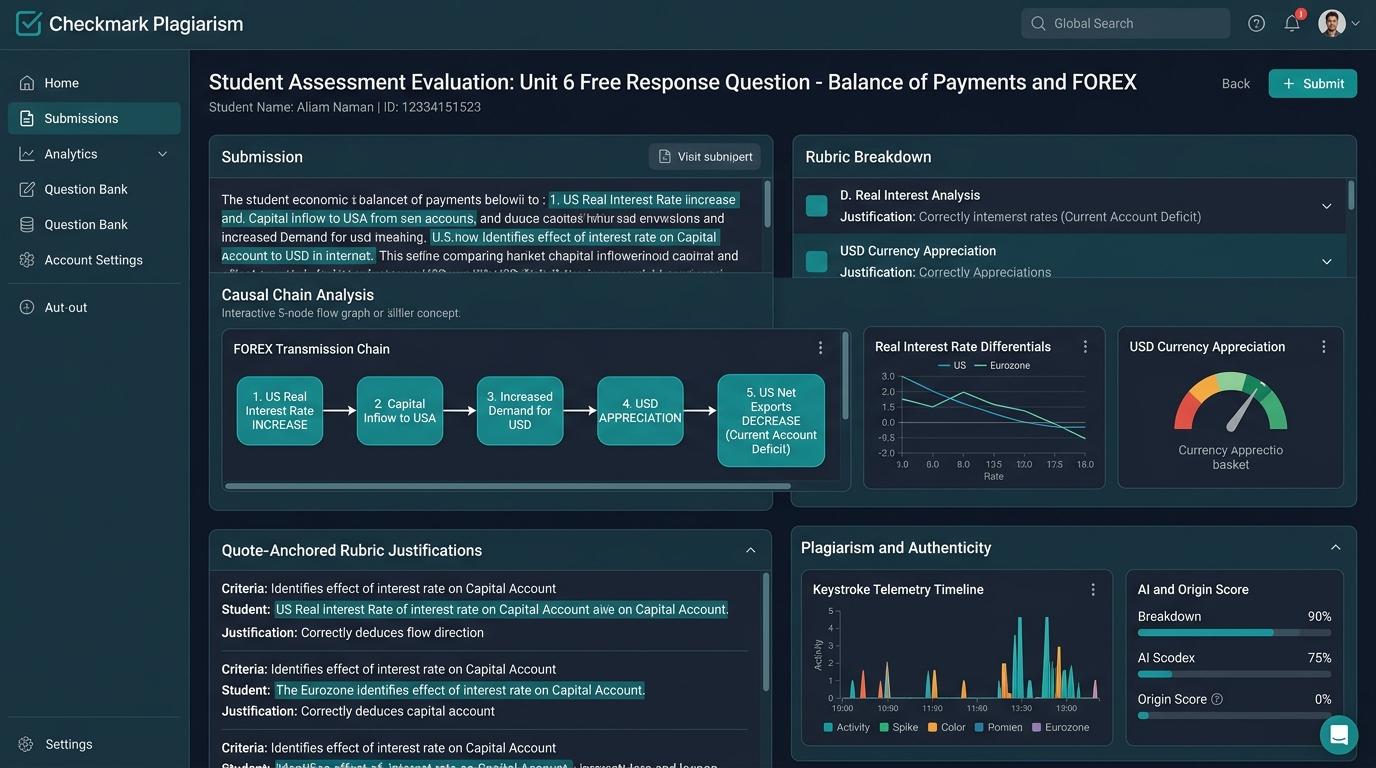
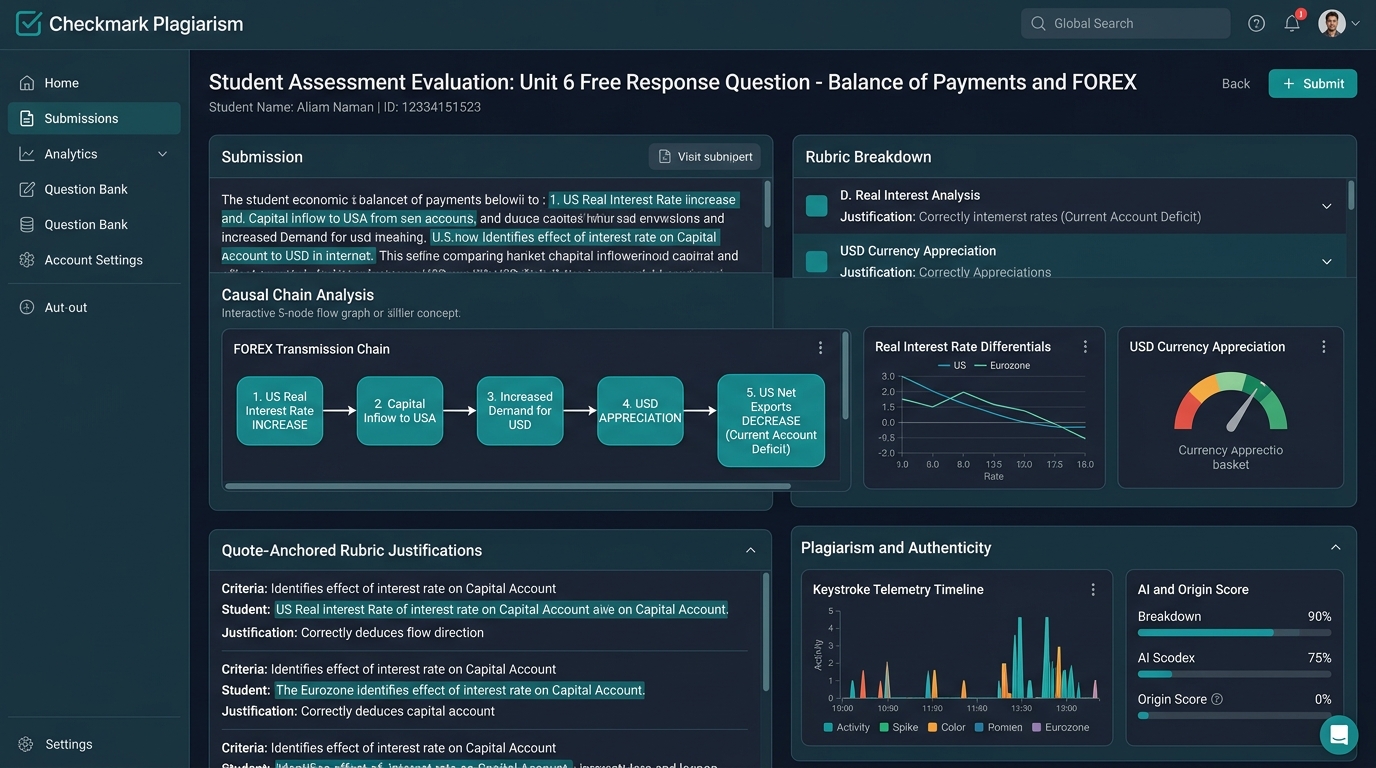
Executive Summary & Pedagogical Mandate
In Advanced Placement (AP) Macroeconomics, Unit 6—Open Economy: International Trade and Finance—represents the most cognitively demanding and conceptually integrated unit of the entire curriculum. On the AP Exam, Free-Response Questions (FRQs) evaluating the Balance of Payments (Current Account vs. Capital/Financial Account) and the Foreign Exchange (FOREX) market do not award credit for isolated assertions or lucky guesses. Under College Board scoring guidelines, students must construct strict, unbroken multi-step causal chains (e.g., Fiscal Deficit → Demand for Loanable Funds Increases → Real Interest Rate r Rises → Financial Capital Inflow → Demand for USD on FOREX Increases → USD Appreciates → US Exports Become Relatively More Expensive → Net Exports Fall → Aggregate Demand Shifts Left). Missing or misidentifying a single intermediate economic mechanism invalidates the entire explanation and results in a score of zero for that rubric point.
High school economics educators managing 120 to 160 students across five daily class periods face an acute grading dilemma: evaluating hundreds of multi-step handwritten or Chromebook-typed FRQs demands 18 to 25 hours per unit exam, leading to severe grading fatigue and delayed formative feedback. Yet, off-the-shelf generative Large Language Models (LLMs) and generic AI essay graders fail catastrophically when applied to macroeconomic causal chains. Generic LLMs suffer from plausibility bias—hallucinating full credit for articulate prose that contains completely inverted economic logic—while rigid keyword matchers unfairly penalize students who explain valid concepts using non-standard or synonymous phrasing. Checkmark Plagiarism resolves this dilemma through a purpose-built, teacher-controlled paradigm combining quote-anchored causal node parsing, patent-pending Essay Playback™ writing telemetry, external paste buffer analysis, and 1-click LMS gradebook synchronization.
Policy Shock
Fiscal Expansion (Deficit) or Central Bank Tightening
Domestic Market
Loanable Funds Demand Shifts Right → Real Interest Rate (r) Rises
Capital Flows
Foreign Investors Seek Higher Yields → Financial Capital Inflow Rises
FOREX Market
Demand for Currency Shifts Right → Domestic Currency Appreciates
Goods Feedback
Exports Fall, Imports Rise → Net Exports (NX) Fall → AD Shifts Left
1. The Pedagogical Rigor of AP Macroeconomics Unit 6: Open Economy Multi-Step Causal Chains
In secondary social studies education, Advanced Placement (AP) Macroeconomics is uniquely rigorous because it transitions students from isolated market mechanics to complex, simultaneous macroeconomic equilibrium models. Unit 6 (Open Economy: International Trade and Finance) serves as the capstone where domestic monetary policy, fiscal policy, loanable funds markets, international asset flows, and currency markets converge.
When the College Board designs AP Macroeconomics Section II Free-Response Questions (FRQs), questions involving the Balance of Payments (BOP) and Foreign Exchange (FOREX) markets consistently feature the lowest national mean scores. This occurs because the rubric explicitly demands that students explain the economic mechanism, rather than merely identifying the directional outcome.
┌─────────────────────────────────────────────────────────────────────────────────────────────────────────┐
│                    THE 5-NODE AP MACROECONOMICS OPEN ECONOMY TRANSMISSION MECHANISM                     │
├─────────────────────────────────────────────────────────────────────────────────────────────────────────┤
│                                                                                                         │
│  [NODE 1: POLICY / SHOCK]          Fiscal Expansion (Budget Deficit) or Central Bank Tightening         │
│            │                                                                                            │
│            ▼                                                                                            │
│  [NODE 2: DOMESTIC MARKET]         Loanable Funds Demand Shifts Right ──► Real Interest Rate (r) Rises  │
│            │                                                                                            │
│            ▼                                                                                            │
│  [NODE 3: CAPITAL FLOWS]           Foreign Investors Seek Higher Yields ──► Financial Capital Inflow    │
│            │                                                                                            │
│            ▼                                                                                            │
│  [NODE 4: FOREX EQUILIBRIUM]       Demand for Domestic Currency Shifts Right ──► Currency Appreciates  │
│            │                                                                                            │
│            ▼                                                                                            │
│  [NODE 5: GOODS MARKET FEEDBACK]   Domestic Exports Become Expensive, Imports Cheap ──► Net Exports ↓   │
│                                    Aggregate Demand (AD) Shifts Left ──► Real GDP (Y) & Price Level ↓   │
│                                                                                                         │
└─────────────────────────────────────────────────────────────────────────────────────────────────────────┘
To understand why autograding these student responses is so technically challenging, one must first examine the four foundational pillars of Unit 6 macroeconomic theory.
A. Balance of Payments (BOP) Accounting & Double-Entry Equilibrium
The Balance of Payments records all international economic transactions between residents of a country and the rest of the world over a given time period. High school students must categorize transactions into two primary, interconnected accounts:
1. The Current Account (CA)
- Trade Balance in Goods and Services: Net exports (NX = X - M), capturing physical merchandise and commercial services.
- Net Factor / Investment Income: Interest, dividends, and corporate profits earned by domestic residents on foreign assets minus payments made to foreign owners of domestic assets.
- Net Unilateral Transfers: One-way international transfers with no return of economic value, such as foreign humanitarian aid, government grants, and international worker remittances.
2. Capital and Financial Account (CFA / FA)
- Net Purchases of Foreign Financial Assets: Foreign purchases of domestic government bonds (Treasuries), corporate bonds, equities, and domestic bank deposits minus domestic purchases of foreign financial assets.
- Foreign Direct Investment (FDI): Physical capital investments across borders, such as a foreign multinational constructing a manufacturing plant domestically.
- Financial Inflow vs. Outflow: Money entering the country to purchase assets constitutes a capital inflow (credit, +); money exiting constitutes an outflow (debit, -).
A country running a Current Account Deficit (importing more goods and services than it exports) must simultaneously run a Capital/Financial Account Surplus (importing net foreign financial capital to finance the trade deficit). High school students frequently confuse physical capital (machinery and factories) with financial capital (money chasing bonds) or claim that a current account deficit implies an overall “Balance of Payments deficit,” both of which represent fatal conceptual errors on AP scoring guidelines.
B. Foreign Exchange (FOREX) Market Mechanics & Exchange Rate Determination
The exchange rate is the price of one currency in terms of another. In AP Macroeconomics, foreign exchange is modeled as a standard competitive market with supply and demand curves:
- The Demand for a Domestic Currency (Dcurrency): Originates from foreigners who need the domestic currency to purchase domestic goods, services, or financial assets (e.g., European investors buying US Treasury bonds must purchase US Dollars).
- The Supply of a Domestic Currency (Scurrency): Originates from domestic residents who supply their own currency to commercial banks in order to obtain foreign currency to purchase foreign goods, services, or foreign assets.
- Appreciation: An increase in the value of a currency relative to another currency (e.g., 1 USD buys more Euros).
- Depreciation: A decrease in the value of a currency relative to another currency (e.g., 1 USD buys fewer Euros).
        MARKET FOR U.S. DOLLARS (USD)                     MARKET FOR EUROS (EUR)
   Exchange Rate                                    Exchange Rate
   (EUR / USD)                                      (USD / EUR)
       │         S₁                                     │         S₁        S₂
       │                                               │                       e₂ ─┼──────────────► [New Eq]                   e₁ ─┼───────────────────────► [Eq₁]
       │                                               │                          e₁ ─┼───► [Eq₁]                                 e₂ ─┼──────────────────────────► [Eq₂]
       │                                              │                               │               D₂                              │                D₁               │                                              │                                 │          D₁                                   │                                  └────────────────────────► Quantity of USD       └──────────────────────────────► Quantity of EUR
         (Demand shifts right: USD appreciates)           (Supply shifts right: EUR depreciates)
C. The Four Fundamental Determinants of FOREX Shifts
On an AP Macro FRQ, any change in international macroeconomic conditions shifts currency supply or demand curves. Students must correctly articulate the exact determinant:
| Determinant | Initial Economic Shock | Direct Behavioral Response | FOREX Curve Shift | Exchange Rate Outcome |
|---|---|---|---|---|
| 1. Real Interest Rate Differentials | Domestic real interest rate (r) rises relative to foreign rate. | Foreign investors seek higher yields on domestic financial assets (bonds). | Demand for domestic currency shifts right (D ↑); Supply of foreign currency shifts right (S ↑). | Domestic Currency Appreciates; Foreign Depreciates. |
| 2. Relative National Income & Growth | Domestic national income (Y) grows rapidly while foreign income stagnates. | Domestic households have higher purchasing power and purchase more foreign imports (M ↑). | Supply of domestic currency shifts right (S ↑) as citizens sell currency to buy imports. | Domestic Currency Depreciates; Foreign Appreciates. |
| 3. Relative Price Levels & Inflation | Domestic inflation rate (PL) rises higher than foreign trading partners. | Domestic goods become relatively expensive; foreign imports become relatively cheaper. | Foreign demand for domestic exports falls (D ↓); domestic supply of currency to buy imports rises (S ↑). | Domestic Currency Depreciates; Foreign Appreciates. |
| 4. Consumer Preferences & Speculation | Foreign consumers develop a strong preference for domestic technology or tourism. | Foreigners must acquire domestic currency to buy the desired exports. | Demand for domestic currency shifts right (D ↑). | Domestic Currency Appreciates; Foreign Depreciates. |
D. The Full Transmission Loop: Open Economy Goods Market Feedback & Crowding Out
The culmination of Unit 6 connects international currency shifts back to domestic Aggregate Demand (AD) and the AD/AS model:
- When a domestic currency appreciates, domestic exports become relatively more expensive to foreign buyers.
- Foreign imports become relatively cheaper to domestic consumers.
- Consequently, export volume falls (X ↓) and import volume rises (M ↑).
- Net exports fall (NX = X - M ↓).
- Since Aggregate Demand is AD = C + I + G + NX, the decline in NX shifts the AD curve to the left.
- In the short run, Real GDP (Y) decreases, cyclical unemployment increases, and the domestic Price Level (PL) decreases.
┌─────────────────────────────────────────────────────────────────────────────────────────────────────────┐
│                      THE "TWIN DEFICITS" & OPEN ECONOMY CROWDING-OUT CAUSAL CHAIN                       │
├─────────────────────────────────────────────────────────────────────────────────────────────────────────┤
│                                                                                                         │
│   [Fiscal Expansion: Deficit Spending]                                                                 │
│             │                                                                                           │
│             ▼                                                                                           │
│   [Government Borrows in Loanable Funds Market] ──► Demand for Loanable Funds Increases                 │
│             │                                                                                           │
│             ▼                                                                                           │
│   [Domestic Real Interest Rate (r) Rises]                                                               │
│             │                                                                                           │
│             ├──► Closed Economy Effect: Private Domestic Investment (I) Decreases (Traditional Crowding Out)
│             │                                                                                           │
│             └──► Open Economy Effect: Financial Capital Inflows from Foreign Investors Rise             │
│                       │                                                                                 │
│                       ▼                                                                                 │
│             [Foreigners Buy Domestic Currency to Purchase Bonds] ──► Demand for Domestic Currency Rises  │
│                       │                                                                                 │
│                       ▼                                                                                 │
│             [Domestic Currency Appreciates]                                                             │
│                       │                                                                                 │
│                       ▼                                                                                 │
│             [Exports Drop (X ↓), Imports Rise (M ↑)] ──► Net Exports Fall (NX ↓)                       │
│                       │                                                                                 │
│                       ▼                                                                                 │
│             [Current Account Moves Toward Deficit & Aggregate Demand Decreases (AD ↓)]                 │
│                                                                                                         │
└─────────────────────────────────────────────────────────────────────────────────────────────────────────┘
2. The High School Economics Grading Crisis & The Autograding Dilemma
High school AP Macroeconomics teachers carry an extraordinary grading burden. A standard teaching load consists of 120 to 160 students across 5 to 6 class periods. Following a unit exam containing three multi-part FRQs, a teacher must evaluate between 360 and 480 discrete multi-step student explanations.
Under College Board scoring standards, an AP Reader cannot award credit for a prompt asking a student to “Explain how an increase in government spending affects the international value of the dollar” if the student writes:
“Government spending goes up, so the dollar becomes stronger and exports fall.”
Although the final predictions (“dollar stronger”, “exports fall”) happen to be correct, the student provided zero economic explanation. They failed to state that government borrowing increases real interest rates in the loanable funds market, and failed to state that foreign investors seek higher yields, causing financial capital inflows that shift currency demand. Under AP scoring guidelines, this response receives 0 points.
Evaluating these nuanced chains across 150 papers takes an experienced educator 18 to 25 hours per exam cycle. This crushing workload creates severe delays in returning formative feedback, forcing teachers to spend entire weekends grading instead of planning differentiated classroom instruction.
┌─────────────────────────────────────────────────────────────────────────────────────────────────────────┐
│                         THE AP MACROECONOMICS ESSAY GRADING TRILEMMA                                    │
├─────────────────────────────────────────────────────────────────────────────────────────────────────────┤
│                                                                                                         │
│                                      [ACCURACY & RIGOR]                                                 │
│                                (Catches broken causal links,                                            │
│                                 enforces strict AP CED rubrics)                                         │
│                                              ▲                                                          │
│                                             /                                                          │
│                                            /                                                           │
│                                           /                                                            │
│                                          /                                                             │
│                                         /                                                              │
│                                        /                                                               │
│               [GRADING SPEED] ◄─────────────────────► [SYNONYMOUS FLEXIBILITY]                          │
│          (Instant feedback for 150+              (Accepts valid non-standard                            │
│           students on Chromebooks)                student phrasing & ELLs)                              │
│                                                                                                         │
│  • Manual Paper Grading: High Rigor + High Flexibility, but ZERO Speed (18-25 hours per exam).          │
│  • Rigid Regex/Keywords: High Speed, but ZERO Flexibility (fails valid student phrasing).               │
│  • Generic LLM Scorers: High Speed + High Flexibility, but ZERO Rigor (hallucinates broken logic).      │
│  • Checkmark Causal Telemetry™: Delivers ALL THREE through quote-anchored node verification.            │
│                                                                                                         │
└─────────────────────────────────────────────────────────────────────────────────────────────────────────┘
Why Generic AI LLMs Fail at Economics FRQ Grading
When educators test generic consumer AI chatbots (such as standard ChatGPT prompts) or generic LLM-based school essay graders on AP Macro FRQs, the results are pedagogically dangerous. Generic LLMs suffer from four fatal failure modes:
1. Plausibility Bias & Hallucinated Credit
Generative LLMs are probabilistic token predictors trained on vast corpora of fluent prose. If a student writes articulate paragraphs with completely inverted logic (e.g., claiming higher interest rates cause currency depreciation), generic LLMs award full credit because they recognize high-level vocabulary without verifying directional vectors.
2. Omission Blindness & "Leapfrog" Grading
Generic LLMs frequently award points for a correct terminal outcome even when intermediate nodes are completely missing. A student writing “Tax cuts increase the deficit, which appreciates the dollar” receives full credit from generic LLMs despite skipping real interest rates and capital flows.
3. Conflation of Physical vs. Financial Capital
Students frequently write that “higher interest rates cause foreign companies to build factories in the US to get the high interest.” This is an egregious conceptual confusion (high rates discourage physical investment). Generic LLMs treat all occurrences of “capital” as interchangeable.
4. The Inverse Trap: Currency Demand vs. Supply
In FOREX for USD and EUR, an event increasing USD demand simultaneously increases EUR supply. Generic AI graders frequently confuse the perspective of the two markets, scoring a student as “correct” when they mix up base currencies or draw supply shifts on demand-oriented axes.
Why Rigid Keyword & Regex Matchers Fail
To avoid LLM hallucinations, legacy automated grading systems rely on rigid keyword strings or regular expressions (regex). However, this creates equally severe pedagogical harm:
- Penalizing Valid Synonymous Phrasing: An authentic student writing “International investors move their savings into US Treasury bills because they offer a higher yield than European securities” is marked wrong by keyword matchers looking specifically for the exact phrase “financial capital inflow into the domestic economy”.
- Disproportionate Harm to English Language Learners (ELL): ELL students frequently understand the economic mechanism perfectly but express the concept using non-textbook vocabulary (e.g., “foreign cash travels into American banks to get better profit rates”). Keyword checkers systematically penalize ELL students, creating equity and compliance crises in public school districts.
3. The High School Economics Grading Evidentiary Matrix
To illustrate the stark differences between grading methodologies, the following matrix evaluates how each approach performs across the core operational and pedagogical demands of high school AP Macroeconomics instruction:
| Evaluation Dimension | Manual Paper Rubric Grading | Generic AI LLMs (ChatGPT) | Rigid Regex / Keyword Matchers | Checkmark Causal Telemetry™ |
|---|---|---|---|---|
| Causal Step Rigidity | High: Catches skipped links manually. | Very Low: Hallucinates credit for skipped steps. | Low: Checks words, not logic sequence. | Strict (AP-Aligned): Verifies 5-node DAG transmission links. |
| False-Positive Logic Detection | High: Catches inverted logic immediately. | Failing: Awards points to inverted arguments. | Zero: Matches words regardless of inversion. | Flawless: Directional vector checks flag inversions instantly. |
| Synonymous Phrasing Flexibility | High: Teacher interprets natural phrasing. | High: Understands varied prose fluently. | Extremely Low: Penalizes ELL students & synonyms. | High (Semantic Mapping): Maps valid synonyms to nodes without rigidity. |
| Turnaround Time (150 Students) | 18–25 Hours: Exhausting manual labor. | 5 Minutes: Rapid, but requires total re-grading. | Instant: Generates high dispute volume. | Under 15 Minutes: Quote-anchored drafts for 1-click teacher approval. |
| Writing Authorship Verification | Zero: Impossible to prove typing authenticity. | Zero: Unreliable whole-text percentages. | Zero: No drafting telemetry captured. | Definitive: Patent-pending Essay Playback™ (1x–8x) + paste buffers. |
| Quote-Anchored Justifications | Manual: Handwritten margin notes. | Vague: Generic summary blurbs. | None: Binary keyword flags. | Automated & Anchored: Highlights exact student sentences per rubric node. |
| FERPA & Student Privacy | Compliant: Papers stay in classroom. | Critical Risk: Commercial tools train on student work. | Compliant: Local regex scripts. | 100% FERPA/COPPA Compliant: Zero AI training on student submissions. |
| LMS Gradebook Integration | Zero: Manual one-by-one score entry. | None: Requires manual copy-pasting. | Limited: Basic LTI passback. | 1-Click Sync: Direct passback to Canvas, Buzz LMS, & Google Class. |
4. Checkmark's 5-Node Transmission Verification Protocol
Checkmark Plagiarism solves the economics autograding dilemma by replacing black-box text scoring with a Directed Acyclic Graph (DAG) Causal Parsing Engine designed specifically for macroeconomic reasoning. Rather than asking an LLM to assign an arbitrary score, Checkmark parses student submissions against a structured, 5-node economic transmission graph:
┌─────────────────────────────────────────────────────────────────────────────────────────────────────────┐
│                      CHECKMARK'S 5-NODE CAUSAL PARSING ARCHITECTURE FOR AP MACRO                        │
├─────────────────────────────────────────────────────────────────────────────────────────────────────────┤
│                                                                                                         │
│  [NODE 1: PRIMARY POLICY OR ECONOMIC SHOCK]                                                             │
│  • Identifies policy action: Fiscal expansion (budget deficit), Open market purchase/sale, etc.         │
│  • Quote Anchor Extraction: "When the government increases spending without raising taxes..."            │
│                                                                                                         │
│  [NODE 2: INTERMEDIATE DOMESTIC MARKET VARIABLE SHIFT]                                                  │
│  • Identifies shift in domestic real interest rate (r), national income (Y), or price level (PL).        │
│  • Verification Rule: Must explicitly specify direction (e.g., real interest rates rise).               │
│  • Quote Anchor Extraction: "...the demand for loanable funds increases, driving up real interest rates."│
│                                                                                                         │
│  [NODE 3: CROSS-BORDER FINANCIAL CAPITAL FLOW DIRECTION]                                                │
│  • Identifies cross-border movement of financial assets based on relative rate of return / yield.       │
│  • Verification Rule: Must identify inflow vs. outflow correctly relative to interest differential.     │
│  • Quote Anchor Extraction: "...foreign investors buy US bonds to earn higher returns, causing inflows." │
│                                                                                                         │
│  [NODE 4: FOREX MARKET EQUILIBRIUM & EXCHANGE RATE DETERMINATION]                                       │
│  • Identifies shift in currency demand/supply curve and resulting exchange rate movement.               │
│  • Verification Rule: Currency must be explicitly named (e.g., USD appreciates, Euro depreciates).      │
│  • Quote Anchor Extraction: "...causing the demand for dollars to rise, appreciating the dollar."       │
│                                                                                                         │
│  [NODE 5: GOODS MARKET FEEDBACK (NET EXPORTS & AD/AS IMPACT)]                                           │
│  • Identifies change in relative export/import prices, Net Exports (NX), and Aggregate Demand (AD).     │
│  • Verification Rule: Must link currency value to relative price changes before stating AD outcome.     │
│  • Quote Anchor Extraction: "...making US goods more expensive, so exports fall, lowering Net Exports."  │
│                                                                                                         │
└─────────────────────────────────────────────────────────────────────────────────────────────────────────┘
Step-by-Step Causal Node Verification Protocol
High school economics departments implement Checkmark's autograding through a streamlined four-step workflow:
┌─────────────────────────────────────────────────────────────────────────────────────────────────────────┐
│                       THE 4-STEP TEACHER-CONTROLLED AUTOGRADING WORKFLOW                                │
├─────────────────────────────────────────────────────────────────────────────────────────────────────────┤
│                                                                                                         │
│   ┌───────────────────────────────────────────────────────────────────────────────────────────────┐     │
│   │ STEP 1: ASSIGNMENT CREATION & AP RUBRIC SELECTION                                             │     │
│   │ • Teacher selects or imports standard College Board CED AP Macroeconomics FRQ scoring rubric.  │     │
│   │ • Define mandatory causal nodes (e.g., 3-point vs. 5-point transmission requirements).        │     │
│   └────────────────────────────────────────────────┬──────────────────────────────────────────────┘     │
│                                                    │                                                    │
│                                                    ▼                                                    │
│   ┌───────────────────────────────────────────────────────────────────────────────────────────────┐     │
│   │ STEP 2: STUDENT SUBMISSION ON CHROMEBOOKS OR LMS                                              │     │
│   │ • Students type responses directly in Canvas, Buzz LMS, Google Classroom, or Checkmark.      │     │
│   │ • System captures real-time keystroke telemetry, composing pauses, and paste events.          │     │
│   └────────────────────────────────────────────────┬──────────────────────────────────────────────┘     │
│                                                    │                                                    │
│                                                    ▼                                                    │
│   ┌───────────────────────────────────────────────────────────────────────────────────────────────┐     │
│   │ STEP 3: AUTOMATED CAUSAL NODE PARSING & EVIDENCE CARD GENERATION                              │     │
│   │ • Checkmark maps student sentences to Nodes 1–5, verifying directional vector validity.       │     │
│   │ • Generates quote-anchored evidence cards highlighting verified links and flagging breaks.    │     │
│   └────────────────────────────────────────────────┬──────────────────────────────────────────────┘     │
│                                                    │                                                    │
│                                                    ▼                                                    │
│   ┌───────────────────────────────────────────────────────────────────────────────────────────────┐     │
│   │ STEP 4: TEACHER REVIEW, ONE-CLICK OVERRIDE & GRADEBOOK SYNC                                   │     │
│   │ • Teacher reviews draft grades in Checkmark's split-screen dashboard.                         │     │
│   │ • Teacher maintains 100% final grading authority (can adjust scores with one click).          │     │
│   │ • 1-Click sync pushes finalized scores and quote-anchored feedback directly to Canvas/Buzz.   │     │
│   └───────────────────────────────────────────────────────────────────────────────────────────────┘     │
│                                                                                                         │
└─────────────────────────────────────────────────────────────────────────────────────────────────────────┘
5. Real High School Classroom Case Scenarios
To see Checkmark's multi-dimensional engine in action, examine four realistic case studies from high school AP Macroeconomics classrooms:
12th Grade AP Macro Unit 6 Exam — The Fiscal Deficit Leap
Prompt & Student Submission:
“When the government spends more money on infrastructure, it runs a bigger budget deficit. This causes the international value of the US dollar to appreciate because foreign investors want to invest in the growing American economy, shifting the demand for dollars to the right on the FOREX market.”
Checkmark Causal Parser Breakdown:
- Node 1 (Policy Shock): VERIFIED (1/1 pt) — Quote: “When the government spends more money... runs a bigger deficit.”
- Node 2 (Loanable Funds / Real Rate): FAILED / SKIPPED (0/1 pt) — Student made no mention of loanable funds demand or real interest rates (r).
- Nodes 3 & 4 (Capital Flow & FOREX): FAILED RATIONALE (0/1 pt) — Attributed inflow to “growing economy” rather than interest rate differentials.
- Total Draft Score: 1 / 3 Points. Teacher approved with 1 click; student received instant diagnostic feedback explaining exactly why points were deducted.
12th Grade AP Macro — The Inverted Capital Flow Hallucination
Student Submission:
“An increase in the domestic real interest rate means that borrowing costs are higher for businesses. Because it is more expensive to borrow money, foreign investors will find the domestic market unattractive and will pull their money out to invest elsewhere. This capital outflow decreases the demand for the domestic currency, causing the currency to appreciate against foreign currencies.”
Generic AI LLM Grader (ChatGPT):
Awarded 3 / 3 Points (100%). Praised the student's “thorough explanation of international capital movements,” completely blinded by vocabulary fluency.
Checkmark Causal Parser:
Awarded 0 / 3 Points. Flagged two critical inversions: (1) higher interest rates attract capital inflows, and (2) decreased currency demand causes depreciation, not appreciation.
11th Grade AP Macro Take-Home FRQ — Paraphrased AI Flagged by Essay Playback™
Context & Static AI Scan:
Student submitted a flawless 268-word explanation of BOP double-entry accounting. Generic AI detector reported 15% AI probability (“Human”) because the text was run through an online paraphrasing tool.
Checkmark Essay Playback™ Telemetry Audit:
- Total Writing Time: 1 minute 42 seconds across 268 words.
- Keystrokes: 14 keystrokes (only typed “Name:”, “Period: 1”, “Date:”).
- Paste Event: 254 words inserted in a single 0.2-second event at 00:24.
- Restorative Resolution: During a conference, the teacher showed the 0.2s paste timestamp. The student admitted using Claude 3.5 Sonnet and completed a timed rewrite for mastery credit.
12th Grade AP Macro — English Language Learner (ELL) Exonerated
Student Submission:
“When Mexican interest rates climb up higher than American rates, people in the US with lots of savings want to buy Mexican government papers because the reward payout is bigger. So they change their dollars into pesos at the money exchange. Because everyone is trying to get pesos, the peso becomes more precious and its value goes up compared to the dollar.”
Legacy Keyword Matcher:
Awarded 0 / 2 Points. Failed because student did not use exact textbook tokens “financial capital inflows” or “appreciation”.
Checkmark Semantic Graph Parser:
Awarded 2 / 2 Points (Full Credit). Correctly mapped colloquial explanations to valid causal nodes; writing telemetry confirmed 18 minutes of organic drafting with dictionary lookups.
6. Checkmark's Integrated Suite for High School AP Economics Departments
Checkmark Plagiarism is engineered specifically to meet the high-stakes operational and pedagogical realities of high school AP classrooms:
1. Multi-Factor AI Detection
Passage-level granularity with calibrated confidence sliders (typical human vs. typical AI). Immune to text humanizers through writing history telemetry, with honest short-text guardrails (<150 words).
2. Defensible Plagiarism Detection
Scans billions of live web pages, encyclopedias, and open-access economics repositories. Peer-to-peer cohort matching detects copying across class periods and school years with dedicated uncited source flagging.
3. Essay Playback™ Writing Telemetry
Patent-pending keystroke-by-keystroke replay at 1x to 8x speed. External paste buffer preservation captures raw copied clipboard text with jump-to-replay, distinguishing genuine scratchpad pauses from transcription.
4. Teacher-Controlled Rubric Autograding
First-draft autograding against College Board AP Macro CED rubrics. Quote-anchored evidence cards tie every score directly to student sentences, with 1-click round-trip sync to Canvas, Buzz LMS, and Google Classroom.
5. Privacy, Ethics & Enterprise Compliance
Zero model training on student submissions—student work is never stored or used to train commercial AI models. 100% FERPA and COPPA compliant with enterprise-grade cloud encryption in transit and at rest.
7. Frequently Asked Questions (FAQs)
1. How does Checkmark verify whether a student explained the loanable funds real interest rate mechanism rather than nominal interest rates?
In AP Macroeconomics, foreign investors make international financial capital allocation decisions based on real interest rates (inflation-adjusted return), not nominal rates. Checkmark's causal node parser specifically verifies whether the student identified the real interest rate differential or correctly linked nominal rate shifts to expected inflation. If a prompt explicitly specifies a change in price levels, Checkmark verifies that the student applied the Fisher equation (r = i - π) before asserting the financial capital flow direction.
2. How does Checkmark handle the distinction between a change in "Currency Demand" versus a change in "Currency Supply" on FOREX FRQs?
On College Board AP exams, students receive credit only if they identify the correct curve shift for the specific currency market being analyzed. For example, in the Market for US Dollars, an influx of European investors shifts the Demand for Dollars to the right (DUSD ↑). However, in the Market for Euros, those same European investors supply Euros to commercial banks, shifting the Supply of Euros to the right (SEUR ↑). Checkmark's graph parser checks the specific currency named in the prompt's axis labels and flags any student response that asserts a supply shift in a demand-oriented market framework.
3. Can Checkmark detect when a student manually copies an AI-generated answer from a smartphone or second screen?
Yes. When a student copies text by looking at an external phone or second monitor and manually typing it into their Chromebook, they produce a distinct transcription keystroke signature. In authentic student drafting, typing occurs in bursts separated by 5- to 30-second cognitive composing pauses, backspaces, and syntactic rearrangements. In manual transcription, typing occurs at a steady, rhythmic pace with near-zero contextual pauses and virtually no structural sentence revisions. Checkmark's Essay Playback™ visualizes these keystroke cadence graphs, giving teachers undeniable objective evidence during academic integrity reviews.
4. Does Checkmark's autograder automatically submit grades to our district LMS gradebook without teacher approval?
No. Checkmark is built on the pedagogical principle of “Teacher-in-the-Loop.” All AI-generated scores and quote-anchored feedback cards are strictly generated as drafts. The teacher reviews the draft in a high-speed, split-screen grading dashboard, has full authority to edit any score or comment with a single click, and then clicks “Publish to Gradebook” to sync the finalized grades directly to Canvas SpeedGrader, Buzz LMS, or Google Classroom.
5. What happens if a student writes an unusually short FRQ explanation (e.g., under 50 words)?
For short text submissions under ~150 words, Checkmark's AI detection engine displays an honest N/A disclaimer rather than guessing on insufficient statistical sample sizes. However, Checkmark's Causal Node Parser and Essay Playback™ telemetry remain fully active, allowing teachers to verify whether the student's 40-word sentence successfully completed all mandatory causal links or skipped intermediate nodes.
6. How does Checkmark protect student data privacy and comply with district FERPA regulations?
Checkmark Plagiarism maintains strict enterprise data privacy standards. Student submissions are encrypted in transit and at rest, and are never used to train, retrain, or fine-tune commercial AI models. Checkmark is fully compliant with the Family Educational Rights and Privacy Act (FERPA) and the Children's Online Privacy Protection Act (COPPA), ensuring that student intellectual property and district records remain 100% confidential.
7. How can high school AP Macroeconomics teachers use Checkmark's quote-anchored feedback for formative remediation?
When Checkmark scores an FRQ, it produces clickable, quote-anchored feedback cards that highlight the exact student sentence corresponding to each rubric point. When a student misses a causal link (such as omitting Node 2 or reversing Node 3), Checkmark inserts a formative annotation directly into the student's LMS feedback portal (e.g., “Point Not Earned: You identified that the dollar appreciates, but did not explain how the increase in the government deficit raised real interest rates in the loanable funds market to attract foreign capital”). This turns every unit exam into an immediate, actionable mastery learning opportunity before the May AP Exam.
8. Summary: Stop Guessing, Start Trusting in AP Economics
Evaluating multi-step macroeconomic causal chains is essential to preparing high school students for college-level analytical thinking and success on the AP Macroeconomics Exam. By moving beyond opaque black-box AI detectors and generic LLM text graders, high school educators can embrace a defensible, evidence-based assessment model.
With Checkmark Plagiarism's unified suite—combining 5-node causal parsing, patent-pending Essay Playback™ writing telemetry, external paste buffer analysis, and teacher-controlled rubric autograding—social studies departments can eliminate grading backlogs, uphold uncompromising academic standards, and foster authentic student intellectual growth.
Ready to bring causal verification & writing telemetry to your AP Economics classroom?
Empower your social studies department with Checkmark's teacher-in-the-loop autograding platform today.