
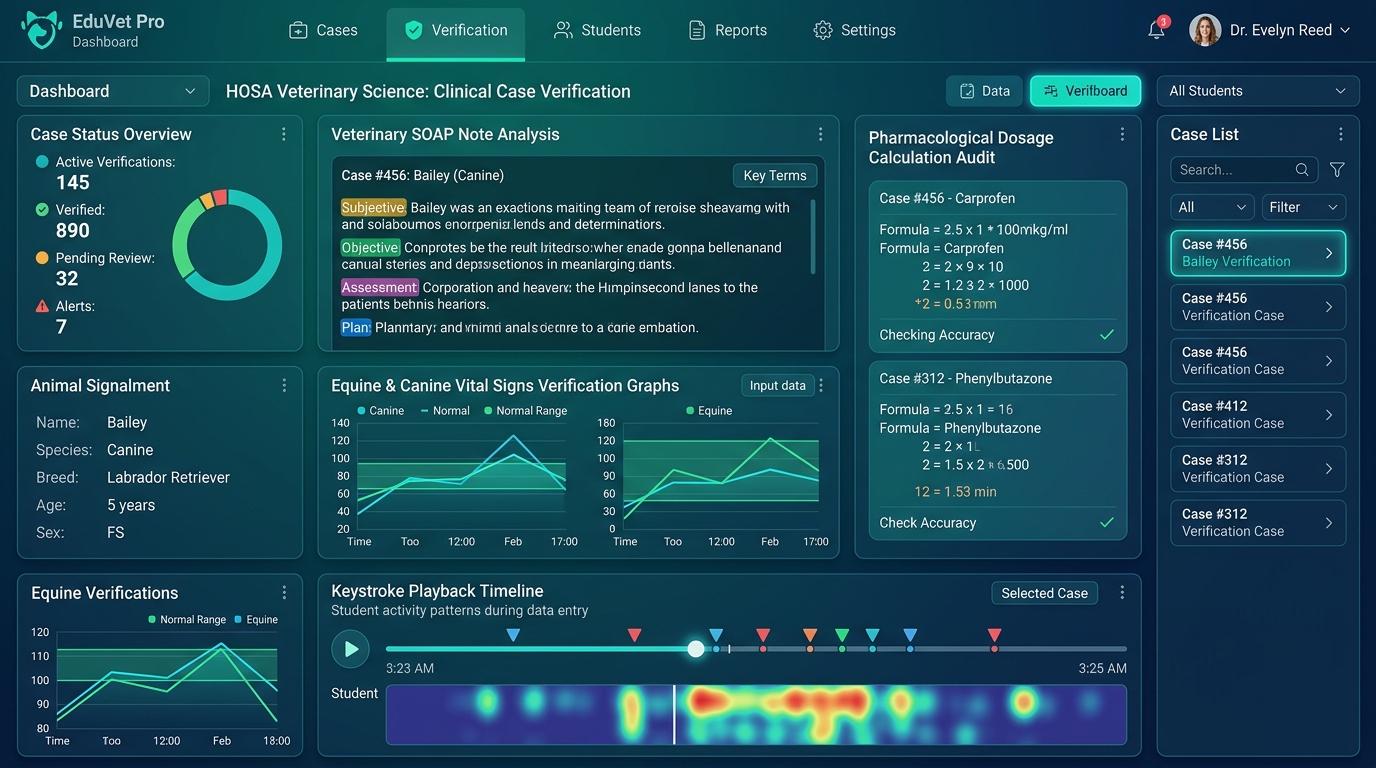
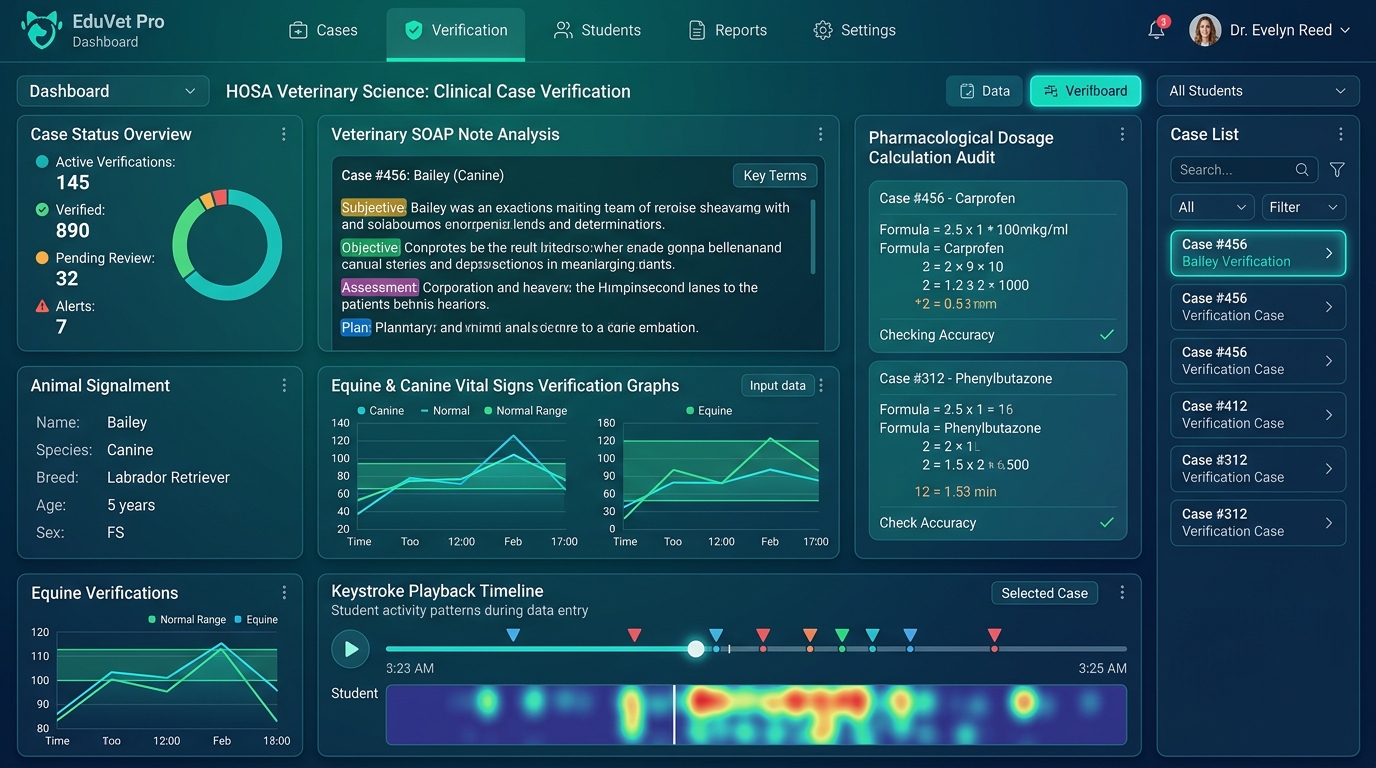
High School Career and Technical Education (CTE) Health Science and Agriculture instructors, Secondary Veterinary Assisting teachers, and HOSA–Future Health Professionals chapter advisers face an urgent instructional and clinical challenge: verifying the authenticity, mathematical accuracy, and physiological validity of student-authored clinical case management writeups, SOAP notes (Subjective, Objective, Assessment, Plan), and animal treatment portfolios. When high schoolers prepare competitive portfolios for HOSA Veterinary Science, Clinical Specialty, or regional FFA Agriscience competitions under tight deadlines, many turn to Generative AI (such as ChatGPT or Claude) to synthesize complex case studies. While the resulting text appears grammatically polished and laden with veterinary terminology, it frequently produces “The Synthetic Vet Chart”—fabricating physiological vitals that are impossible for the patient's species (e.g., assigning a resting equine patient a canine pulse of 120 bpm), hallucinating non-existent diagnostic lab panels, confabulating generic client discharge instructions, and generating lethal pharmacological dosage calculation errors (e.g., confusing mg/kg with mg/lb, administering toxic NSAIDs to felines, or prescribing neurotoxic ivermectin doses to MDR1-mutant herding breeds).
Traditional verification tools fail completely in secondary veterinary classrooms. Generic whole-document AI percentage detectors trigger aggressive false positives on standard, formulaic veterinary terminology (subcutaneous, auscultation, borborygmi, erythrocytes, zoonotic, CRT < 2s, BAR, QAR), while remaining blind to fabricated patient records and lethal pharmacological errors. Checkmark Plagiarism resolves this crisis through Writing Process Telemetry, Physiological Concordance Auditing, and Teacher-in-the-Loop Rubric Autograding. By combining patent-pending Essay Playback™ (1x–8x scrubbable video replay of typing cadence, unit conversion pauses, and diagnostic reflection), an External Paste Buffer Inspector (distinguishing legitimate clinical template pasting from raw external AI dumps), Passage-Level AI Confidence Sliders with Short-Text (<150w) Guardrails, and HOSA / NCHSE-aligned Rubric Autograding, secondary veterinary educators can verify authentic clinical reasoning, eliminate safety risks, and mentor future animal health professionals with defensible, transparent evidence.
Checkmark Plagiarism provides high school CTE veterinary science departments, agricultural magnet academies, and HOSA chapters with forensic writing telemetry, species-specific clinical concordance audits, and native LMS integrations across Canvas LMS, Agilix Buzz, and Google Classroom.
1. The Architecture of HOSA Veterinary Science Portfolios & Clinical Documentation
Secondary Career and Technical Education (CTE) programs in Veterinary Science, Animal Science, and Allied Health Careers serve as vital preparatory pipelines for students aspiring to become veterinary assistants, licensed veterinary technicians (CVT/LVT/RVT), and Doctors of Veterinary Medicine (DVM). In thousands of comprehensive high schools, agricultural magnet academies, and CTE technical centers across the country, students participate in HOSA–Future Health Professionals and the National FFA Organization, where clinical documentation and case management represent marquee competitive events.
CTE Vet Assisting Labs
- Live Animal Restraint & Low-Stress Handling
- Fecal Flotation, Urinalysis & Direct Cytology
- Surgical Pack Prep & Autoclave Asepsis
- Prescription Filling & Dimensional Analysis Math
HOSA Competitive Events
- Veterinary Science (Round 1 Exam & Round 2 Skills)
- Clinical Specialty Shadowing Portfolios
- Health Career Display & Clinical Case Boards
- Biomedical Research & Animal Welfare Debates
FFA Agriscience Clinicals
- Veterinary Science Career Development Event (CDE)
- Animal Systems Agriscience Research Reports
- Small Animal Care & Nutrition Practicums
- Equine & Livestock Barn Treatment Logs
HOSA National Competitive Event Structure: Veterinary Science
The HOSA Veterinary Science competitive event is structured into two demanding phases designed to test theoretical knowledge and clinical execution:
- Round 1: Written Knowledge Examination: A 50-item multiple-choice test covering anatomy and physiology, veterinary medical terminology, animal diseases and zoonoses, surgical instrumentation, sanitation/asepsis, animal nutrition, behavior and handling, and pharmacological mathematics. Competitors must achieve a qualifying score to advance to the practical round.
- Round 2: Clinical Skill Performance Stations: High-performing qualifiers rotate through hands-on clinical performance stations evaluated by practicing veterinarians and licensed technicians. Evaluated skills include:
- Skill I: Preparation of the Operative Site (Surgical Scrubbing & Draping)
- Skill II: Simple Fecal Flotation Technique & Microscopic Examination
- Skill III: Measurement and Administration of Liquid & Solid Medications (Prescription Filling and Labeling)
- Skill IV: Safe Restraint Techniques (Canine Cephalic/Saphenous Venipuncture, Feline Towel Wrap/Scruffing, Equine Haltering)
- Skill V: Applying a Commercial Muzzle & Gauze Muzzle
- Skill VI: Radiographic Positioning & Radiation Safety Compliance
In complementary events such as Clinical Specialty, Health Career Display, and comprehensive CTE capstone courses, students compile extensive Clinical Case Study & Treatment Portfolios documenting actual veterinary hospital shadowing encounters, simulation scenarios, or school barn animal health management logs.
The 7-Stage Architecture of a Veterinary Clinical Case Portfolio
A rigorous veterinary clinical portfolio is not a generalized essay; it is a structured, legally binding medical record format that follows seven distinct components:
Patient Signalment
Foundational demographic data that dictates all physiological baselines, breed predispositions, and pharmacological parameters:
- Species: Canine (Canis lupus familiaris), Feline (Felis catus), Equine (Equus caballus), Bovine (Bos taurus), Caprine, Ovine, Porcine, Avian, or Exotic.
- Breed: Specific breed identification (e.g., Australian Shepherd, Persian, Thoroughbred, Holstein) to account for known genetic mutations (such as ABCB1/MDR1 mutations).
- Age & Life Stage: Pediatric/Neonate, Juvenile, Young Adult, Senior, or Geriatric.
- Sex & Reproductive Status: Intact Male, Castrated Male (Neutered/Gelding), Intact Female, or Spayed Female (Ovariohysterectomy / OVE).
- Body Weight: Recorded with extreme precision in both pounds (lb) and kilograms (kg), where
Weight (kg) = Weight (lb) / 2.20462.
Chief Complaint & History of Presenting Illness (HPI)
The client's primary reason for seeking veterinary care, documented alongside a structured chronological history including onset & progression (acute vs. chronic), dietary history (toxic plant, rodenticide, foreign body), and preventative healthcare status (vaccination records, heartworm antigen testing, parasiticides).
The 4-Pillar Veterinary SOAP Note
Diagnostic Workup & Laboratory Results
CBC (PCV/hematocrit, WBC differential), Serum Chemistry (BUN, Creatinine, ALT, ALKP, TP, Glucose, Electrolytes), Urinalysis (USG via refractometer, sediment), Radiographic Views (Right Lateral & VD), and In-House Fecal Flotation / Cytology.
Differential Diagnoses Matrix (DAMNIT-V)
Structured listing of etiologies categorized by the DAMNIT-V scheme (Degenerative, Anomalous, Metabolic, Neoplastic/Nutritional, Infectious/Inflammatory/Immune-mediated/Idiopathic, Toxic/Traumatic, Vascular) with pathophysiological justifications.
Therapeutic Treatment Plan & Mathematical Pharmacology
Dose (mg) = Wt (kg) × Rate (mg/kg)
Vol (mL) = Dose (mg) / Conc (mg/mL)
gtt/min = (mL/hr × gtt/mL) / 60 min
Client Communication, Animal Welfare & DEA / OSHA Compliance
Non-technical client discharge instructions, low-stress handling protocols (Fear Free® restraint), radiation safety logs, and dual-signature Schedule II–V controlled substance logbook recording.
2. The “Synthetic Vet Chart” Dilemma: When High Schoolers Prompt AI for Clinical Portfolios
High school CTE Veterinary Science teachers manage severe pedagogical demands: supervising up to 150 students across multiple periods, managing animal housing and school barn livestock, sanitizing surgical labs, and scoring complex multi-page portfolios. When students face cognitive overload or time pressure, many turn to Large Language Models (LLMs) like ChatGPT, Claude, or Microsoft Copilot.
A high schooler might enter a prompt such as:
“Write a complete veterinary clinical case study and SOAP note for an equine patient presenting with severe colic and abdominal pain. Include realistic vitals, lab work, differential diagnoses, and an emergency treatment plan with medications.”
The generated text appears remarkably fluent, adopting veterinary jargon with ease. However, in an applied animal science setting, uncritical reliance on generative AI introduces dangerous clinical, biological, and mathematical errors that comprise “The Synthetic Vet Chart.”
Species Discordance
AI generates canine vitals (HR 120 bpm, Temp 101.5°F) for a 500 kg adult horse.
Normal equine resting HR is 28–44 bpm; 120 bpm indicates impending cardiovascular collapse or shock. Vitals are biologically absurd.
Lethal Pharmacology
Confuses mg/kg with mg/lb causing fatal 2.2x overdoses.
Prescribes toxic NSAIDs/acetaminophen to cats (fatal hepatic necrosis) or drops decimals on potent alpha-2 sedatives like xylazine.
Genetic Blindness
Prescribes high-dose ivermectin to Australian Shepherds or Collies without screening for ABCB1 / MDR1 gene mutations.
Hallucinates human-only cardiac enzymes (Troponin-I) or thoracic vesicular breath sounds in avian patients.
Species-Specific Physiological Vitals & Common AI Hallucinations
| Clinical Parameter | Canine (Dog) | Feline (Cat) | Equine (Horse) | Bovine (Cattle) | Common AI Hallucination Error |
|---|---|---|---|---|---|
| Normal Heart Rate | 60 – 140 bpm | 140 – 220 bpm | 28 – 44 bpm | 40 – 80 bpm | Assigns canine HR (120 bpm) to a resting horse or bovine patient. |
| Normal Respiratory Rate | 10 – 30 brpm | 20 – 42 brpm | 8 – 16 brpm | 10 – 30 brpm | Assigns feline panting rates (60+ brpm) to a calm standing horse. |
| Normal Rectal Temp | 100.0 – 102.5°F | 100.5 – 102.5°F | 99.0 – 101.5°F | 100.4 – 103.1°F | Assigns human normal (98.6°F) to a dog or cat (severe hypothermia). |
| Mucous Membranes | Pink, CRT < 2s | Pale Pink, CRT < 2s | Pale Pink, CRT < 2s | Pink, CRT < 2s | Hallucinates “moist pink sclera without jaundice” in avian species. |
| Packed Cell Volume (PCV) | 37 – 55% | 30 – 45% | 32 – 53% | 24 – 46% | Hallucinates human adult hematocrit tables without species reference ranges. |
When a high school student submits a horse SOAP note listing a heart rate of 120 bpm, a respiratory rate of 35 brpm, and a temperature of 98.6°F under the description “Patient is resting comfortably in stall with normal vital signs,” the submission proves complete clinical discordance.
3. The CTSO Ethics & Competitive Competency Dilemma
In Career and Technical Student Organizations (CTSOs) such as HOSA–Future Health Professionals and the National FFA Organization, academic integrity is not merely a classroom grading concern—it is a core pillar of professional ethics, competition rules, and animal welfare standards.
“I believe in the health care profession and my role as a future health professional.” Mandatory adherence to honesty, academic authenticity, and patient safety advocacy. Prohibits unauthorized AI ghostwriting or fabricated clinical logs.
- 5–10 Point Penalty: Formatting errors, incomplete citations.
- 15–20 Point Penalty: Critical safety violations, incorrect drug routes, dosage errors.
- Disqualification (DQ): Authorship fraud, fabricated case logs.
Practicing DVMs and RVTs cross-examine student competitors on portfolio submissions. An AI-assisted student cannot derive the dosage math on a whiteboard or explain mechanism of action, resulting in total loss of credibility.
Why Generic Whole-Document AI Detectors Fail in Secondary Veterinary Classrooms
To catch AI misuse, many high school CTE departments resort to generic whole-document AI percentage detectors. In a veterinary health science setting, these detectors fail catastrophically:
Why Formulaic Veterinary Acronyms Trigger Continuous False Alarms
Veterinary medical records require standardized universal shorthand: BAR, QAR, CRT < 2s, TPR, BCS 5/9, NPO, BID, TID, SID, SQ, IM, IV, PO, USG 1.035.
4. Real High School CTE Veterinary Science Case Studies
To understand how writing integrity breakdowns occur in secondary classrooms, consider three authentic case studies drawn from high school CTE Veterinary Assisting and HOSA competition environments:
11th Grade Vet Assisting Lab — The “Canine-Hearted Horse” Equine Colic Case
Assignment & Setting:
11th Grade Veterinary Assisting students observed a large animal clinical simulation of an adult Quarter Horse gelding (520 kg) presenting with acute spasmodic colic. Students submitted a digital SOAP note with TPR vitals and emergency plan in Canvas.
Student Submission:
“Patient: 5yo Quarter Horse Gelding, 520 kg. Vitals: Temp 98.6°F, Heart Rate 115 bpm, Respiratory Rate 14 brpm. Abdominal auscultation: normal active borborygmi in all 4 quadrants. Plan: Administer Flunixin Meglumine 1.1 mg/kg IV.”
Investigation & Telemetry Proof:
- Biological Impossibility: Equine resting HR is 28–44 bpm. A HR of 115 bpm indicates severe shock, contradicting the student's chart of “normal gut sounds.”
- Essay Playback™: Total drafting time was 1 minute 12 seconds. Student pasted a 480-word block from an external browser tab.
- Paste Inspector: Captured the student's prompt: “Write a high school vet SOAP note for a horse with colic.”
520 kg × 1.1 mg/kg = 572 mg ÷ 50 mg/mL = 11.44 mL IV), and resubmitted an authentic clinical log.
12th Grade HOSA Competitor — The Hallucinated Feline Meloxicam Overdose
Assignment & Setting:
High school seniors preparing for HOSA Veterinary Science Clinical Specialty compiled a post-operative pain management protocol for a 3.5 kg domestic shorthair feline undergoing routine spay surgery.
Student Submission:
“Administer Meloxicam (Metacam) 0.2 mg/kg SQ post-op, followed by Meloxicam oral suspension 0.1 mg/kg PO once daily for 5 consecutive days to manage surgical pain.”
Investigation & Telemetry Proof:
- Clinical Danger: Repeated multi-day oral meloxicam at canine doses (0.1 mg/kg/day) is toxic to cats due to deficient glucuronyl transferase enzymes, causing acute renal failure.
- Passage Sliders: Highlighted the pharmacological section with a 96% typical AI confidence score.
- Essay Playback™: Entire 350-word pharmacological rationale was pasted in 2 seconds with zero dimensional analysis typing.
3.5 kg × 0.2 mg/kg = 0.7 mg = 0.14 mL of 5 mg/mL solution) and drafted proper feline discharge warnings.
10th Grade Agriscience / Vet Science — The MDR1 Aussie with Toxic Ivermectin Dosage
Assignment & Setting:
10th Grade Agriculture Education students in an introductory Veterinary Science pathway completed a parasite management case study for an 18 kg Australian Shepherd presenting with pruritus and suspected sarcoptic mange.
Student Submission:
“Administer Ivermectin 1% injectable solution (10 mg/mL) at an off-label dose of 300 mcg/kg (0.3 mg/kg) SQ weekly for 4 weeks. Patient: 18 kg Australian Shepherd.”
Investigation & Telemetry Proof:
- Genetic Toxicity Hazard: Herding breeds carry a high prevalence (~50%) of the ABCB1-1Δ (MDR1) mutation. High-dose ivermectin causes massive neurotoxicity, comatose stupor, and death.
- Side-by-Side Matcher: Checkmark identified that the dosage was scraped from an unverified online cattle deworming forum and run through an AI rewriter without genetic safety screening.
5. The High School CTE Veterinary Evidentiary Matrix
To evaluate clinical writing authenticity fairly, secondary veterinary science teachers and HOSA advisers need a multi-dimensional evidentiary framework that surpasses legacy tools:
| Evidentiary Dimension | Paper Clinical Logbooks | Generic Whole-Document AI Detectors | Google Docs Revision History | Checkmark Telemetry & Playback™ |
|---|---|---|---|---|
| Granularity of Analysis | Document-level physical review only. | Single whole-document percentage (e.g., “78% AI”). | Macro revision snapshots every few minutes. | ✅ Passage-level granularity with calibrated sliders & keystroke replay. |
| Handling of Veterinary Jargon | High (teacher manually reads terms). | ❌ Extremely Poor: Flags standard terms (BAR, CRT, TPR, BID, SQ). |
Neutral (records text without clinical context). | ✅ High Precision: Ignores formulaic acronyms; focuses on underlying synthesis. |
| Short-Text Protection (<150w) | Manual review. | ❌ Catastrophic: Generates random guesses on short SOAP sections. | None. | ✅ Honest Guardrails: Displays N/A under ~150 words to prevent false alarms. |
| Dosage Math Cadence | Shows final written numbers only. | ❌ Blind to mathematical reasoning. | Shows text appearance, not calculation pauses. | ✅ Keystroke Replay: Visualizes natural pauses during dimensional analysis. |
| Paste Buffer Inspection | None. | ❌ None. | Shows text added in bulk; cannot show clipboard source. | ✅ Full Preservation: Captures timestamped pastes, preserving prompt text. |
| Transcription Detection | None. | ❌ Blind to physical copying. | Cannot distinguish steady typing from thought. | ✅ Velocity Analysis: Identifies mechanical, zero-pause typing from a second screen. |
| Rubric Autograding & LMS | Manual grading (15+ hours/weekend). | ❌ None. | None. | ✅ Teacher-in-the-Loop: Scores against HOSA rubrics with direct LMS sync. |
| FERPA, COPPA & Privacy | Compliant (physical paper). | High risk of training public models on student work. | Google Workspace ecosystem. | ✅ Zero-Training: FERPA/COPPA compliant; student work is never ingested. |
6. Step-by-Step HOSA Adviser & CTE Teacher Audit Protocol
High school veterinary science instructors and HOSA chapter advisers can implement this practical, 5-step audit workflow to verify authentic clinical documentation:
Step 1: Patient Signalment & Physiological Vitals Concordance Audit
Cross-check TPR, CRT, MM, and BCS against species-specific biological baselines. Verify that charted vitals match the physical simulation mannequin, school animal, or lab station rather than textbook normal baselines.
Step 2: Pharmacological Dosage & Species Toxicity Sanity Check
Audit dimensional analysis: Dose (mg) = Weight (kg) × Dosage (mg/kg) and Vol (mL) = Dose (mg) / Conc (mg/mL). Check unit conversions (lb vs kg) and screen for species contraindications (feline NSAIDs, MDR1 herding breed ivermectin, ruminant xylazine).
Step 3: Scrub Essay Playback™ for Drafting Cadence & Calculation Pauses
Open Checkmark Essay Playback™ and scrub timeline at 1x–8x speed. Authentic drafting shows natural pauses (30–60 seconds) during math calculations, unit adjustments, and diagnostic edits. Synthetic drafting shows instantaneous massive text dumps or steady mechanical transcription.
Step 4: Inspect External Paste Buffer Payloads
Review Checkmark Paste Inspector to examine full text of clipboard insertions. Differentiate legitimate clinical lab templates (headers like S:, O:, A:, P:) from external raw LLM generated outputs.
Step 5: Conduct Restorative Clinical Debrief at the Animal Treatment Table
Meet student at clinical skills station with veterinary drug formulary and physical model. Frame inquiry around patient safety, HOSA competition readiness, and clinical mastery.
Restorative Clinical Debrief at the Animal Treatment Table
Adviser: “Marcus, let's look at your treatment plan for this feline spay recovery. In your Plan, you prescribed Meloxicam oral suspension at 0.1 mg/kg once daily for 5 days. Let's walk over to our veterinary pharmacy reference shelf and look up meloxicam in Plumb's Veterinary Drug Handbook.”
Student: “Okay... I thought meloxicam was a standard pain medication.”
Adviser: “It is widely used in canine medicine, but feline liver metabolism is fundamentally different due to deficient glucuronyl transferase enzymes. Repeated daily oral dosing in cats causes acute renal failure. If this was submitted at the HOSA State Competition, the judges would issue an immediate 20-point safety penalty. In a real clinic, this would be a fatal medical error.”
Student: “I was running out of time before the deadline and asked an AI to generate the pain plan. I didn't realize it gave me a dog dosage.”
Adviser: “In Checkmark Essay Playback, we saw that this section was pasted in 3 seconds without dosage calculation steps. Our goal in CTE is to make sure you develop real clinical intuition and math competency so you can protect animal patients. Let's pull out your calculator, work through the safe one-time injectable dose, and rewrite an authentic feline discharge plan together.”
7. How Checkmark Plagiarism Empowers Secondary CTE & Agriculture Educators
Checkmark Plagiarism provides a purpose-built academic integrity and rubric evaluation suite tailored for high school CTE Health Science, Veterinary Assisting, and Agriculture Education pathways:
Passage-Level AI Confidence Sliders
Underlines specific passages with granular confidence sliders rather than opaque whole-document percentages. Short-Text Guardrails (<150w) display N/A on brief TPR entries to eliminate false positives on clinical shorthand.
Patent-Pending Essay Playback™ (1x–8x Speed)
Reconstructs the complete writing session keystroke-by-keystroke like a video timeline. Visualizes calculation pauses, unit revisions, diagnostic deliberations, and typing velocity.
External Paste Buffer Inspector
Timestamped capture of all pasted text; preserves original source text even if edited. Differentiates approved clinical chart templates from unauthorized external AI generation.
Teacher-in-the-Loop Rubric Autograding
Autogrades portfolios against HOSA/NAVTA/NCHSE rubrics with quote-anchored justifications. Direct 1-click grade and feedback sync into Canvas LMS, Buzz LMS, and Google Classroom.
8. Frequently Asked Questions (FAQ)
1. How does Checkmark prevent false AI flags on standard veterinary acronyms like BAR, CRT, and TPR?
Generic AI detectors evaluate text using statistical predictability (perplexity) and sentence length variation (burstiness). Because veterinary medical documentation relies on standardized abbreviations (BAR, QAR, CRT < 2s, TPR, WNL, SQ, BID, NPO), generic tools flag authentic clinical charts as AI. Checkmark avoids this by utilizing passage-level multi-factor analysis combined with honest short-text guardrails (<150 words) that disregard formulaic clinical shorthand and focus on authentic composition syntax.
2. Can Checkmark detect when a student retypes an AI-generated veterinary case study from a phone or second screen?
Yes. When a student copies text from an external device or second monitor, they exhibit mechanical transcription dynamics—typing at a steady, unvarying pace without natural cognitive pauses, brainstorming stops, or syntactic revisions. Checkmark's Essay Playback™ detects this unnatural cadence and highlights the lack of calculation pauses during multi-step dosage mathematics.
3. How does Essay Playback™ verify authentic student pharmacology math?
When a high school student authentically calculates a veterinary dosage (e.g., converting a 45 lb canine to kilograms, calculating active milligrams at 5 mg/kg, and dividing by a 25 mg/mL concentration), their keystroke timeline shows distinct calculation pauses (30–90 seconds) where the student works on scratch paper or a calculator, followed by iterative typing and unit adjustments. In contrast, an AI shortcut displays instantaneous text entry without mathematical reflection pauses.
4. What is the difference between an approved clinical template paste and an unauthorized AI paste in Checkmark?
CTE instructors frequently provide students with empty SOAP note templates containing structural headers (Signalment:, Subjective:, Objective:, Assessment:, Plan:). When a student pastes this template, Checkmark's External Paste Buffer Inspector captures the empty structure, and Essay Playback™ shows the student subsequently spending 30–60 minutes typing authentic observations into the slots. If an unauthorized AI paste occurs, Checkmark preserves the complete, pre-filled synthetic case narrative.
5. How should a HOSA adviser handle a disputed AI allegation in a veterinary clinical portfolio?
Advisers should adopt a restorative, evidence-based approach. Rather than issuing an immediate punitive penalty, the adviser opens Checkmark Essay Playback™ alongside the student and reviews the drafting timeline together. The teacher asks the student to explain their clinical reasoning and derive the dosage calculations on a whiteboard. This transforms integrity reviews into powerful clinical learning moments while maintaining high academic and professional standards.
6. Does Checkmark integrate directly with Canvas, Buzz, and Google Classroom in high school CTE programs?
Yes. Checkmark features native LTI 1.3 integration with Canvas LMS, Buzz LMS, and Google Classroom. Teachers can launch integrity audits directly within their LMS grading workflow, autograde portfolios against customized HOSA/CTE rubrics, and sync finalized scores and written feedback straight to the gradebook with a single click.
7. Are student veterinary portfolios uploaded to Checkmark used to train public AI models?
No. Checkmark operates under a strict Zero-Training Enterprise Data Architecture. Student submissions, clinical notes, and case studies are encrypted in transit and at rest, fully complying with FERPA and COPPA standards. Student data is never sold, shared, or ingested to train general Large Language Models.
Suggested Internal & External Resources
- HOSA National Competitive Events Guidelines: Veterinary Science & Clinical Specialty Event Regulations (
hosa.org/guidelines) - NAVTA (National Association of Veterinary Technicians in America): Approved Veterinary Assistant (AVA) Educational Competencies
- NCHSE (National Consortium for Health Science Education): National Health Science Standards & Clinical Practice Rubrics
- Checkmark Plagiarism Knowledge Base: Understanding Keystroke Dynamics, Essay Playback™, and Passage-Level AI Detection in Secondary CTE Classrooms